
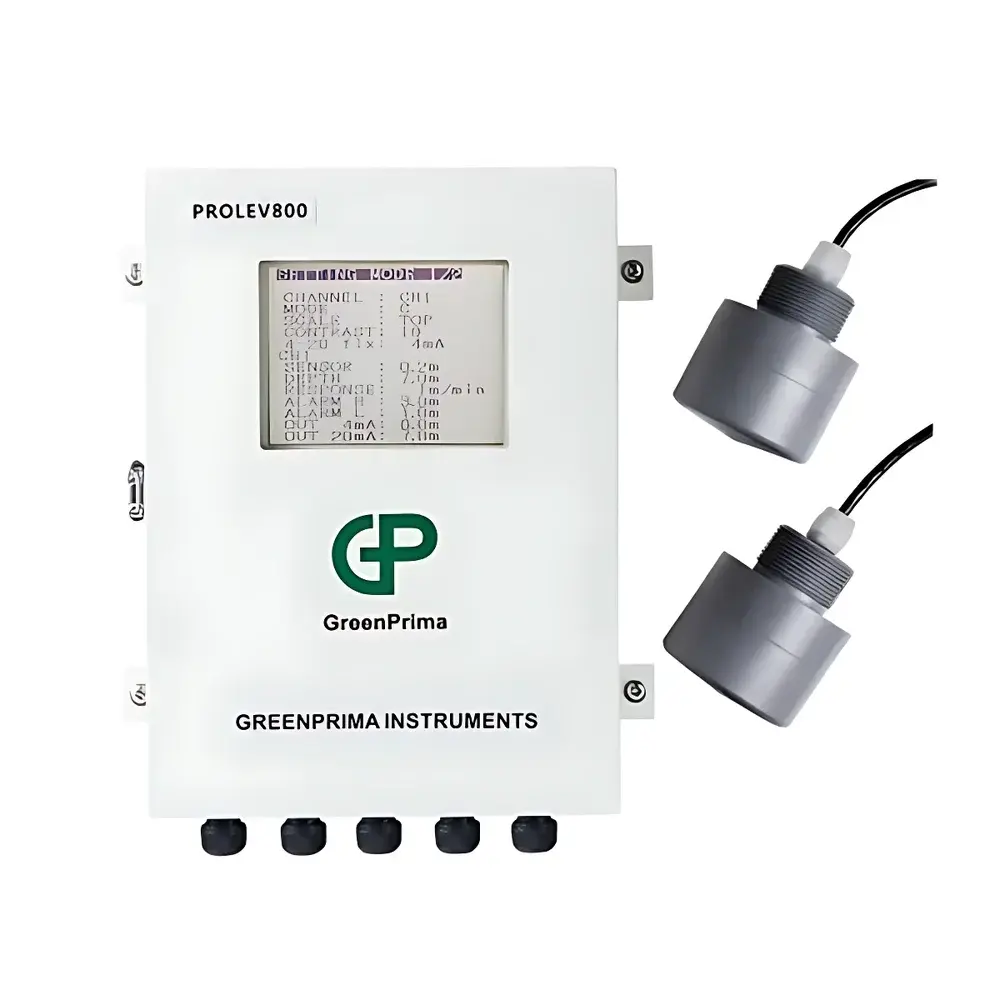
GreenPrima Prolev800 Ultrasonic Sludge Interface Gauge
| Brand | GreenPrima |
|---|---|
| Origin | United Kingdom |
| Manufacturer Type | Original Equipment Manufacturer (OEM) |
| Product Category | Imported Instrument |
| Model | Prolev800 |
| Measurement Range | 0.4–10 m |
| Sensor Capacity | Up to 2 independent probes |
| Accuracy | ±1 cm |
| Response Time | 1 s |
| Operating Temperature | −20 to +60 °C |
| Display | Graphical LCD with adjustable brightness |
| Ingress Protection | IP68 |
| Weight | 3.6 kg (transmitter), 3 kg (per probe) |
| Output Signal | 4–20 mA analog output |
| Alarm Outputs | 2 configurable high/low level relay outputs |
| Communication Interface | RS-232C (cable length ≤10 m) |
| Power Supply | 85–264 VAC, 10 VA |
| Cable Length | 20 m |
Overview
The GreenPrima Prolev800 Ultrasonic Sludge Interface Gauge is an industrial-grade, non-contact level measurement instrument engineered for continuous, real-time monitoring of sludge blanket depth and interface position in wastewater treatment clarifiers, thickeners, and pre-concentration tanks. Based on time-of-flight ultrasonic pulse-echo principle, the Prolev800 emits high-frequency acoustic waves (typically 20–50 kHz) from a submerged or top-mounted transducer; the transit time between emission and echo return from the sludge–water interface is precisely measured and converted into distance using calibrated sound velocity profiles. Unlike mechanical or optical methods, this ultrasonic approach eliminates moving parts, avoids fouling-related drift, and delivers stable performance across variable suspended solids concentrations (SS), temperature gradients, and turbidity levels — critical for reliable operation in activated sludge, anaerobic digesters, and dissolved air flotation (DAF) units.
Key Features
- Single transmitter unit supports simultaneous connection and independent calibration of two ultrasonic probes — enabling dual-point profiling (e.g., surface water level + sludge interface) or redundancy configuration.
- Integrated graphical LCD display with user-adjustable backlight intensity; visualizes real-time sludge interface height alongside dynamic trend plots spanning 5 minutes to 48 hours — facilitating rapid identification of settling anomalies or hydraulic overloads.
- No mechanical actuators or optical windows: fully solid-state design ensures long-term stability, minimal maintenance, and immunity to biofilm accumulation or sediment clogging.
- Field-configurable parameters via intuitive menu navigation — including damping factor, echo threshold, zero offset, and alarm hysteresis — without requiring PC software or service technician intervention.
- High-reliability analog output (4–20 mA) with galvanically isolated circuitry; compatible with PLCs, SCADA systems, and DCS architectures per IEC 61000-6-2/6-4 EMC standards.
- IP68-rated housing for both transmitter and probe — certified for permanent submersion up to 10 m depth under static pressure conditions.
Sample Compatibility & Compliance
The Prolev800 is validated for use in municipal and industrial wastewater streams containing total suspended solids (TSS) up to 50,000 mg/L, pH 4–11, and temperatures within −20 to +60 °C. It complies with EN 61326-1 (electromagnetic compatibility), EN 61000-6-2 (immunity), and EN 61000-6-4 (emissions). Its analog output meets NAMUR NE43 standards for signal fault detection. While not intrinsically safe, optional ATEX-certified versions (II 2G Ex db IIB T4 Gb) are available for Zone 1 hazardous areas. The device supports audit-ready data logging when integrated with compliant SCADA platforms adhering to ISO/IEC 17025 traceability requirements and aligns with operational best practices referenced in ISO 24510 (management of wastewater services) and EPA Method 160.1 (sludge blanket monitoring).
Software & Data Management
Although the Prolev800 operates autonomously via front-panel interface, optional GreenPrima Link™ PC utility enables advanced configuration, firmware updates, and historical data export (CSV/TXT). All parameter changes are timestamped and stored in non-volatile memory with built-in event logging — supporting GLP/GMP traceability where required. When connected to supervisory control systems, the 4–20 mA output can be mapped to digital twin models for predictive sludge blanket forecasting. RS-232 communication supports Modbus RTU protocol (customizable baud rate), allowing integration into legacy or modern automation infrastructures without gateway dependency. Data integrity is preserved through cyclic redundancy check (CRC) validation during serial transmission.
Applications
- Continuous monitoring of sludge blanket depth in secondary clarifiers to optimize return activated sludge (RAS) flow rates and prevent washout events.
- Interface tracking in gravity thickeners and lamella settlers to assess thickening efficiency and detect early-stage rill formation or floating scum layers.
- Real-time feedback control of sludge wasting pumps in biological nutrient removal (BNR) trains — improving process resilience against diurnal loading fluctuations.
- Pre-concentration tank surveillance in sludge dewatering lines, ensuring optimal feed consistency to centrifuges or belt presses.
- Troubleshooting abnormal settling behavior (e.g., bulking, pin floc, or stratification) through longitudinal profile visualization of interface dynamics over extended timeframes.
FAQ
Can the Prolev800 measure both water level and sludge interface simultaneously?
Yes — when configured with two probes, one can be mounted above the liquid surface (for clear-water level) and the other submerged at a fixed depth (for sludge interface), enabling differential thickness calculation.
Is calibration required after initial installation?
A one-time zero/span calibration is recommended during commissioning using known reference depths; subsequent drift correction is rarely needed due to temperature-compensated transducer design and stable acoustic propagation modeling.
Does the device support HART or Profibus communication protocols?
No — the standard Prolev800 uses 4–20 mA analog output and RS-232. HART-enabled variants (Prolev800-H) and Profibus-DP modules are available as factory-configured options.
What maintenance intervals are recommended for long-term deployment?
Visual inspection every 6 months; transducer face cleaning only if fouling is observed — typically required annually in well-maintained plants with adequate pre-screening.
How does the instrument handle foam or scum layers at the surface?
The system employs adaptive echo discrimination algorithms to distinguish primary interface reflections from false echoes caused by surface foam; users may adjust sensitivity thresholds to suppress spurious returns while preserving true sludge layer detection accuracy.
Related Products







