
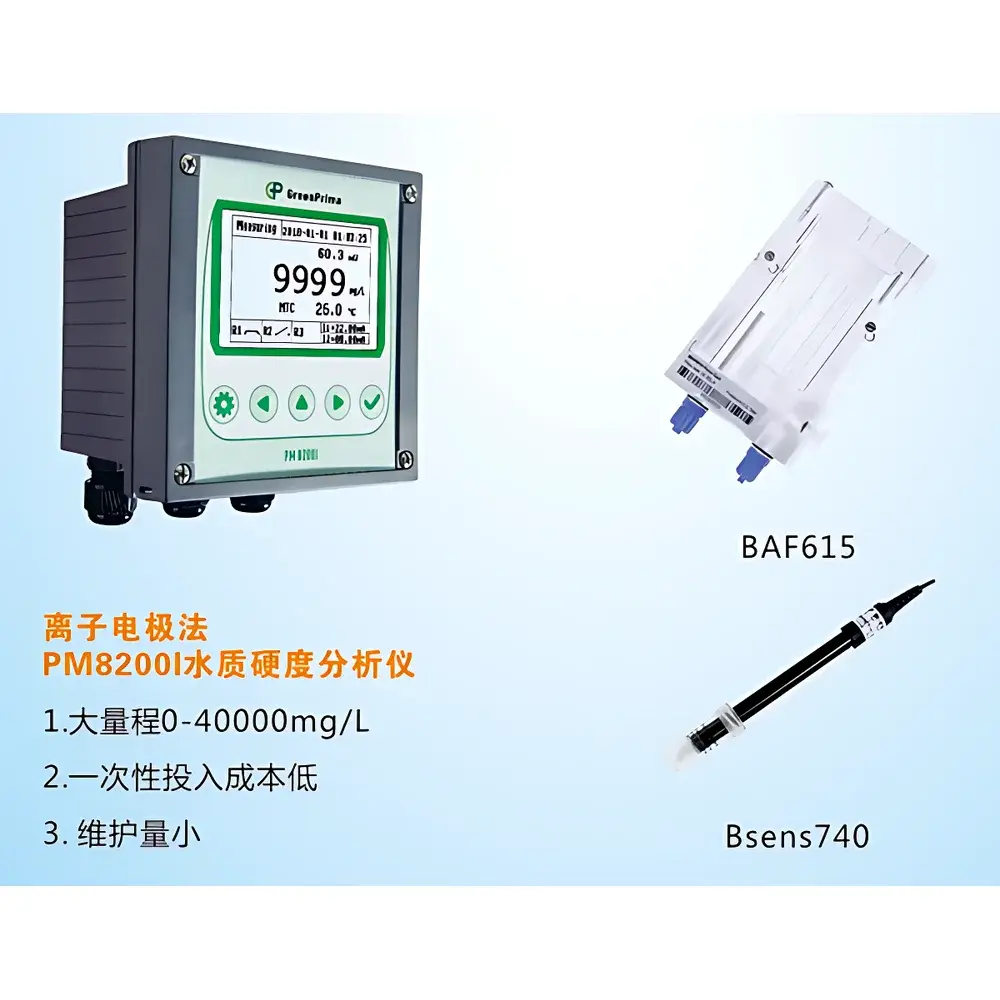
GreenPrima sycon2800 Water Hardness Analyzer
| Brand | GreenPrima |
|---|---|
| Origin | United Kingdom |
| Manufacturer Type | Original Equipment Manufacturer (OEM) |
| Product Category | Imported Instrument |
| Model | sycon2800 |
| Pricing | Available Upon Request |
Overview
The GreenPrima sycon2800 Water Hardness Analyzer is a robust, industrial-grade online analyzer engineered for continuous, reagent-free measurement of total water hardness—expressed as calcium carbonate (CaCO₃) equivalent—in real time. Unlike colorimetric or titration-based methods requiring consumables and manual intervention, the sycon2800 employs a potentiometric ion-selective electrode (ISE) principle, specifically utilizing a high-stability calcium-selective sensor (Bsens740) coupled with an integrated ion controller. This electrochemical detection method delivers direct, stable, and drift-resistant readings across a wide dynamic range (0–40,000 mg/L CaCO₃), making it suitable for raw water intake, boiler feedwater monitoring, cooling tower management, wastewater effluent compliance, and municipal distribution systems. The system operates on the Nernst equation response of the calcium-selective membrane, with built-in automatic temperature compensation (ATC) from –10 °C to 130 °C—critical for maintaining accuracy in thermally variable process streams.
Key Features
- Reagent-free operation: Eliminates chemical consumption, calibration drift from reagent degradation, and maintenance associated with peristaltic tubing, dosing pumps, or waste disposal.
- Rugged IP65-rated controller housing: Designed for wall-mount, panel-mount, or pole-mount installation in humid, dusty, or splash-prone environments—including outdoor enclosures and utility corridors.
- Field-proven Bsens740 calcium ISE: Constructed with chemically resistant PPS (polyphenylsulfone) body and optimized membrane formulation for long-term stability in high-TDS, high-chloride, or low-pH waters.
- Dual 4–20 mA analog outputs: Independently configurable for hardness value and temperature, each with full-scale accuracy of ±0.1% FS and loop resistance up to 500 Ω—compatible with PLCs, DCS, and SCADA systems.
- Three programmable relay outputs: Configurable as alarm (Hi/Lo), cleaning trigger, or maintenance alert—with adjustable hysteresis and time-delay logic to prevent nuisance tripping.
- Extended data logging: Stores up to 600,000 timestamped records (hardness, temperature, sensor status, calibration events) onboard; supports export via RS485 Modbus RTU protocol.
Sample Compatibility & Compliance
The sycon2800 is validated for use in drinking water, surface water, groundwater, industrial process water, and treated effluent. It meets key international performance expectations for continuous hardness monitoring under ISO 7888 (water quality — determination of hardness), ASTM D1126 (Standard Test Method for Hardness in Water), and EU Drinking Water Directive (2020/2184) Annex I parametric values. While not a certified reference method, its ISE-based output is traceably correlated to EDTA titration standards and routinely accepted for operational control and trend analysis in GLP-compliant water laboratories and GMP-regulated pharmaceutical utilities. Sensor response remains stable in turbidities up to 100 NTU and suspended solids < 50 mg/L; optional flow-through cell (sold separately) ensures laminar, bubble-free sample presentation.
Software & Data Management
The embedded controller firmware supports dual-language UI (English and Chinese) with intuitive navigation via membrane keypad and backlit graphical LCD. All configuration parameters—including calibration points (single- or two-point), temperature compensation mode (manual/automatic), cleaning interval (0.1–1000 h), and cleaning duration (1–1000 s)—are accessible without external software. Data export is enabled via RS485 serial interface using standard Modbus RTU protocol (function codes 03/04/06/10), allowing seamless integration into supervisory control platforms. Audit trails—including operator login timestamps, calibration logs, alarm history, and sensor diagnostics—are retained in non-volatile memory and comply with basic electronic record requirements per FDA 21 CFR Part 11 when deployed with validated IT infrastructure.
Applications
- Power generation: Monitoring feedwater hardness to prevent scale formation in high-pressure boilers and steam turbines.
- Food & beverage: Ensuring consistent hardness levels in CIP rinse water and product-contact process streams.
- Pharmaceutical manufacturing: Supporting purified water (PW) and water-for-injection (WFI) system validation per USP .
- Municipal utilities: Real-time tracking of hardness breakthrough in softening plants and post-treatment distribution networks.
- Industrial cooling circuits: Early detection of scaling risk and optimization of antiscalant dosing strategies.
FAQ
Does the sycon2800 require regular calibration? How often?
Yes—calibration is recommended at least once per week for critical applications, or daily in highly variable or aggressive matrices. A single-point calibration using a certified 200 mg/L CaCO₃ standard is typically sufficient for routine operation.
Can the sensor be used in seawater or brackish water?
The Bsens740 electrode exhibits measurable interference from high sodium and potassium concentrations (>10,000 mg/L TDS); for such matrices, a dedicated seawater-hardness correlation protocol or cross-validation with laboratory EDTA titration is advised.
Is remote configuration possible via Ethernet or Wi-Fi?
No—the sycon2800 communicates exclusively via RS485 Modbus RTU and 4–20 mA analog signals. For networked deployment, a Modbus TCP gateway is required.
What is the typical service life of the calcium ISE sensor?
Under normal operating conditions (pH 5–9, temperature < 60 °C, no oil or heavy metal fouling), the Bsens740 sensor maintains metrological integrity for 12–18 months before recalibration frequency increases significantly.
How does the system handle air bubbles or particulate fouling?
The optional flow-through cell provides turbulent flow conditioning and bubble rejection; additionally, programmable cleaning cycles (via relay-actuated air purge or mechanical wiper) mitigate sensor surface deposition.
Related Products







