
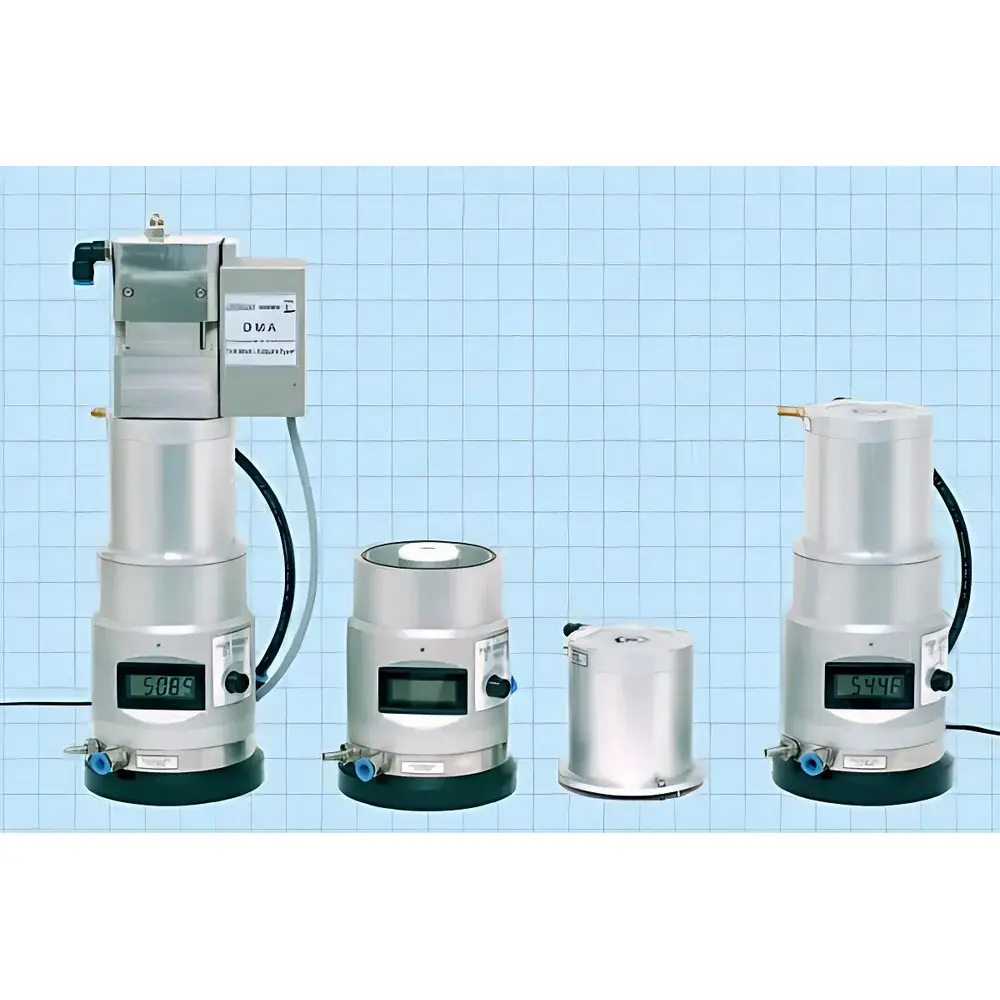
GRIMM FCE Faraday Cup Electrostatic Precipitator
| Brand | GRIMM |
|---|---|
| Country of Origin | Germany |
| Model | FCE |
| Instrument Type | Aerosol Detector |
| Voltage Range | 0–10,000 V (user-selectable polarity) |
| Flow Rate | 0.3–5 L/min (external pump required) |
| Electrode Diameter | 10 mm or 20 mm (magnetically mounted) |
| Substrate Compatibility | Conductive or non-conductive sampling substrates |
| Particle Size Range | 0.8–1100 nm (when coupled with GRIMM DMA systems) |
| Dimensions | Ø126 mm × H264 mm |
| Weight | 3.3 kg |
| Power Supply | 100–240 VAC, 50–60 Hz or 12–18 VDC |
| Operating Temperature | 10–40 °C |
| Relative Humidity | 0–95% RH (non-condensing) |
| Status Indication | LED indicators |
Overview
The GRIMM FCE Faraday Cup Electrostatic Precipitator is a precision-engineered aerosol sampling device designed for quantitative collection of charged submicron and nanoscale particles onto solid substrates under controlled electrostatic conditions. Based on the principle of unipolar or bipolar electrostatic precipitation, the FCE applies a high-voltage electric field (0–10,000 V) between coaxial electrodes to induce directional migration of charged aerosol particles toward a central collecting electrode—typically a conductive or insulating substrate mounted on a magnetically secured 10 mm or 20 mm diameter electrode. Unlike impactors or filters, this method preserves particle morphology, crystallinity, and surface chemistry, making it ideal for offline microanalytical characterization via SEM-EDX, TEM, XRD, or Raman spectroscopy. The FCE is not a standalone detector but functions as an interface module—optimized for integration with GRIMM differential mobility analyzers (DMAs), condensation particle counters (CPCs), and scanning mobility particle sizers (SMPS), enabling size-resolved, charge-selected aerosol sampling across the 0.8–1100 nm range.
Key Features
- High-voltage electrostatic field generation (0–10 kV), with user-selectable polarity (positive/negative) to accommodate both positively and negatively charged aerosol populations.
- Magnetically mounted electrode platform supporting rapid, tool-free exchange of 10 mm or 20 mm diameter substrates—compatible with silicon wafers, carbon tabs, TEM grids, quartz filters, or conductive polymer films.
- Low-flow, laminar sampling regime (0.3–5 L/min) ensures minimal particle diffusion loss and high deposition efficiency for nanoparticles without turbulent resuspension.
- Integrated LED status indicators provide real-time feedback on power state, voltage application, and operational readiness—critical for GLP-compliant laboratory workflows.
- Compact, shielded cylindrical architecture (Ø126 × H264 mm; 3.3 kg) minimizes electromagnetic interference and supports benchtop deployment in cleanrooms, mobile labs, or ambient monitoring stations.
- Dual-power capability: accepts universal AC input (100–240 VAC, 50–60 Hz) or low-voltage DC (12–18 VDC), facilitating field use with battery packs or vehicle power systems.
Sample Compatibility & Compliance
The FCE accommodates a broad spectrum of sampling substrates—including conductive (e.g., Au/Pd-coated Si wafers, Cu grids) and non-conductive (e.g., polycarbonate membranes, glass slides, mica) materials—enabling compatibility with diverse post-collection analytical techniques. Its design conforms to ISO 14644-1 (cleanroom classification), ASTM D6243 (aerosol sampling standards), and EU Directive 2008/50/EC (ambient air quality assessment). When operated within specified environmental limits (10–40 °C, ≤95% RH non-condensing), the system maintains stable deposition efficiency and electrical integrity. No internal pump is included; users must integrate a calibrated, pulse-free vacuum source meeting ISO 21501-4 flow stability requirements.
Software & Data Management
The FCE operates as a hardware-controlled module without embedded firmware or onboard data logging. Voltage, polarity, and timing parameters are set manually via front-panel controls. For traceable, auditable operation in regulated environments (e.g., ISO/IEC 17025-accredited labs or FDA-regulated inhalation toxicology studies), integration with external programmable power supplies and LabVIEW/Python-controlled DAQ systems is recommended. Full audit trails—including timestamped voltage settings, operator ID, substrate lot numbers, and environmental logs—can be maintained in accordance with 21 CFR Part 11 when paired with validated electronic lab notebooks (ELNs) and secure networked storage.
Applications
- Size- and charge-resolved nanoparticle collection for morphological and elemental analysis (SEM-EDX, TEM-EELS).
- Reference material generation for calibration of optical particle counters and laser-induced breakdown spectrometers.
- Inhalation toxicology: deposition of engineered nanomaterials (ENMs) onto biological substrates for in vitro exposure assays.
- Ambient aerosol source apportionment—coupled with GRIMM SMPS systems for urban, industrial, or indoor air quality studies.
- Process monitoring in semiconductor fabrication, pharmaceutical dry powder inhaler (DPI) development, and battery electrode slurry aerosolization.
FAQ
Does the FCE include an integrated pump?
No. A compatible external vacuum pump with stable, pulse-free flow (0.3–5 L/min) must be supplied by the user.
Can the FCE collect neutral particles?
Only charged particles are efficiently precipitated. Neutral aerosols require prior charging—typically via a soft X-ray or radioactive (e.g., 85Kr) charger upstream of the FCE.
What is the maximum recommended operating voltage for long-term stability?
GRIMM specifies 10,000 V as the absolute upper limit; for routine operation with >10,000-hour electrode lifetime, voltages between 3,000–7,000 V are recommended depending on aerosol mobility and flow rate.
Is the FCE compliant with ISO 21501-4 for particle sizing instrumentation?
While the FCE itself is not a sizing instrument, it is fully compatible with ISO 21501-4–certified DMA-CPC chains and contributes to measurement traceability when used within validated SMPS configurations.
How often should the electrode surfaces be cleaned?
Cleaning frequency depends on sample loading; GRIMM recommends ethanol or isopropanol wipe-down after every 5–10 collection cycles, followed by plasma cleaning for ultra-low-background applications.







