
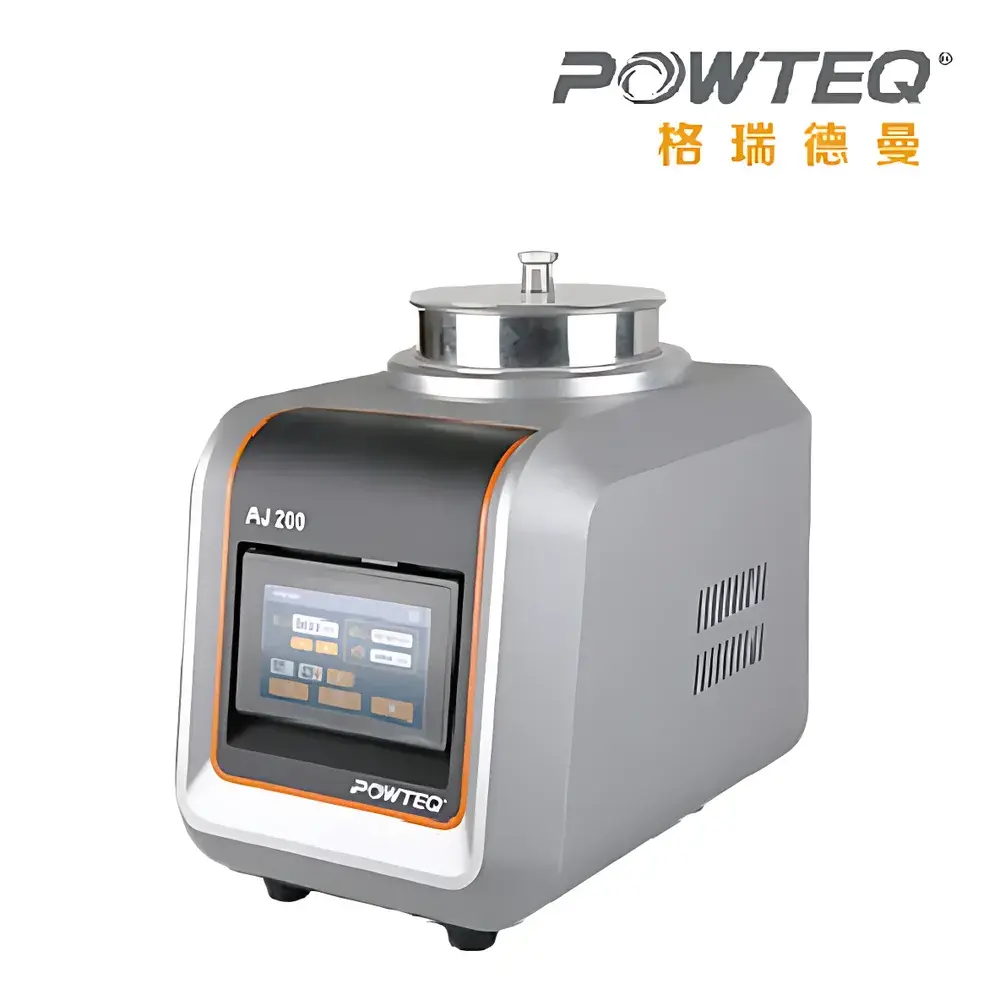
Grinderman AJ200 Air Jet Sieve Analyzer
| Brand | Grinderman |
|---|---|
| Origin | Beijing, China |
| Manufacturer Type | Direct Manufacturer |
| Country of Origin | China |
| Model | AJ200 |
| Price Range | USD 7,000 – 14,000 |
| Measurement Range | 5 µm – 5 mm |
| Sieving Principle | Air Jet Dispersion with Rotating Nozzle |
| Sieve Diameter Compatibility | 203 mm (200 mm with adapter) |
| Maximum Sample Load | 0.3 – 100 g |
| Negative Pressure Range | 20 – 99 mbar (0.3 – 1.45 psi) |
| Nozzle Rotational Speed | 5 – 55 rpm (digitally controlled) |
| Programmable SOPs | 9 stored methods + Quick Start mode |
| Timer Range | 00:01 – 99:59 min |
| Vacuum Interface | RS232 |
| Sieving Motion | Dispersive air jet (parallel flow) |
| Max Sieve Stages | 1 (2 with cyclone separator) |
| Power Supply | 220 V, 50 Hz |
Overview
The Grinderman AJ200 Air Jet Sieve Analyzer is an engineered solution for rapid, reproducible dry particle size distribution analysis of free-flowing and mildly cohesive powders. It operates on the principle of air jet dispersion—leveraging controlled negative pressure and a precisely rotating nozzle to fluidize and separate particles across standardized sieve meshes. Unlike mechanical vibratory or tapping sieves, the AJ200 eliminates mechanical energy transfer that may fracture fragile particles or induce static aggregation. Instead, it generates a high-velocity, tangential air jet beneath the sieve base, inducing turbulent shear at the powder–mesh interface. This action simultaneously disperses agglomerates, prevents blinding, and drives undersized fractions through the aperture into a downstream collection system (vacuum cleaner or cyclone separator). Designed for compliance with ISO 9001 quality management frameworks and aligned with ASTM E11 and ISO 3310-1 specifications for test sieves, the AJ200 delivers traceable, operator-independent results essential for QC laboratories in regulated environments.
Key Features
- Digitally controlled rotating nozzle (5–55 rpm) ensures uniform radial air distribution and minimizes edge effects during sieving.
- Adjustable negative pressure (20–99 mbar) enables optimization for diverse material densities and cohesivity—critical for pharmaceutical actives, toner pigments, or ceramic precursors.
- Full parameter digital control: real-time adjustment of sieving time (00:01–99:59 min), vacuum level, and rotational speed via intuitive front-panel interface.
- RS232 serial interface supports external data logging and integration into LIMS or laboratory automation workflows.
- Compatible with standard 203 mm (8-inch) analytical sieves per ISO 3310-1; 200 mm sieves accommodated via optional adapter ring—ensuring global method harmonization.
- Low-noise operation achieved via integration with industrial-grade vacuum units meeting CE and IEC 61000-3-2 electromagnetic compatibility standards.
- Nine programmable SOPs plus Quick Start mode allow rapid recall of validated protocols for routine batches—reducing setup error and supporting GLP/GMP documentation requirements.
Sample Compatibility & Compliance
The AJ200 is validated for dry, non-hygroscopic, non-fibrous powders within the 5 µm–5 mm range. Typical applications include active pharmaceutical ingredients (APIs), excipients (e.g., lactose, microcrystalline cellulose), polymer resins, pigment dispersions, food-grade starches, and mineral fillers. It is not suitable for wet, oily, or highly electrostatic materials without prior conditioning. The instrument complies with ISO 2591-1 for air jet sieving methodology and supports audit-ready reporting when used with calibrated sieves traceable to NIST or PTB reference standards. All operational parameters—including time, pressure, speed, and cycle count—are logged with timestamps, satisfying FDA 21 CFR Part 11 requirements for electronic records when paired with compliant software.
Software & Data Management
While the AJ200 operates as a standalone benchtop analyzer, its RS232 output enables bidirectional communication with third-party data acquisition platforms. Users may export timestamped sieving logs (including setpoints, actual values, and duration) to CSV or Excel formats for statistical process control (SPC) analysis. Optional firmware upgrades support enhanced data tagging (e.g., sample ID, operator code, batch number) and automatic pass/fail flagging against predefined acceptance criteria—facilitating integration into enterprise QA systems. Audit trails are maintained locally on device memory for ≥1,000 runs, preserving integrity during internal or regulatory inspections.
Applications
- Pharmaceutical: Granule size verification pre-compression; blend uniformity assessment per USP <786>.
- Chemicals: Quality release testing of catalyst powders, fumed silica, and sodium bicarbonate.
- Food & Feed: Particle size consistency checks for flour, powdered milk, and nutritional supplements.
- Advanced Materials: Sizing of battery cathode precursors (e.g., LiCoO₂), 3D printing metal powders, and abrasive grits.
- Research & Development: Method development for dry dispersion techniques; correlation studies with laser diffraction or dynamic image analysis.
FAQ
What sieve diameters does the AJ200 support?
The AJ200 is configured for 203 mm (8-inch) analytical sieves as standard; a mechanical adapter allows use of 200 mm sieves without performance compromise.
Can the AJ200 be used for wet samples?
No—it is strictly a dry-sieving instrument. Moisture or solvent presence will impair air jet efficiency and risk contamination of the vacuum system.
Is calibration required before each run?
No routine recalibration is needed; however, periodic verification using certified reference powders (e.g., NIST SRM 1990) is recommended per ISO/IEC 17025 guidelines.
How many sieve fractions can be collected simultaneously?
The base configuration supports single-stage separation; adding a cyclone separator enables two-stage fractionation (coarse + fine + oversize).
Does the AJ200 meet FDA 21 CFR Part 11 requirements?
Yes—when operated with validated SOPs and paired with compliant data capture software, all electronic records include user authentication, audit trail, and tamper-proof timestamps.



