
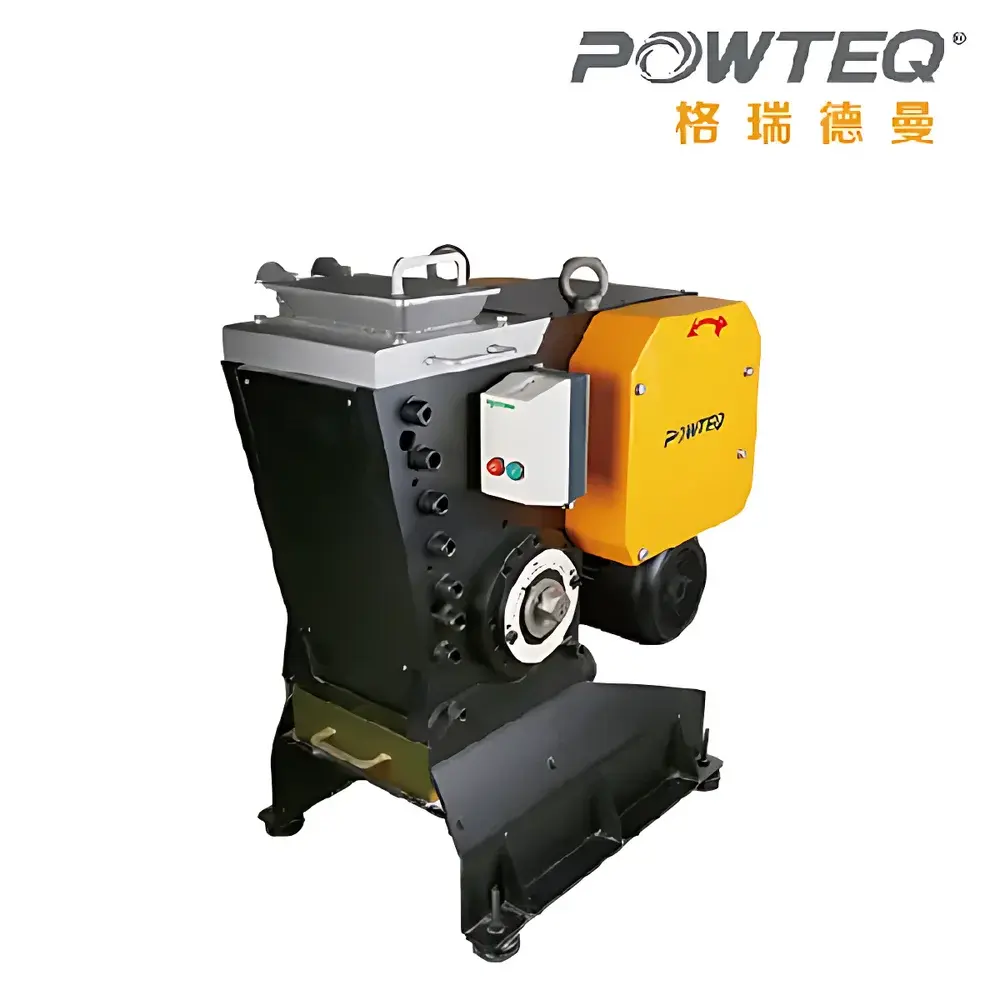
Grinderman JC7 Heavy-Duty Jaw Crusher
| Brand | Grinderman |
|---|---|
| Origin | Beijing, China |
| Manufacturer Type | Direct Manufacturer |
| Region of Origin | Domestic (China) |
| Model | JC7 |
| Instrument Type | Jaw Crusher |
| Sample Applicability | Hard and Brittle Materials |
| Feed Size | < 110 mm |
| Discharge Size (Typical) | 95% < 2 mm |
| Final Output Particle Size Range | 0.01–0.5 mm |
| Throughput Capacity | 300 kg/h |
| Motor Power | 7.5 kW |
| Rotational Speed | 300 rpm |
| Dimensions (W×D×H) | 930 × 1080 × 1380 mm |
| Weight | 1100 kg |
Overview
The Grinderman JC7 is a heavy-duty, high-capacity jaw crusher engineered for primary size reduction of hard, abrasive, and heterogeneous bulk materials in geological, metallurgical, and industrial laboratory environments. Based on the classic toggle-free eccentric shaft vibration principle—distinct from conventional single-toggle or double-toggle jaw mechanisms—the JC7 employs a dynamically balanced crank-arm system to generate controlled, high-frequency compressive force between fixed and movable jaw plates. This architecture enables single-stage comminution with a typical reduction ratio of up to 50:1, allowing direct feed of drill core samples and lump ores up to 110 mm in maximum dimension, and delivering a consistently fine output where ≥95% of particles fall below 2 mm. Designed for continuous operation under demanding conditions, the JC7 serves as a critical front-end sample preparation unit in geochemical assay workflows, raw material quality control, and reference material certification protocols requiring representative sub-sampling.
Key Features
- Toggle-free eccentric shaft drive system eliminates traditional pitman linkage, reducing mechanical backlash and enabling precise, repeatable jaw gap control.
- Adjustable jaw plate clearance via calibrated micrometer screw—accuracy ±0.1 mm—ensures reproducible particle size distribution across batches.
- Reinforced manganese steel jaw plates with optimized tooth profile enhance wear resistance and crushing efficiency for siliceous and metallic matrices.
- 7.5 kW TEFC (Totally Enclosed Fan-Cooled) motor delivers robust torque at 300 rpm, supporting stable throughput of up to 300 kg/h under full-load conditions.
- Integrated vibration-damping base frame minimizes operational transmission to laboratory flooring, meeting ISO 2631-1 human exposure limits for hand-arm vibration.
- Front-access service panel and modular jaw assembly allow tool-free jaw plate replacement and routine maintenance without disassembling structural components.
Sample Compatibility & Compliance
The JC7 is validated for comminution of hard, non-fibrous, non-sticky materials including but not limited to: quartzite, granite, basalt, iron ore, bauxite, slag, sintered ceramics, fused alumina, tungsten carbide, and metallurgical alloys (e.g., ferrovanadium, ferrotitanium). It is unsuitable for ductile metals, elastomers, wet or clay-rich aggregates, or temperature-sensitive organics. The crusher complies with CE machinery directive 2006/42/EC, IEC 60204-1 electrical safety standards, and incorporates emergency stop circuitry conforming to EN ISO 13850. While not certified for GMP or GLP environments per se, its mechanical traceability (adjustment log capability), absence of lubricant contact with sample path, and documented maintenance intervals support integration into ISO/IEC 17025-accredited testing laboratories.
Software & Data Management
The JC7 operates as a standalone mechanical instrument with no embedded microcontroller or digital interface. However, its design supports audit-ready documentation: jaw gap settings are recorded manually using the integrated scale; batch logs—including feed mass, run duration, ambient temperature, and visual inspection notes—can be entered into LIMS-compatible spreadsheets or electronic lab notebooks (ELN). For laboratories operating under FDA 21 CFR Part 11 requirements, external data capture systems may be deployed to record timestamps, operator IDs, and calibration verification events associated with jaw plate replacement and gap validation procedures.
Applications
- Geological exploration labs: Primary crushing of NQ/HQ-size drill core prior to riffle splitting and pulverization.
- Metallurgical R&D facilities: Size reduction of alloy ingots and sintered compacts for XRF fusion bead preparation.
- Cement and refractory QA/QC: Rapid conditioning of clinker, limestone, and fireclay samples for loss-on-ignition and chemical analysis.
- Environmental soil testing labs: Pre-processing of contaminated concrete rubble and slag for TCLP extraction.
- Academic materials science departments: Controlled fragmentation of brittle ceramic composites for microstructural correlation studies.
FAQ
What is the recommended maintenance interval for jaw plate replacement?
Under standard operation with silica-rich rock feed, jaw plates require inspection every 200 operational hours and replacement after 600–800 hours, depending on feed hardness and throughput consistency.
Can the JC7 be integrated with automated sample handling systems?
Yes—its standardized 930 mm width and rear-mounted discharge chute (height 350 mm above floor level) allow coupling with vibratory feeders, belt conveyors, and cyclone classifiers via ANSI B20.1-compliant guarding interfaces.
Is dust suppression available as an option?
A factory-installed water misting kit (0.8 MPa pressure, adjustable flow rate 0.5–2.0 L/min) is offered for applications generating respirable crystalline silica; it meets OSHA 1910.1053 engineering control criteria when used with local exhaust ventilation.
Does the JC7 meet ASTM D2974 or ISO 11277 particle size reduction requirements?
While the JC7 itself is not a test method apparatus, its output—when operated within specified parameters—is suitable for preparing representative subsamples compliant with ASTM D2974 (for organic matter determination) and ISO 11277 (soil particle size analysis) pre-treatment steps.
What electrical supply is required?
Three-phase 380 V ±10%, 50 Hz, with dedicated 32 A circuit breaker and proper grounding per IEC 61000-3-12 harmonic emission limits.



