
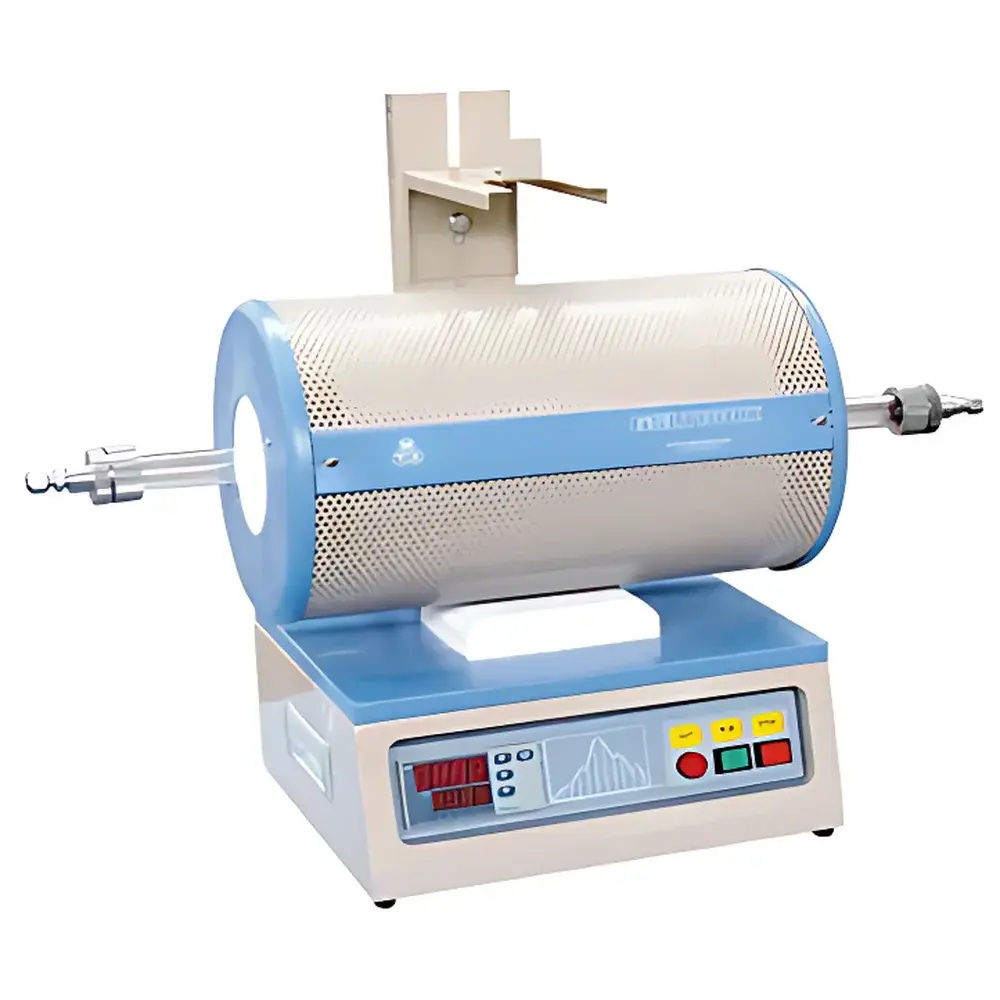
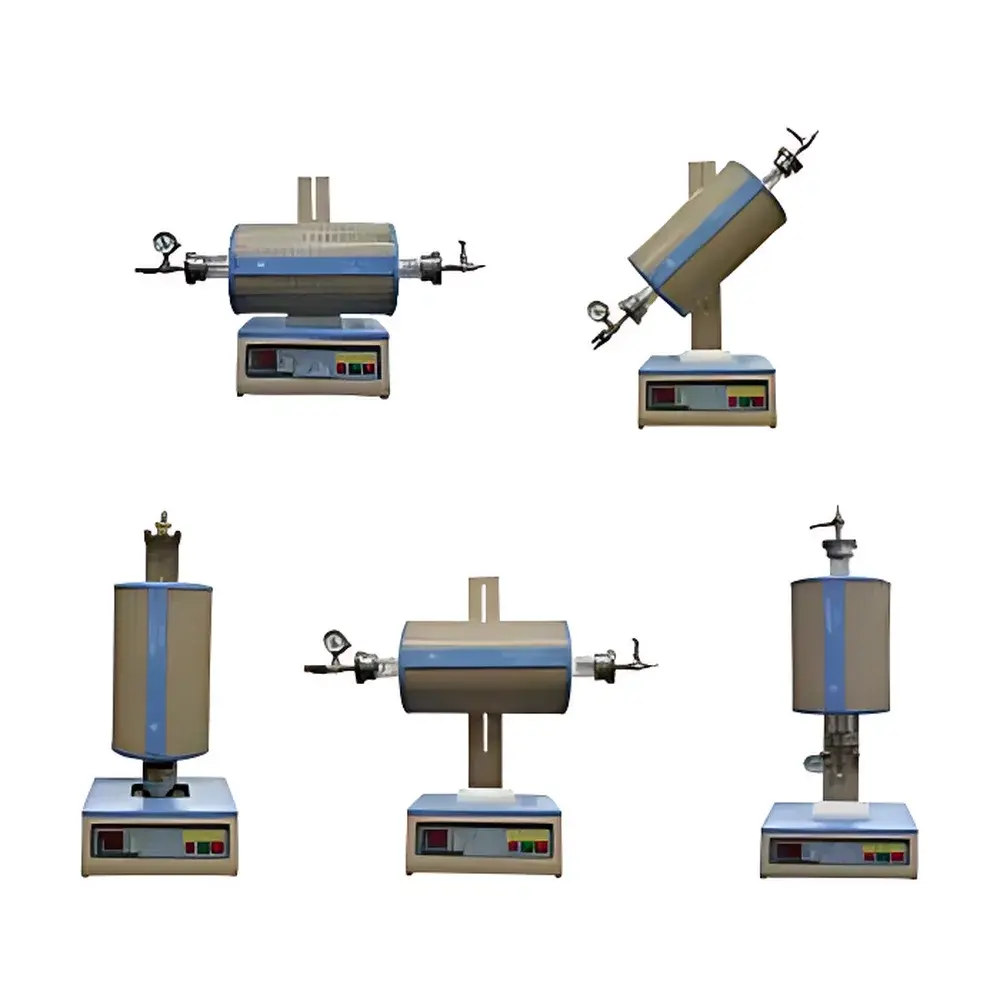
GSL-1100X-S 1100°C Multi-Station Horizontal/Vertical Tube Furnace (KJ GROUP / SYNERGY)
| Brand | KJ GROUP (Shenyang Kejing) |
|---|---|
| Origin | Liaoning, China |
| Manufacturer Type | Authorized Distributor |
| Country of Origin | China |
| Model | GSL-1100X-S |
| Pricing | Upon Request |
| Power | AC 220 V, 50 Hz |
| Max. Temperature | 1100 °C (<2 h) |
| Operating Temperature | ≤1000 °C |
| Heating Zone Length | 300 mm |
| Uniform Temperature Zone | 120 mm |
| Ramp Rate | ≤20 °C/min |
| Temperature Control Accuracy | ±1 °C |
| Thermocouple Type | K-type |
| Heating Element | Mo-doped Fe-Cr-Al alloy wire with ZrO₂ coating |
| Tube Dimensions | Φ25 mm × 600 mm & Φ50 mm × 600 mm (quartz) |
| Vacuum Capability | 10⁻² torr (with mechanical pump) |
| Furnace Dimensions | 400 mm × 300 mm × 550 mm |
| Net Weight | 19 kg |
Overview
The GSL-1100X-S is a compact, multi-configurable horizontal/vertical tube furnace engineered for precision thermal processing of small-scale samples in research and development laboratories. Designed around a dual-orientation mechanical architecture, it supports both horizontal and vertical sample loading—enabling flexible integration into vapor-solid-liquid (VLS) growth, chemical vapor deposition (CVD), annealing, oxidation, reduction, and rapid thermal quenching workflows. Its core heating system employs Mo-doped Fe-Cr-Al resistance wire with a stabilized zirconia (ZrO₂) protective coating, ensuring long-term structural integrity and consistent emissivity at elevated temperatures. The furnace chamber features an internally alumina-coated mullite insulation lining, which enhances infrared reflectivity, improves thermal uniformity across the 120 mm isothermal zone, and reduces power consumption during sustained operation at 1000 °C. Temperature regulation is implemented via a 30-segment programmable PID controller with independent over-temperature cutoff and thermocouple break detection—meeting fundamental safety requirements for unattended operation under GLP-compliant protocols.
Key Features
- Bi-directional orientation: Configurable for horizontal or vertical mounting to accommodate diverse reactor geometries and gas flow dynamics in CVD or diffusion-controlled synthesis.
- High-efficiency thermal design: Internal alumina reflective coating increases radiant heat transfer efficiency and extends refractory lifetime under cyclic thermal stress.
- Precision temperature control: 30-step programmable ramp-soak profiles with ±1 °C steady-state accuracy (verified per ASTM E220 calibration methodology) and real-time deviation logging.
- Robust heating element: Molybdenum-alloyed Fe-Cr-Al wire with ceramic ZrO₂ encapsulation resists oxidation and creep deformation up to 1100 °C (short-term).
- CE-certified electrical architecture: Compliant with EN 61000-6-3 (EMC) and EN 61000-6-2 (immunity), supporting integration into ISO/IEC 17025-accredited lab environments.
- Modular vacuum interface: Standard Swagelok-compatible (Bartell-type) gas inlet; optional VCR, KF-25, or bellows connections available for ultra-high-purity or high-vacuum applications (down to 10⁻² torr with two-stage rotary vane pump).
Sample Compatibility & Compliance
The GSL-1100X-S accommodates standard quartz tubing (Φ25 mm × 600 mm and Φ50 mm × 600 mm), enabling compatibility with inert, reducing, oxidizing, and halogen-containing atmospheres—subject to quartz thermal shock limits and gas compatibility charts (e.g., HF, Cl₂, and Br₂ require quartz grade selection per ASTM F1895). The furnace meets essential safety and electromagnetic compatibility requirements outlined in the EU Machinery Directive 2006/42/EC and Low Voltage Directive 2014/35/EU. While not inherently 21 CFR Part 11 compliant, its digital controller supports external audit-trail-capable data loggers for GMP-aligned process validation when paired with time-stamped, user-access-controlled recording systems.
Software & Data Management
The integrated PID controller includes RS485 communication capability (Modbus RTU protocol) for third-party SCADA or LabVIEW-based monitoring. Optional OEM software packages enable remote profile upload/download, real-time temperature graphing, and CSV export of timestamped setpoint/actual temperature pairs. All firmware versions maintain traceable revision logs, and configuration changes are recorded with operator ID and timestamp when connected to enterprise-level historian systems. No embedded cloud functionality is included—data residency remains fully on-premise per institutional IT policy requirements.
Applications
- Low-pressure CVD of metal oxides (e.g., SnO₂, ZnO) and transition metal dichalcogenides (MoS₂, WS₂) using precursor vapor transport.
- VLS nanowire synthesis with Au or Ni catalyst nanoparticles under controlled Ar/H₂ or N₂ atmospheres.
- Post-deposition annealing of thin-film photovoltaic stacks (CIGS, perovskites) requiring precise thermal budgets below 1000 °C.
- Controlled oxidation of 2D materials (graphene, h-BN) to tune defect density and surface functionalization.
- Thermal calibration of micro-sensors and MEMS devices under reproducible soak conditions.
- Small-batch sintering of ceramic precursors where localized heating minimizes grain coarsening.
FAQ
Can the GSL-1100X-S be operated continuously at 1100 °C?
Continuous operation above 1000 °C is not recommended; 1100 °C is rated for ≤2 hours per cycle to preserve heating element longevity and thermal insulation integrity.
Is the furnace compatible with hydrogen gas atmospheres?
Yes—when equipped with VCR double-ferrule fittings and leak-tested quartz tubing, it supports H₂/N₂ mixtures up to 5% H₂ at ≤900 °C; full hydrogen requires additional explosion-proof venting per NFPA 55 guidelines.
What vacuum level can be achieved without optional accessories?
Using the standard mechanical pump and Bartell fittings, base pressure reaches ~10⁻² torr; adding a KF-25 adapter and stainless steel bellows improves repeatability and lowers outgassing contribution.
Does the unit include vacuum gauging capability?
No—vacuum measurement requires optional Pirani or capacitance manometer modules, which integrate via analog 0–10 V output or RS485 Modbus.
Are custom tube lengths or diameters supported?
Standard configurations use 600 mm tubes; custom quartz dimensions (e.g., Φ32 mm × 800 mm) are available upon engineering review and thermal modeling verification.
Related Products



