
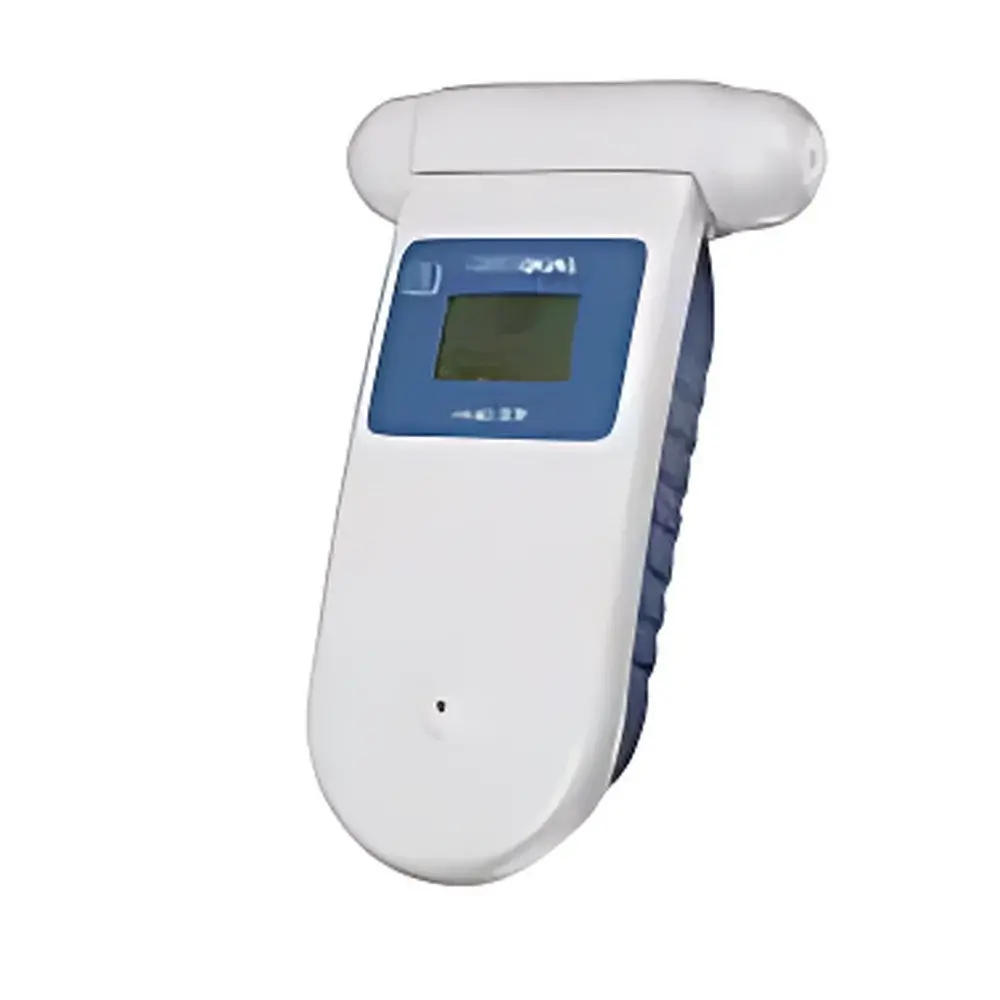
GSS 200 Portable & Fixed-Mount Hydrogen Peroxide (H₂O₂) Gas Detector
| Origin | Imported |
|---|---|
| Manufacturer Type | Authorized Distributor |
| Model | 200 |
| Price | Upon Request |
| Measurement Range | 0–10 ppm |
| LOD | 0.01 ppm |
| Accuracy | ±10% of reading |
| T90 Response Time | <60 s |
| Sensor Type | GSS Semiconductor Gas Sensor |
| Operating Temperature | −20 °C to +50 °C |
| Operating Humidity | 5–95% RH (non-condensing) |
| Certifications | UL 2034, BS 7860, FCC Part 15, EN 50082-1:1997, EN 50081-1:1992 |
| Power Supply | 12 VDC, 800 mA |
| Battery Options | 9.6 V Ni-Cd (940 mAh) or 9.6 V Ni-MH (2100 mAh) |
| Enclosure Rating | IP20 / NEMA 1 |
| Dimensions (w/ probe) | 195 × 122 × 54 mm |
| Weight (w/ probe & battery) | <460 g |
| Probe-to-Host Separation Distance | Up to 14 m |
Overview
The GSS 200 Portable & Fixed-Mount Hydrogen Peroxide (H₂O₂) Gas Detector is an engineered solution for real-time, quantitative monitoring of airborne hydrogen peroxide vapor in critical environments including pharmaceutical cleanrooms, sterilization tunnels, isolators, and aseptic processing suites. Unlike broad-spectrum electrochemical or catalytic bead sensors, the GSS 200 employs a proprietary semiconductor-based gas sensing element optimized specifically for H₂O₂ detection—offering selectivity against common interferents such as humidity, ethanol, ozone, and hydrogen peroxide decomposition products. The instrument operates on the principle of surface conductivity modulation in response to H₂O₂ adsorption, enabling stable baseline performance and low-drift operation across its full 0–10 ppm measurement range. Designed for both mobile verification and semi-permanent deployment, the system supports flexible integration into environmental monitoring programs compliant with ISO 14644-1, EU GMP Annex 1, and USP , where precise H₂O₂ concentration control is essential for validated vapor-phase sterilization cycles.
Key Features
- Modular architecture: Main unit accepts interchangeable GSS sensor probes—including H₂O₂, ozone, nitrogen dioxide, and formaldehyde—enabling cross-application reuse without hardware replacement.
- Dual deployment modes: Functions as a handheld survey instrument or, when mounted in FRP (fiberglass-reinforced polymer) enclosure, transitions seamlessly to fixed-point continuous monitoring with wall or duct mounting options.
- High-fidelity display interface: Backlit LCD provides real-time concentration readout in ppm, sensor status indicators, battery level, and alarm activation flags—all legible under low-light cleanroom conditions.
- Extended probe separation: Sensor head connects to main electronics via shielded cable up to 14 meters in length, permitting remote placement in high-risk or hard-to-access zones while maintaining operator safety and signal integrity.
- Low-power operational design: Supports extended field use with two rechargeable battery configurations—standard Ni-Cd (940 mAh) for routine checks or high-capacity Ni-MH (2100 mAh) for multi-shift deployments.
- Robust environmental tolerance: Rated for operation between −20 °C and +50 °C and 5–95% RH (non-condensing), ensuring reliability in cold storage areas, humidified pass-through chambers, and ambient manufacturing spaces.
Sample Compatibility & Compliance
The GSS 200 is calibrated and validated for gaseous H₂O₂ in air matrices only; it is not intended for liquid-phase or aerosolized droplet measurement. Its sensor exhibits minimal cross-sensitivity to water vapor below 80% RH, and built-in temperature/humidity compensation algorithms mitigate drift under variable ambient conditions. The device complies with UL 2034 (household carbon monoxide and toxic gas alarms), BS 7860 (specification for fixed gas detection systems), and electromagnetic compatibility standards EN 50082-1 and EN 50081-1. While not intrinsically safe for Class I Div 1 hazardous locations, its IP20/NEMA 1 enclosure meets general-purpose indoor industrial requirements. For regulated pharmaceutical applications, the instrument supports audit-ready documentation packages—including factory calibration certificates traceable to NIST standards—and can be integrated into electronic logging systems meeting FDA 21 CFR Part 11 data integrity requirements when paired with compliant software platforms.
Software & Data Management
Data output is provided via analog 4–20 mA and RS-485 Modbus RTU interfaces, enabling direct connection to building management systems (BMS), SCADA networks, or centralized environmental monitoring systems (EMS). Optional PC-based configuration utility allows users to adjust alarm thresholds (high/low), enable/disable auto-zero functions, configure sampling intervals (1–60 s), and export time-stamped CSV logs. All configuration changes are logged with timestamp and user ID—supporting GLP/GMP-aligned change control procedures. Firmware updates are delivered via secure USB interface and include version rollback capability for validation continuity. No cloud connectivity or proprietary subscription services are required; all data remains under end-user control at the network edge.
Applications
- Verification of H₂O₂ concentration profiles during VHP® (vaporized hydrogen peroxide) sterilization cycle qualification and routine requalification.
- Real-time leak detection around isolator glove ports, transfer hatches, and chamber door seals during bio-decontamination operations.
- Occupational exposure monitoring in compounding labs and R&D facilities handling concentrated H₂O₂ solutions.
- Environmental surveillance in HVAC supply/return ducts to confirm residual H₂O₂ clearance prior to personnel re-entry.
- Supporting ISO 14644-3 particle and chemical contamination testing protocols where oxidant residue assessment is mandated.
FAQ
Is the GSS 200 suitable for use in ISO Class 5 cleanrooms?
Yes—the instrument’s non-shedding housing, static-dissipative casing, and absence of outgassing materials comply with ISO 14644-1 cleanliness requirements for Class 5 environments when operated according to manufacturer guidelines.
Does the sensor require periodic recalibration?
Yes—GSS recommends functional verification with certified H₂O₂ challenge gas every 30 days and full two-point calibration (zero and span) every 90 days or after exposure to concentrations >8 ppm.
Can the device measure H₂O₂ in nitrogen-purged environments?
No—the sensor requires oxygen presence for optimal electrochemical response kinetics; measurements in inert atmospheres may yield reduced sensitivity and extended T90 response times.
What is the expected service life of the GSS semiconductor sensor?
Under typical cleanroom operating conditions (≤5 ppm average exposure, ≤30 °C), the sensor demonstrates a functional lifespan of 24–36 months before sensitivity degradation exceeds specification limits.
Is firmware validation documentation available for GMP-regulated sites?
Yes—validated firmware release packages include IQ/OQ test scripts, traceability matrices, and version-controlled release notes aligned with ASTM E2500 and ICH Q9 principles.







