
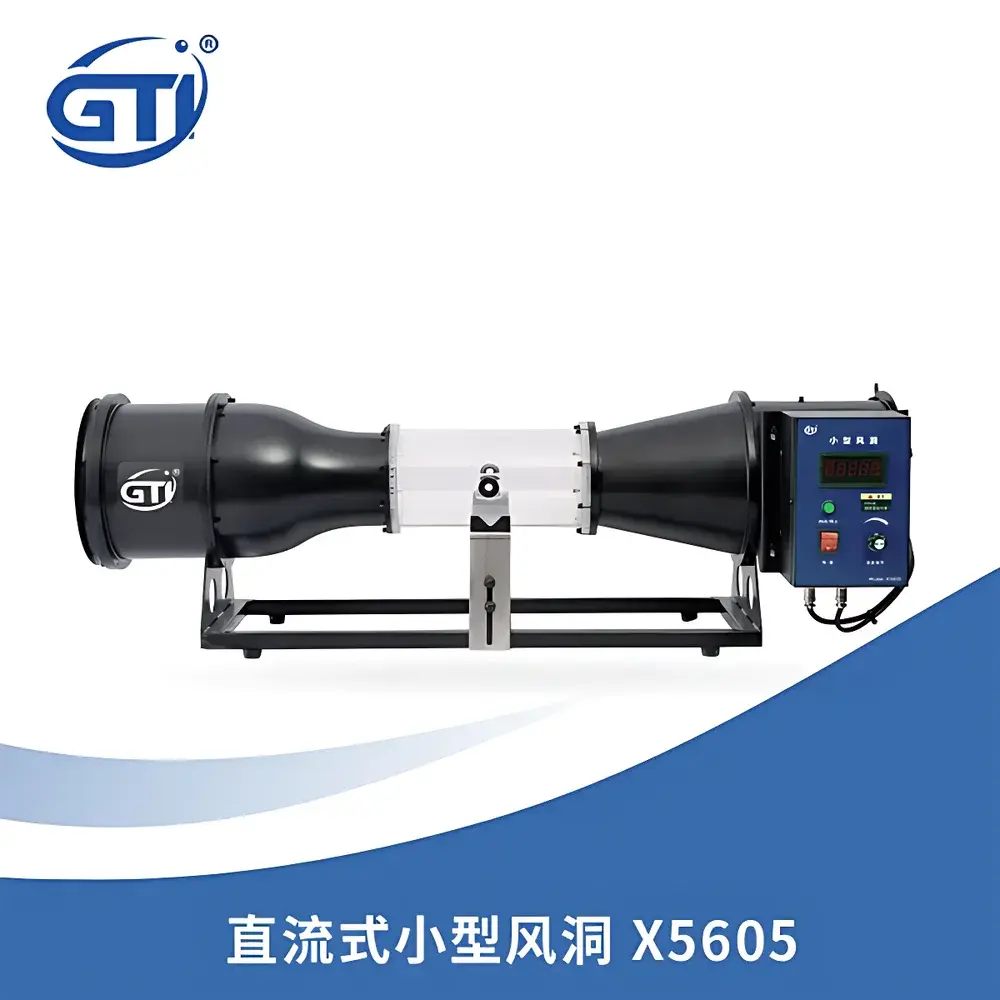
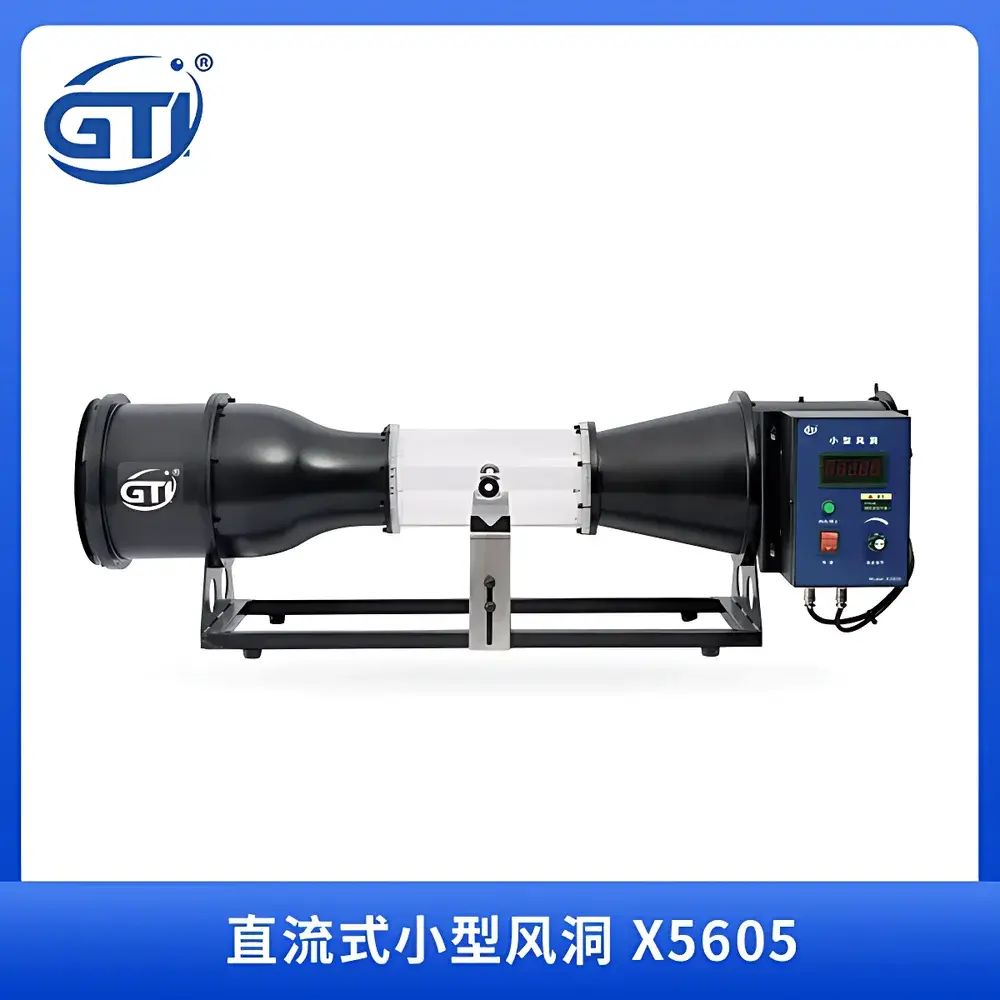
GTI X5605 Compact Direct-Current Wind Tunnel
| Brand | GTI |
|---|---|
| Origin | Liaoning, China |
| Manufacturer Type | Authorized Distributor |
| Country of Origin | China |
| Model | X5605 |
| Power Supply | AC 220 V, 50 Hz, 450 W |
| Weight | ~20 kg |
| Test Section Dimensions | 230 mm × φ120 mm (ID) |
| Test Port Diameter Range | φ2–φ20 mm |
| External Dimensions | 1002 × 237 × 319 mm |
| Air Velocity Range | 1–30 m/s |
| Flow Type | Direct-current suction-type |
| Flow Conditioning | Integrated honeycomb flow straightener |
| Visual Test Section | Transparent acrylic walls |
Overview
The GTI X5605 Compact Direct-Current Wind Tunnel is a benchtop-scale, suction-type aerodynamic test facility engineered for precision calibration, validation, and fundamental fluid dynamics research. Operating on the principle of controlled laminar-to-turbulent transition within a stabilized boundary layer, the X5605 generates a well-conditioned, axis-aligned airflow across its cylindrical test section—enabling repeatable, traceable velocity profiles essential for sensor metrology and small-scale aerodynamic characterization. Unlike open-loop or fan-bench setups, the X5605 integrates a calibrated axial blower with variable-speed control and a multi-stage flow conditioning system—including a precision-machined honeycomb straightener and contraction nozzle—to minimize turbulence intensity (<1.2% at 15 m/s) and ensure uniform velocity distribution (±2.3% deviation across cross-section per ISO 5167-4 Annex C guidelines). Its compact footprint and direct-current suction architecture eliminate recirculation artifacts and thermal drift commonly observed in closed-loop tunnels, making it especially suitable for laboratory environments where space, power, and operational simplicity are constrained.
Key Features
- Stable, programmable air velocity range from 1 to 30 m/s, digitally adjustable via integrated frequency-controlled motor drive with ±0.1 m/s repeatability over 8-hour continuous operation.
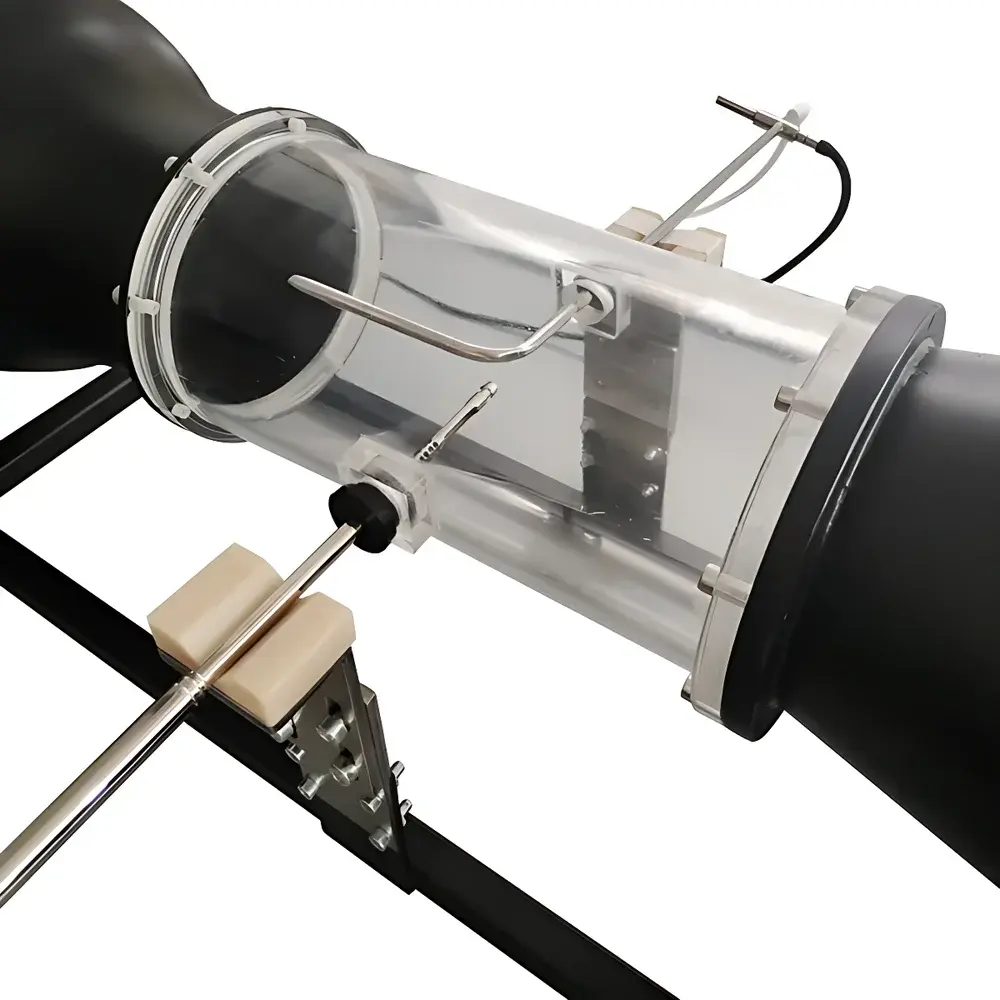
- Optically transparent acrylic test section (230 mm length × φ120 mm internal diameter) enabling real-time visualization of smoke-wire flow patterns, particle seeding trajectories, and sensor positioning during active measurement.
- Honeycomb flow straightener and streamlined contraction geometry certified to meet ISO/IEC 17025-compliant flow uniformity criteria for calibration-grade wind tunnels (per ASTM D5096-21 Annex A2).
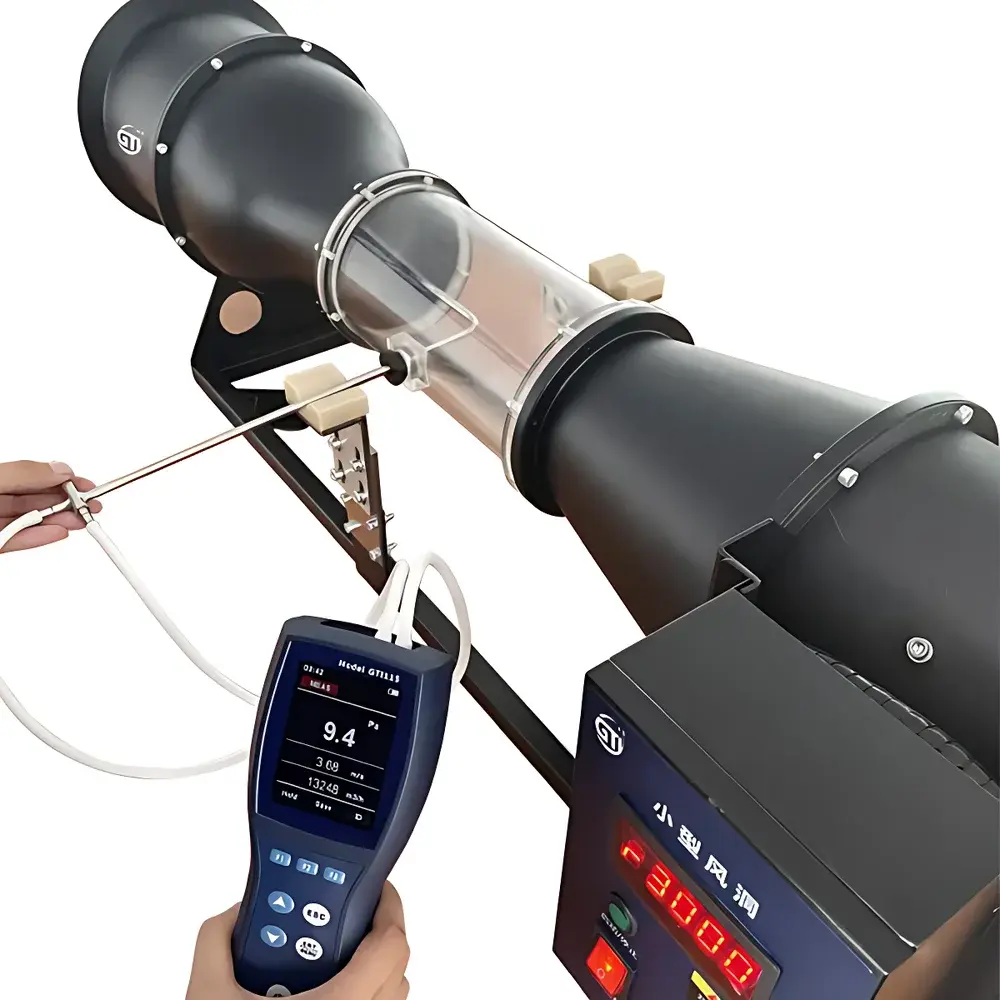
- Modular test port interface accommodating probe diameters from φ2 mm to φ20 mm; includes interchangeable flange adapters, O-ring sealed mounting collars, and strain-relieved cable feedthroughs for pressure, temperature, and hot-wire anemometer integration.
- Self-contained mechanical architecture requiring no external support frame, vibration isolation table, or auxiliary ducting—fully operational upon level placement and electrical connection.
- Low acoustic signature (<58 dB(A) at 1 m), enabling use in shared laboratory spaces without dedicated acoustic enclosures.
Sample Compatibility & Compliance
The X5605 supports calibration and testing of anemometers (vane, cup, thermal, ultrasonic), Pitot-static tubes, differential pressure transducers, and micro-scale aerodynamic models up to 100 mm in chord length. Its test section geometry complies with ISO 6446:2020 (Wind tunnel calibration of anemometers) and aligns with NIST SP 250-99 recommendations for low-speed calibration facilities. All structural components conform to RoHS Directive 2011/65/EU and CE-marked electrical subsystems satisfy EN 61000-6-3:2019 (EMC emission limits) and EN 61000-6-2:2019 (immunity requirements). The unit is designed for GLP-compliant laboratories and supports audit-ready documentation including factory calibration certificates (traceable to CNAS-accredited reference standards) and as-built dimensional verification reports.
Software & Data Management
While the X5605 operates as a standalone hardware platform, its analog output (0–10 V DC proportional to setpoint RPM) and optional RS-485 Modbus RTU interface enable seamless integration with third-party DAQ systems (e.g., National Instruments CompactDAQ, Keysight DAQ970A) and LIMS platforms. Users may log velocity setpoints, motor current draw, and ambient temperature/humidity (via optional external sensors) using timestamped CSV export. Firmware updates and configuration backups are managed via USB-C port; all operational logs retain ISO 8601-compliant timestamps and support 21 CFR Part 11–compliant electronic signature workflows when deployed with validated software layers.
Applications
- Primary and secondary calibration of air velocity sensors per ISO/IEC 17025 accredited procedures.
- Aerodynamic force/moment measurements on scaled components (e.g., HVAC grilles, drone airfoils, medical device flow restrictors) using external six-component balances.
- Boundary layer development studies and surface shear stress mapping via oil-film interferometry or thermal paint techniques.
- Validation of CFD simulations for low-Mach-number flows (Ma < 0.3) using PIV or LDV reference data acquired within the test section.
- Educational demonstrations of Bernoulli’s principle, vortex shedding, and separation phenomena using visible smoke injection and high-speed imaging.
- Environmental chamber pre-test screening for air sampling device performance under controlled flow conditions.
FAQ
What standards does the X5605 comply with for sensor calibration?
It meets the geometric and flow quality requirements specified in ISO 6446:2020 and ASTM D5096-21 for low-speed anemometer calibration facilities.
Can the X5605 be used for hot-wire anemometry?
Yes—the test section provides unobstructed access, stable DC flow, and minimal vibration, satisfying the mechanical stability prerequisites outlined in ISO/IEC 17025 Clause 6.4.3 for hot-wire system validation.
Is external exhaust ducting required?
No—the suction-type design discharges conditioned air directly into the ambient lab environment; however, local ventilation is recommended if operating continuously above 25 m/s for >4 hours.
Does GTI provide NIST-traceable calibration documentation?
Each unit ships with a factory calibration report traceable to CNAS-accredited primary standards; NIST-traceable re-calibration services are available through authorized GTI service centers.
What maintenance intervals are recommended?
Blower bearing inspection and honeycomb cleaning are advised every 1,000 operational hours; full system verification (velocity profile, uniformity, repeatability) is recommended annually per ISO/IEC 17025 Clause 7.7.
Related Products







