
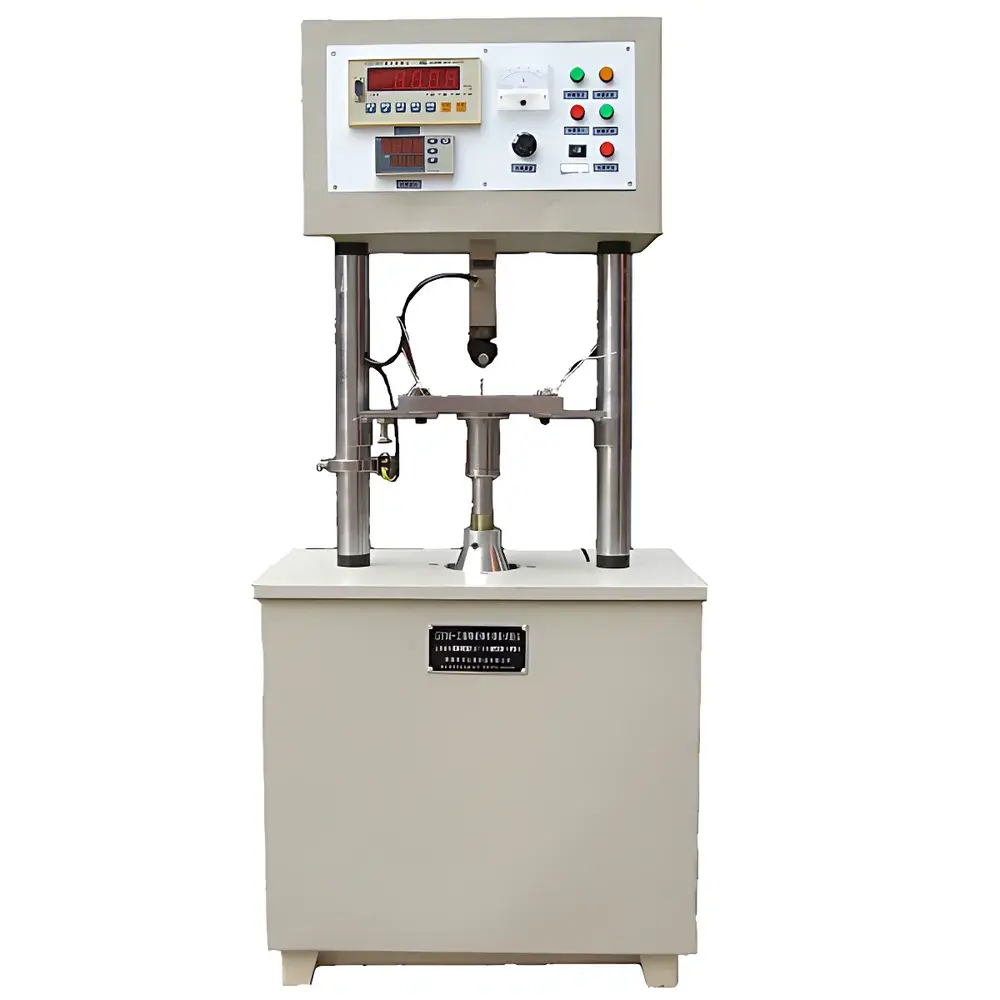
GTM- Series Digital Static Elastic Modulus Tester for Advanced Ceramics
| Origin | Hunan, China |
|---|---|
| Manufacturer Type | Authorized Distributor |
| Regional Origin | Domestic (PRC) |
| Model | GTM- |
| Price Range | USD 1,400 – 2,800 |
| Load Capacity Options | 0–5 kN, 0–10 kN, 0–20 kN, 0–50 kN |
| Measurement Accuracy | ±0.15% FS (Load), ±0.5% FS (Deformation) |
| Deformation Range | ±5 mm |
| Displacement Rate | 0–1 mm/min (adjustable) |
| Temperature Capability | GTM-1 — Ambient only |
| Sample Dimension Tolerance | Parallelism ≤0.02 mm, Perpendicularity ≤0.02 mm, Surface Roughness Rz ≤1.60 µm |
| Strain Gauge Length Limits | ≤1 mm (3-point bend), ≤5 mm (4-point bend) |
| Compliance Standards | GB/T 10700–2006, GB/T 6569, GB/T 1182, GB/T 1031 |
Overview
The GTM- Series Digital Static Elastic Modulus Tester is an engineered precision instrument designed for the static mechanical characterization of advanced structural and functional materials under controlled loading conditions. It operates on the principle of quasi-static three-point or four-point bending, enabling direct determination of Young’s modulus (E) via linear regression of the stress–strain or load–deflection relationship within the material’s elastic regime. Unlike dynamic or ultrasonic methods, this system delivers high reproducibility for brittle and quasi-brittle ceramics—including silicon carbide, alumina, zirconia, silicon nitride—and extends reliably to graphite, optical glass, polymer matrix composites, and metallic alloys where microstructural homogeneity and surface integrity are critical. The tester conforms to internationally aligned national standards including GB/T 10700–2006 (equivalent in scope to ISO 14704 and ASTM C1161 for ceramic flexural testing), ensuring data traceability and inter-laboratory comparability in quality assurance, R&D validation, and regulatory submission contexts.
Key Features
- Modular load frame architecture with selectable capacity options (5 kN, 10 kN, 20 kN, 50 kN), each calibrated to ISO 376 Class 0.5 accuracy and validated per ISO 7500-1.
- Dual measurement modes: high-fidelity strain measurement using bonded foil gauges (with strict gauge length constraints per GB/T 10700–2006), and high-resolution displacement measurement with integrated contact deformation correction protocol.
- Automated deflection correction methodology compliant with GB/T 6569 Annex B: uses ultra-high-stiffness reference specimens (e.g., tungsten carbide, E ≈ 600 GPa) to isolate and subtract contact compliance—critical for thick-to-span ratio > 0.06 geometries.
- Precision-machined support and loading rollers with parallelism ≤0.02 mm and surface finish Ra < 0.4 µm, minimizing boundary condition artifacts during bending tests.
- Thermally stable base structure with low thermal expansion coefficient alloy construction; GTM-2 variant integrates a programmable high-temperature furnace (ambient to 1000 °C) with PID-controlled heating and ±1 °C uniformity across the test zone.
- Motor-driven crosshead with closed-loop displacement control, offering continuous rate adjustment from 0.001 to 1 mm/min (resolution: 0.0001 mm/s), fully compatible with ISO 204 and ASTM E8/E8M displacement-rate requirements.
Sample Compatibility & Compliance
The GTM- system accommodates standard rectangular beam specimens per GB/T 6569 and ISO 14704, with width and thickness measured to ±0.01 mm using certified micrometers. Specimen preparation adheres to strict geometric tolerances: opposing faces parallel within 0.02 mm, adjacent faces perpendicular within 0.02 mm, and surface roughness Rz ≤ 1.60 µm (per GB/T 1031). Minimum batch size is five specimens per test condition to satisfy statistical validity per ISO 5725 and GB/T 10700–2006. The instrument supports both ambient and elevated temperature testing (GTM-2), with furnace integration enabling modulus evaluation under service-relevant thermal conditions—essential for aerospace-grade SiC/SiC composites or nuclear-grade graphite. All test procedures align with GLP documentation requirements, supporting audit-ready records for ISO/IEC 17025-accredited laboratories.
Software & Data Management
An optional PC interface (RS-232 or USB 2.0) enables real-time acquisition of load, displacement, and (when equipped) strain signals at up to 100 Hz sampling rate. The bundled software provides automated calculation of Young’s modulus from initial linear slope of the stress–strain curve, with user-definable elastic limit thresholds (e.g., 70% of flexural strength per GB/T 6569). Raw data export is supported in CSV and XLSX formats; all test files include metadata stamping (operator ID, timestamp, environmental temperature, calibration certificate ID). For regulated environments, the software package can be configured to meet FDA 21 CFR Part 11 requirements—including electronic signatures, audit trail logging, and role-based access control—upon customer specification and validation support.
Applications
- Quality control of sintered technical ceramics in manufacturing lines (e.g., insulators, wear parts, biomedical implants).
- High-temperature modulus mapping for ceramic matrix composites used in gas turbine hot-section components.
- Interlaboratory round-robin studies validating new ceramic formulations against ISO 14704 benchmark datasets.
- Failure analysis of brittle materials where elastic stiffness degradation precedes crack initiation.
- Supporting ASTM C1341 or ISO 178 flexural property correlations in polymer-ceramic hybrid development.
- Teaching laboratories requiring ISO-aligned hands-on instruction in mechanical behavior of advanced materials.
FAQ
What standards does the GTM- Series comply with?
It is fully aligned with GB/T 10700–2006, GB/T 6569, GB/T 1182, and GB/T 1031, with functional equivalence to ISO 14704, ASTM C1161, and ISO 204 for static modulus determination.
Can the system measure both tensile and compressive modulus?
No—it is specifically configured for flexural modulus via bending configurations (3-point or 4-point). Tensile or compressive modulus requires uniaxial testing systems per ISO 527 or ISO 3187.
Is the contact deformation correction method validated?
Yes—the reference specimen methodology follows GB/T 6569 Annex B and has been verified using NIST-traceable calibration beams with known E-values across 50–400 GPa range.
Does the GTM-2 model support rapid thermal cycling?
The GTM-2 furnace is optimized for steady-state high-temperature testing (soak times ≥30 min); thermal ramp rates are limited to ≤5 °C/min to maintain mechanical stability and sensor integrity.
What documentation is provided for ISO/IEC 17025 compliance?
Each unit ships with a factory calibration certificate (traceable to CNAS-accredited labs), uncertainty budget per ISO/IEC 17025 Clause 6.4, and a full set of operating instructions compliant with ISO/IEC 17025 Clause 7.2.2.



