
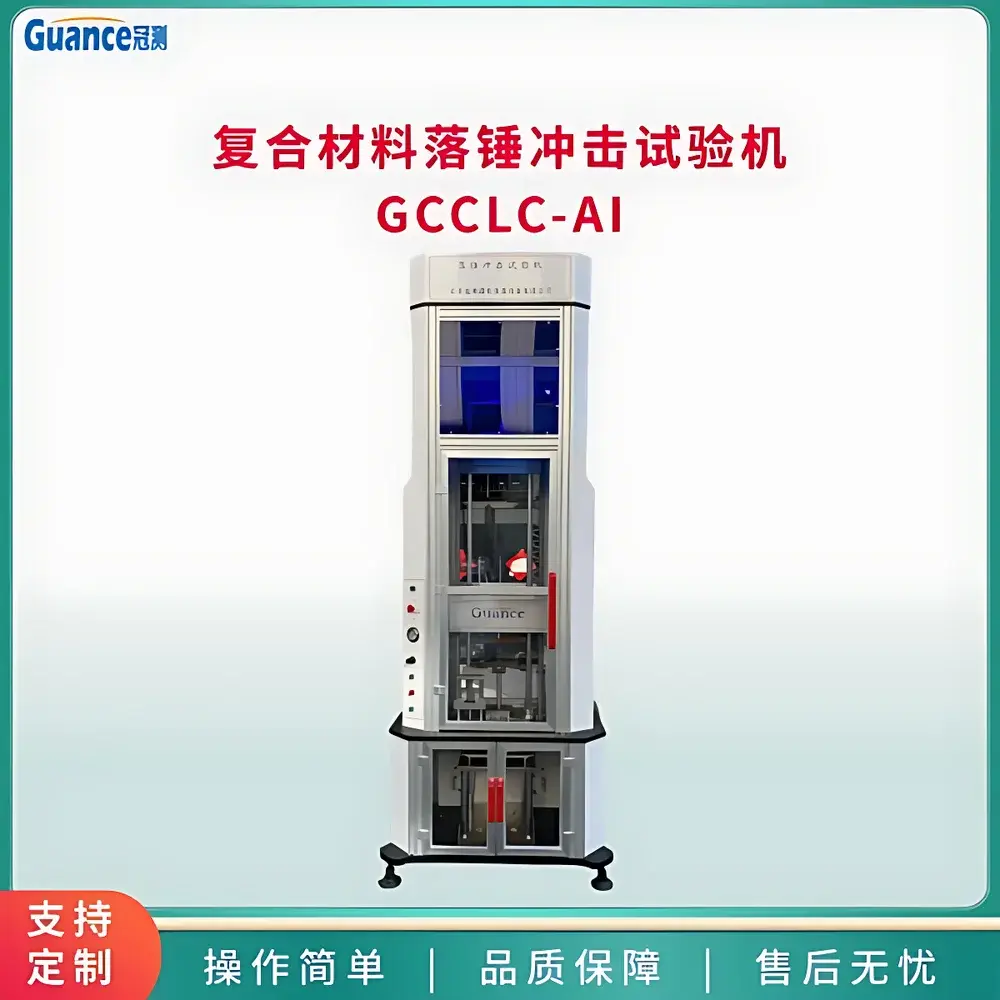



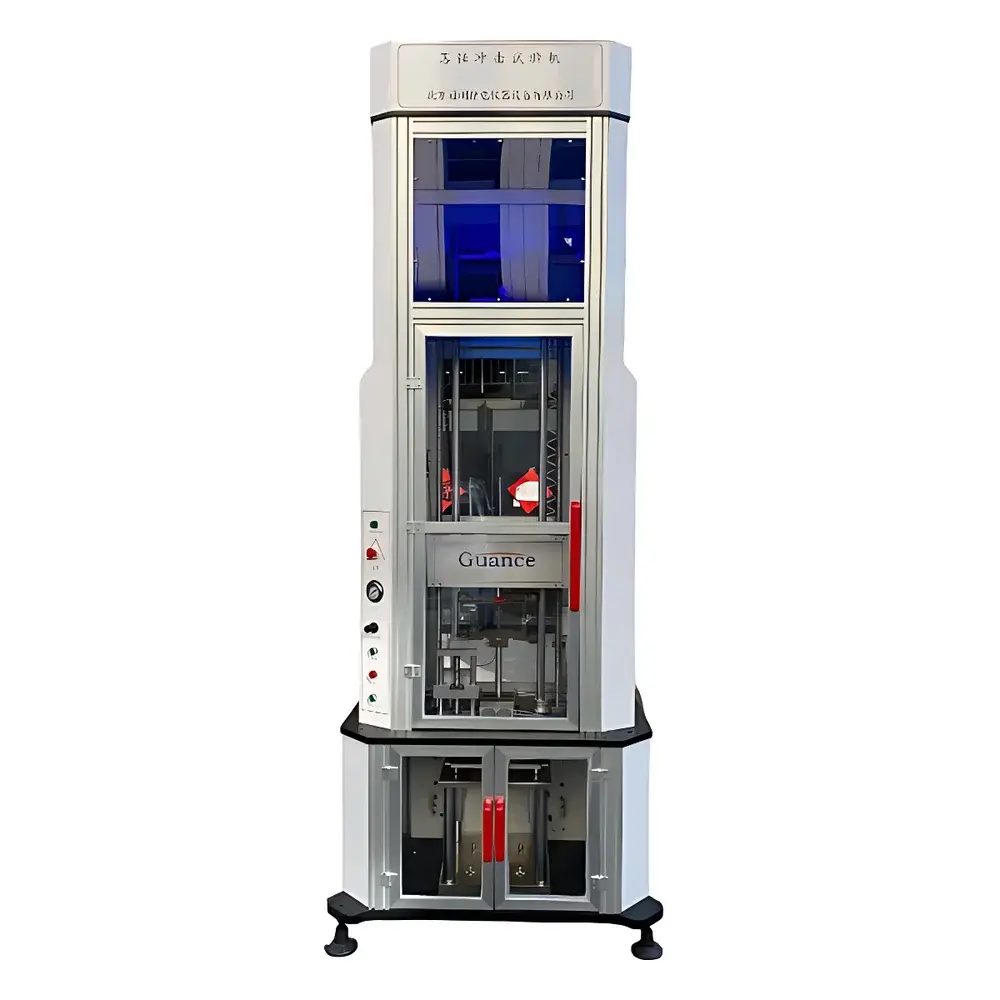
Guance GCCLC-AI Instrumented Drop Weight Impact Tester
| Brand | Guance |
|---|---|
| Model | GCCLC-AI |
| Origin | Beijing, China |
| Manufacturer Type | Authorized Distributor |
| Regional Classification | Domestic (China) |
| Price | USD 2,250 (FOB Beijing) |
| Impact Energy Range | 100–1000 J |
| Max Impact Height | 2000 mm |
| Impact Velocity Range | 0–10 m/s |
| Force Sensor Range | 10–250 kN (optional) |
| Dynamic Measurement Error | <2% |
| Test Chamber Dimensions | 600 × 550 × 450 mm |
| Hammer Tip Diameters | Ø12.0, Ø12.5, Ø16.0, Ø20.0 mm (±0.1 mm) |
| Hammer Hardness | HRC 60–65 |
| Mass Accuracy | ≤±0.5% |
| Positioning Accuracy | ±1 mm |
| Data Acquisition Rate | Up to 1 MHz (NI PXI platform) |
| Optical Velocity Sensor Response Time | 0.5 µs |
| Temperature Chamber Option | –40°C to +150°C |
| Power Supply | 220 V / 50 Hz |
| Machine Height | 3600 mm |
| Net Weight | 2000 kg |
Overview
The Guance GCCLC-AI Instrumented Drop Weight Impact Tester is an ASTM D7136/D7136M-23 and ISO 6603-2 compliant system engineered for high-fidelity dynamic characterization of polymeric composites, fiber-reinforced laminates, thermoplastic sheets, and advanced lightweight structural materials. It operates on the principle of instrumented Charpy-type impact testing: a calibrated hammer of known mass is elevated to a precise height and released under gravity, delivering controlled kinetic energy to a clamped specimen. Unlike conventional non-instrumented systems, the GCCLC-AI integrates synchronized high-speed force, acceleration, and optical velocity sensing to capture full transient load–displacement–time histories at microsecond resolution. This enables quantitative evaluation of impact resistance, damage initiation thresholds, energy absorption capacity, and fracture mode transitions (e.g., ductile-to-brittle behavior) — critical parameters for aerospace primary structures, automotive crash components, and wind turbine blade certification.
Key Features
- Multi-sensor instrumentation: Co-located piezoelectric force transducer (10–250 kN range, optional) and triaxial accelerometer provide redundant, cross-validated dynamic response data; dual-channel real-time trend overlay ensures measurement integrity and outlier detection.
- Ultra-fast optical velocity acquisition: Proprietary grating-based photonic sensor with 0.5 µs response time delivers true instantaneous impact and rebound velocity — eliminating interpolation errors common in encoder- or laser-Doppler-based systems.
- Direct analog signal acquisition: National Instruments PXIe-4353 high-speed DAQ card acquires raw mV-level sensor outputs without signal conditioning amplification, preserving bandwidth (>1 MHz sampling), phase coherence, and signal fidelity.
- Automated mechanical alignment: Motorized leveling base and laser-guided plumb line ensure vertical hammer trajectory within ±0.1°, minimizing off-axis loading and torsional artifacts during impact.
- Configurable impact protocols: User-selectable control modes — impact energy (J), drop height (mm), or impact velocity (m/s) — each dynamically validated in real time prior to release.
- Integrated deformation visualization: Synchronized high-speed imaging (up to 10,000 fps) coupled with digital image correlation (DIC) algorithms reconstructs 3D surface displacement fields and quantifies localized strain distribution during impact event.
Sample Compatibility & Compliance
The GCCLC-AI accommodates standard ASTM D7136, ISO 6603-2, and GB/T 21140 test geometries, including 100 × 100 mm, 100 × 150 mm, and Ø100 mm specimens. Pneumatic clamping with interchangeable aperture inserts (75 × 75 mm, 75 × 125 mm, Ø75 mm) ensures uniform pressure distribution and eliminates edge slippage. Optional environmental chamber (–40°C to +150°C) supports low-temperature toughness validation per MIL-STD-810H Method 502.2 and high-temperature impact assessment for thermally aged composites. All hardware and firmware comply with IEC 61000-6-2/6-4 EMC standards. Data acquisition and reporting workflows support audit-ready GLP/GMP traceability, including electronic signatures, metadata stamping, and 21 CFR Part 11–compliant audit trails when paired with validated software modules.
Software & Data Management
Guance ImpactSuite v4.2 (Windows 10/11, 64-bit) provides full-cycle test management: parameter configuration, real-time oscilloscope view, automated zero-point calibration, and post-test analysis. The software computes ASTM-defined metrics — peak impact force (Fmax), maximum absorbed energy (Eabs), damage dissipation energy (Ediss), critical damage onset point (via second derivative inflection), and ductile–brittle transition energy (DBTT). Advanced curve-fitting tools apply Johnson–Holmquist, modified Ludwik, and power-law models to extract material-specific dynamic constitutive parameters. Export formats include CSV, XML, HDF5, and PDF reports with embedded metadata (operator ID, calibration certificate ID, environmental conditions). Raw binary data (.tdms) is retained for third-party reprocessing in MATLAB, Python (NumPy/Pandas), or commercial FEA pre-processors.
Applications
- Aerospace: Interlaminar fracture toughness (GIC, GIIC) validation of carbon-fiber prepregs per ASTM D6671.
- Automotive: Crashworthiness screening of CFRP bumper beams and battery enclosure panels under regulated ECE R94/R95 impact conditions.
- Renewable Energy: Edge-delamination resistance testing of wind blade spar caps subjected to simulated hail or tool-drop events.
- Biomedical: Impact fatigue performance of polymer-based orthopedic implant substrates (e.g., PEEK, UHMWPE) per ISO 17853.
- Academic Research: High-strain-rate constitutive modeling of nanocomposites, syntactic foams, and bio-inspired hierarchical materials.
FAQ
What standards does the GCCLC-AI support out-of-the-box?
It natively configures test templates for ASTM D7136/D7136M-23, ISO 6603-2, GB/T 21140, and EN 2562, with optional add-ons for MIL-STD-810H and DO-160 Section 25.
Can the system perform repeated impact testing at fixed energy levels?
Yes — programmable multi-strike sequences (1–99 impacts) with automatic specimen repositioning and force-threshold-based stop conditions are fully supported.
Is calibration traceable to national metrology institutes?
All force sensors are supplied with NIST-traceable calibration certificates (valid 12 months); velocity sensor calibration is performed using laser interferometry per ISO 17025-accredited procedures.
Does the system meet cybersecurity requirements for lab network integration?
The embedded controller runs a locked-down Windows IoT Enterprise image with disabled SMBv1, TLS 1.2+ enforcement, and configurable firewall rules — certified for integration into secure corporate intranets under ISO/IEC 27001-aligned IT policies.
Related Products



