
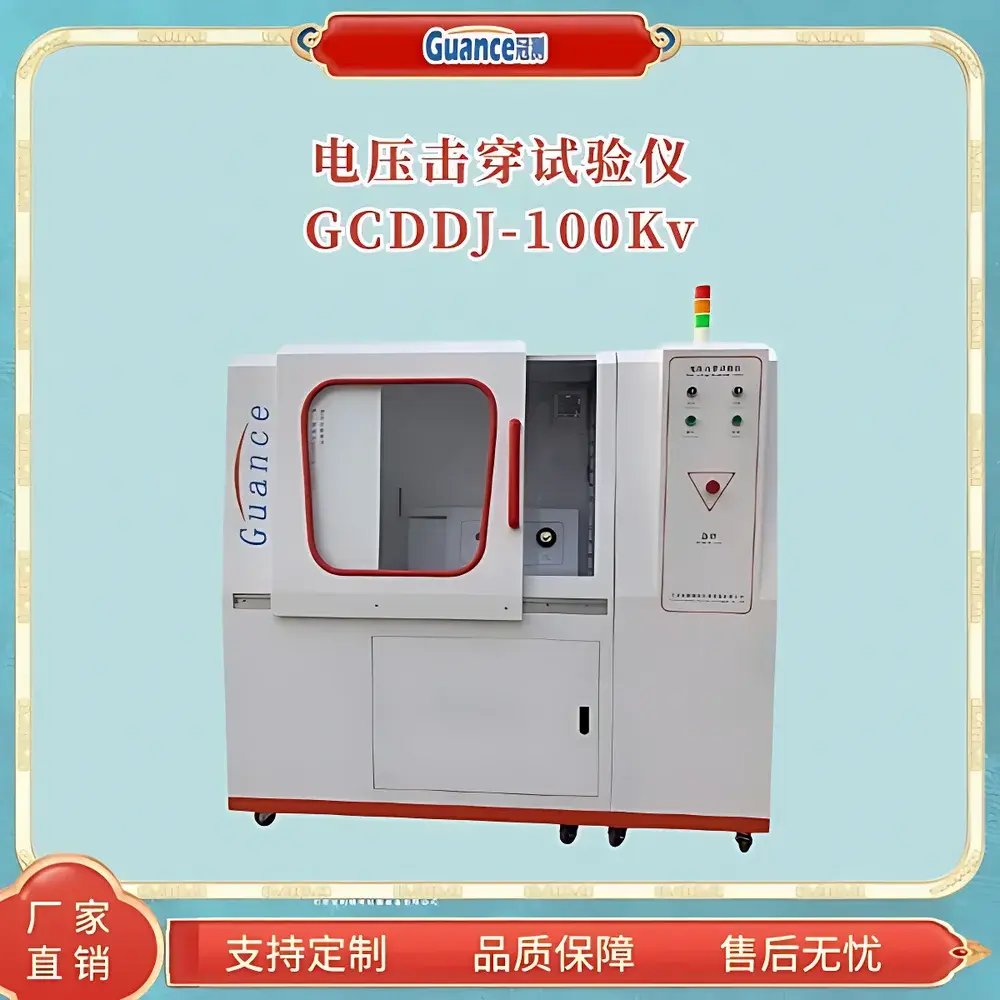
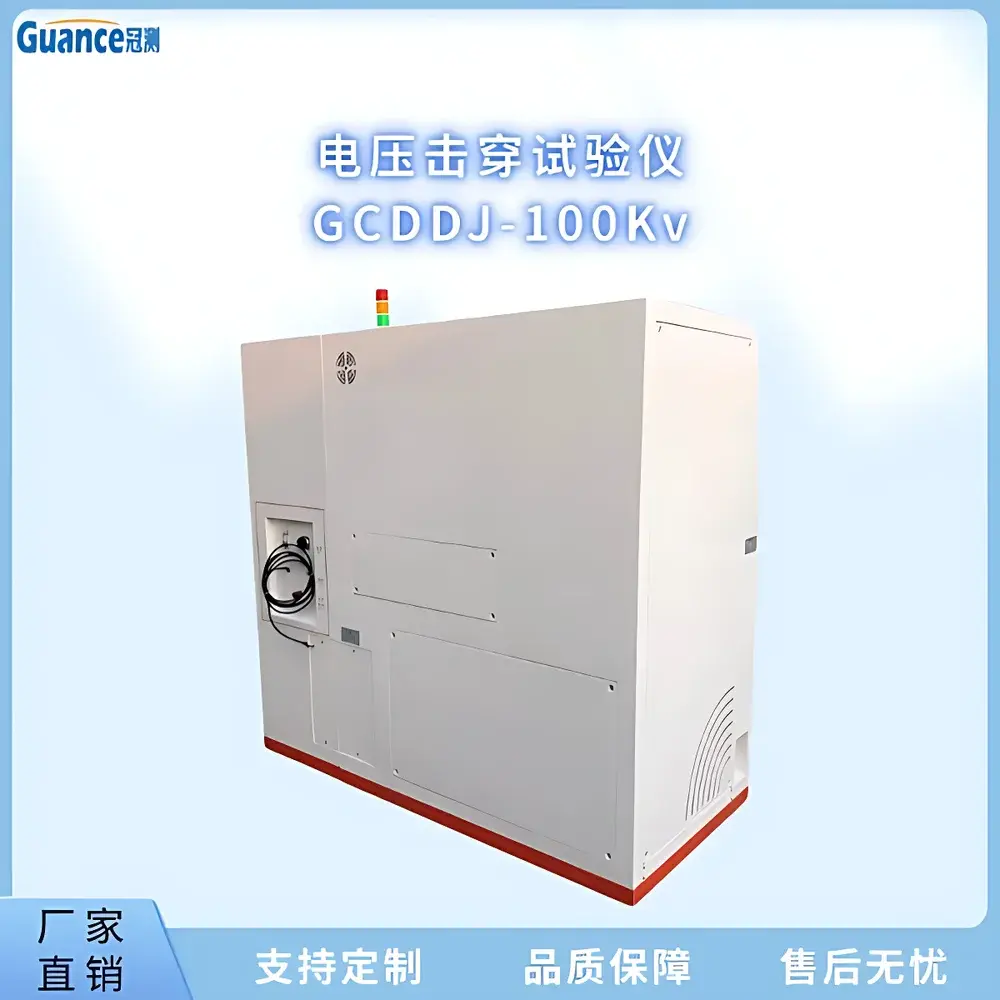
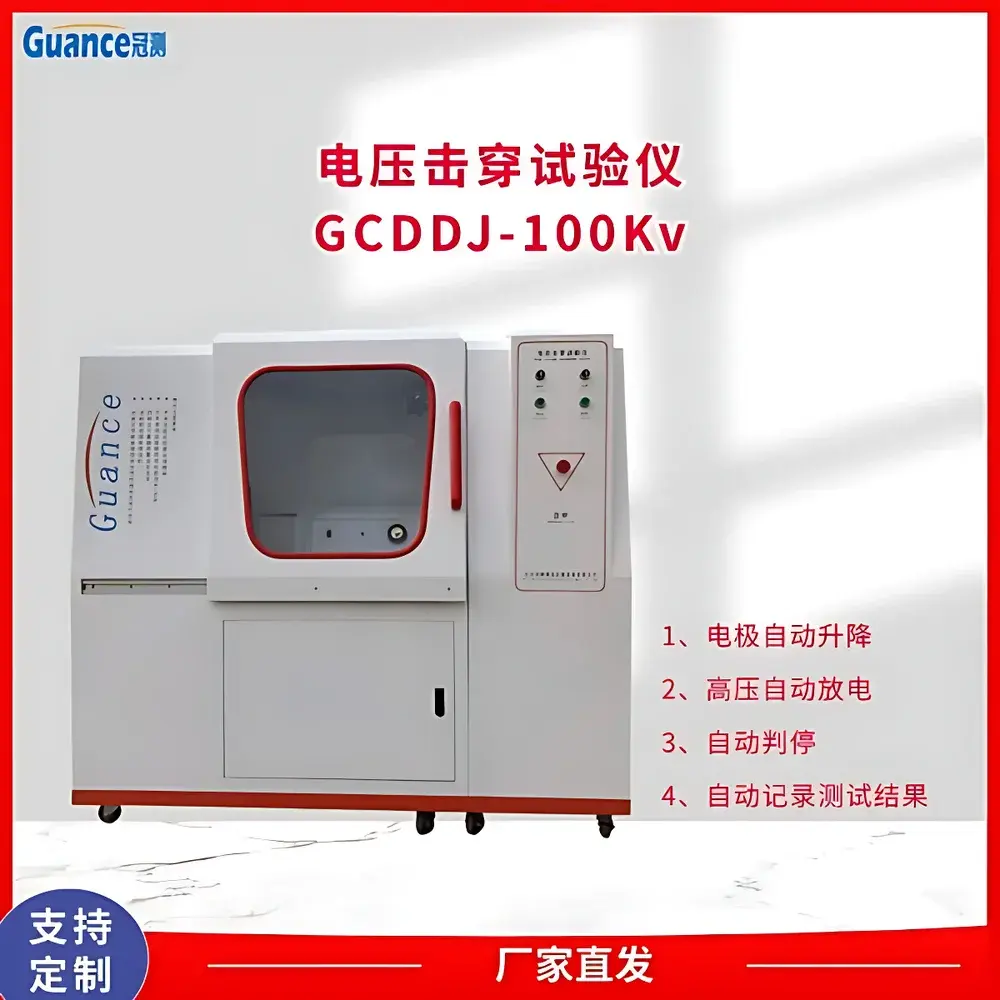
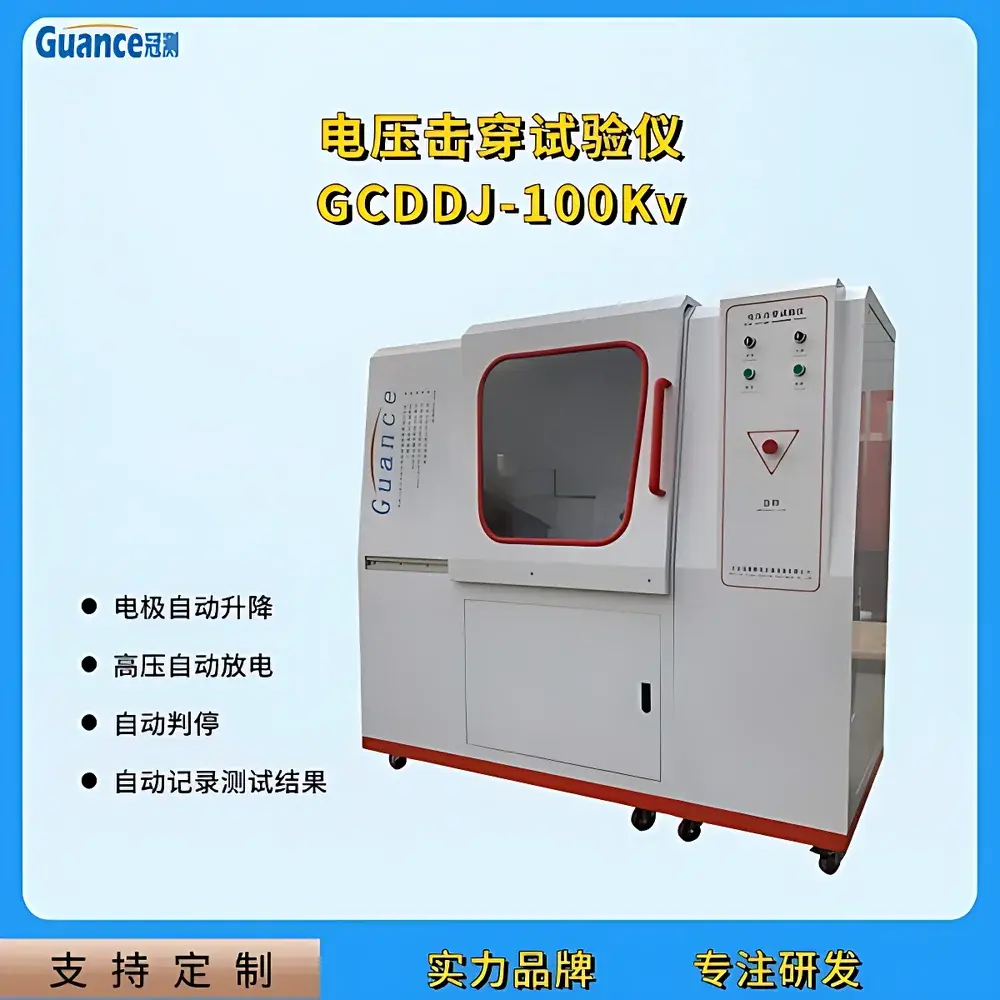
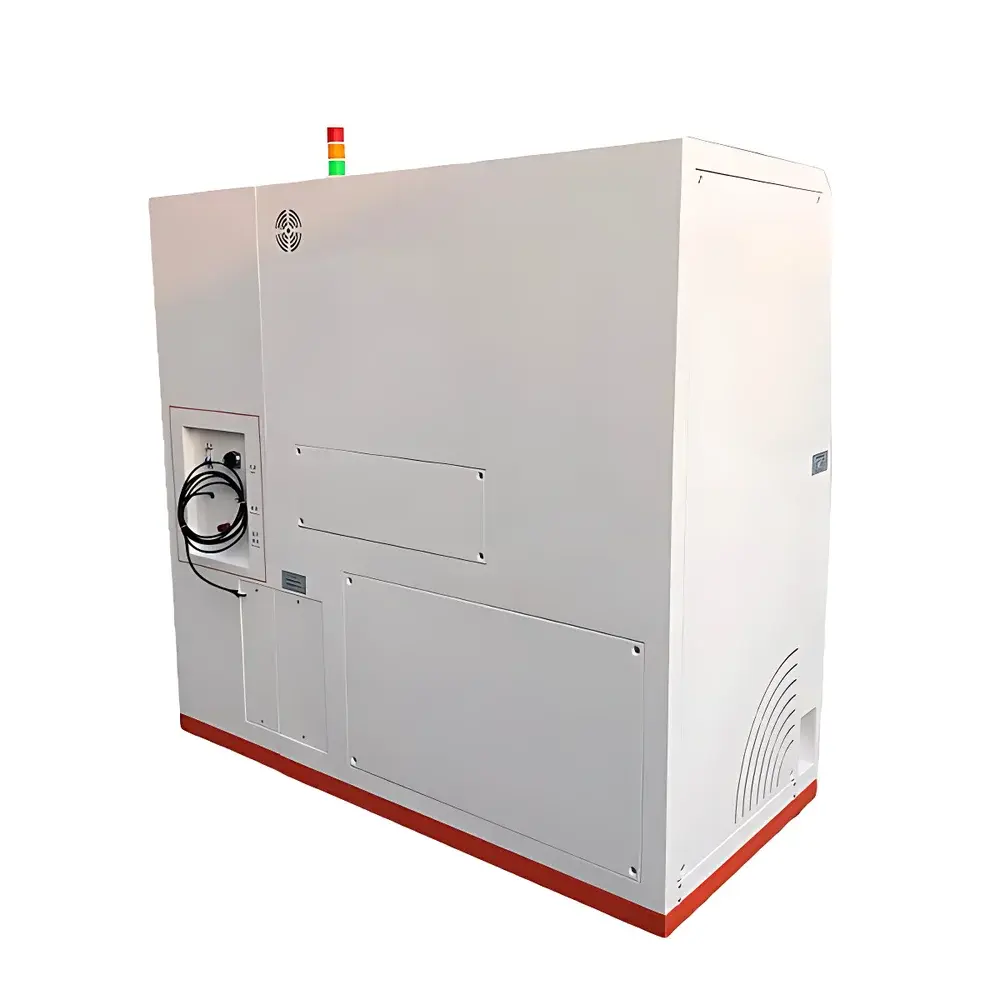
GuanCe GCDDJ-100kV Solid Insulating Material Voltage Breakdown Tester
| Brand | GuanCe Instruments |
|---|---|
| Origin | Beijing, China |
| Manufacturer Type | Authorized Distributor |
| Country of Origin | China |
| Model | GCDDJ-100kV |
| Breakdown Voltage Range | 0–100 kV AC/DC |
| Electrical Capacity | 5 kVA |
| Input Voltage | AC 220 V / 50 Hz |
| Voltage Accuracy | ≤ ±1.5% |
| Rise Rate Adjustment | 0.1–5 kV/s (stepless) |
| Test Modes | Dielectric Strength, Withstand Voltage, Stepwise Voltage Testing |
| Detection Method | Dual-criterion (voltage drop + leakage current threshold) |
| Leakage Current Range | 0–100 mA |
| Voltage Sensor Range | 0–100 V (scaled to 100 kV) |
| Electrode Options | φ25 mm (×2), φ75 mm (×1), customizable |
| Test Medium | Ambient air, insulating oil bath (300 × 150 × 200 mm), optional high-temperature chamber |
| Safety Systems | Overvoltage, overcurrent, short-circuit, and ground-fault protection |
| Data Acquisition | Optically isolated digital I/O with Siemens S7 PLC control |
| Software Platform | Windows-based GUI with real-time curve plotting, Excel export, configurable reporting, and audit-ready test logging |
Overview
The GuanCe GCDDJ-100kV Solid Insulating Material Voltage Breakdown Tester is an industrial-grade dielectric strength measurement system engineered for precise, repeatable evaluation of electrical insulation integrity under standardized AC or DC stress conditions. It operates on the principle of controlled voltage ramping until electrical breakdown occurs—defined as a sudden, irreversible loss of insulating resistance accompanied by sustained arcing or conduction path formation. Designed in accordance with core requirements of IEC 60243-1 (Electric Strength of Insulating Materials – Part 1: Tests at Power Frequencies), ASTM D149 (Dielectric Breakdown Voltage of Solid Electrical Insulating Materials at Commercial Power Frequencies), and GB/T 1408.1 (Chinese national standard aligned with IEC 60243), this instrument delivers traceable, laboratory-validated performance for R&D labs, quality control departments, and third-party certification bodies evaluating polymers, ceramics, composites, laminates, elastomers, varnishes, and molded insulators.
Key Features
- Full 0–100 kV AC/DC output capability with programmable rise rates from 0.1 to 5 kV/s—enabling compliance with both slow-ramp (IEC 60243-1 Method A) and rapid-rise (Method B) test protocols.
- Siemens S7-1200 PLC-based control architecture with optically isolated data acquisition, eliminating electromagnetic interference during high-voltage transients and ensuring signal fidelity across long cable runs.
- Dual-criterion breakdown detection: simultaneous monitoring of voltage collapse (ΔV) and leakage current surge (>10 mA threshold default, user-adjustable) to minimize false positives and enhance test repeatability.
- Modular high-voltage generation stage featuring oil-immersed transformer design with EMI-suppressed winding geometry and integrated corona shielding—optimized for stable output up to 100 kV with <±1.5% full-scale accuracy.
- Configurable electrode assemblies—including standard brass disk electrodes (φ25 mm × 2, φ75 mm × 1) and optional custom geometries—to accommodate diverse sample forms (films, rods, sheets, molded parts) per ASTM D149 Annex A1–A4.
- Integrated safety interlock system: pneumatic-assisted observation door with microswitch validation, multi-stage overvoltage cutoff (<105% setpoint), automatic post-test discharge (<5 s), and tower-status lighting (green/yellow/red) synchronized with real-time operational state.
Sample Compatibility & Compliance
The GCDDJ-100kV supports testing across heterogeneous solid dielectrics including thermoplastics (e.g., PE, PP, PTFE), thermosets (epoxy, phenolic), elastomers (silicone rubber, EPDM), ceramic substrates (alumina, zirconia), glass compositions, mica tapes, and impregnated paper or fiber-reinforced laminates. Sample mounting accommodates ambient-air tests (ASTM D149 Method I), oil-immersed configurations (Method II, using ASTM D877-compliant mineral oil), and high-temperature variants (optional oven integration up to 200 °C, supporting IEC 60243-2 thermal aging correlation studies). All mechanical interfaces—including electrode spacing adjustment, oil-bath suspension rack, and LED-lit viewing window (550 × 600 mm tempered glass)—are designed to meet ISO/IEC 17025 environmental control prerequisites for accredited laboratories. The system’s electrical safety architecture conforms to IEC 61010-1:2010 (Measurement, Control and Laboratory Equipment – Safety Requirements) and includes documented risk assessment per EN 62366-1 for usability engineering.
Software & Data Management
The Windows-native control software provides full GLP/GMP-aligned test execution and documentation. Each test session generates timestamped, digitally signed records containing raw voltage/current time-series data (100 Hz sampling), annotated test parameters (rise rate, hold time, electrode type, medium), operator ID, and environmental metadata (ambient temperature/humidity logged via optional external sensor input). Export functions support direct .CSV and native Excel (.xlsx) formats; reports are fully customizable with company letterhead, test standard references, pass/fail criteria, and statistical summaries (mean, SD, CV%). Audit trail functionality logs all user actions—including parameter edits, report modifications, and calibration events—with immutable timestamps and operator credentials, satisfying FDA 21 CFR Part 11 electronic record requirements when deployed with validated Windows OS configuration and domain-level authentication.
Applications
- Quality assurance of incoming raw materials (e.g., polymer pellets, ceramic green bodies, prepreg sheets) prior to manufacturing.
- Process validation of curing cycles, coating thicknesses, or lamination pressures affecting bulk resistivity.
- Comparative analysis of aging effects—thermal, UV, or humidity-induced degradation—via longitudinal breakdown voltage tracking.
- Development of high-voltage insulation systems for EV battery modules, power electronics enclosures, and aerospace wiring harnesses.
- Third-party conformity assessment for UL 746, IEC 60601-1 (medical device insulation), and RoHS-compliant material declarations.
FAQ
What standards does the GCDDJ-100kV comply with?
It is configured to execute tests per IEC 60243-1, ASTM D149, GB/T 1408.1, and ISO 2309, with software templates preloaded for common test methods.
Can the system perform both AC and DC breakdown tests?
Yes—dual-mode high-voltage generator supports sinusoidal 50/60 Hz AC and ripple-free DC output, each with independent calibration and safety interlocks.
Is remote operation or network integration supported?
The system features Ethernet TCP/IP interface for LAN-based control and data retrieval; OPC UA compatibility is available via optional firmware upgrade.
How is calibration traceability maintained?
Voltage and current channels are calibrated annually against NIST-traceable reference standards (Fluke 9500B calibrator); calibration certificates include uncertainty budgets and as-found/as-left data.
What maintenance intervals are recommended?
Preventive maintenance every 12 months includes HV transformer oil analysis, contact resistance verification, interlock function testing, and optical isolation channel diagnostics—documented in accordance with ISO/IEC 17025 clause 6.4.10.
Related Products



