
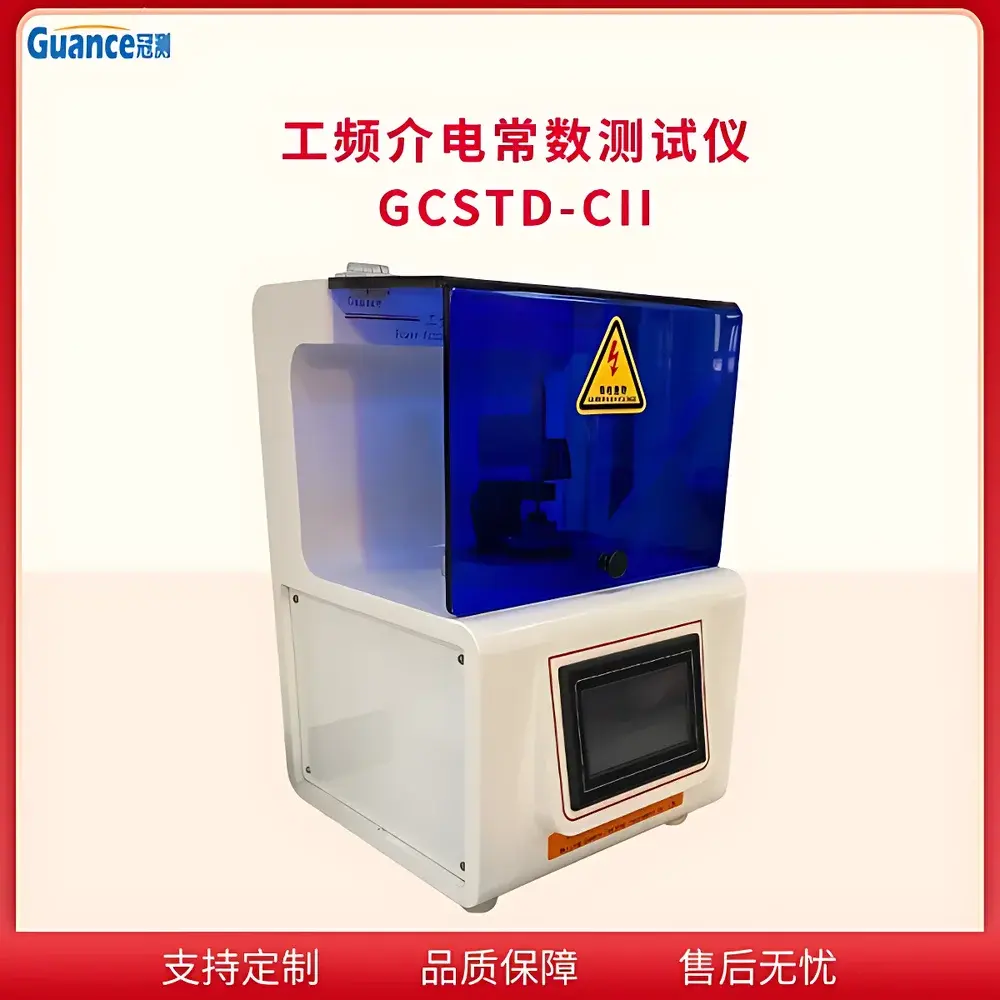
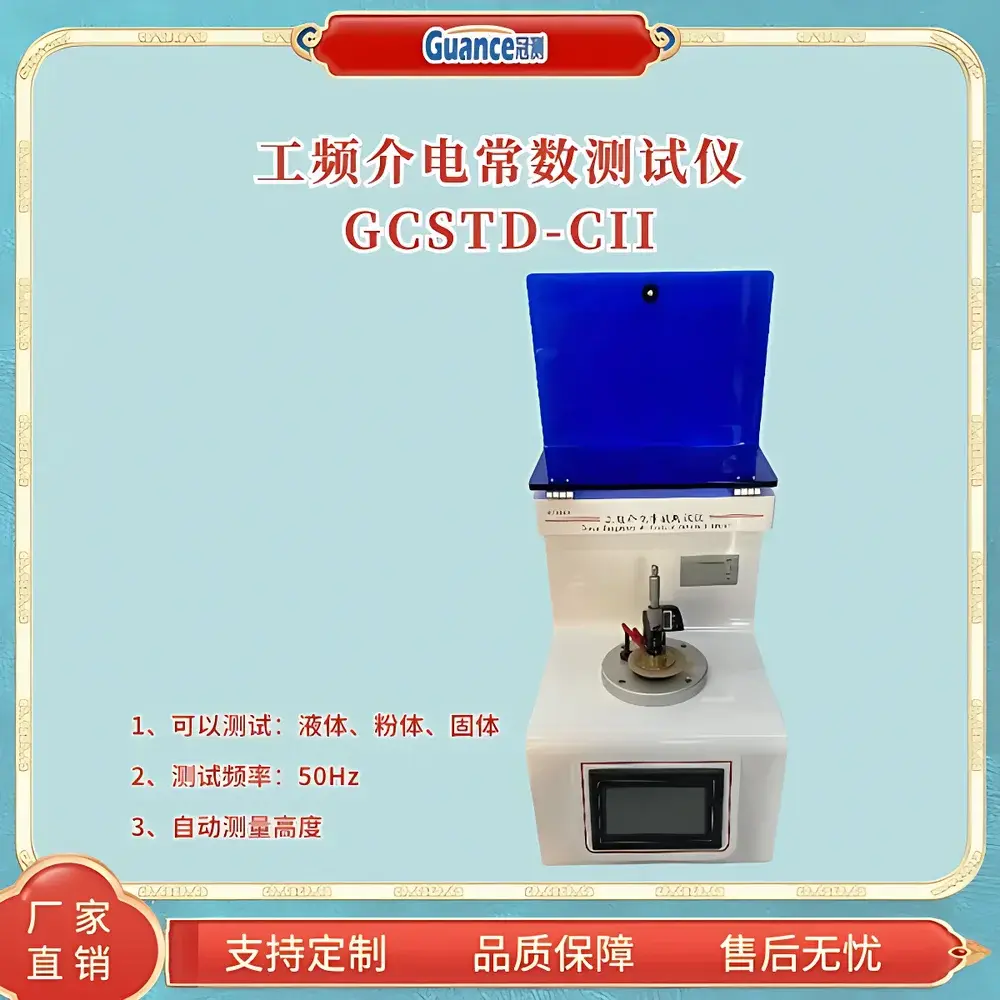
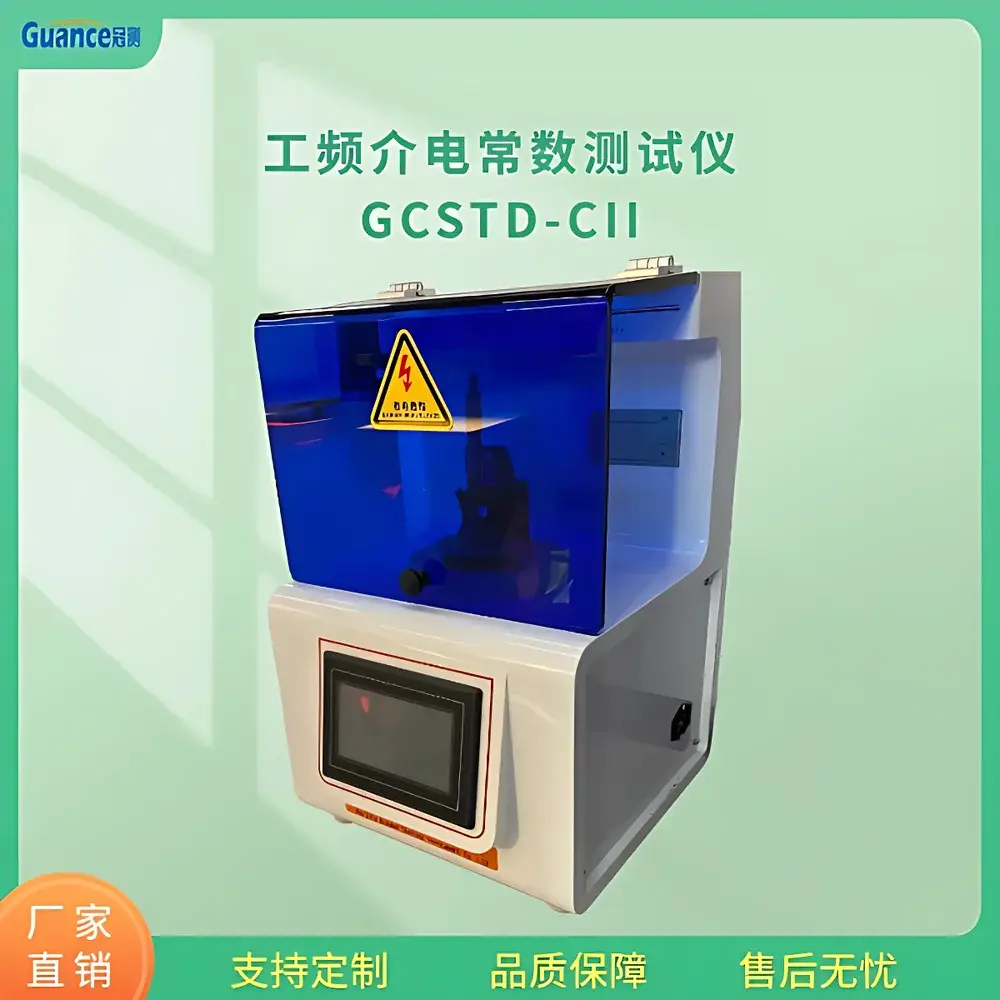
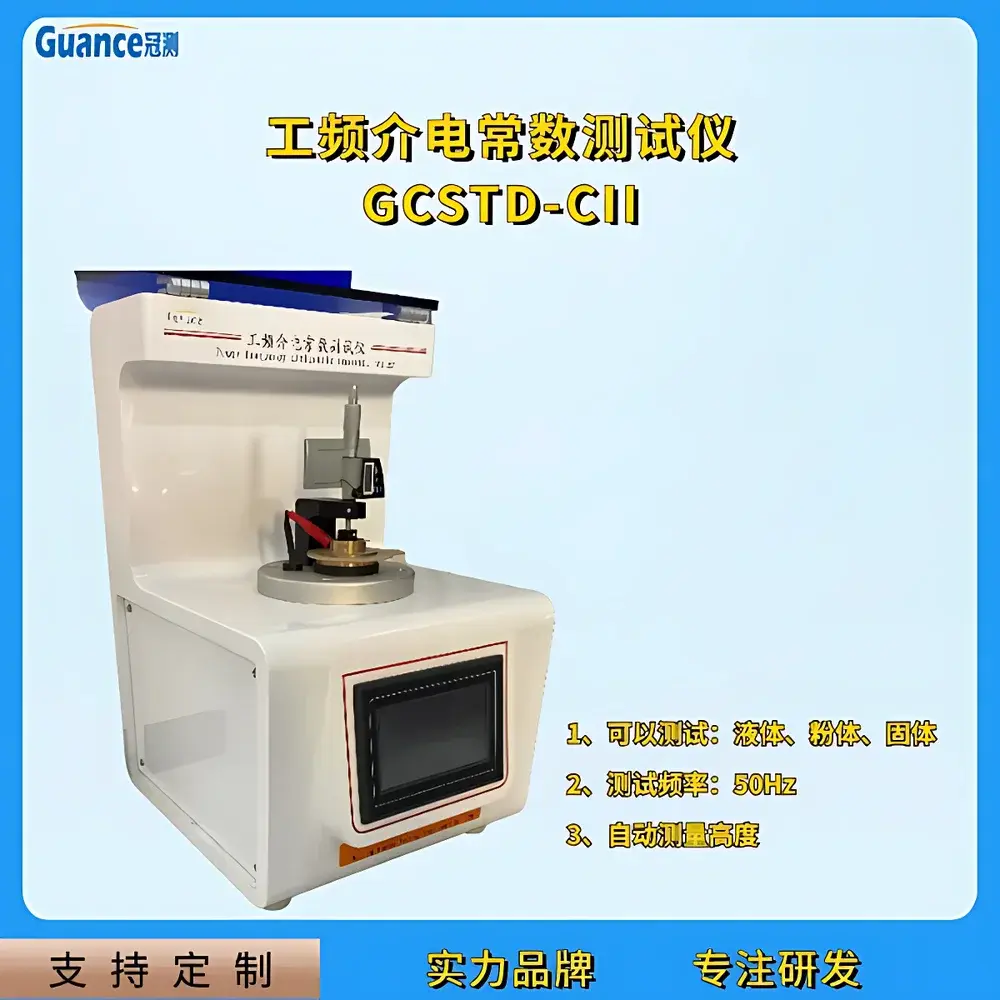
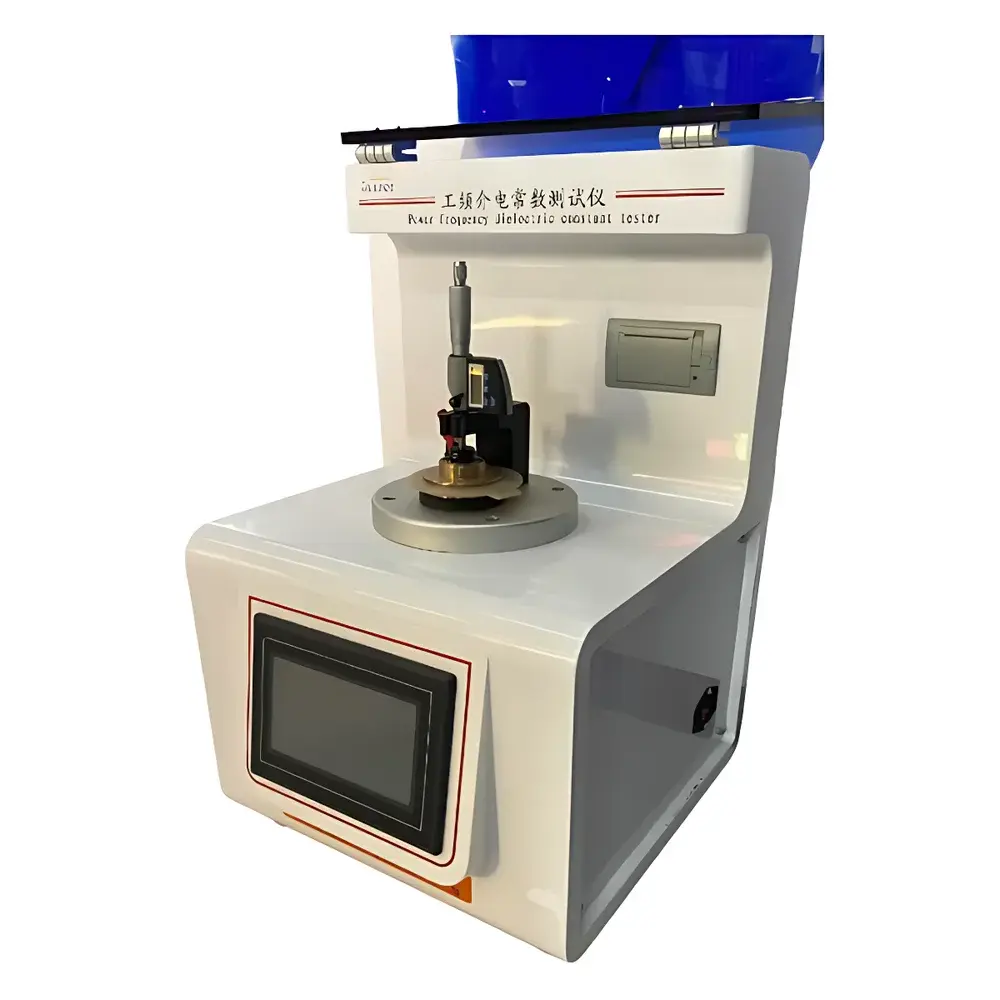
Guance GCSTD-CII5 Dielectric Constant and Dissipation Factor Analyzer
| Brand | Guance Instruments |
|---|---|
| Origin | Beijing, China |
| Manufacturer Type | Authorized Distributor |
| Country of Origin | China |
| Model | GCSTD-CII5 |
| Price | USD 940 (FOB) |
| Test Frequency | 45–65 Hz (Variable-Frequency Power Source) |
| Measurement Parameters | tanδ (dissipation factor), Cₓ (capacitance), εᵣ (relative permittivity, calculated) |
| Voltage Range | 2.5 kV, 5 kV, 10 kV (five-step adjustable AC output) |
| Capacitance Range | 30 pF – 0.3 µF (internal HV source) |
| tanδ Accuracy | ±(1% × reading + 0.09%) |
| Cₓ Accuracy | ±(1.5% × reading + 1 pF) |
| Resolution | 0.01% (tanδ), 0.1 pF (Cₓ) |
| Display | Large LCD with Chinese GUI |
| Compliance Standards | GB/T 1409–2006, GB/T 5654–2007, GB/T 21216–2007, GB/T 1693–2007, GB/T 5594.4–1985 |
| Sample Compatibility | Solid insulating sheets (Ø38 mm, Ø50 mm, Ø100 mm), liquid dielectrics (with standard oil cup), bushings, power cables, transformers, current/voltage transformers, HV capacitors |
| Operating Environment | 10–30 °C, 20–80% RH |
| Power Input | 220 V ±10%, 50/60 Hz |
| Dimensions | 470 × 320 × 360 mm |
| Weight | 16 kg |
| Output Capacity | 1.5 kVA |
| Test Modes | Direct connection, reverse connection, external HV source mode |
| Built-in HV Generator & Reference Capacitor | Yes |
Overview
The Guance GCSTD-CII5 Dielectric Constant and Dissipation Factor Analyzer is an integrated high-voltage AC bridge system engineered for precise determination of relative permittivity (εr) and dielectric loss tangent (tanδ) in solid and liquid insulating materials under power-frequency conditions (45–65 Hz). It operates on the principle of variable-frequency null-balance measurement, wherein a digitally synthesized sinusoidal excitation signal is applied across the test specimen and a built-in precision reference capacitor. By automatically adjusting frequency to minimize interference from ambient 50 Hz electromagnetic fields—and leveraging high-stability analog front-end circuitry and 16-bit ADC resolution—the instrument achieves robust signal-to-noise performance in electrically noisy substation or factory-floor environments. The calculated εr is derived from measured capacitance (Cx) using standardized geometric electrode configurations (e.g., parallel-plate for solid sheets per GB/T 1409–2006), while tanδ is extracted directly from phase-angle deviation between voltage and current waveforms. Designed for routine quality control and diagnostic testing in electrical equipment manufacturing, transformer oil labs, and insulation material R&D, the GCSTD-CII5 meets the metrological traceability requirements implicit in GB-series standards and supports GLP-aligned documentation workflows.
Key Features
- Integrated high-voltage generator (2.5 kV / 5 kV / 10 kV, five-step selectable AC output) eliminates need for external transformers during field testing.
- Onboard precision reference capacitor and calibrated high-voltage divider enable absolute measurement without external calibration artifacts.
- Adaptive frequency synthesis (45–65 Hz sweep) actively suppresses 50 Hz mains coupling—critical for on-site measurements near energized switchgear or busbars.
- Dual-test-mode architecture: direct connection (for grounded specimens), reverse connection (for ungrounded HV bushings), and external HV mode (for integration with 50/60 Hz test sets up to 500 kV).
- Overcurrent protection circuitry limits energy delivery during flashover or short-circuit events, preserving internal HV components and operator safety.
- Large backlit LCD with native Chinese menu navigation ensures intuitive operation without external PCs; all parameters—including test voltage, Cx, tanδ, and pass/fail status per GB limits—are displayed in real time.
- Thermal-stable analog signal path and auto-zeroing DC offset compensation ensure repeatability ≤0.02% (tanδ) over 8-hour continuous operation at 25 °C.
Sample Compatibility & Compliance
The GCSTD-CII5 accommodates standardized geometries defined in national and industry specifications: solid sheet specimens of Ø38 mm, Ø50 mm, and Ø100 mm (per GB/T 1409–2006); liquid samples tested in ASTM D924-compliant oil cups (e.g., ASTM D924-type dual-gap cell); and live equipment including power cable terminations, cast-resin current transformers, and oil-immersed bushings. Its measurement algorithms are validated against GB/T 5654–2007 (liquid dielectrics), GB/T 21216–2007 (conductive liquids), GB/T 1693–2007 (vulcanized rubber), and GB/T 5594.4–1985 (ceramic dielectrics). While not certified to IEC 60250 or ASTM D150, its hardware architecture and uncertainty budget align with the measurement principles stipulated therein. Data records include timestamp, operator ID, environmental temperature/humidity, test voltage, and electrode configuration—supporting internal audit trails compliant with ISO/IEC 17025 Clause 7.7 and enterprise-level QA documentation systems.
Software & Data Management
No proprietary PC software is required for basic operation; however, optional RS-232 or USB-to-serial interface enables raw data export (CSV format) for post-processing in MATLAB, Python (NumPy/Pandas), or LIMS platforms. Each test record contains: measurement date/time (RTC-synchronized), selected voltage step, Cx (pF), tanδ (%), calculated εr, ambient temperature (°C), relative humidity (%), operator code, and pass/fail flag based on user-defined thresholds (e.g., tanδ ≤ 0.5% for new transformer oil per DL/T 596). Internal memory retains ≥500 test logs with cyclic overwrite. All stored data are immutable after acquisition—no edit or delete function exists—to satisfy basic ALCOA+ (Attributable, Legible, Contemporaneous, Original, Accurate) expectations for non-regulated industrial use. Audit trail functionality (e.g., FDA 21 CFR Part 11 electronic signature) is not implemented, as the device is intended for engineering QC—not pharmaceutical or medical device validation.
Applications
- Quality assurance of cellulose-based insulating papers (kraft, crepe, pressboard) used in power transformers and reactors.
- Routine acceptance testing of new and reclaimed mineral insulating oils per GB/T 5654–2007 and IEC 60296.
- Diagnostics of moisture ingress or oxidation aging in transformer windings via trending of tanδ vs. voltage (tip-up analysis).
- Characterization of epoxy resin encapsulants, silicone gels, and polymeric cable jackets for high-voltage DC applications.
- Comparative evaluation of nanocomposite dielectrics (e.g., SiO₂/epoxy, Al₂O₃/polypropylene) in R&D laboratories.
- Field verification of bushing integrity prior to commissioning or after fault events.
FAQ
Does the GCSTD-CII5 support automated temperature compensation?
No. Temperature correction must be applied manually using published εr(T) and tanδ(T) curves for the specific material per GB/T 1409–2006 Annex B.
Can it measure DC resistivity?
No. This instrument performs AC impedance spectroscopy only at power frequencies; DC volume/surface resistivity requires a dedicated high-resistance meter (e.g., ASTM D257-compliant).
Is external calibration required annually?
Yes. While the internal reference capacitor is factory-trimmed, NIST-traceable recalibration of HV output and phase measurement chain is recommended every 12 months—or after any physical shock exceeding 25 g—to maintain stated accuracy.
What electrode systems are supported for solid samples?
The instrument is compatible with standard three-terminal guarded electrodes per GB/T 1409–2006: brass parallel-plate fixtures with guard rings (Ø38 mm, Ø50 mm, Ø100 mm), supplied separately. Custom electrode adapters may be fabricated but must preserve defined fringing-field geometry.
Does it comply with IEC 60404-6 for magnetic steel testing?
No. This analyzer is designed exclusively for dielectric—not magnetic—property measurement; permeability or core loss evaluation requires a different instrument class (e.g., Epstein frame or single-sheet tester).



