
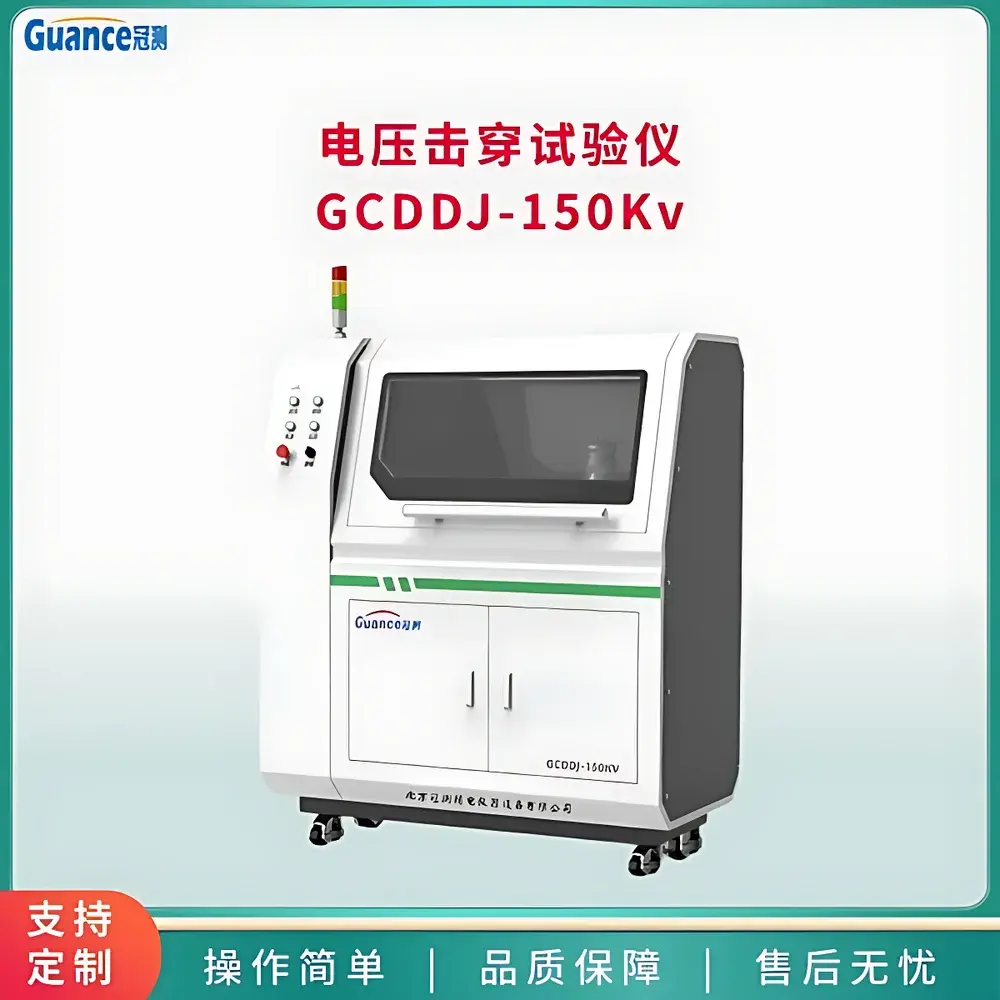
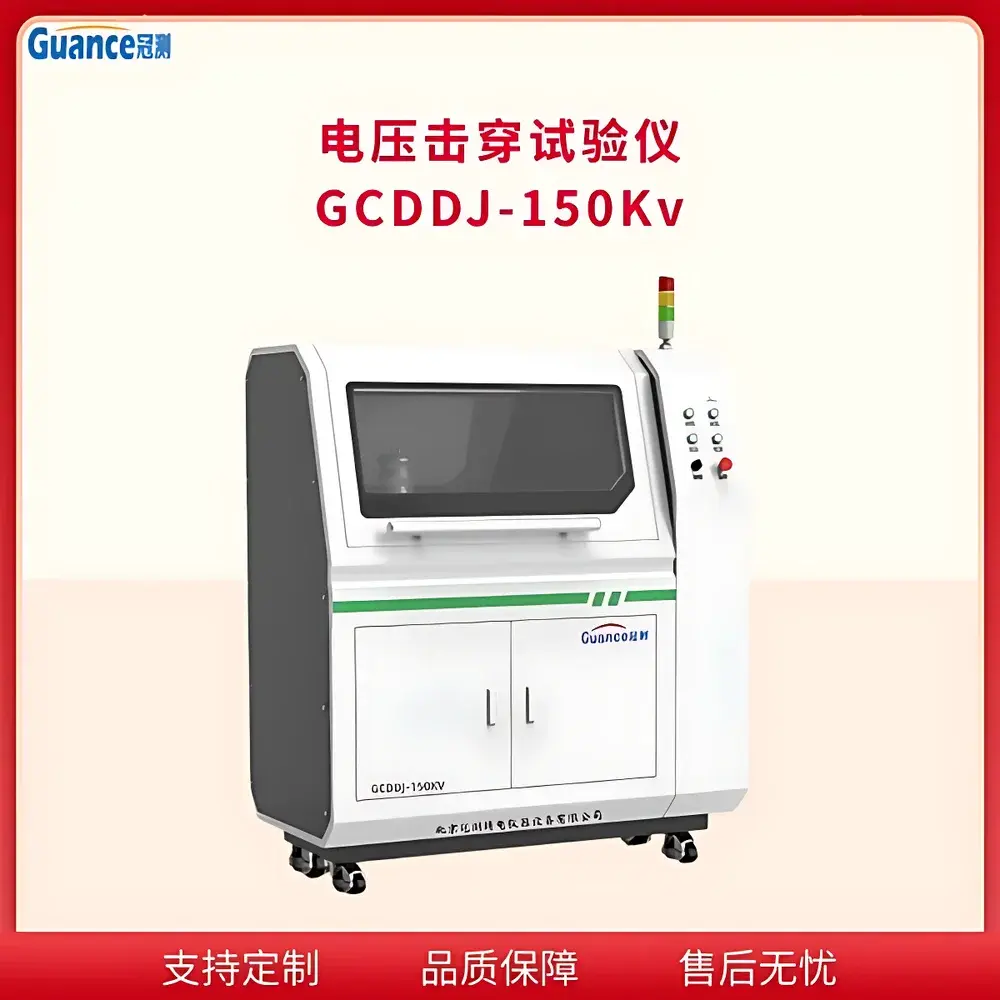
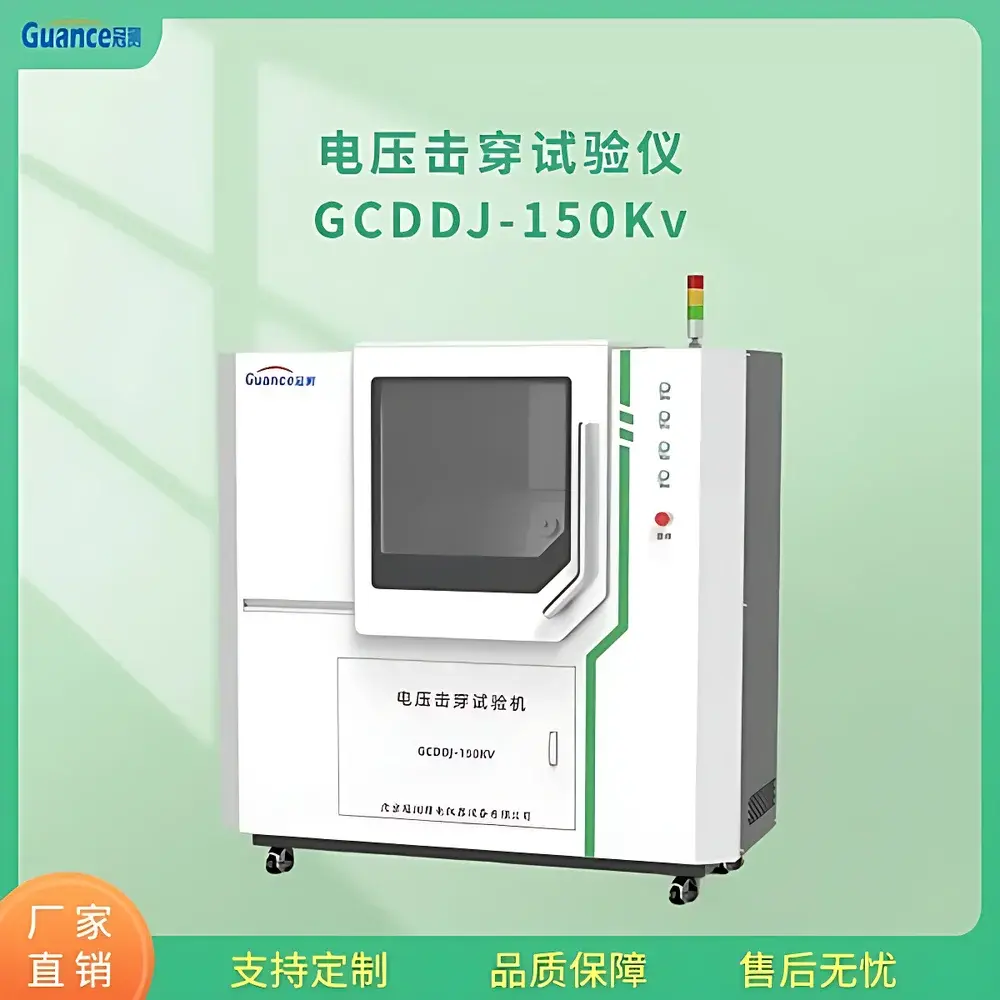
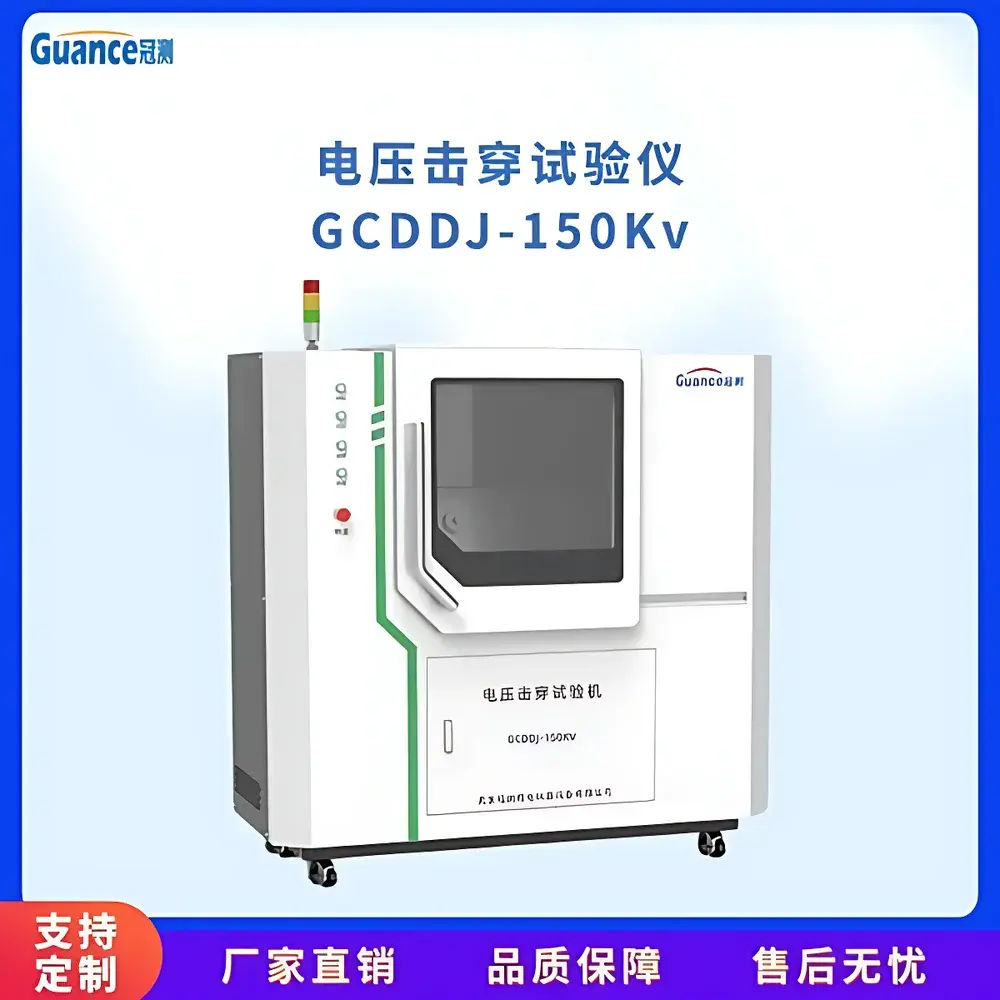
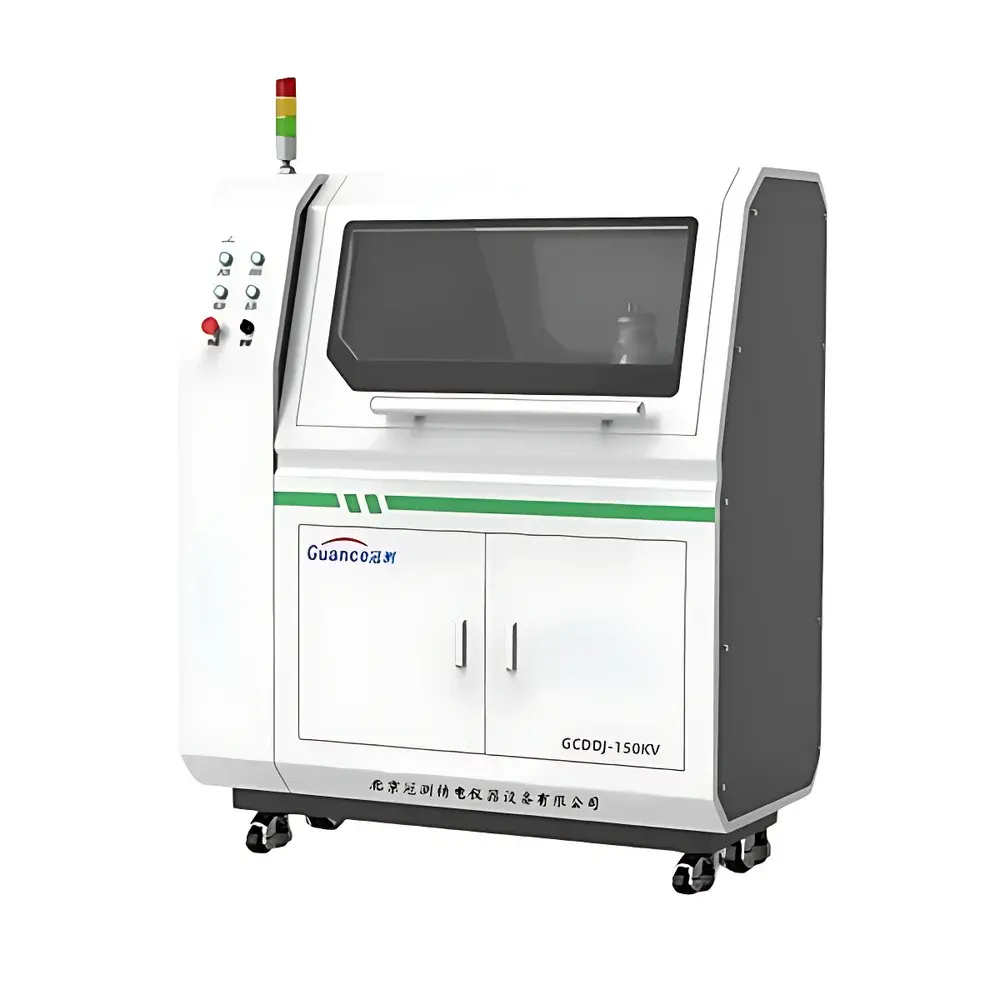
GuanCe Instruments GCDDJ-150kV Voltage Breakdown Tester
| Brand | GuanCe Instruments |
|---|---|
| Origin | Beijing, China |
| Manufacturer Type | Authorized Distributor |
| Country of Origin | China |
| Model | GCDDJ-150kV |
| Breakdown Voltage Range | 0–150 kV (AC/DC) |
| Compliance Standards | GB/T 1408.1–2006, GB/T 1695–2005, GB/T 3333–1999, HG/T 3330–2003, GB/T 12656–1990, ASTM D149–2022 |
| Control Architecture | Siemens S7-1200 PLC with optical-isolated PC communication |
| Data Acquisition | High-precision voltage/current sensors + Siemens digital I/O modules |
| Software Platform | Windows-based GUI with real-time curve plotting, configurable test protocols, and Excel export |
Overview
The GuanCe Instruments GCDDJ-150kV Voltage Breakdown Tester is an engineered solution for determining the dielectric strength and withstand voltage performance of solid insulating materials under standardized AC or DC voltage stress. Operating on the principle of controlled voltage ramping until electrical breakdown occurs—defined as the irreversible loss of insulating integrity—the instrument measures the peak voltage at which a conductive path forms across the specimen under defined electrode geometry, environmental conditions, and voltage application rate. Designed in strict accordance with international and national standards—including ASTM D149, GB/T 1408.1, and IEC 60243-1—the system delivers repeatable, traceable, and auditable results suitable for quality control laboratories, R&D departments, and third-party certification testing facilities engaged in polymer, elastomer, ceramic, composite, and electrical insulation component evaluation.
Key Features
- Full-range programmable DC/AC output up to 150 kV with adjustable ramp rates from 0.1 kV/s to 5.0 kV/s (stepless control)
- Dual-mode operation: dielectric breakdown voltage measurement, dielectric withstand (hi-pot) testing, and stepwise voltage gradient testing
- Siemens S7-1200 PLC-based control architecture ensures deterministic timing, electromagnetic immunity, and long-term operational stability
- Optically isolated communication interface between PC and high-voltage control unit eliminates ground-loop interference and signal corruption
- Real-time synchronized acquisition of voltage, leakage current, and time-stamped event markers (e.g., breakdown detection, arc initiation)
- Integrated safety interlocks including door position sensing, automatic zero-voltage reset, overvoltage cutoff, and emergency stop circuitry compliant with EN 61010-1
- Modular high-voltage generation subsystem featuring oil-immersed transformer, EMI-suppressed wiring, and thermal overload protection
Sample Compatibility & Compliance
The GCDDJ-150kV supports standardized electrode configurations per ASTM D149 (disk electrodes), GB/T 1408.1 (sphere-sphere, sphere-plane, or parallel-plate), and IEC 60243-2 (for thin films). Compatible specimens include thermoplastics (e.g., PE, PP, PTFE), thermosets (epoxy, phenolic), elastomers (silicone rubber, EPDM), ceramics (alumina, porcelain), glass, mica tapes, insulating varnishes, capacitor papers, cable papers, and laminated composites. All test procedures adhere to GLP-aligned documentation practices, supporting audit-ready data trails. The system meets requirements for ISO/IEC 17025-accredited laboratories when operated with calibrated transducers, documented SOPs, and periodic verification per JJG 1085–2013 (Chinese metrological verification regulation for high-voltage testers).
Software & Data Management
The Windows-native software provides a validated, user-configurable interface for test definition, execution, and reporting. It supports multi-standard test templates (e.g., “GB/T 1408 AC Ramp”, “ASTM D149 DC Withstand”), parameter locking for operator-defined limits, and dynamic dual-axis plotting of voltage vs. time and leakage current vs. time. All raw data—including timestamps, sensor outputs, and system status flags—are stored in binary-encoded .dat files with embedded metadata (operator ID, sample ID, ambient temperature/humidity, electrode type). Export functions generate ANSI-compliant CSV or Microsoft Excel (.xlsx) files for statistical analysis. Reports are customizable with company headers, test standard references, pass/fail criteria, and digital signature fields. Audit trail functionality records all user actions, parameter modifications, and calibration events in encrypted logs compliant with FDA 21 CFR Part 11 requirements when deployed on domain-joined systems with role-based access controls.
Applications
This tester serves critical roles in material qualification for power transmission components (insulator housings, bushings), aerospace composites (radome substrates, wire insulation), automotive EV battery pack barriers, medical device encapsulants, and industrial cable manufacturing. It enables comparative screening of batch-to-batch consistency in polymer formulations, aging studies under thermal-humidity preconditioning (when integrated with external climate chambers), and failure mode analysis via post-breakdown surface morphology correlation. In regulatory contexts, data generated supports submissions to CCC (China Compulsory Certification), UL recognition programs, and CE marking under the Low Voltage Directive (2014/35/EU), provided full traceability and uncertainty budgets are maintained per ISO/IEC 17025 Clause 7.7.
FAQ
What voltage accuracy and resolution does the GCDDJ-150kV achieve?
Voltage measurement uncertainty is ≤ ±1.5% of reading (k = 2) across the full 0–150 kV range, verified annually using NIST-traceable high-voltage dividers.
Can the system perform both AC and DC breakdown tests without hardware reconfiguration?
Yes—dual-mode HV generator and auto-switching output stage enable seamless transition between AC (50/60 Hz) and DC polarity modes within the same test sequence.
Is the software compatible with Windows 10/11 64-bit and networked laboratory environments?
Yes; the application supports domain authentication, remote desktop session compatibility, and centralized log file storage on UNC paths or NAS devices.
Does the system support elevated temperature testing?
The base configuration includes ambient-temperature test fixtures; optional high-temperature electrode holders (up to 200 °C) and silicone oil bath accessories are available upon request.
How is calibration and traceability maintained?
Calibration certificates reference CNAS-accredited laboratories (ID: CNAS LXXXXX) and include uncertainty budgets per ISO/IEC 17025. Annual recalibration is recommended, with internal verification checks supported by built-in self-test routines.



