
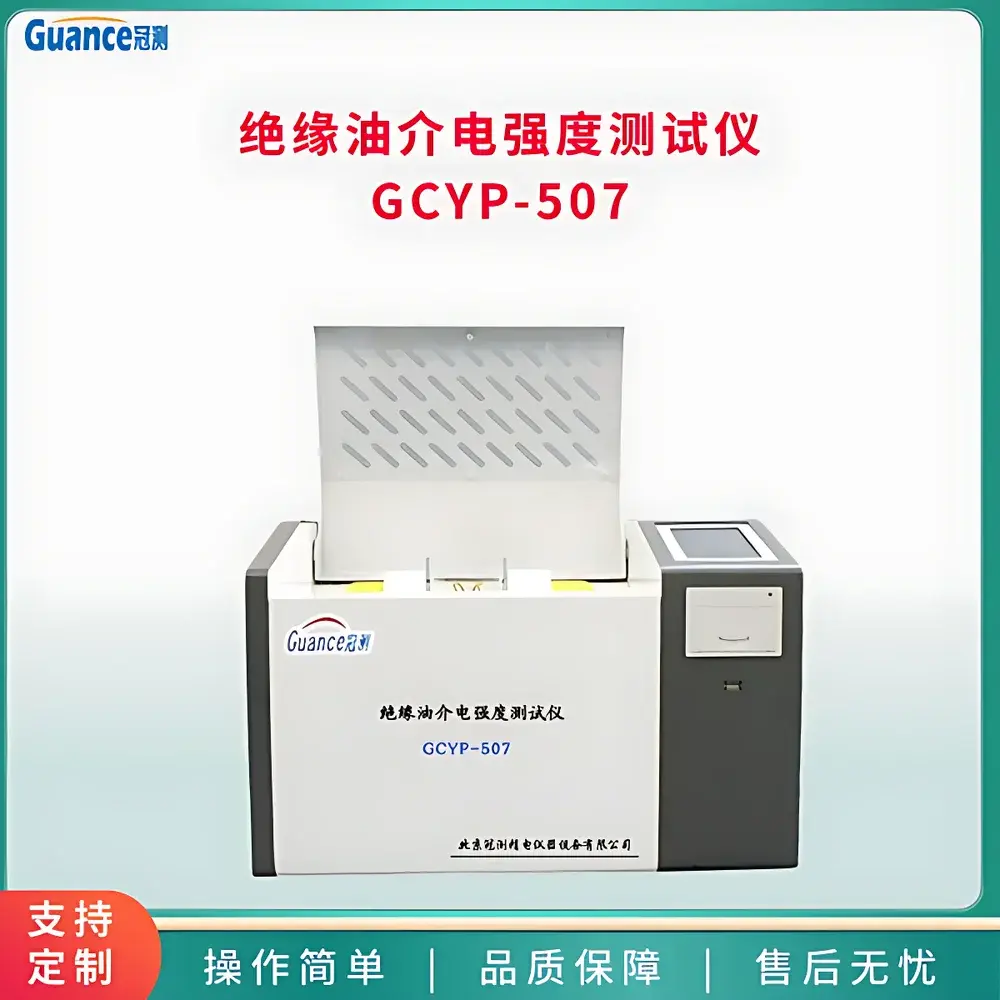
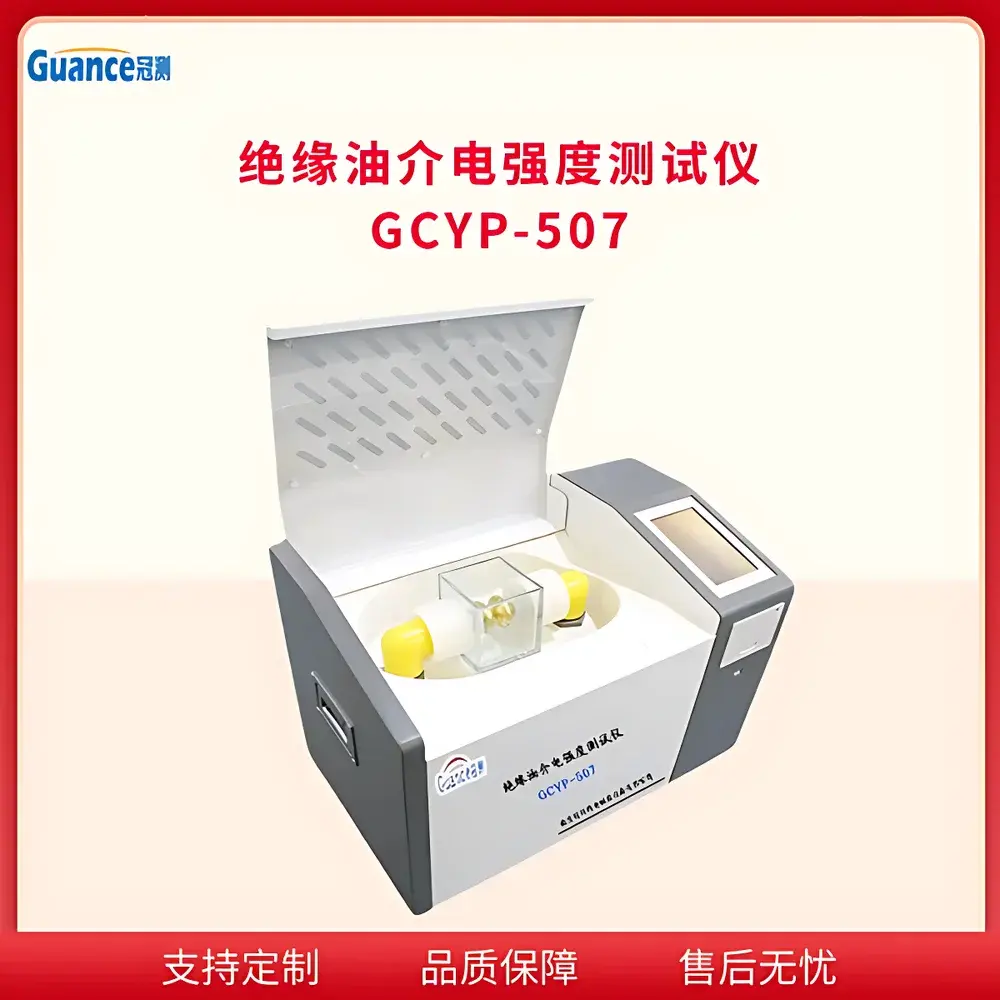
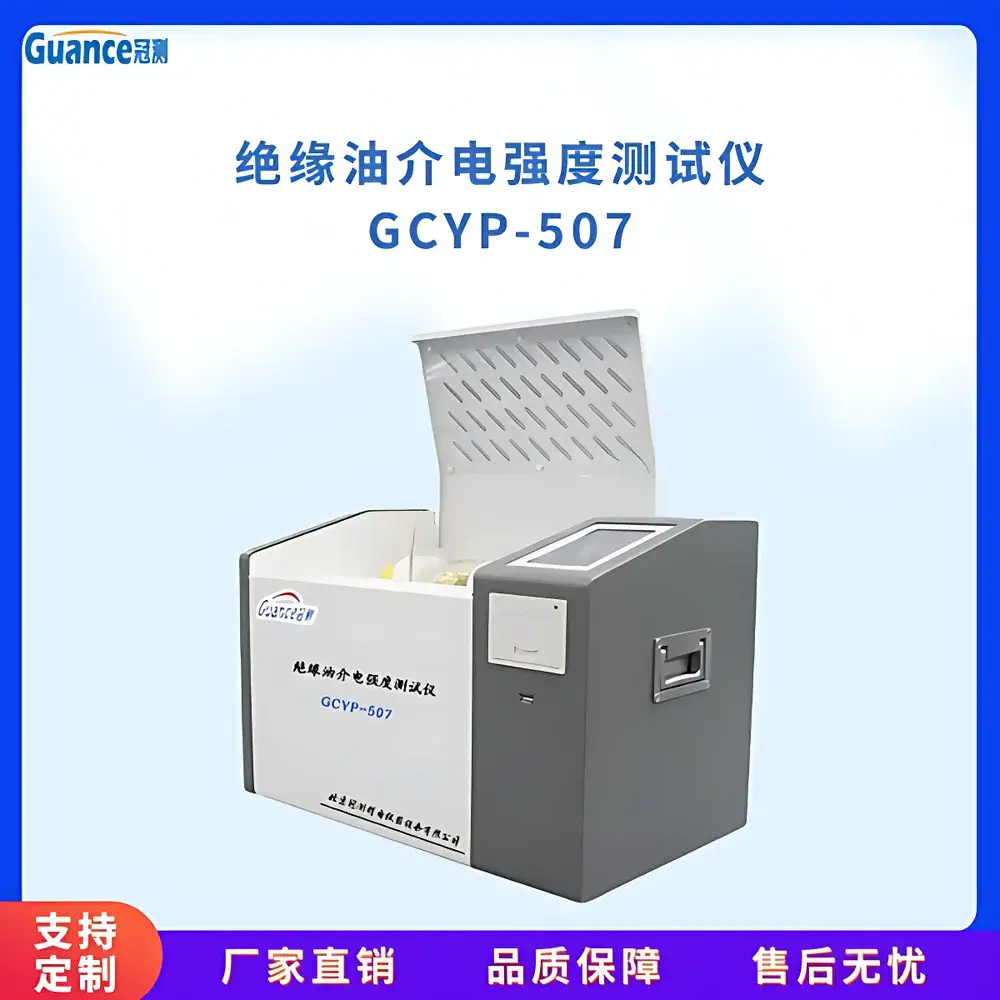
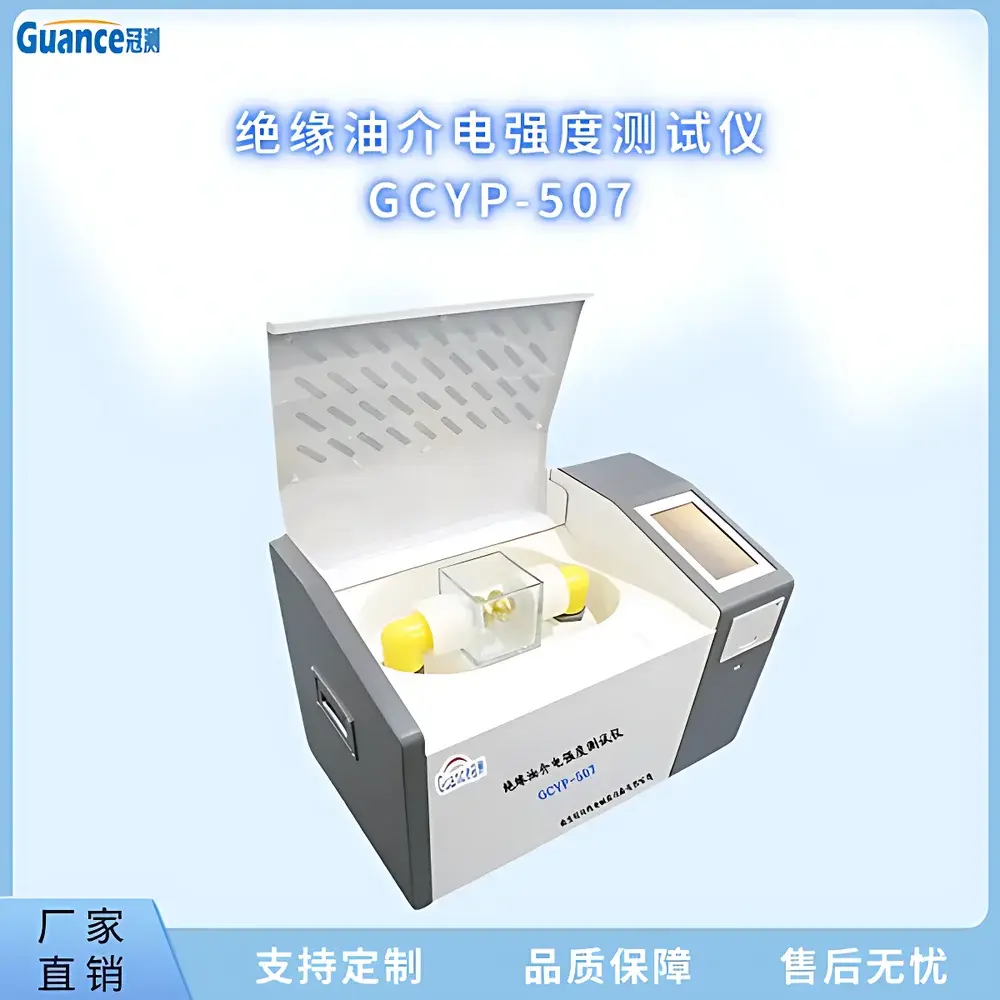
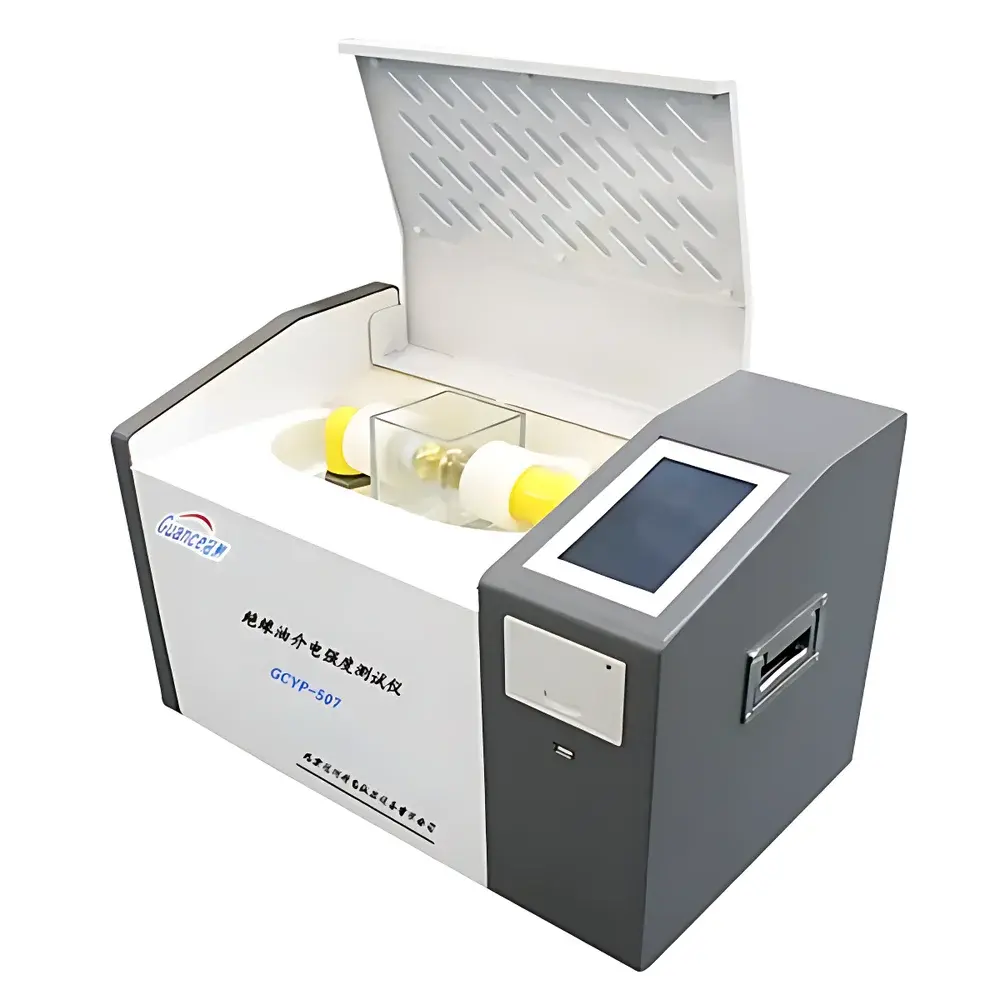
Guance GCYP-507 Insulating Oil Dielectric Strength Tester
| Brand | Guance Instruments |
|---|---|
| Origin | Beijing, China |
| Manufacturer Type | Authorized Distributor |
| Country of Origin | China |
| Model | GCYP-507 |
| Breakdown Voltage Range | 0–100 kV |
| Compliance Standards | GB/T 507–1986, GB/T 507–2002, DL 429.9, IEC 60156 |
| Communication Interface | RS-232 |
| Display Language | Switchable English/Chinese |
| Environmental Monitoring | Integrated Temperature & Humidity Display, Optional Infrared Oil Temperature Sensor |
| Protection Features | Overcurrent, Overvoltage, Short-Circuit, Watchdog Circuit |
| Measurement Architecture | High-Voltage Direct Sampling to ADC, Digital Microprocessor Control |
Overview
The Guance GCYP-507 Insulating Oil Dielectric Strength Tester is a fully digital, microprocessor-controlled instrument engineered for precise determination of the dielectric breakdown voltage (BDV) of transformer oils, turbine oils, and other insulating liquids used in high-voltage power equipment. Based on the principle of stepwise voltage ramping under standardized electrode geometry and oil conditioning protocols, the GCYP-507 complies with internationally recognized test methodologies—including IEC 60156 (formerly IEC 156), ASTM D877 and D1816 (for comparative context), GB/T 507–2002, and DL 429.9—ensuring measurement traceability and interlaboratory reproducibility. Its design prioritizes operational safety, signal integrity, and long-term stability in industrial laboratory and substation maintenance environments. The system applies a controlled AC voltage (50 Hz or 60 Hz selectable) across a standardized spherical-electrode test cell filled with conditioned oil, automatically detecting the onset of disruptive discharge and recording the corresponding breakdown voltage. All timing, voltage ramp rate, hold duration, and post-breakdown recovery are governed by firmware aligned with standard-defined test sequences.
Key Features
- Digital microcontroller architecture with embedded watchdog circuitry ensures continuous system uptime and eliminates software lockup under electromagnetic stress.
- Direct high-voltage sampling at the electrode terminals—prior to analog signal conditioning—minimizes path-induced error and improves A/D conversion fidelity for breakdown detection.
- Integrated environmental monitoring module displays ambient temperature and relative humidity in real time; optional infrared non-contact oil temperature sensor enables correlation of BDV with thermal state per IEC 60156 Annex B recommendations.
- Multi-standard firmware support: preloaded test routines for GB/T 507–1986 (step-up method), GB/T 507–2002 (staged ramp with dwell), DL 429.9 (Chinese utility specification), and IEC 60156 (standardized 2-kV/s ramp with six breakdown iterations).
- Corrosion-resistant test cell constructed from borosilicate glass and chemically inert polymer components; precision-ground stainless-steel electrodes conform to IEC 60156 dimensional tolerances (diameter: 25 mm ± 0.1 mm, gap: 2.5 mm ± 0.1 mm).
- Comprehensive hardware protection suite: current-limiting circuitry, dynamic overvoltage clamping, automatic arc quenching, and short-circuit self-diagnostic during idle and test phases.
- RS-232 serial interface supports bidirectional data exchange with LIMS or QA databases; compatible with Windows-based configuration utilities for test parameter logging and report export (CSV/Excel-ready format).
- Bilingual UI (English/Chinese) configurable via front-panel menu—no firmware reflash required—supporting multilingual technical staff in regional substations and ISO 17025-accredited labs.
Sample Compatibility & Compliance
The GCYP-507 is validated for use with mineral-based insulating oils (naphthenic and paraffinic), synthetic esters, and silicone fluids meeting IEC 60296 specifications. Sample volume requirement is 300–400 mL per test sequence. The instrument’s electrical safety design conforms to IEC 61010-1:2010 (Measurement Category CAT II, Pollution Degree 2), while its electromagnetic compatibility meets IEC 61326-1:2020 (industrial environment, immunity level 3). Test reports generated include operator ID, sample ID, ambient conditions, electrode cleaning timestamp, number of breakdowns, individual BDV values, mean BDV, and standard deviation—structured to satisfy internal QA documentation requirements and external audits per ISO/IEC 17025 clause 7.8.2.
Software & Data Management
Firmware v3.2 includes onboard statistical analysis: automatic calculation of mean breakdown voltage, standard deviation, coefficient of variation, and pass/fail evaluation against user-defined thresholds (e.g., ≥30 kV for new oil per IEEE C57.106). Raw test logs are timestamped with millisecond resolution and stored in non-volatile memory (1,000-test capacity). RS-232 communication supports ASCII protocol with configurable baud rate (9600–115200 bps); data packets include header checksum, test ID, six BDV readings, environmental readings, and pass/fail flag. Integration with laboratory information management systems (LIMS) is achievable via custom scripting or third-party middleware compliant with ASTM E1384 and ISO/IEC 11179 metadata standards. Audit trail functionality records all parameter changes, calibration events, and user logins—aligned with GLP and FDA 21 CFR Part 11 expectations when paired with appropriate access controls.
Applications
- Routine quality control of unused insulating oil prior to transformer filling (per IEC 60296 and GB 2536).
- Condition monitoring of in-service transformer oil during preventive maintenance cycles (DL/T 596, IEEE C57.104).
- Acceptance testing of reclaimed or reconditioned oils following vacuum dehydration and filtration.
- Research and development of alternative insulating fluids, including bio-based esters and nanofluids, where comparative BDV assessment is required.
- Training and certification of high-voltage lab technicians under national grid competency frameworks.
FAQ
What electrode configuration does the GCYP-507 use, and is it interchangeable with other standards?
The instrument employs a fixed 2.5-mm gap, 25-mm diameter spherical electrode pair per IEC 60156. Electrodes are not user-replaceable but are factory-calibrated and certified; replacement kits (including alignment jig and calibration certificate) are available under part number GCYP-507-EL-KIT.
Does the GCYP-507 support automated oil stirring or degassing?
No—manual sample preparation (filtration, settling, and optional vacuum degassing per IEC 60156 Section 6.2) is required prior to loading. The instrument does not integrate mechanical agitation or vacuum subsystems.
Can test results be exported directly to Excel without proprietary software?
Yes—RS-232 output is plain-text ASCII with tab-delimited fields; any terminal emulator or Python/PowerShell script can parse and convert logs to .csv for direct Excel import.
Is firmware upgrade possible in the field, and what is the update process?
Firmware updates are distributed as signed .hex files via secure download portal; installation requires connection to a Windows PC running the Guance Configuration Utility v2.4+, with USB-to-serial adapter (included). No hardware modification is needed.
What is the recommended calibration interval, and which parameters are traceable?
Annual calibration is advised. Voltage accuracy (±2% of reading from 10–100 kV) and timing resolution (±10 ms) are traceable to CNAS-accredited national metrology institutes via external high-voltage divider and time-base calibrator. Certificate includes as-found/as-left data and uncertainty budget.



