
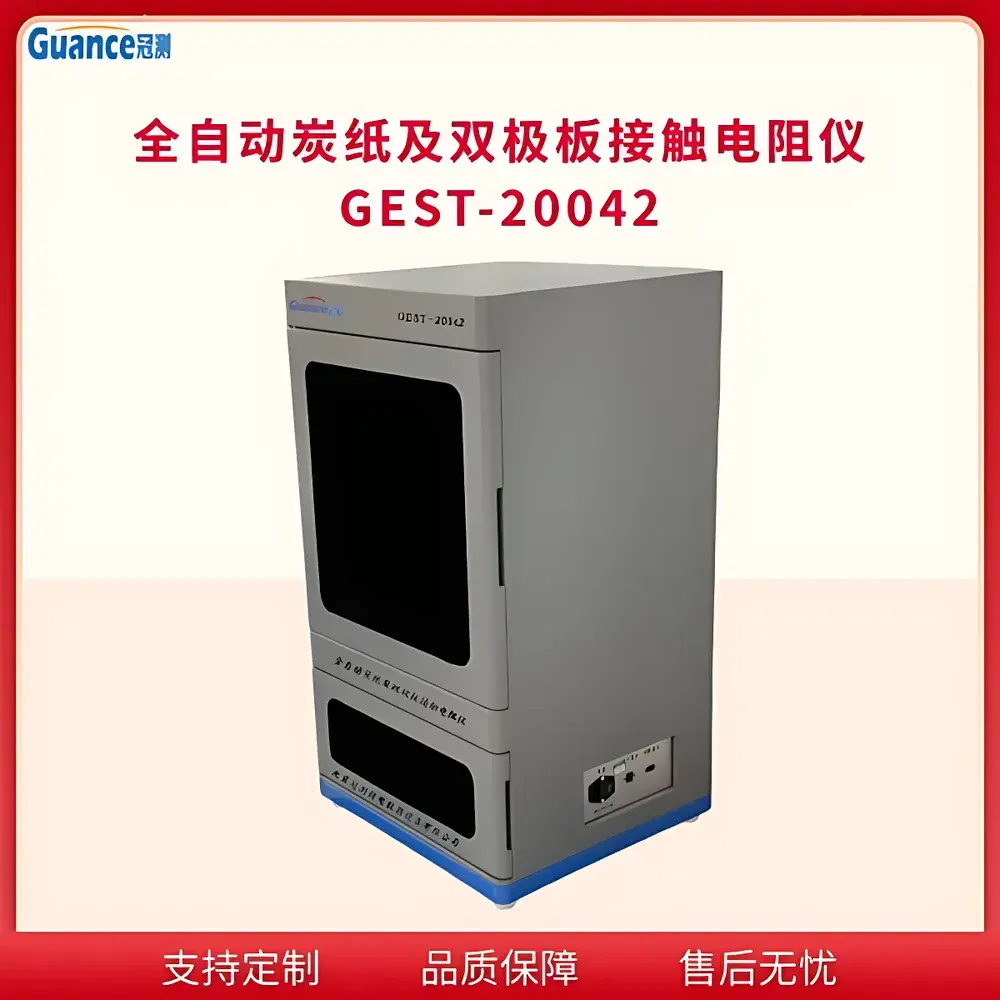
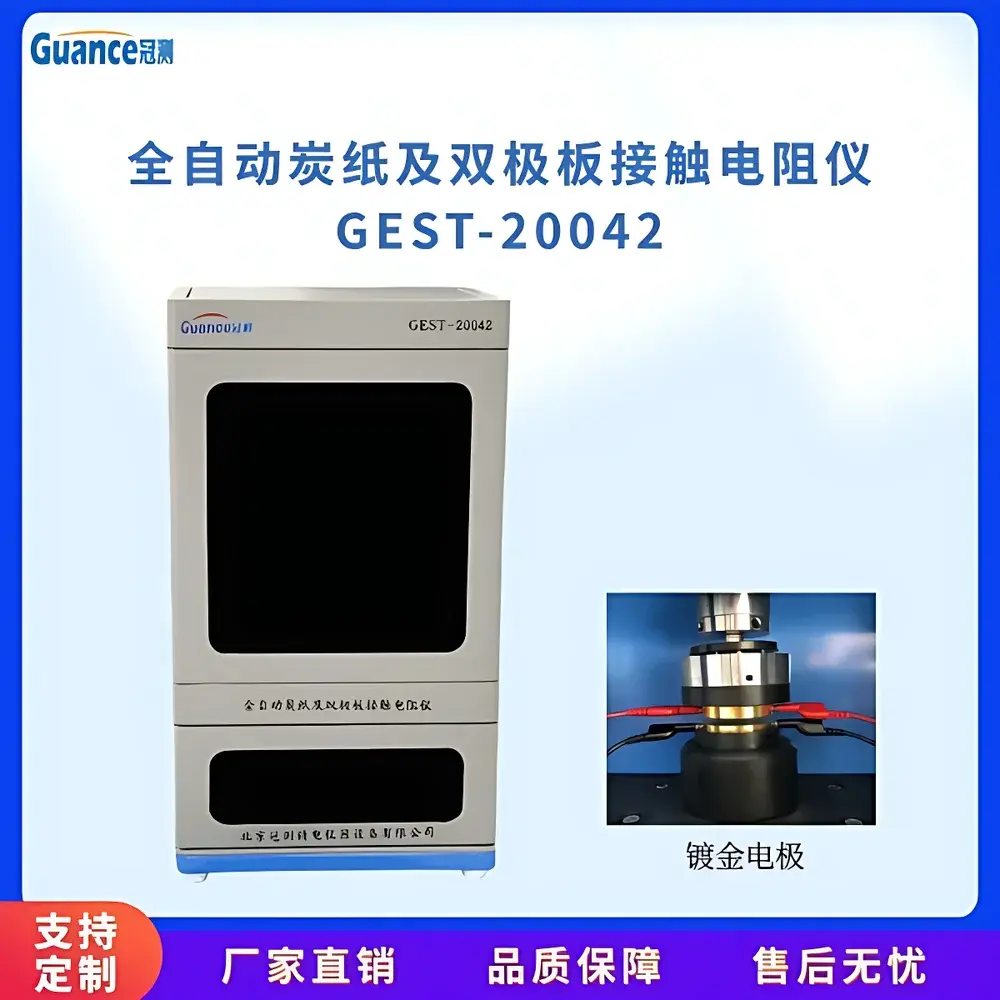
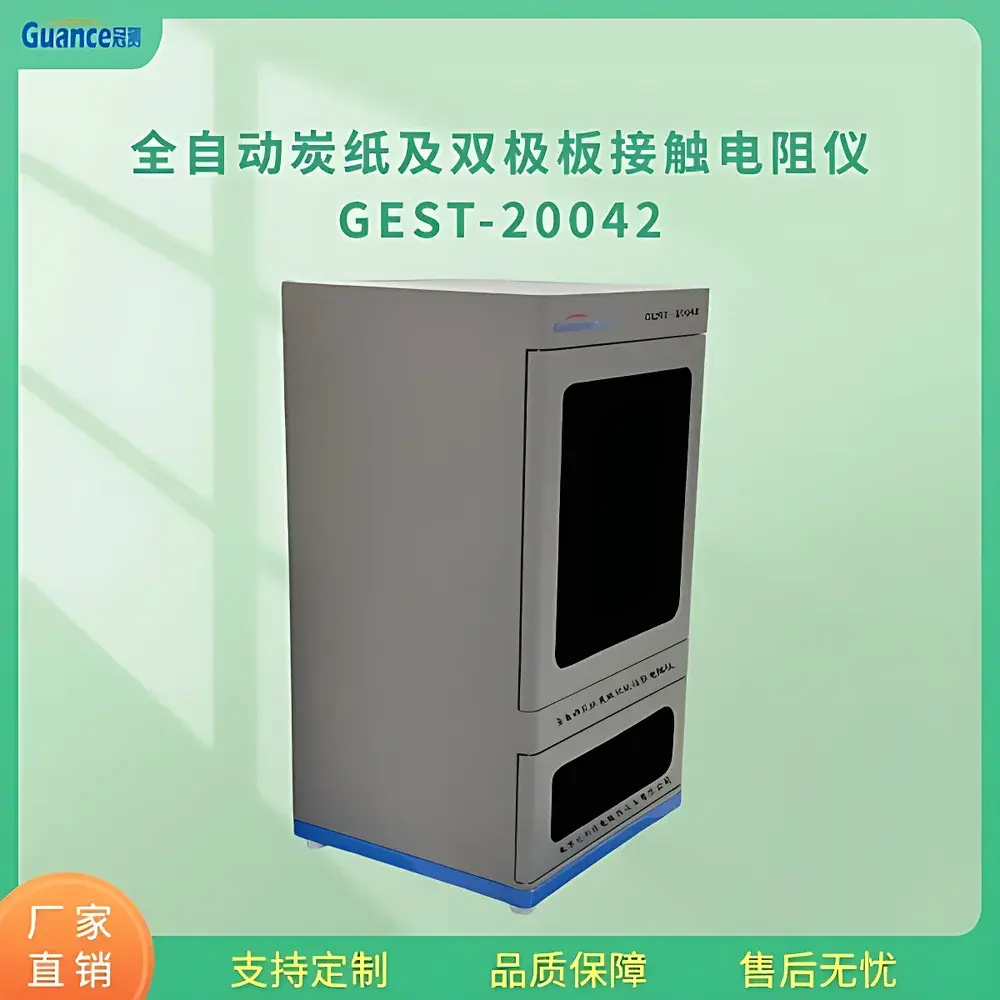
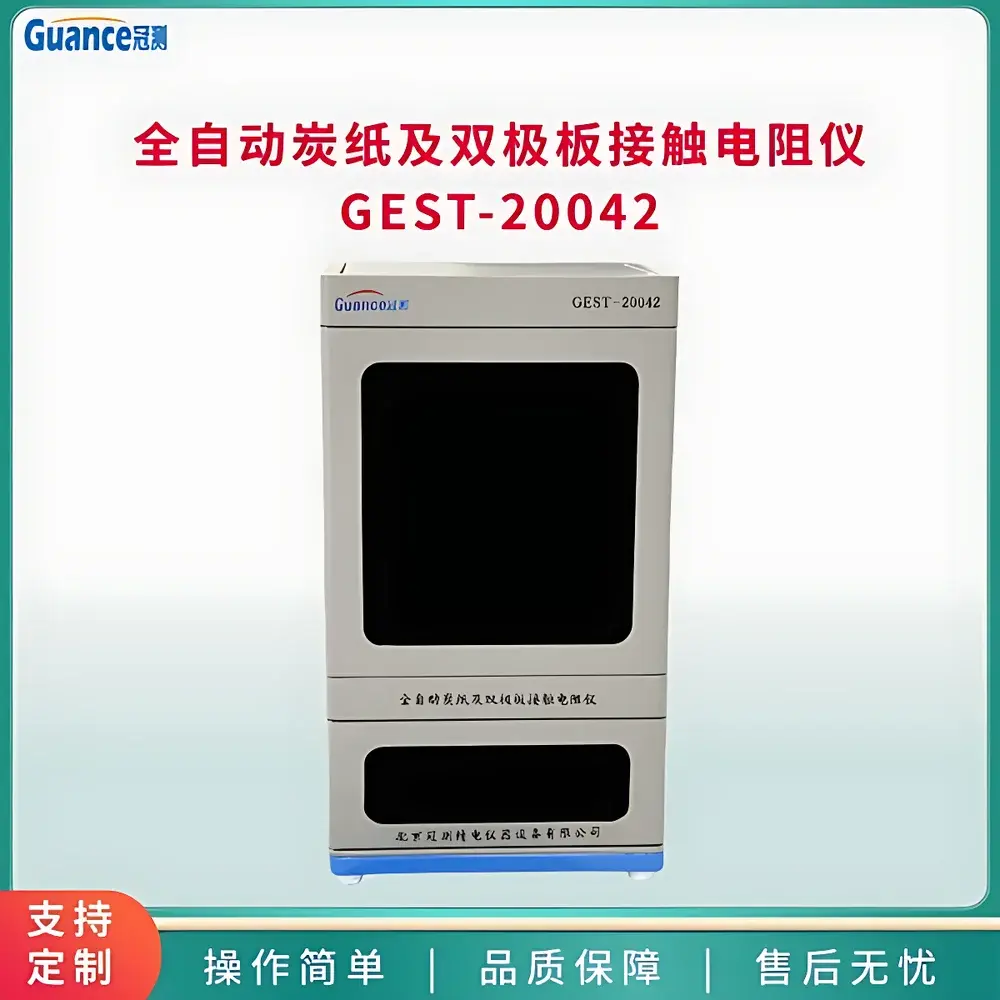
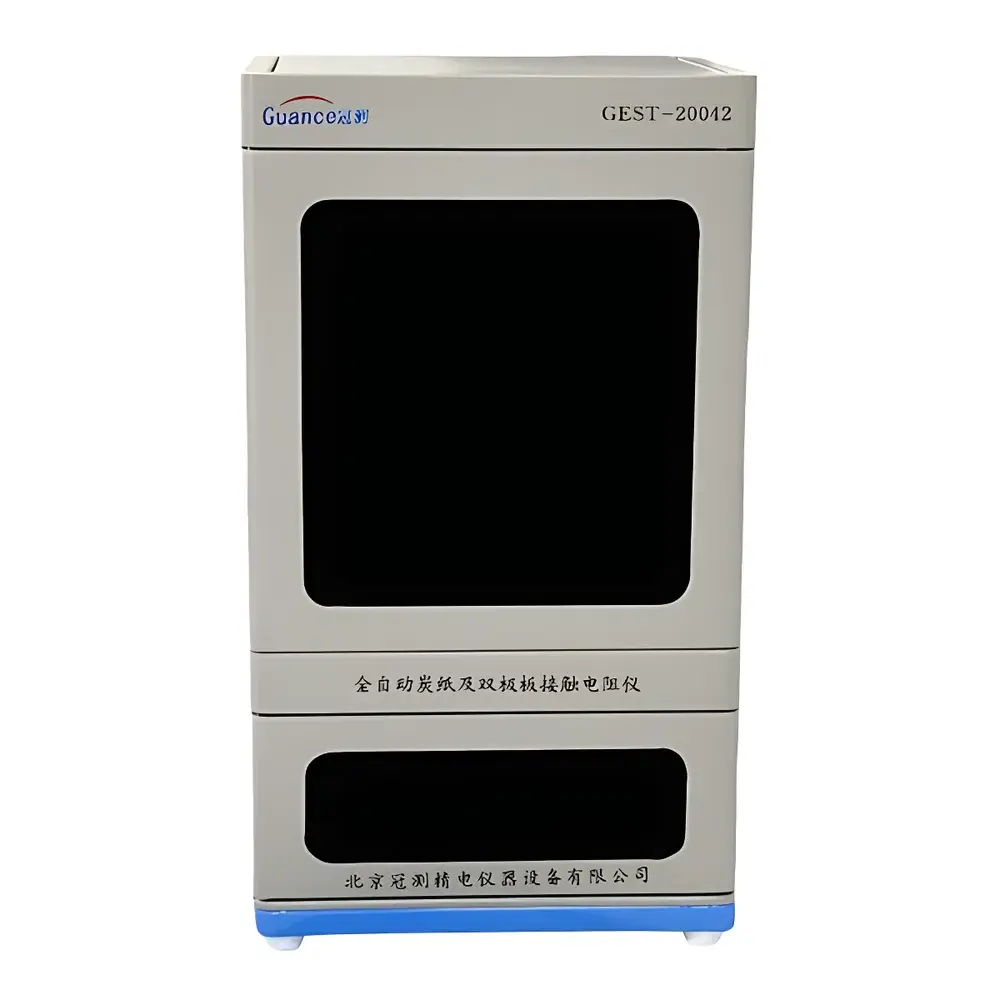
GuanCe GEST-20042 Fully Automated Carbon Paper and Bipolar Plate Contact Resistance Tester
| Brand | GuanCe Instruments |
|---|---|
| Origin | Beijing, China |
| Manufacturer Type | Authorized Distributor |
| Origin Category | Domestic (China) |
| Model | GEST-20042 |
| Price | USD 1,400 (FOB Beijing) |
Overview
The GuanCe GEST-20042 Fully Automated Carbon Paper and Bipolar Plate Contact Resistance Tester is an engineered metrology system designed specifically for the quantitative evaluation of interfacial electrical contact resistance (ICR) in proton exchange membrane fuel cell (PEMFC) components. It operates on the fundamental principle of four-point probe (for in-plane resistivity) and two-point compression-based measurement (for through-plane resistivity), enabling precise separation of bulk material resistivity from contact interface resistance under controlled mechanical loading. The instrument applies calibrated normal force via a servo-driven loading actuator, simulating realistic stack compression conditions encountered during PEMFC operation. Real-time synchronization of mechanical parameters—load, displacement, pressure, and compression ratio—with simultaneous electrical measurements (voltage, current, resistance, resistivity, conductivity) ensures traceable, repeatable characterization compliant with international PEMFC component qualification protocols.
Key Features
- Fully automated test sequence: load application, data acquisition, result calculation, and return-to-zero—all executed without manual intervention
- Dual-mode electrical measurement architecture: four-probe configuration for in-plane (horizontal) resistivity; two-probe compression electrode setup for through-plane (vertical) contact resistance
- Servo-controlled loading system delivering precise, noiseless, continuous force application from 0.1 N to 5,000 N (adjustable range), with closed-loop feedback for pressure stability ±0.5% FS
- Gold-plated 50 mm diameter circular electrodes ensuring low-contact-resistance interfaces and long-term corrosion resistance during repeated testing cycles
- 10-inch industrial-grade capacitive touchscreen HMI with embedded real-time visualization of 12 concurrent parameters: applied load (N), pressure (MPa), sample thickness (µm), compression ratio (%), voltage (mV), current (mA), resistance (Ω), resistivity (Ω·cm), conductivity (S/cm), and derived ICR (mΩ·cm²)
- Multi-mode test protocols: constant-force, constant-pressure, stepwise gradient-force, stepwise gradient-pressure, and fixed-compression-ratio modes
- Automated multi-step gradient testing with built-in comparative analytics: automatic delta-resistance calculation between adjacent load steps and percentage change reporting
Sample Compatibility & Compliance
The GEST-20042 accommodates standard PEMFC component geometries: carbon fiber paper (20–300 µm thickness), microporous layer (MPL)-coated substrates, graphite-based and metal-composite bipolar plates (up to 3 mm thickness, 100 × 100 mm max footprint). Sample clamping is non-destructive and maintains edge integrity for post-test microscopy or further electrochemical analysis. The instrument conforms to the test methodology requirements defined in GB/T 20042.7–2014 (“Proton Exchange Membrane Fuel Cells — Part 7: Test Methods for Carbon Paper”) and GB/T 20042.6–2011 (“Part 6: Test Methods for Bipolar Plates”). While not certified to ISO/IEC 17025, its measurement traceability supports internal laboratory validation per GLP principles and serves as a qualified tool for pre-qualification screening prior to third-party certification per ASTM D374, IEC 62282-2, or USCAR-12.
Software & Data Management
Embedded firmware enables local data storage (≥10,000 test records) with timestamped metadata (operator ID, sample ID, environmental temperature/humidity if externally logged). All raw and processed data export directly to CSV or Excel-compatible formats via USB 2.0 port. The system supports over-the-air firmware updates via secure HTTPS connection. Audit trail functionality logs all user actions—including parameter changes, calibration events, and report generation—with immutable timestamps. While not FDA 21 CFR Part 11 compliant out-of-the-box, the software architecture permits integration with validated LIMS environments where electronic signatures and role-based access control are enforced at the enterprise level.
Applications
- Quality control of carbon paper batches across porosity, graphitization degree, and surface treatment uniformity
- Evaluation of interfacial degradation mechanisms under cyclic compression (e.g., creep, fiber breakage, MPL delamination)
- Comparative assessment of hydrophobic/hydrophilic coatings on bipolar plates for corrosion resistance vs. contact resistance trade-offs
- Development of novel composite bipolar plates (stainless steel, titanium, coated graphite) requiring high conductivity and low interfacial impedance
- Supporting DOE targets for <10 mΩ·cm² through-plane ICR at 1.4 MPa for automotive-grade PEMFC stacks
- Academic research into structure–property relationships linking microstructure (SEM/EDS), mechanical compliance, and electrical transport behavior
FAQ
What standards does the GEST-20042 directly support?
It implements the test procedures specified in GB/T 20042.6–2011 and GB/T 20042.7–2014 for bipolar plate and carbon paper characterization.
Can the instrument measure both in-plane and through-plane resistivity on the same sample?
Yes—via interchangeable electrode configurations: four-probe fixture for in-plane; dual gold-plated compression electrodes for through-plane.
Is calibration traceable to national standards?
Force transducers are factory-calibrated against NIM (National Institute of Metrology, China) reference standards; electrical modules use NIST-traceable shunts and references.
Does the system support custom test protocols beyond the preset modes?
Yes—advanced users may define custom load profiles and measurement intervals via the scripting interface accessible through service mode.
What maintenance is required for long-term accuracy?
Biannual verification of load cell linearity and electrode surface integrity is recommended; gold electrode cleaning with isopropyl alcohol and lint-free wipes after each test series.
Related Products





