
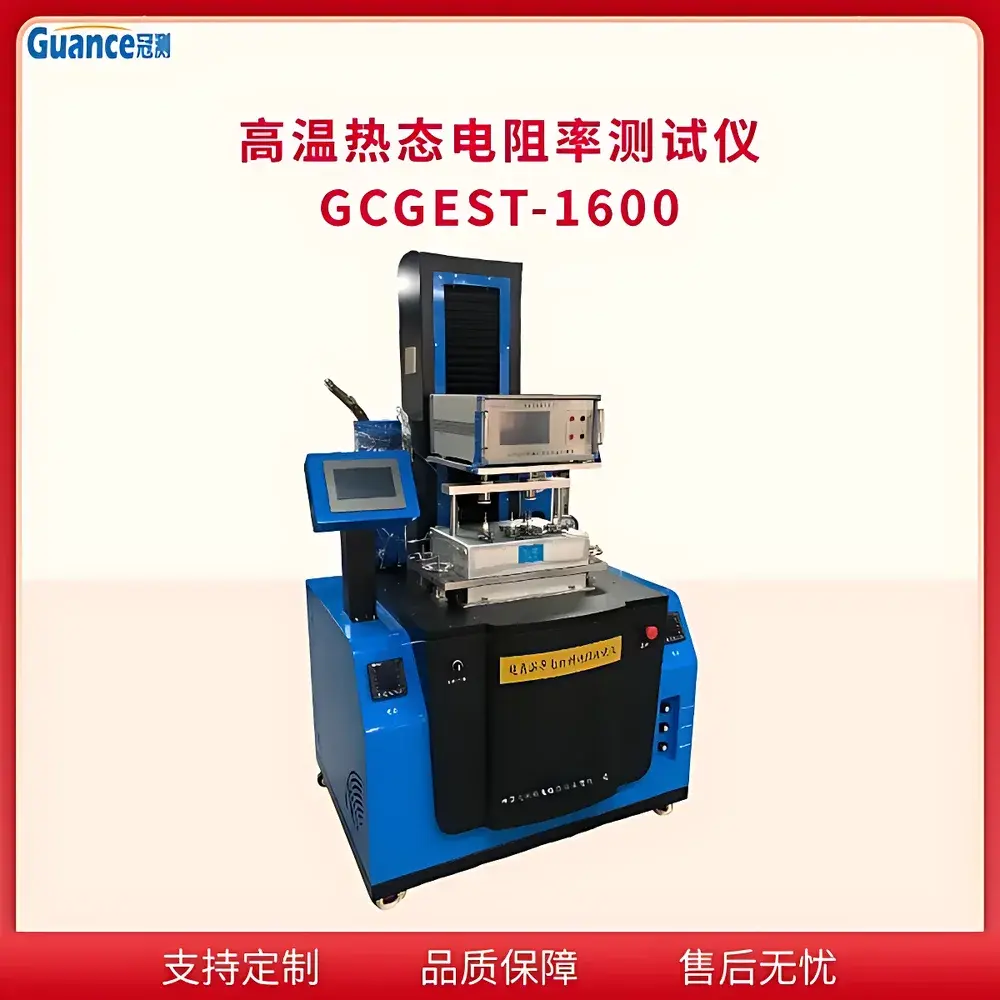
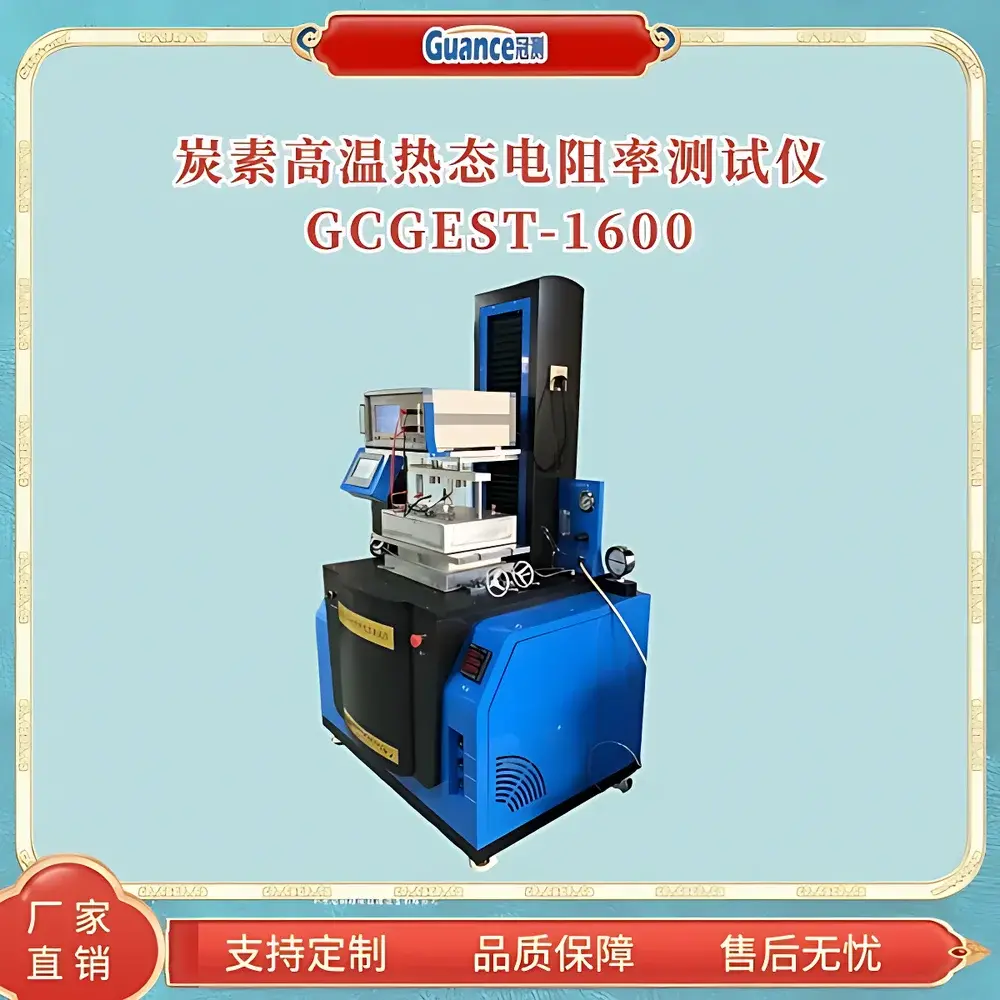
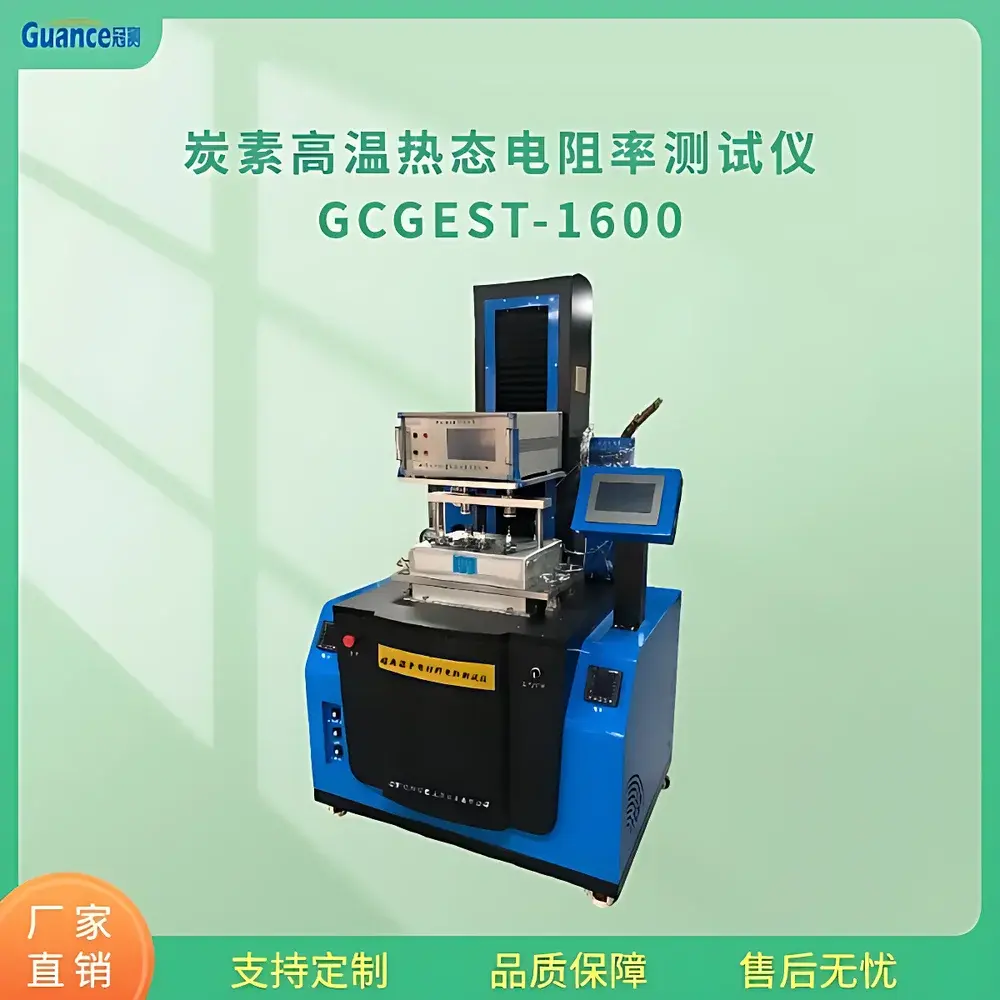
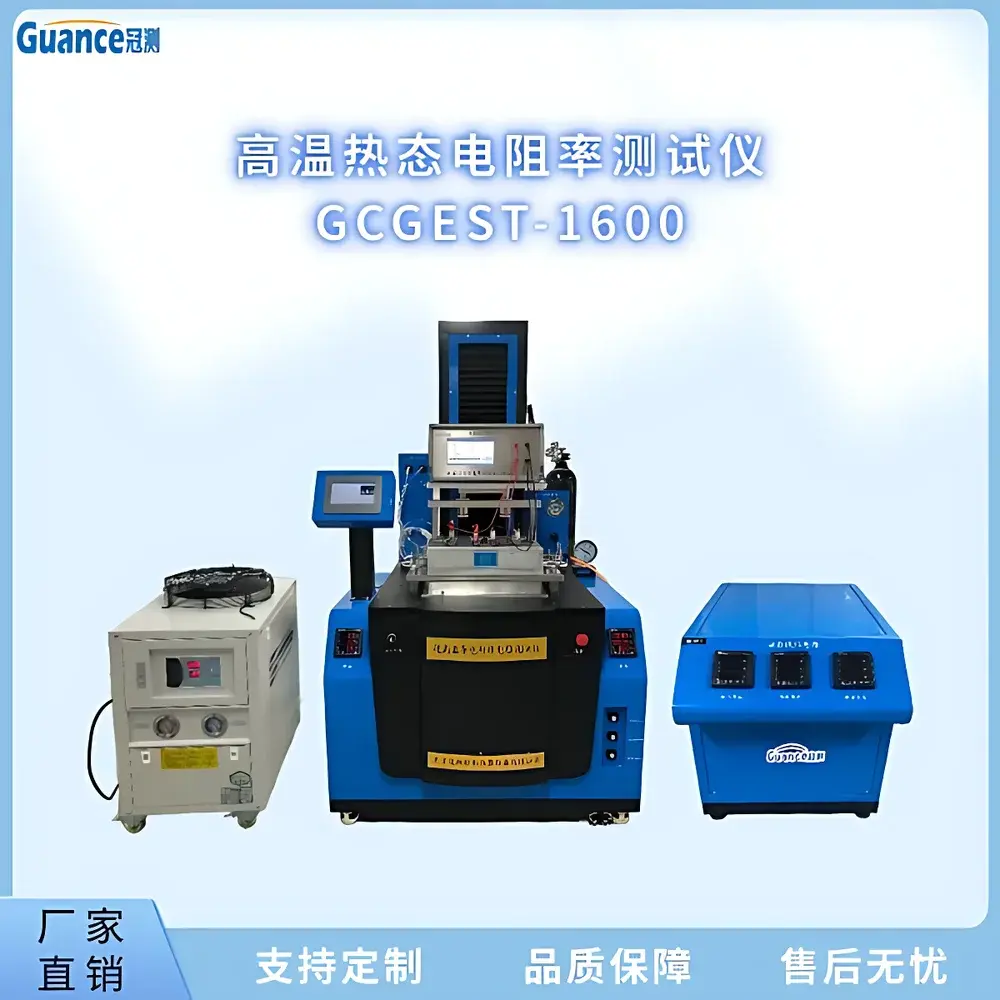
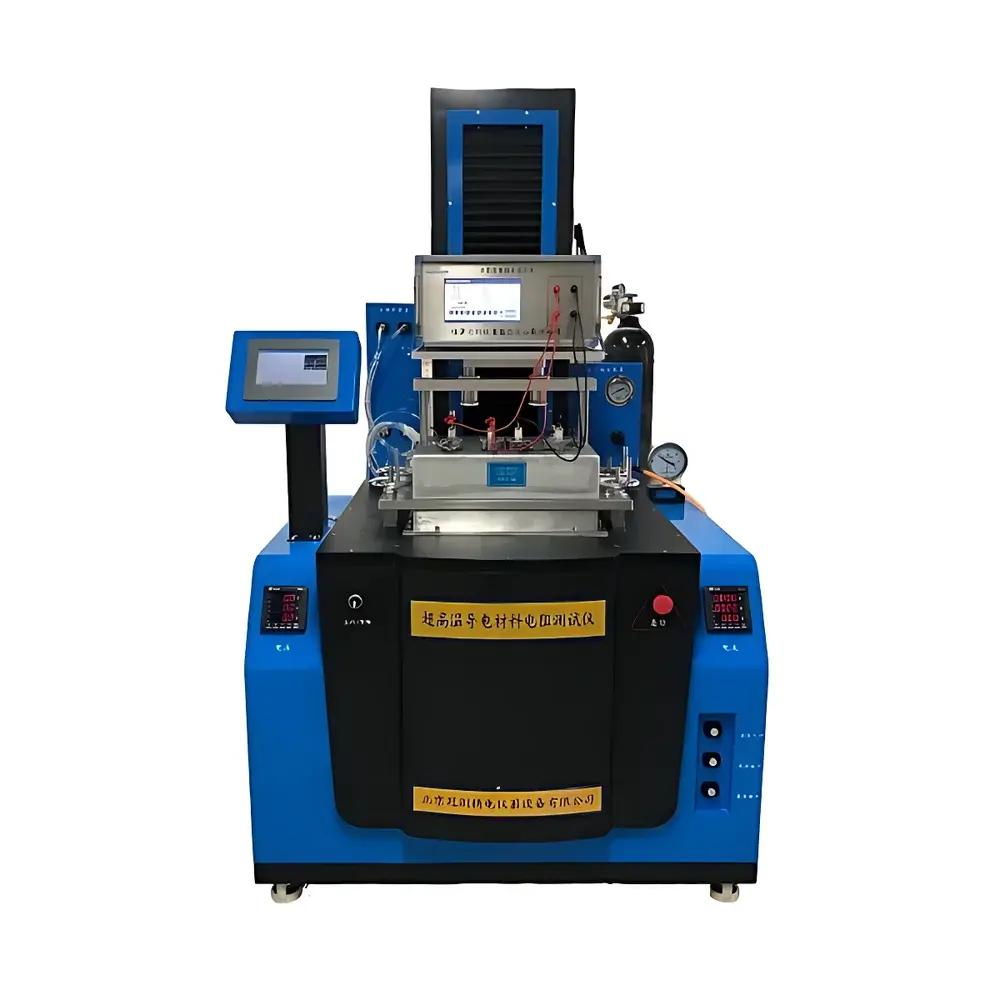
GuanCe High-Temperature Carbon Material Resistivity Tester GCGEST-1600
| Brand | GuanCe Instruments |
|---|---|
| Origin | Beijing, China |
| Manufacturer Type | Authorized Distributor |
| Country of Origin | China |
| Model | GCGEST-1600 |
| Quotation | Available Upon Request |
| Temperature Range | Ambient to 1650 °C |
| Heating Rate | 15 °C/min ±5 °C (adjustable) |
| Temperature Control Accuracy | ±2 °C |
| Atmosphere Control | Vacuum-compatible & gas-purged chamber (N₂, Ar, reducing/oxidizing options) |
| Sample Dimensions | Ø10 mm × 80 mm (cylindrical) |
| Sample Capacity | 1–4 parallel specimens (configurable) |
| Electrode Actuation | Motorized in-situ probe lift mechanism |
| Test Current Range | 10 μA to 10 A (9 discrete steps) |
| Resistivity Measurement Accuracy | ±0.5% of reading |
| Measurement Method | Four-Point Probe (van der Pauw compatible geometry) |
| Compliance Standard | GB/T 24523–2009 (Carbon Materials — Determination of Hot-State Electrical Resistivity) |
Overview
The GuanCe High-Temperature Carbon Material Resistivity Tester GCGEST-1600 is an engineered solution for precise, in-situ electrical resistivity characterization of carbon-based refractory materials under controlled thermal and atmospheric conditions. Designed specifically for the demanding requirements of electrode-grade graphite, carbon composites, silicon carbide precursors, and high-temperature furnace components, this system implements the four-point probe (4PP) method—aligned with the principles of van der Pauw geometry—to eliminate contact resistance errors and deliver traceable, temperature-dependent resistivity data from ambient up to 1650 °C. Unlike conventional room-temperature testers, the GCGEST-1600 integrates a high-stability molybdenum disilicide (MoSi₂) or silicon carbide (SiC) heating element within a dual-zone, water-cooled stainless-steel vacuum chamber capable of achieving pressures down to 10⁻³ Pa and supporting inert (N₂, Ar), reducing (H₂/N₂), or oxidizing (air, O₂) atmospheres. The system operates on a fundamental physical principle: by injecting a known DC current through outer probes while measuring the resulting potential drop across inner probes, resistivity ρ is calculated using geometric correction factors derived from sample dimensions and probe spacing—ensuring compliance with GB/T 24523–2009 and technically harmonized with ASTM D4496 and IEC 62631-3-1.
Key Features
- Programmable thermal profiling: Linear ramp rates from 0.1 to 15 °C/min (±5 °C tolerance), with hold times at up to 10 user-defined setpoints per run
- Motor-driven, pneumatically sealed electrode carriage enabling fully automated probe descent, contact force regulation (0.5–2.0 N range), and retraction post-measurement
- Multi-range constant-current source (10 μA–10 A) with auto-ranging feedback control to maintain current stability within ±0.1% during thermal transients
- High-temperature platinum–rhodium (Pt/Rh) thermocouples (Type S) calibrated per ISO/IEC 17025 accredited procedures, referenced against internal blackbody cavity
- Dual-stage vacuum system (mechanical pump + turbomolecular pump) with digital pressure monitoring and gas mass flow controllers (MFCs) for precise atmosphere composition management
- Modular sample stage accommodating 1–4 cylindrical specimens (Ø10 mm × 80 mm) with independent thermal shielding to minimize inter-sample thermal crosstalk
- Real-time synchronized acquisition of voltage, current, temperature, pressure, and atmosphere composition at 10 Hz sampling rate
Sample Compatibility & Compliance
The GCGEST-1600 supports standardized cylindrical specimens conforming to GB/T 24523–2009 and ASTM C611, including but not limited to isotropic graphite, extruded carbon electrodes, pitch-bonded carbon blocks, carbon–carbon composites, and graphitized petroleum coke. Specimen surfaces require mechanical polishing (Ra ≤ 0.8 µm) and solvent cleaning to ensure reproducible probe contact. The instrument’s architecture meets structural and safety requirements outlined in IEC 61010-1 (Electrical Safety for Laboratory Equipment) and incorporates electromagnetic compatibility (EMC) shielding per EN 61326-1. Data integrity protocols align with GLP and pre-GMP environments: all measurement sessions generate immutable audit trails containing operator ID, calibration timestamps, environmental logs, and raw binary acquisition files—fully compatible with FDA 21 CFR Part 11-compliant LIMS integration when deployed with optional validation packages.
Software & Data Management
Control and analysis are executed via GuanCe’s proprietary GCGEST-Suite v4.2—a Windows-based application built on .NET Framework with deterministic real-time thread scheduling. The interface provides dual-mode operation: guided wizard workflows for routine QC testing and advanced scriptable mode (Python API support) for R&D protocol automation. All resistivity calculations apply automatic geometric correction based on measured specimen diameter and probe pitch. Raw data (voltage, current, T, P, gas flow) are stored in HDF5 format with embedded metadata (CF-1.8 compliant), ensuring long-term readability and interoperability with MATLAB, Python (h5py), and LabVIEW. Export options include CSV (for Excel), PDF reports with embedded plots (resistivity vs. temperature, dρ/dT curves), and XML files structured to ASTM E1447-22 data exchange schema. Calibration records—including probe spacing verification, current source linearity checks, and thermocouple drift logs—are version-controlled and digitally signed.
Applications
- Quality assurance of graphite electrodes used in electric arc furnaces (EAFs) and submerged arc furnaces (SAFs)
- Development of low-resistivity carbon anodes for aluminum smelting (Hall–Héroult process)
- Thermal aging studies of nuclear-grade graphite moderators under simulated reactor conditions
- Resistivity mapping of carbon fiber-reinforced carbon (C/C) composites across sintering cycles
- Correlation of microstructural evolution (grain size, porosity, graphitization degree) with in-situ electrical transport behavior
- Validation of computational models predicting electronic band structure changes in carbon allotropes above 1000 °C
FAQ
What standards does the GCGEST-1600 comply with for high-temperature resistivity measurement?
It is designed and verified per GB/T 24523–2009, with technical alignment to ASTM D4496, IEC 62631-3-1, and ISO 18513 for hot-state electrical characterization of carbonaceous solids.
Can the system operate under reducing atmospheres such as H₂/N₂ mixtures?
Yes—the chamber includes leak-tight gas inlet ports, integrated MFCs, and pressure-regulated exhaust, supporting H₂ concentrations up to 10% in N₂ at temperatures ≤1400 °C.
Is probe-to-sample contact force adjustable?
Yes—motorized actuation allows programmable contact force between 0.5 N and 2.0 N, with real-time load-cell feedback to prevent surface damage on brittle carbon samples.
How is measurement uncertainty quantified across the full temperature range?
Total expanded uncertainty (k=2) is ≤±1.2% for resistivity values between 10⁻⁵ Ω·m and 10⁻² Ω·m, derived from contributions of current source stability, voltage measurement resolution (16-bit ADC, 1 µV LSB), thermocouple calibration, and geometric correction factor sensitivity.
Does the software support automated pass/fail evaluation against specification limits?
Yes—customizable acceptance criteria can be defined per test step; results trigger visual alerts and export flags for statistical process control (SPC) integration.



