
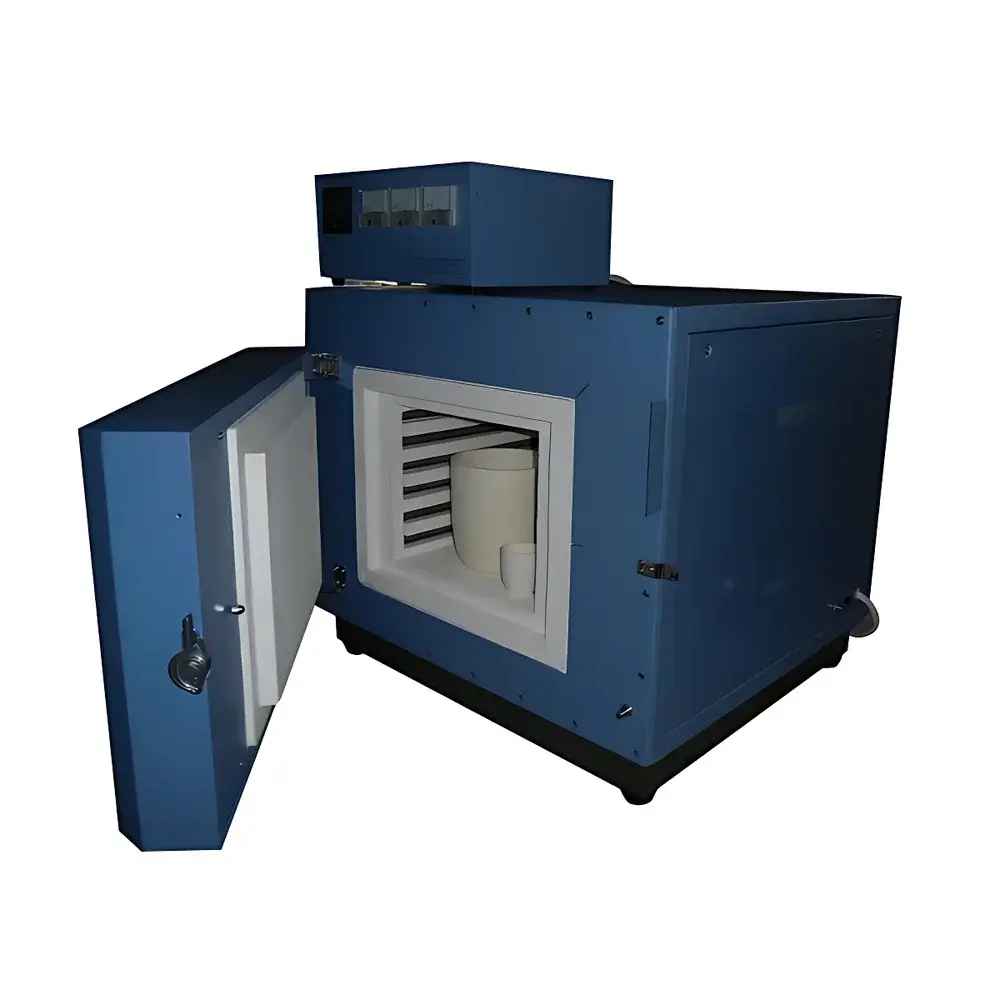
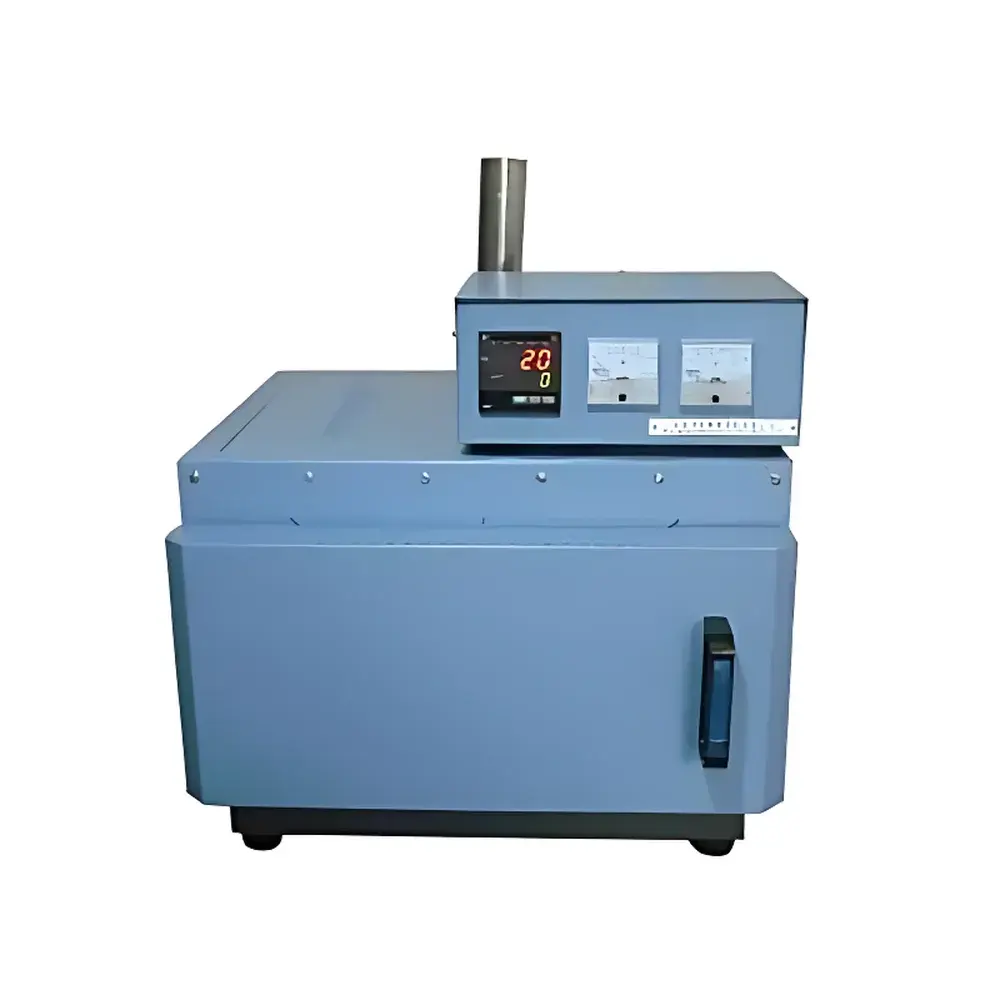
Zhongke Aobo TL2012 High-Temperature Box-Type Muffle Furnace
| Brand | Zhongke Aobo |
|---|---|
| Origin | Beijing, China |
| Model | TL2012 |
| Instrument Type | Box-Type Muffle Furnace |
| Maximum Temperature | 1200 °C |
| Temperature Control Accuracy | ±1 °C |
| Rated Power | 6000 W |
| Heating Rate (to Max Temp) | ≤50 min |
| Heating Element | Resistance Wire |
| Internal Chamber Dimensions | 400 × 250 × 200 mm (W × D × H) |
| Insulation Material | Ceramic Fiber |
| Thermocouple Type | K-Type |
| Control System | PID Programmable Controller |
| Power Supply | 3-Phase 380 V AC, 16 A |
Overview
The Zhongke Aobo TL2012 is a high-performance, laboratory-grade box-type muffle furnace engineered for precise thermal processing in research, quality control, and routine analytical workflows. Operating on the principle of resistive heating within a fully insulated ceramic fiber chamber, it delivers stable, uniform, and contamination-free thermal environments up to 1200 °C—ideal for ashing, calcination, heat treatment, and thermal decomposition applications. Its design adheres to fundamental thermodynamic requirements for reproducible high-temperature exposure: minimal thermal mass, rapid heat transfer, and low external surface temperature during operation. Unlike traditional refractory brick furnaces, the TL2012 employs lightweight, low-conductivity ceramic fiber insulation—reducing energy consumption by over 40% while achieving faster ramp rates and improved thermal stability across the working zone.
Key Features
- Robust ceramic fiber insulation ensures uniform temperature distribution (±2 °C across chamber at 1000 °C) and maintains external casing surface temperature below 55 °C under continuous operation—meeting IEC 61000-3-2 safety guidelines for operator protection.
- Side-opening door with reinforced ceramic gasket provides reliable sealing and minimizes heat loss during sample loading; dual-sided resistance wire heating elements ensure symmetrical thermal input and extend service life.
- PID programmable temperature controller (TL20 series) supports up to 8 heating/soaking steps per program, with time resolution of 1 minute and temperature resolution of 0.1 °C; digital setpoint entry eliminates parallax error associated with analog dials.
- Integrated safety architecture includes over-temperature cut-off (OTC), open-circuit thermocouple detection, and automatic power shutdown upon door opening—compliant with EN 60519-1 for industrial electroheating equipment.
- Modular construction separates furnace chamber and control unit, simplifying maintenance, calibration, and field replacement of components such as heating elements or thermocouples.
- Standard exhaust port (M12 threaded) enables optional integration with fume hoods or inert gas purge systems (N₂, Ar); custom gas inlet/outlet configurations available upon request for controlled-atmosphere applications.
Sample Compatibility & Compliance
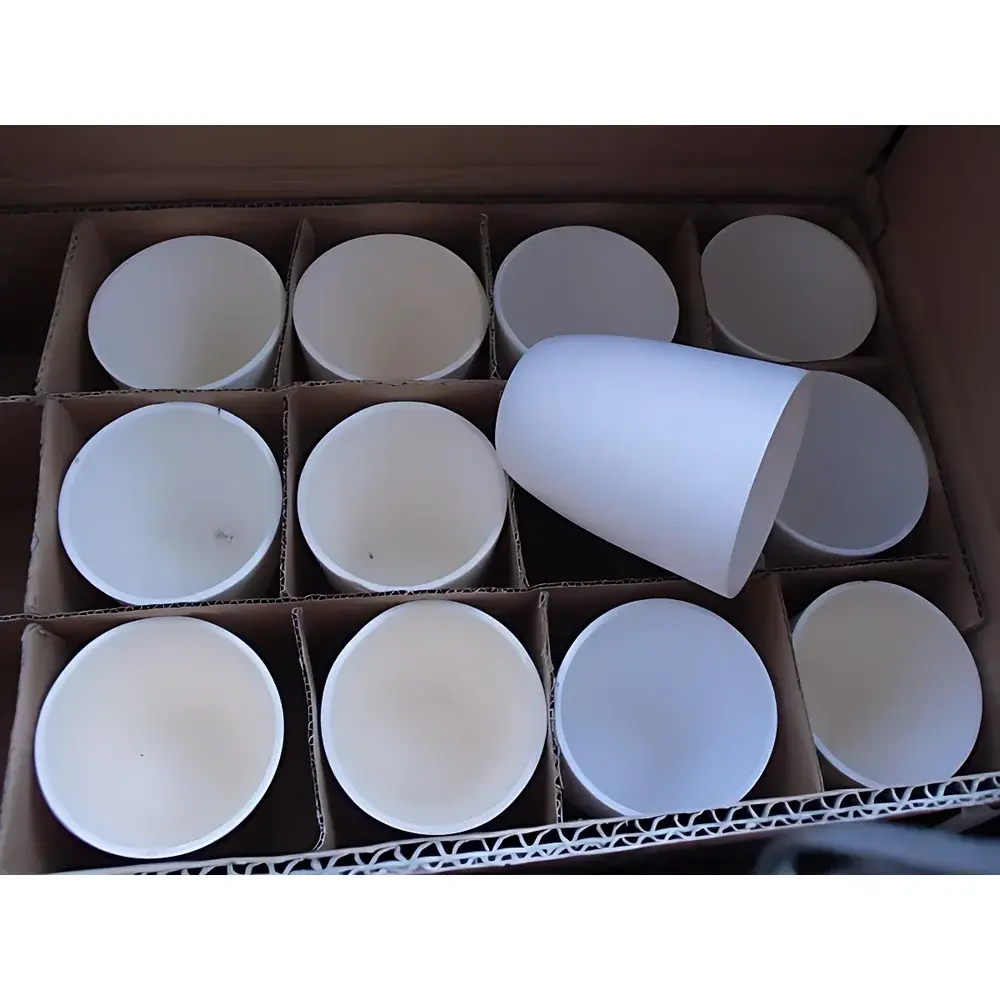
The TL2012 accommodates standard crucibles (alumina, quartz, platinum, stainless steel) and sample boats up to 400 mm wide, 250 mm deep, and 200 mm high. It is routinely deployed in ASTM D3174 (ash content in coal), ASTM E1663 (residue-on-ignition in pharmaceuticals), ISO 1171 (determination of ash in solid mineral fuels), and USP <281> (residue on ignition). The furnace’s thermal uniformity and repeatability support GLP-compliant documentation when paired with validated calibration procedures (e.g., using NIST-traceable reference thermocouples). Its K-type thermocouple input and PID logic meet minimum instrumentation requirements for FDA 21 CFR Part 11–aligned data integrity protocols when connected to compliant logging software.
Software & Data Management
While the TL2012 operates via standalone hardware control, its analog voltage output (0–5 V or 4–20 mA) is compatible with third-party data acquisition systems (e.g., LabVIEW, MATLAB, or SCADA platforms) for real-time temperature logging and trend analysis. Optional RS485 Modbus RTU interface (available as upgrade kit) enables remote monitoring, alarm triggering, and audit-trail generation—supporting traceability in regulated environments. All temperature programs are retained in non-volatile memory and survive power interruption; firmware updates are performed via USB interface using manufacturer-provided utility tools.
Applications
- Coal & Energy Analysis: Determination of moisture, volatile matter, fixed carbon, ash content, ash fusion temperature, and elemental composition per ASTM D3172–D3176 and ISO 1171–1172.
- Pharmaceutical & Biomedical Testing: Residue-on-ignition assays (USP <281>), sterilization validation support, and pre-digestion of biological matrices prior to ICP-OES/MS analysis.
- Environmental & Water Quality Labs: Total suspended solids (TSS) gravimetric analysis (EPA Method 160.2), total dissolved solids (TDS) residue quantification, and catalyst recovery from wastewater sludge.
- Materials Science Research: Sintering of ceramic precursors, thermal cycling of battery electrode materials, and oxidation behavior studies of metal alloys under ambient air conditions.
- Cement & Construction Materials: Loss-on-ignition (LOI) testing of clinker and supplementary cementitious materials per ASTM C114 and EN 196-2.
FAQ
What is the recommended calibration frequency for the TL2012?
Annual calibration against NIST-traceable standards is advised for GLP/GMP environments; internal verification using calibrated reference thermocouples should be performed before each critical batch.
Can the TL2012 operate under inert or reducing atmospheres?
Yes—optional gas inlet/outlet ports allow connection to nitrogen or argon supply lines; for reducing atmospheres (e.g., H₂/N₂), consult factory for modified gasket and thermocouple sheath compatibility.
Is the furnace suitable for ashing organic tissue samples?
Yes—its rapid ramp rate and precise hold capability minimize charring artifacts; use of platinum or quartz crucibles is recommended for biological ashing per AOAC 942.05.
Does the TL2012 support ramp-hold-ramp programming?
Yes—the 8-step PID controller allows sequential ramp-to-target, dwell, and cooldown profiles, including optional natural cooling or forced-air assisted cooling stages.
What maintenance is required to sustain optimal performance?
Quarterly inspection of heating element continuity, thermocouple junction integrity, and ceramic fiber integrity; annual cleaning of ventilation grilles and verification of door seal compression force.



