
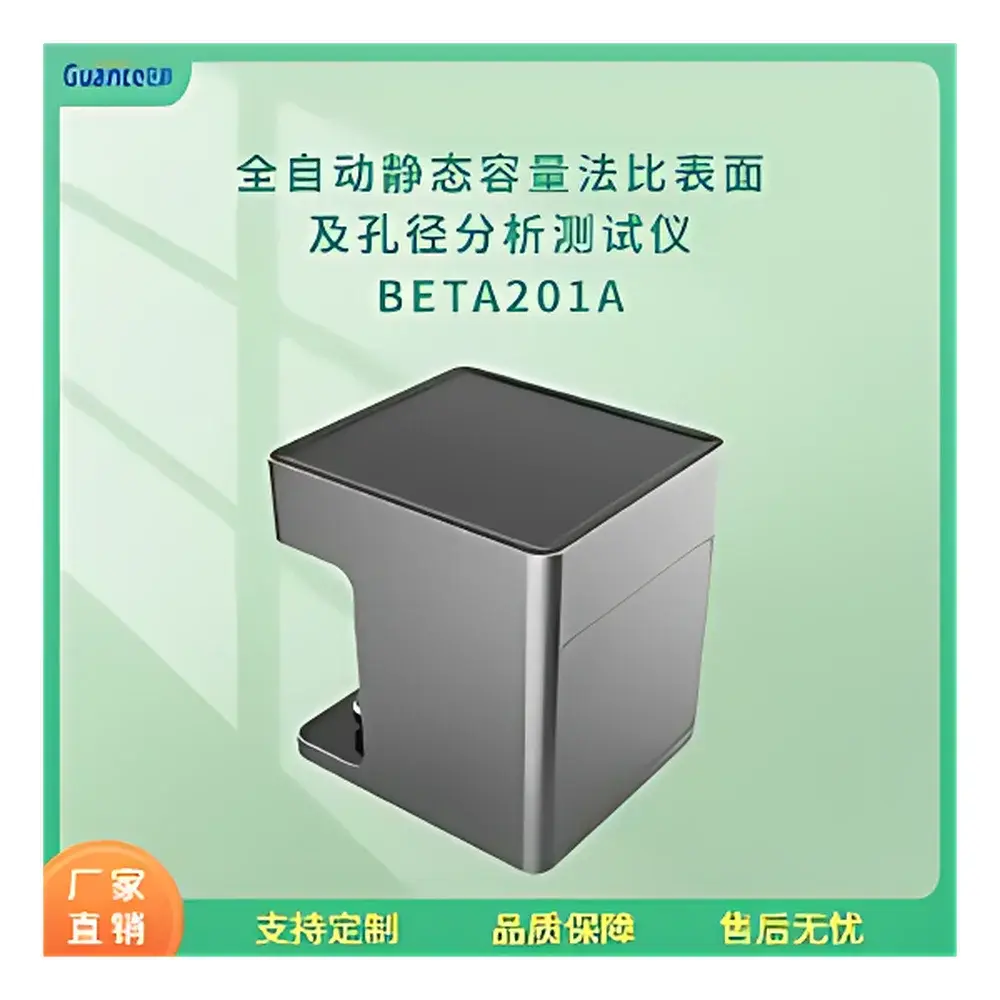
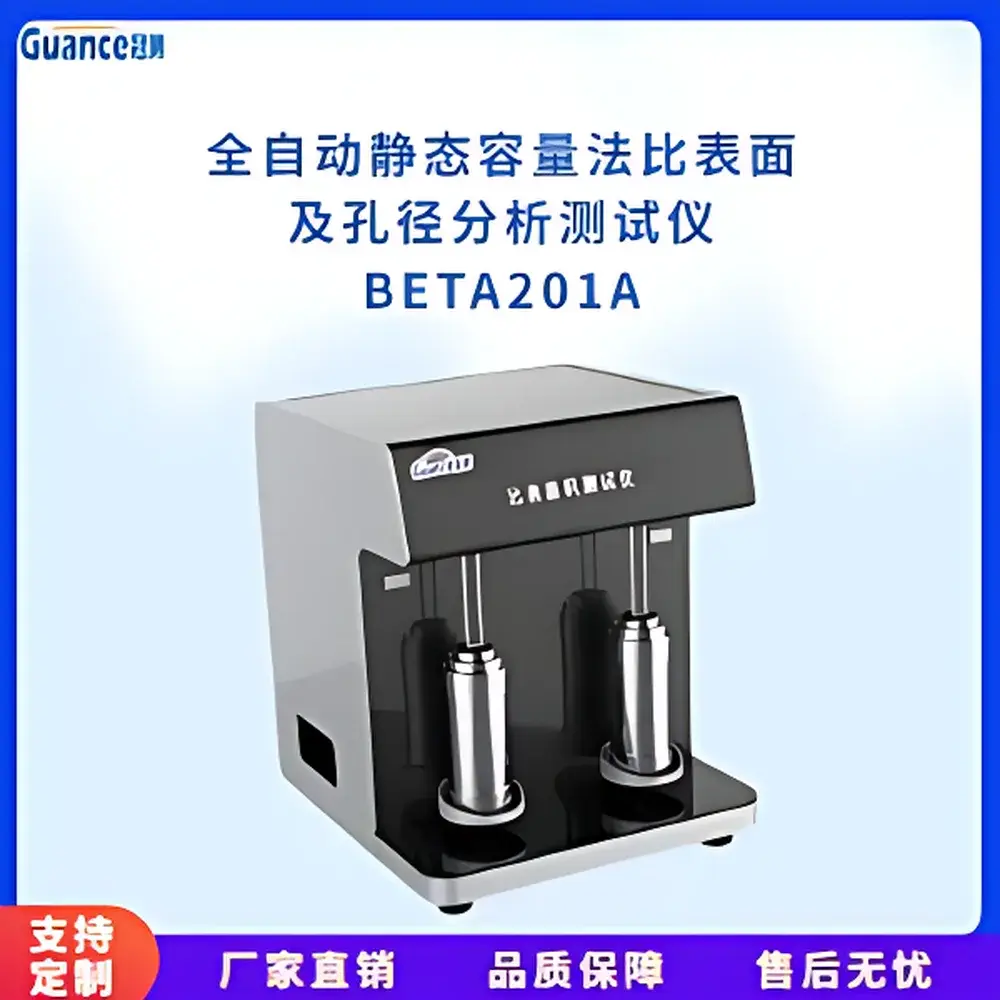
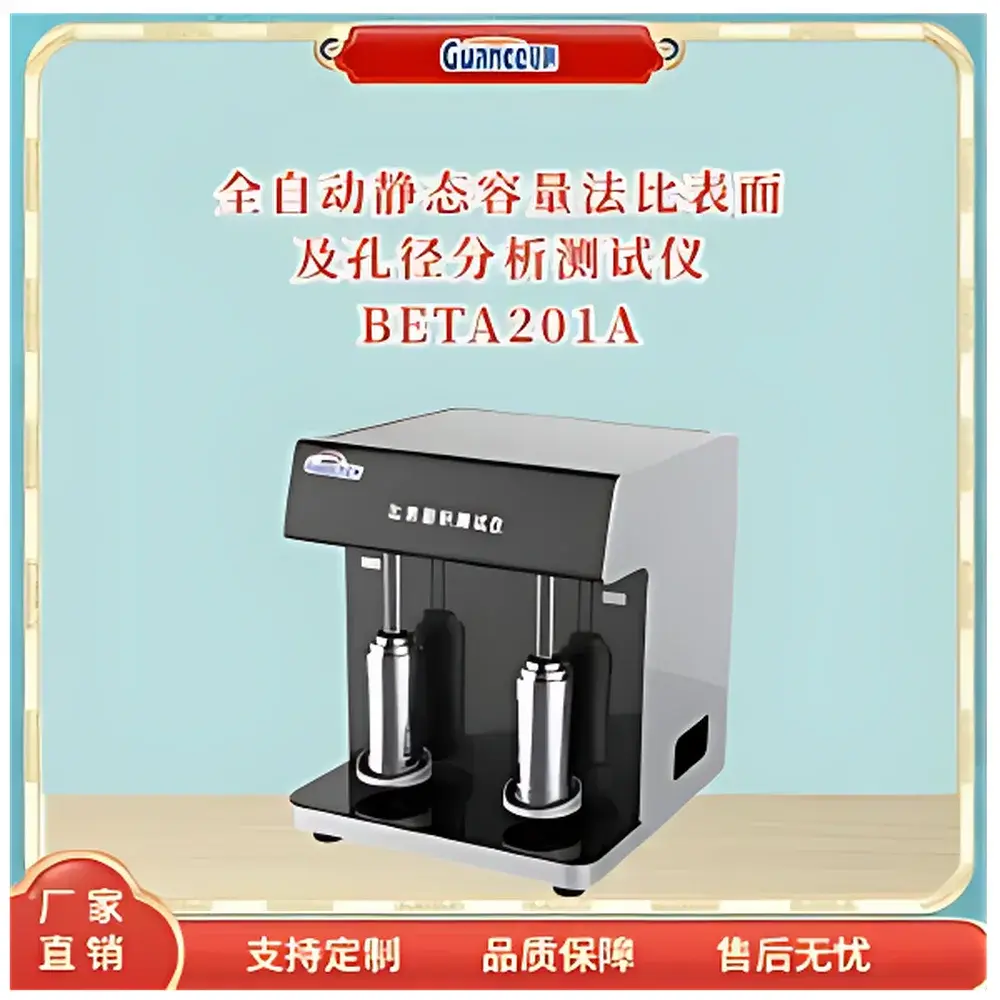
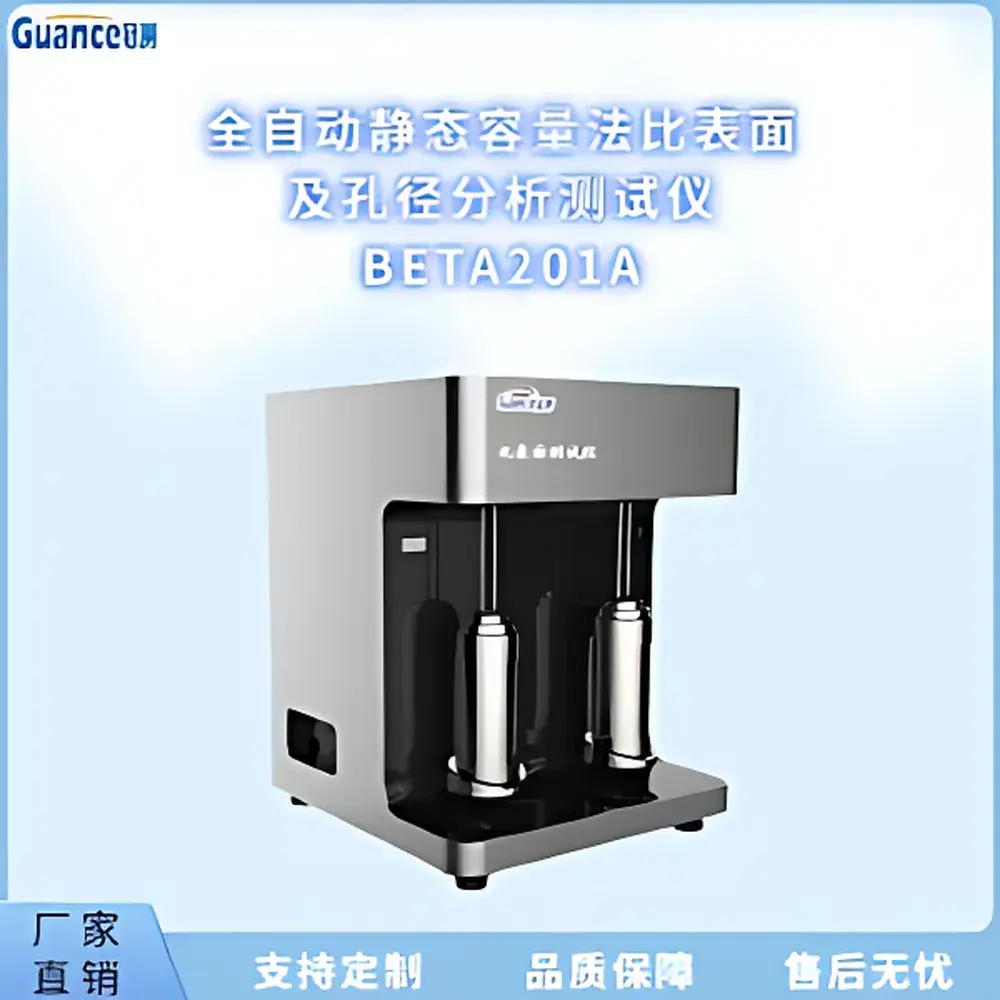
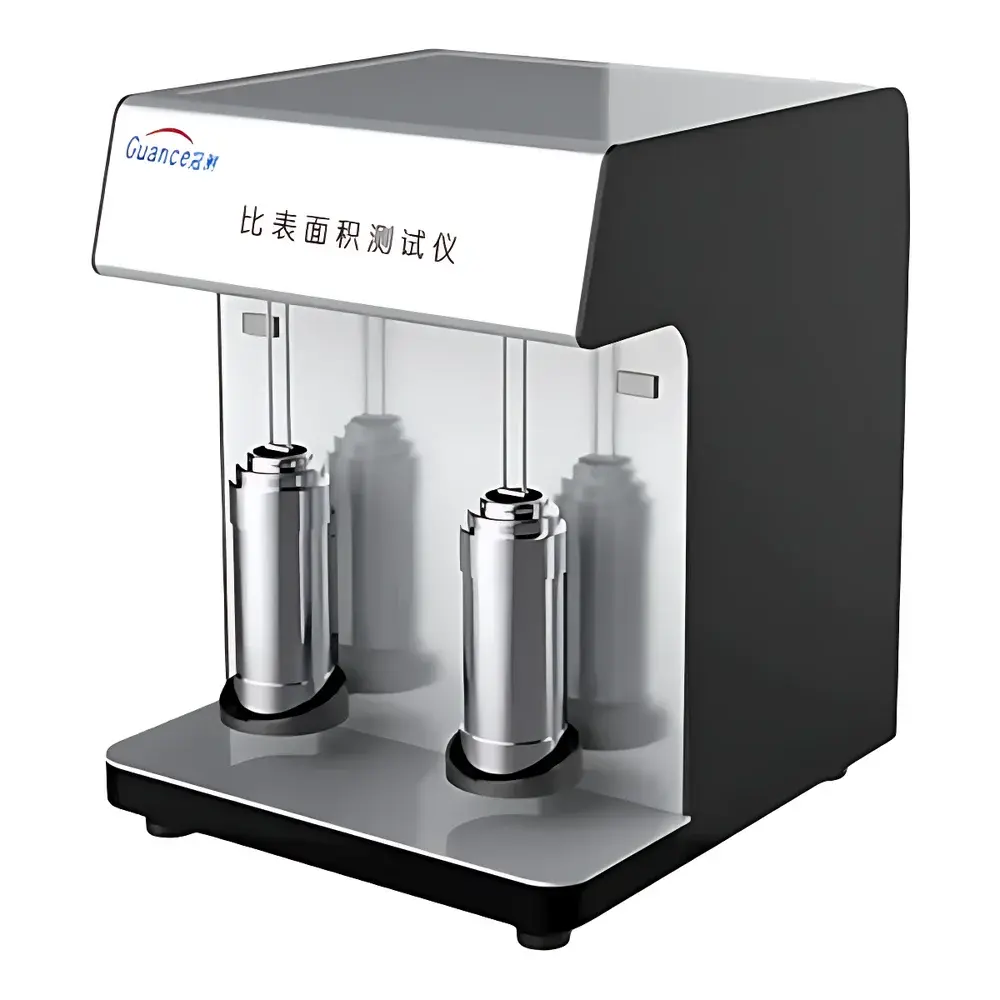
GuanCe Instruments BETA201A2 Specific Surface Area and Pore Size Analyzer
| Brand | GuanCe Instruments |
|---|---|
| Origin | Beijing, China |
| Manufacturer Type | Authorized Distributor |
| Country of Origin | China |
| Model | BETA201A2 |
| Instrument Type | Specific Surface Area Analyzer |
| Measurement Principle | Static Volumetric Method (with optional dynamic mode capability) |
| Number of Analysis Stations | 4 |
| Surface Area Range | 0.0001 m²/g (using Kr adsorption) to unlimited |
| Pressure Range | 0–133 kPa |
| Repeatability | ±1% (typical under controlled conditions) |
| Pore Size Range | 0.35 nm – 500 nm |
| Minimum Detectable Pore Volume | 0.0001 cm³/g (N₂ adsorption, with high-vacuum option) |
| Analysis Time | ~25 min per surface area measurement |
| Gas Compatibility | N₂, Ar, Kr, NH₃, CO₂, H₂, CO, O₂, CH₄, C₄H₁₀ (non-corrosive only) |
| Vacuum Base Pressure | ≤1×10⁻⁴ Torr (standard) |
| P/P₀ Resolution | up to 0.9995 |
| Detector | Imported capacitive absolute pressure transducer (0–10 Torr & 0–1000 Torr ranges), 0.1% full-scale accuracy, 24-bit ADC |
| Sample Tube Heating | Integrated in-situ degassing with dual-path valve isolation |
| Data Interface | USB or Ethernet (RJ45) |
| Software Language | Switchable Chinese/English UI & report output |
| Compliance | Designed for GLP-compliant environments |
Overview
The GuanCe Instruments BETA201A2 Specific Surface Area and Pore Size Analyzer is a high-precision, multi-station gas sorption system engineered for rigorous physical characterization of porous and powdered materials. It operates on the static volumetric principle—measuring gas uptake at controlled equilibrium pressures—to determine specific surface area (SSA), pore size distribution (PSD), pore volume, and related microstructural parameters. The instrument employs nitrogen (or alternative gases including Kr, Ar, CO₂, and H₂) as adsorbates at cryogenic temperatures (typically 77 K for N₂), enabling quantification across micropores (<2 nm), mesopores (2–50 nm), and macropores (50–500 nm). Its quadruple analysis station architecture allows parallel processing of up to four samples—either identically conditioned or under independent protocols—significantly improving throughput for QC laboratories and R&D facilities handling diverse material classes such as cementitious binders, battery cathode/anode powders, zeolites, activated carbons, metal oxides (e.g., Al₂O₃), soils, polymers, and fibrous composites.
Key Features
- Four independent analysis stations with individual pressure sensing and thermal control, supporting true parallel operation without cross-contamination.
- Dual-capacity pressure detection system: high-sensitivity transducer (0–10 Torr) for precise P₀ and low-pressure adsorption measurements, and high-range transducer (0–1000 Torr) for desorption and outgassing monitoring—both calibrated to ±0.1% FS with 24-bit analog-to-digital resolution.
- In-situ degassing architecture with patented three-way valve isolation: separates degas and analysis manifolds physically, preventing condensable byproducts from contaminating sensors or analysis lines during thermal treatment.
- Integrated large-capacity liquid nitrogen Dewar (70-hour hold time) with isothermal jacketing; optional auto-refill module enables unattended multi-day runs.
- Advanced vacuum subsystem: all-stainless-steel piping, metal-sealed joints, silver-plated internal surfaces, and dual-layer vacuum shielding—achieving base pressures ≤10⁻⁴ Torr standard; molecular pump upgrade available for ultra-high vacuum (≤10⁻⁸ Torr) required for Kr-based sub-0.1 m²/g SSA measurements.
- Fully automated operation: no front-panel controls; all sequences—including evacuation, dosing, equilibration, and regeneration—are governed by software with real-time feedback loops.
- Intelligent vacuum management: adaptive pump cycling reduces acoustic noise, extends pump service life, and minimizes thermal drift during long-duration isotherms.
- Fail-safe operational safeguards: automatic atmospheric repressurization pre-sample removal; power-loss recovery with state-resume capability; emergency shutdown for overpressure, overcurrent, short circuit, ground fault, and sensor anomaly detection.
Sample Compatibility & Compliance
The BETA201A2 accommodates standard 6–12 mm OD sample tubes (glass or quartz), accommodating powders, granules, monoliths, fibers, and thin films—provided geometric constraints permit uniform gas access. It supports ASTM D3663 (surface area of catalysts), ISO 9277 (BET surface area), ISO 15901-2 (pore size distribution by gas adsorption), and USP (porosity of pharmaceutical excipients). Its hardware architecture and firmware design align with GLP and GMP documentation requirements: raw pressure/time series, calibration logs, user action timestamps, and environmental metadata are embedded in each dataset. When deployed with validated software modules, the system meets traceability and electronic record integrity expectations under FDA 21 CFR Part 11 (audit trail, electronic signature, and data immutability provisions).
Software & Data Management
The proprietary GuanCe SorptionSuite™ provides a dual-language (English/Chinese) interface with role-based access control, customizable test templates, and modular analysis libraries—including BET, Langmuir, t-plot, DFT/NLDFT kernel libraries (for carbon, silica, and alumina models), BJH, DH, HK, and SF methods. All data are stored in a relational SQLite database with versioned schema support. Export options include PDF reports (with embedded isotherms, PSD curves, and tabular summaries), Excel (.xlsx) datasets (raw and processed), and CSV for third-party modeling. Remote operation via Ethernet enables centralized fleet management across lab networks; diagnostic telemetry permits preemptive maintenance alerts. The software supports batch comparison—overlaying isotherms or PSDs from different dates, instruments, or pretreatment conditions—for trend analysis and method transfer validation.
Applications
This analyzer serves critical quality and development functions across industrial and academic domains: quantifying active surface area in lithium-ion battery electrode materials (e.g., NMC, LFP, graphite); evaluating pozzolanic reactivity of supplementary cementitious materials (SCMs); characterizing pore architecture in MOFs and hierarchical zeolites for gas separation; assessing catalyst sintering resistance via surface area loss after thermal aging; determining filler dispersion efficiency in polymer nanocomposites; and validating sterilization efficacy in medical device packaging substrates through pore tortuosity metrics. Its Kr-adsorption capability extends reliable SSA measurement to ultra-low-area materials (<0.01 m²/g), such as highly sintered ceramics or dense metallurgical powders where N₂ fails to yield measurable uptake.
FAQ
Does the BETA201A2 require helium for free-space calibration?
No. It uses nitrogen as the primary adsorbate and incorporates an independent, temperature-stabilized P₀ reference tube for accurate saturation pressure determination—eliminating the need for costly and logistically constrained helium.
Can the system perform analyses using gases other than nitrogen?
Yes. It supports Ar, Kr, CO₂, H₂, NH₃, CH₄, C₄H₁₀, and other non-corrosive gases—enabling tailored characterization (e.g., CO₂ at 273 K for ultramicropore assessment in carbons).
What vacuum level is achievable with the standard configuration?
The base system achieves ≤1×10⁻⁴ Torr. Optional molecular pumping extends this to ≤1×10⁻⁸ Torr, essential for Kr-based measurements on low-surface-area samples.
How is data integrity ensured during extended无人值守 runs?
All raw sensor outputs are timestamped and checksummed; power interruption triggers automatic save-to-disk and resume-on-reboot with position recovery—preserving >99.8% of acquired isotherm points.
Is remote diagnostics supported out-of-the-box?
Yes. Ethernet connectivity enables secure remote login for firmware updates, parameter tuning, and real-time error log review—reducing onsite service dependency.



