
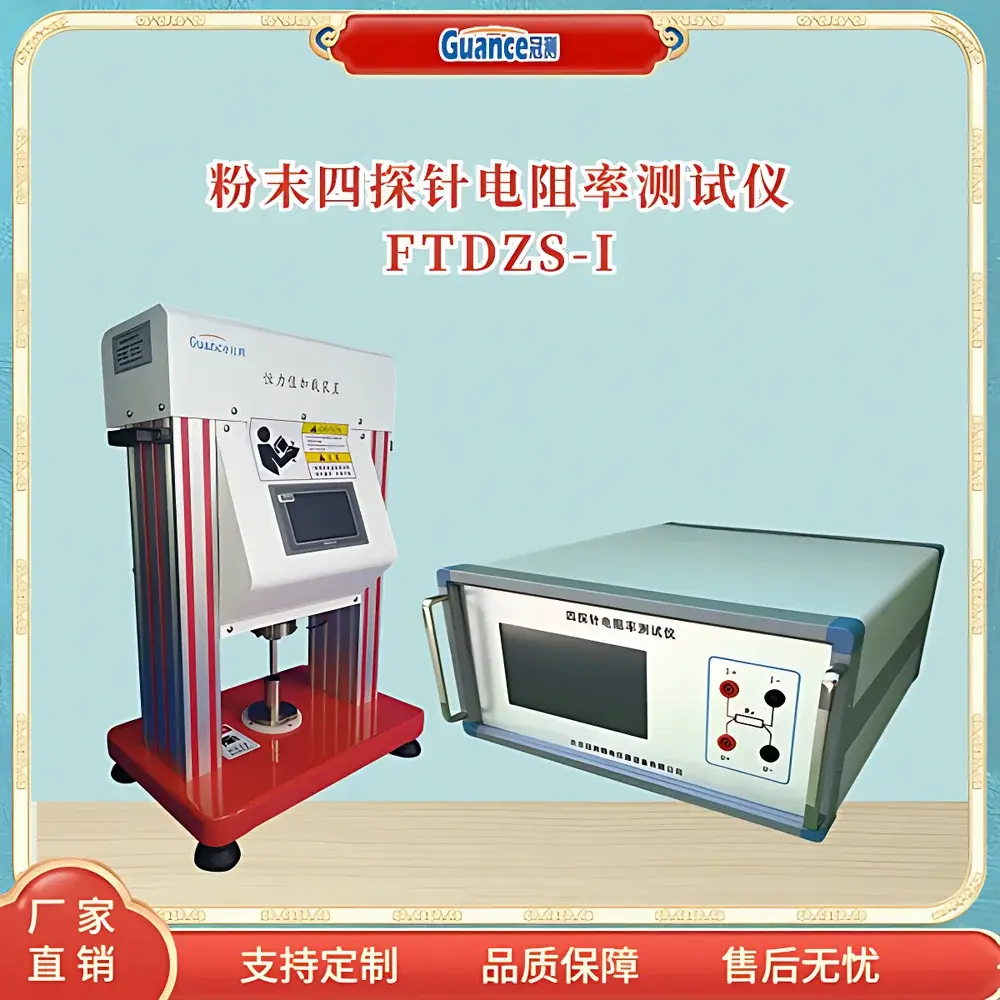
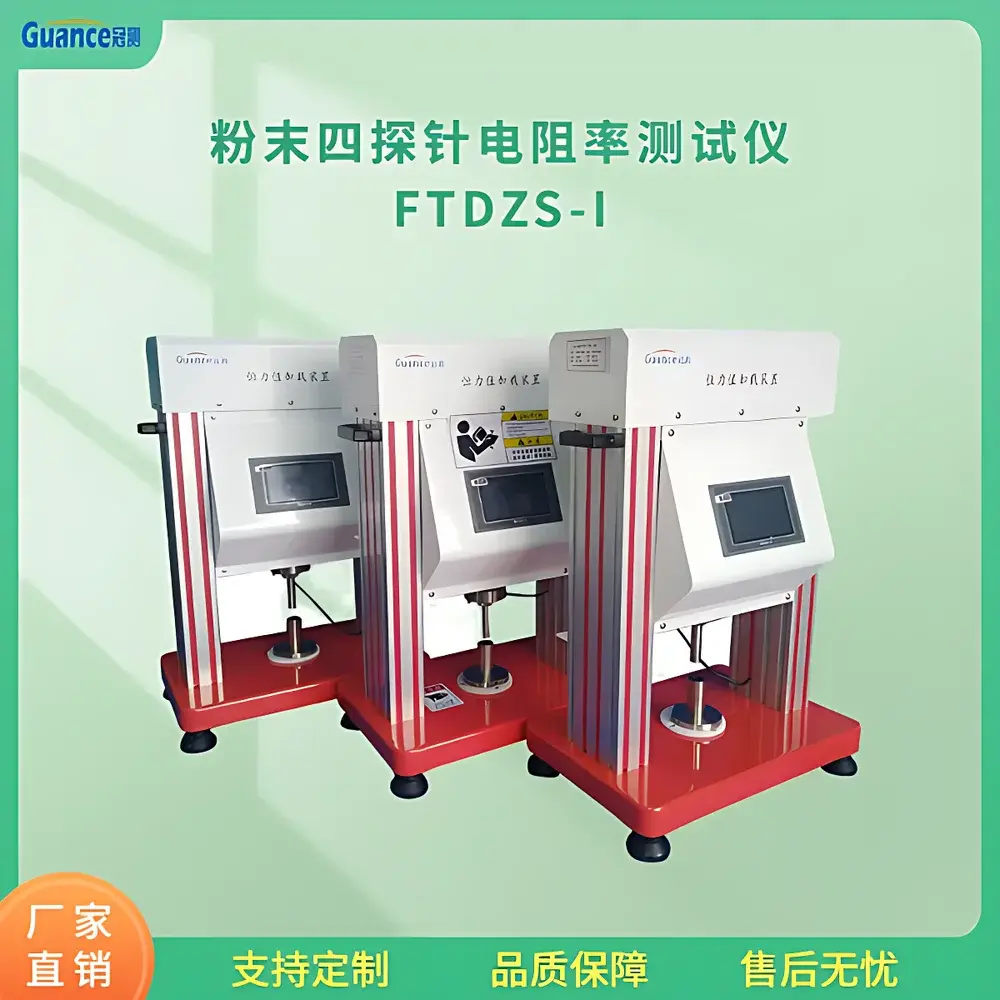
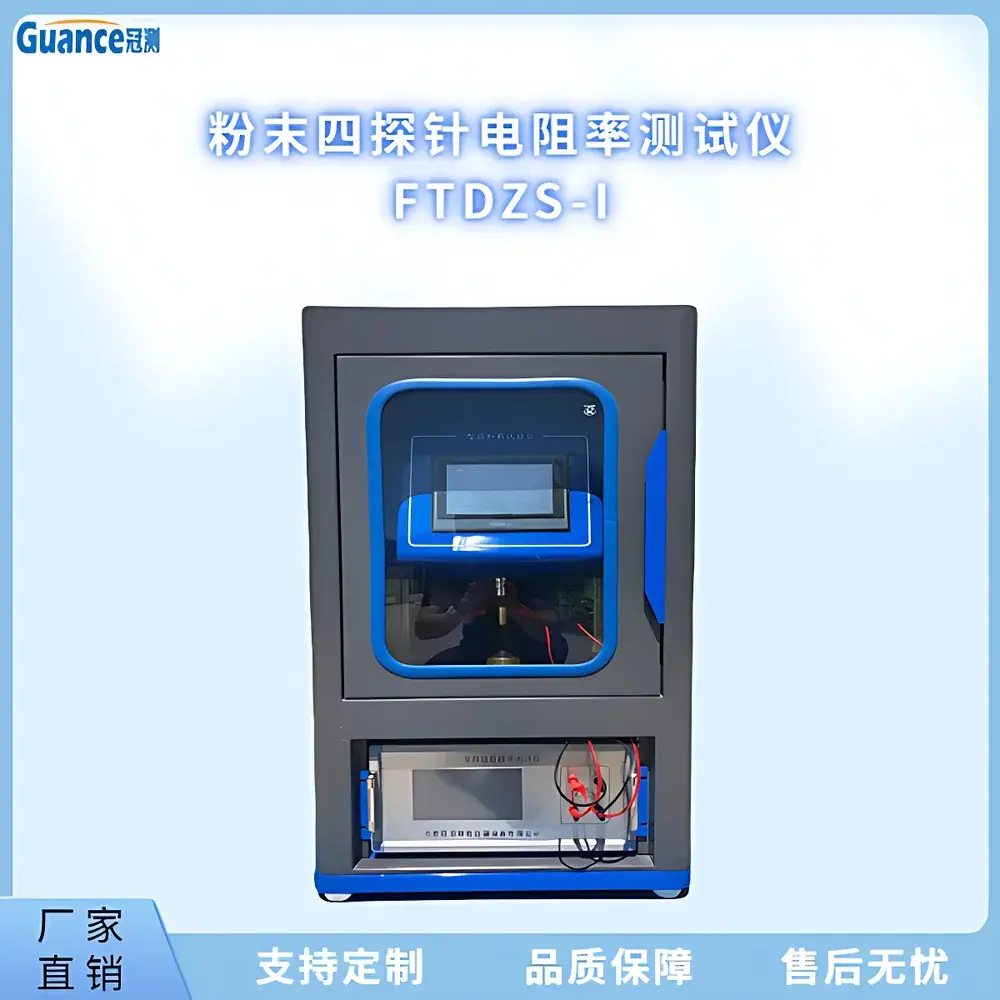
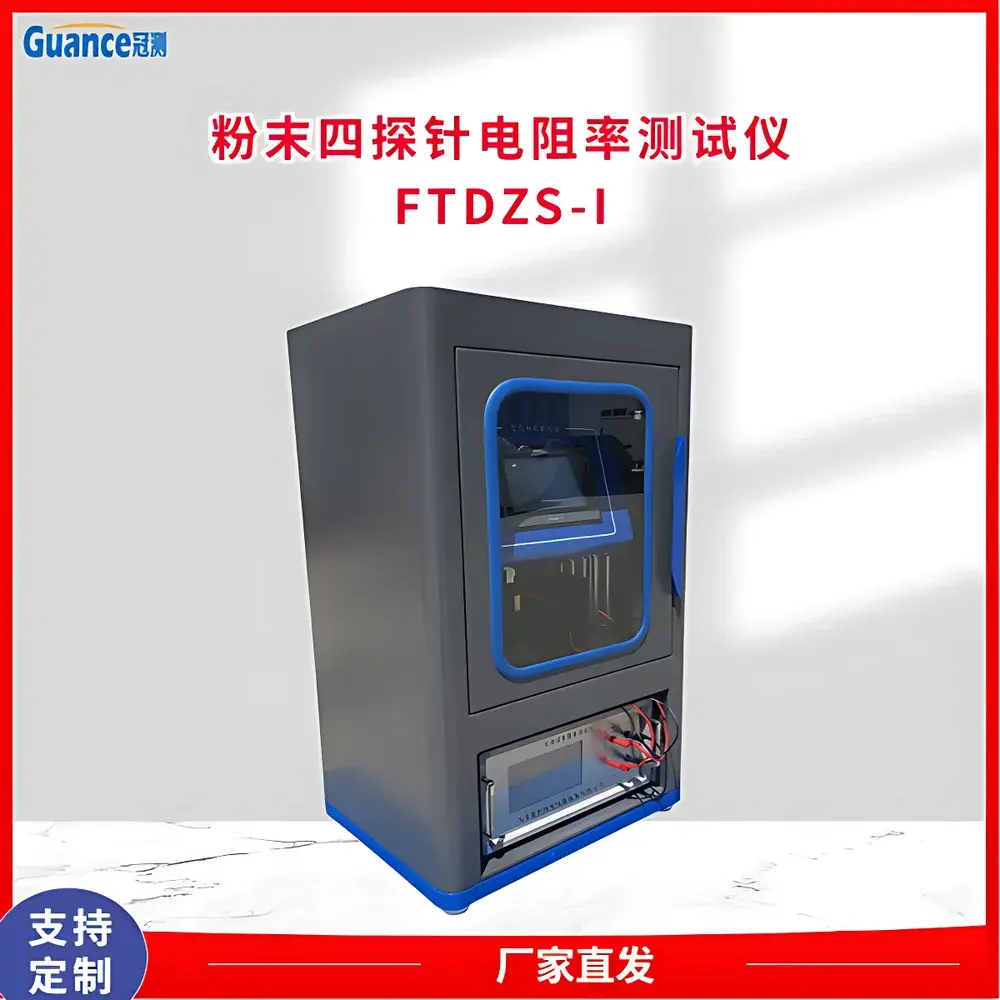
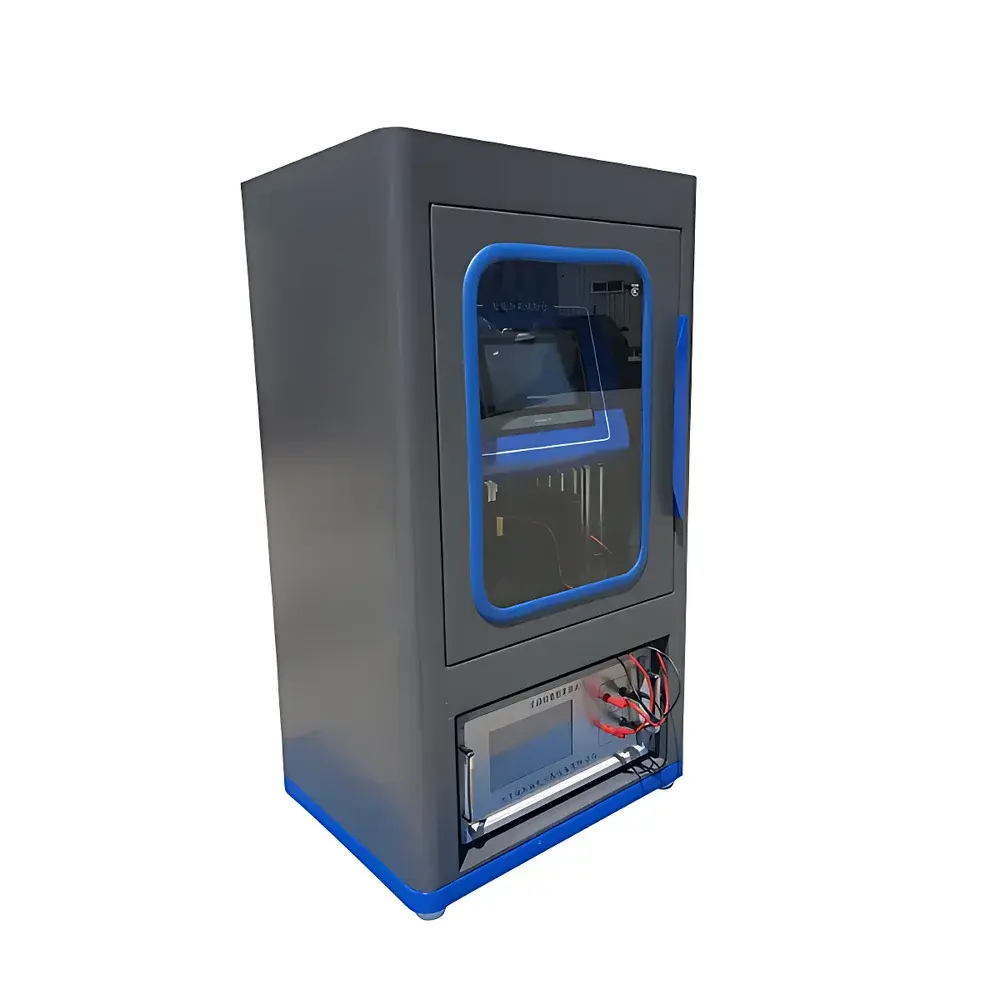
GuanCe Instruments FTDZS-I Powder Resistivity Tester (Four-Point Probe Method)
| Brand | GuanCe Instruments |
|---|---|
| Origin | Beijing, China |
| Manufacturer Type | Authorized Distributor |
| Regional Category | Domestic (PRC) |
| Model | FTDZS-I |
| Price | USD 2,150 (FOB Beijing) |
Overview
The GuanCe Instruments FTDZS-I Powder Resistivity Tester is a precision-engineered instrument designed specifically for the quantitative determination of volume resistivity in granular and powdered materials using the four-point probe (4PP) method. Unlike bulk solid or thin-film measurements, powder resistivity testing requires strict control of sample density—due to the strong dependence of interparticle contact resistance on compaction state. The FTDZS-I integrates a calibrated uniaxial compression stage with programmable pressure control (0–10 MPa range, typical), enabling standardized resistivity evaluation under both loose-fill and tapped-density conditions per ASTM D3764, ISO 3915, and GB/T 3048.7. Its core architecture couples a low-noise, 6½-digit DC nanovoltmeter (±0.005% reading accuracy) with a highly stable, current-reversal-capable DC constant-current source (10 nA–100 mA, 0.02% stability over 1 hour), eliminating thermoelectric offset and contact potential errors inherent in two-point measurements.
Key Features
- Four-point probe configuration with spring-loaded, tungsten-carbide tipped probes (tip diameter: 0.5 mm, spacing: 1.0 mm) ensuring reproducible penetration depth and minimal particle displacement during measurement
- Integrated electromechanical compression module with digital pressure feedback and real-time load monitoring—compliant with ISO 3953 for powder densification protocols
- 7-inch capacitive touchscreen HMI with intuitive workflow navigation, preloaded test templates (e.g., “Loose Density”, “Vibrated Density”, “ISO Standard Tap”)
- Onboard thermal drift compensation algorithm active during extended measurements (>30 min), referencing internal reference resistors traceable to NIM (National Institute of Metrology, China)
- Compact benchtop footprint (W320 × D350 × H410 mm); all-metal chassis with EMI-shielded enclosure meeting IEC 61326-1 Class A requirements
- USB-C and RS-232 interfaces supporting direct data export to CSV or Excel-compatible formats; no proprietary software installation required
Sample Compatibility & Compliance
The FTDZS-I accommodates powder samples with particle sizes ranging from 1 µm to 2 mm and apparent densities between 0.1 g/cm³ and 4.5 g/cm³. It is routinely deployed for quality control and R&D in carbon black, graphite anode powders, metal injection molding (MIM) feedstocks, conductive polymer composites, and battery cathode precursors (e.g., LiCoO₂, NMC). All electrical safety design complies with IEC 61010-1:2010 Ed.3. Measurement traceability aligns with ISO/IEC 17025 requirements when operated within certified laboratory environments. While not FDA-registered, its data integrity features—including timestamped measurement logs, operator ID tagging, and non-erasable result history—support GLP-aligned documentation practices.
Software & Data Management
The embedded firmware implements a deterministic real-time operating system (RTOS) with dual-buffered data acquisition at 10 Hz sampling rate. Each test record stores raw voltage/current pairs, applied pressure, temperature (via internal PT100 sensor), and density-corrected resistivity (ρ = 2πs·V/I, where s is probe spacing). Data export supports audit-ready formatting: CSV files include column headers compliant with ASTM E29 standard rounding rules and embedded metadata (e.g., “TestID_20240522_142833_Pressure_2.5MPa”). Optional PC-based utility (Windows/macOS/Linux) enables batch statistical analysis (mean, SD, CV%), trend charting against process parameters, and PDF report generation with customizable lab letterhead.
Applications
- Quality assurance of conductive additives in lithium-ion battery electrode slurries
- Batch-to-batch consistency verification of synthetic graphite powders used in fuel cell bipolar plates
- Resistivity mapping across sintering temperature gradients in ceramic green bodies
- Correlation studies between powder morphology (SEM/BET) and bulk electronic transport behavior
- Validation of anti-static performance in pharmaceutical excipient blends prior to tableting
- Research into percolation thresholds in polymer-nanocarbon nanocomposites
FAQ
Does the FTDZS-I comply with ASTM D3764 or ISO 3915?
Yes—the instrument’s pressure-controlled compaction cycle, probe geometry, and current/voltage measurement methodology are explicitly aligned with the procedural requirements of both standards.
Can it measure powders with high moisture content or hygroscopicity?
Not directly—samples must be preconditioned to stable humidity (e.g., 23°C/50% RH per ISO 291) prior to loading; optional desiccator-integrated sample chamber kits are available as accessories.
Is calibration traceable to national metrology institutes?
Factory calibration uses reference resistors certified by NIM (China) with full uncertainty budgets; users may perform field verification using supplied 1 kΩ and 100 kΩ check standards.
What is the minimum measurable resistivity for fine metal powders?
Down to 10⁻⁵ Ω·cm (e.g., copper flake powders at 5 MPa compaction), limited primarily by contact resistance stability rather than instrument noise floor.
Does the system support automated sequence testing for multiple pressure steps?
Yes—up to 12 user-defined pressure setpoints can be queued; the system auto-executes compression → dwell → measurement → decompression per step without intervention.



