
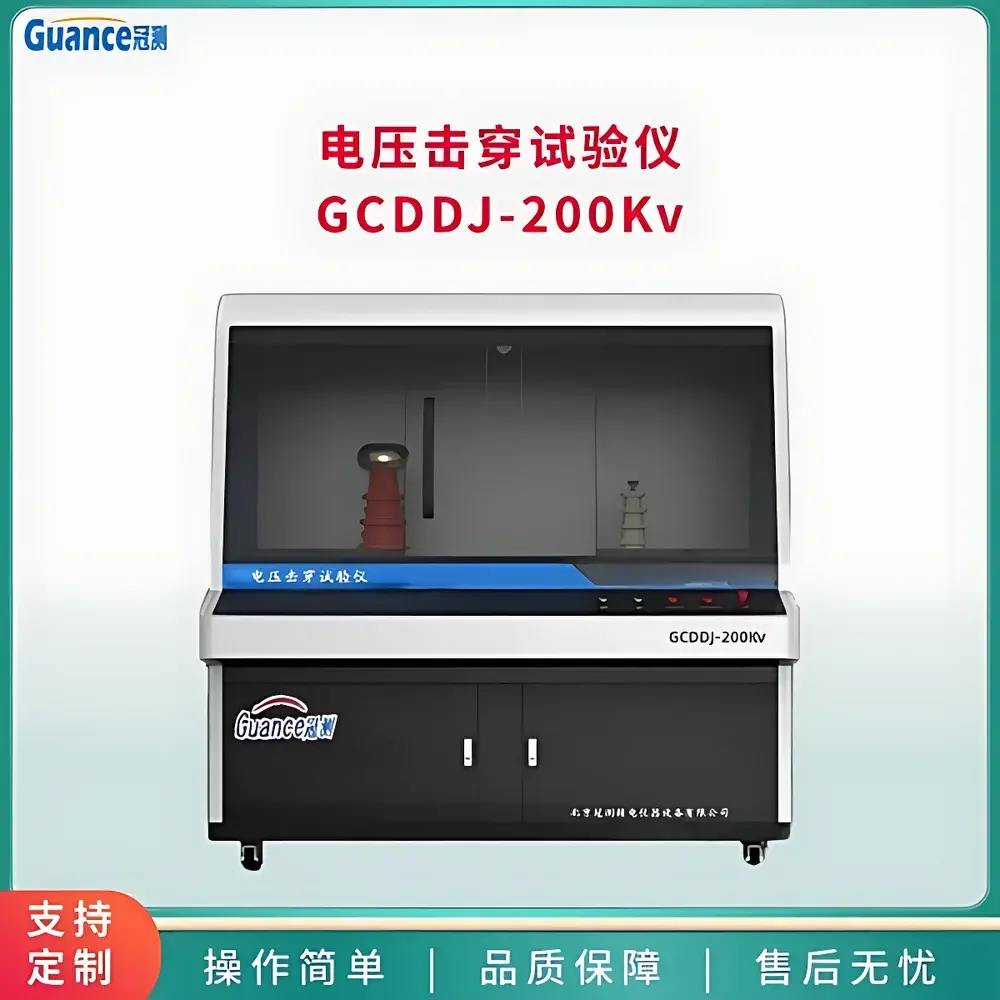
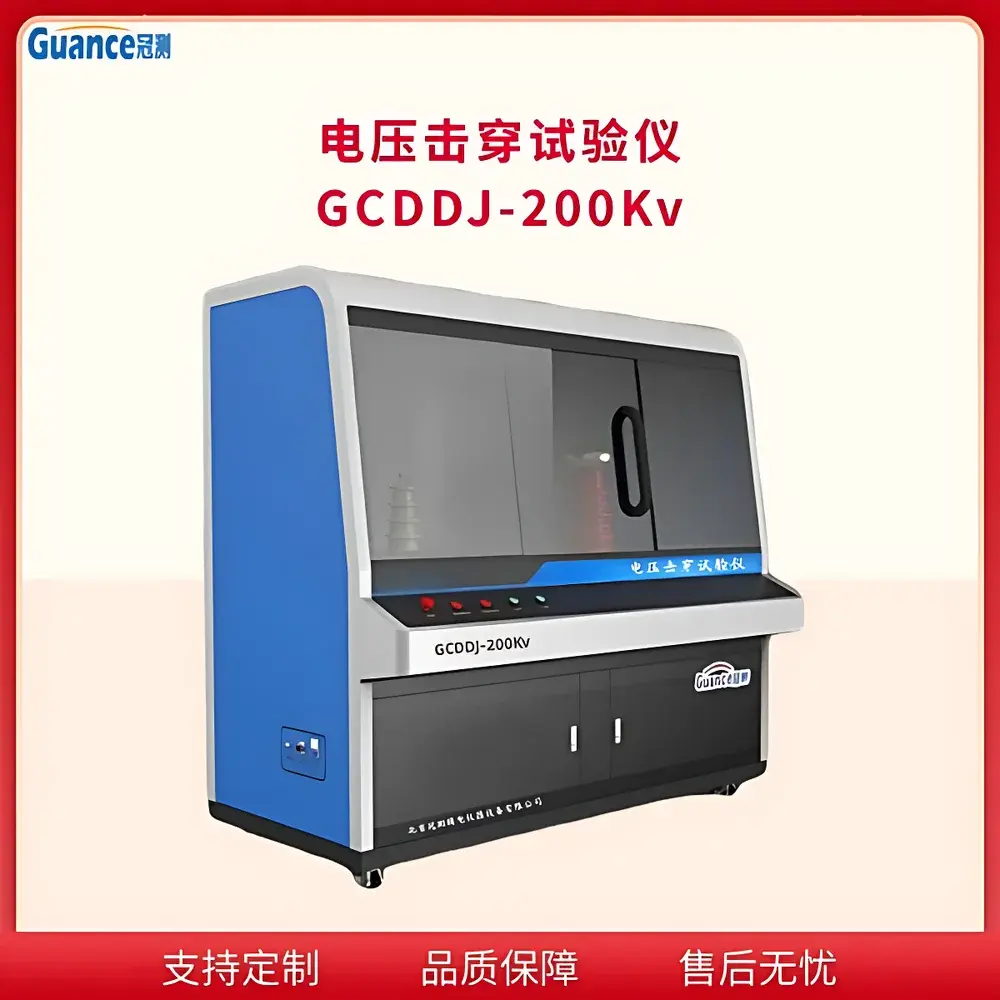
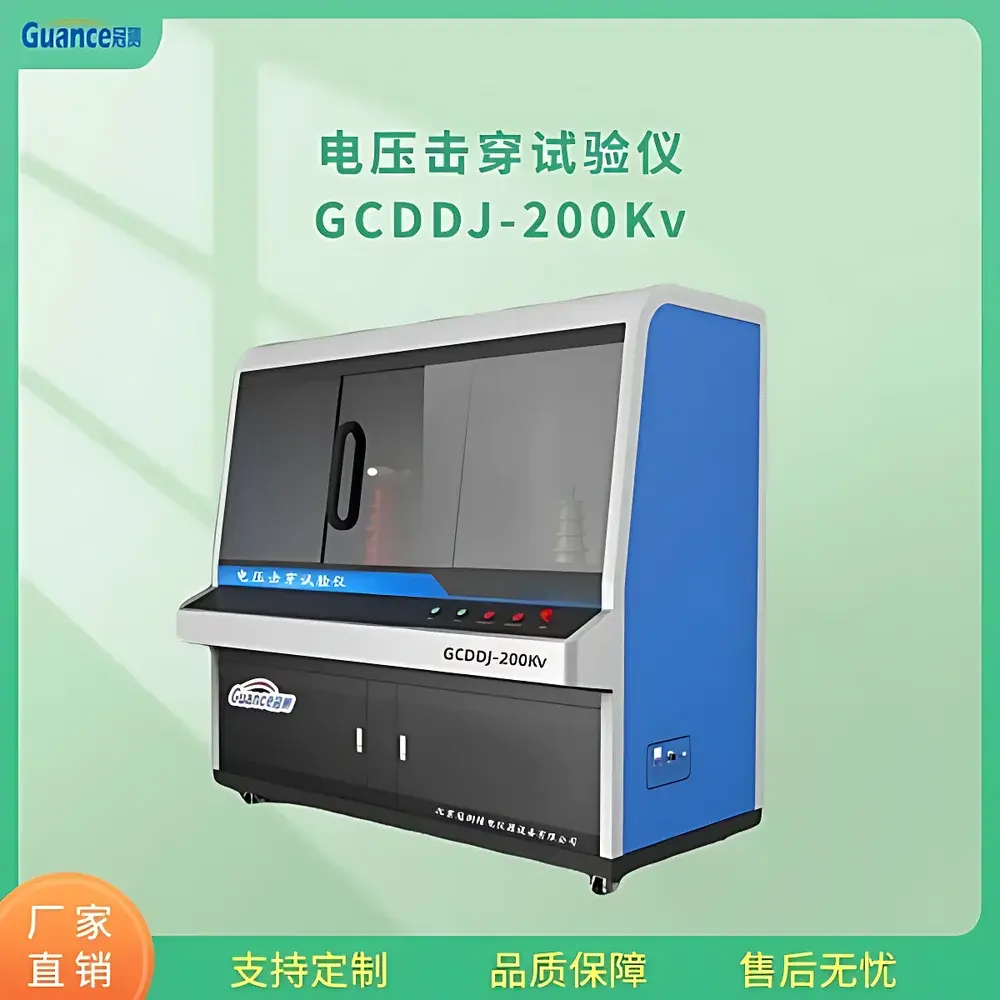
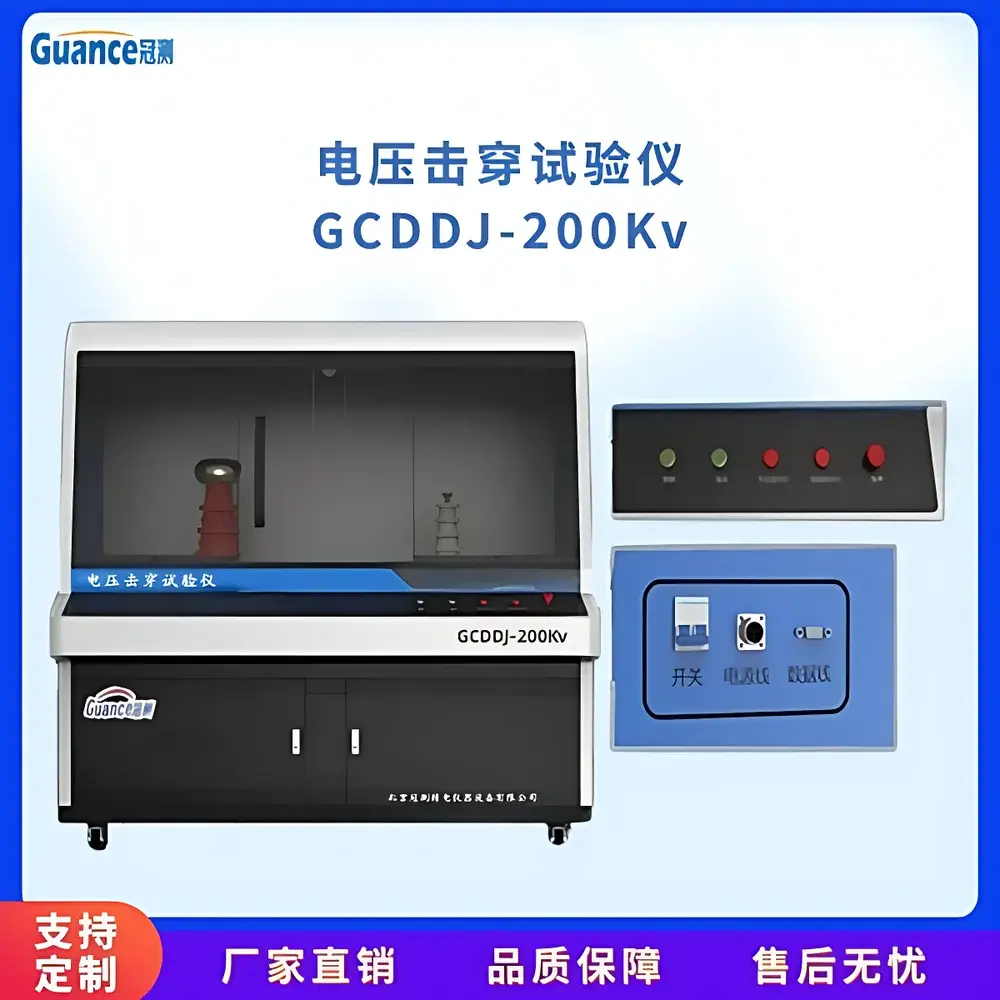
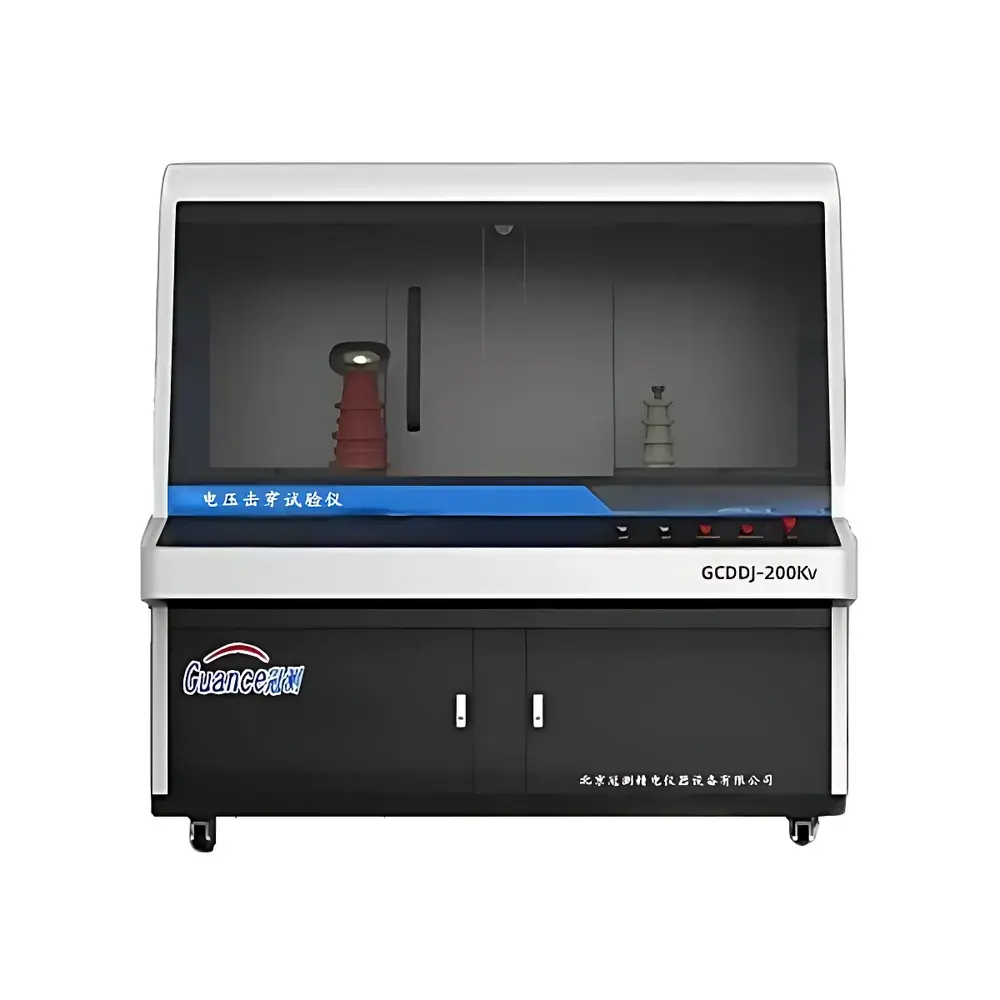
GuanCe Instruments GCDDJ-200KV2 Dielectric Breakdown Tester for Enamel-Coated Wire
| Brand | GuanCe Instruments |
|---|---|
| Origin | Beijing, China |
| Model | GCDDJ-200KV2 |
| Maximum Output Voltage | 200 kV AC/DC |
| Rated Power | 5 kVA |
| Voltage Accuracy | ≤1.5% |
| Adjustable Ramp Rate | 0.1–5 kV/s |
| Dielectric Test Medium | Air, Oil Bath (300×150×200 mm), Optional High-Temperature Chamber |
| Electrode Configurations | φ25 mm (×2), φ75 mm (×1) |
| Safety Protections | Overvoltage, Overcurrent, Short-Circuit, Leakage Current |
| Data Acquisition | Optically Isolated Siemens PLC + Digital I/O Modules |
| Software Platform | Windows-Based GUI with Real-Time Curve Plotting, ASTM/IEC-Compliant Reporting, Excel Export, and Audit-Trail-Ready Test Logging |
Overview
The GuanCe Instruments GCDDJ-200KV2 Dielectric Breakdown Tester is an industrial-grade high-voltage testing system engineered for precise determination of dielectric strength and withstand voltage performance of solid insulating materials under alternating or direct current stress. Operating on the principle of controlled voltage ramping until electrical breakdown occurs—defined as the irreversible loss of insulating integrity—the instrument complies with fundamental test methodologies outlined in IEC 60243-1, ASTM D149, and GB/T 1408.1. Designed specifically for quality assurance in wire & cable manufacturing, transformer component validation, and insulation material R&D, the GCDDJ-200KV2 delivers reproducible, traceable results across diverse dielectric media including air, silicone oil immersion, and (with optional thermal chamber integration) elevated-temperature environments up to 150 °C. Its architecture integrates a Siemens S7-series PLC for deterministic real-time control, optically isolated data acquisition paths to suppress EMI during high-voltage transients, and dual-mode sensing for simultaneous voltage (0–100 V range, scaled to 200 kV) and leakage current (0–100 mA) monitoring—ensuring compliance with GLP and pre-audit requirements for regulated laboratories.
Key Features
- True dual-mode operation: selectable AC (50 Hz) or DC high-voltage output up to 200 kV, rated at 5 kVA continuous duty
- Precision programmable ramp rate: linear voltage rise from 0.1 kV/s to 5.0 kV/s, adjustable in 0.1 kV/s increments via software interface
- Multi-criteria breakdown detection: configurable auto-stop based on voltage collapse, current surge (>1 mA threshold), or user-defined time-limited hold
- Modular electrode system: standard brass electrodes (φ25 mm ×2, φ75 mm ×1) with custom geometry support; oil bath tank (300 × 150 × 200 mm) includes suspended sample rack for rapid specimen exchange
- Integrated safety architecture: redundant hardware interlocks (pneumatic door switch, overpressure cutoff, arc-flash suppression), plus active discharge circuitry (<1 s residual voltage decay to <50 V)
- Full optical isolation between HV section and control electronics, eliminating ground-loop interference and enabling stable measurement in electrically noisy production environments
- Real-time dual-channel oscillography: synchronized display of applied voltage waveform and leakage current transient during test execution
Sample Compatibility & Compliance
The GCDDJ-200KV2 accommodates rigid and flexible dielectric specimens per standardized geometries defined in IEC 60243 and ASTM D149, including films, sheets, molded parts, wound coils, and enamel-coated conductors. Testing may be conducted in ambient air, dielectric oil (e.g., transformer-grade naphthenic oil), or—when equipped with the optional thermal enclosure—in temperature-controlled atmospheres (−10 °C to +150 °C). All mechanical interfaces—including electrode spacing, sample mounting fixtures, and oil bath dimensions—are dimensionally aligned with ISO 293 and UL 746C dimensional tolerances. The system supports full traceability per FDA 21 CFR Part 11 when operated with enabled electronic signatures, audit trail logging, and user-access controls. Calibration certificates are provided traceable to CNAS-accredited national standards (GB/T 19022).
Software & Data Management
The Windows-based control application provides a validated, menu-driven interface compliant with ICH GCP and ISO/IEC 17025 documentation requirements. Core capabilities include: dynamic real-time plotting of voltage vs. time and leakage current vs. time; customizable pass/fail criteria per test method; automatic generation of PDF/Excel reports with embedded metadata (operator ID, timestamp, environmental conditions, calibration status); batch test sequencing with auto-reset between specimens; and secure role-based access (administrator, technician, reviewer). All raw waveform data and event logs are stored in encrypted binary format with SHA-256 hash integrity verification. Exported Excel files contain unprocessed sensor readings, calculated breakdown voltage, ramp rate deviation metrics, and statistical summaries (mean, SD, CV%) across replicate tests.
Applications
- Quality conformance testing of magnet wire enamel systems (polyester-imide, polyamide-imide, AI/PB types) per NEMA MW 1000 and IEC 60851-5
- Determination of comparative tracking index (CTI) precursor data for polymer composites and laminates
- Validation of potting compound integrity in high-voltage motor windings and EV battery module encapsulation
- Accelerated aging studies correlating dielectric strength degradation with thermal cycling or humidity exposure
- Supplier qualification testing for insulating sleeves, bushings, and busbar coatings used in power electronics
- Research into nanocomposite dielectrics where interfacial polarization effects influence breakdown path morphology
FAQ
What voltage accuracy specifications apply across the full 200 kV range?
Voltage measurement uncertainty is ≤±1.5% of reading (k = 2) from 10 kV to 200 kV, verified per JJG 1085-2013 using NIST-traceable resistive dividers.
Can the system perform step-stress (multi-level) withstand tests?
Yes—software supports programmable multi-step protocols: hold at intermediate voltages (e.g., 50 kV → 100 kV → 150 kV), dwell duration per step, and conditional progression based on leakage current thresholds.
Is oil bath temperature control integrated or external?
Oil bath heating/cooling requires external circulator (not included); the standard tank includes PT100 sensor ports and mounting brackets for third-party thermal units.
How is operator safety enforced during automated testing?
Three independent hardware interlocks: (1) pneumatic door lock disengages HV when opened, (2) emergency stop button triggers immediate discharge and ramp termination, (3) continuous arc-detection circuit cuts output within 10 µs upon ionization onset.
Does the software support LIMS integration?
Yes—via configurable ODBC driver and HL7-compliant XML export; test records include unique UUIDs, digital signatures, and immutable timestamps required for LIMS ingestion.



