
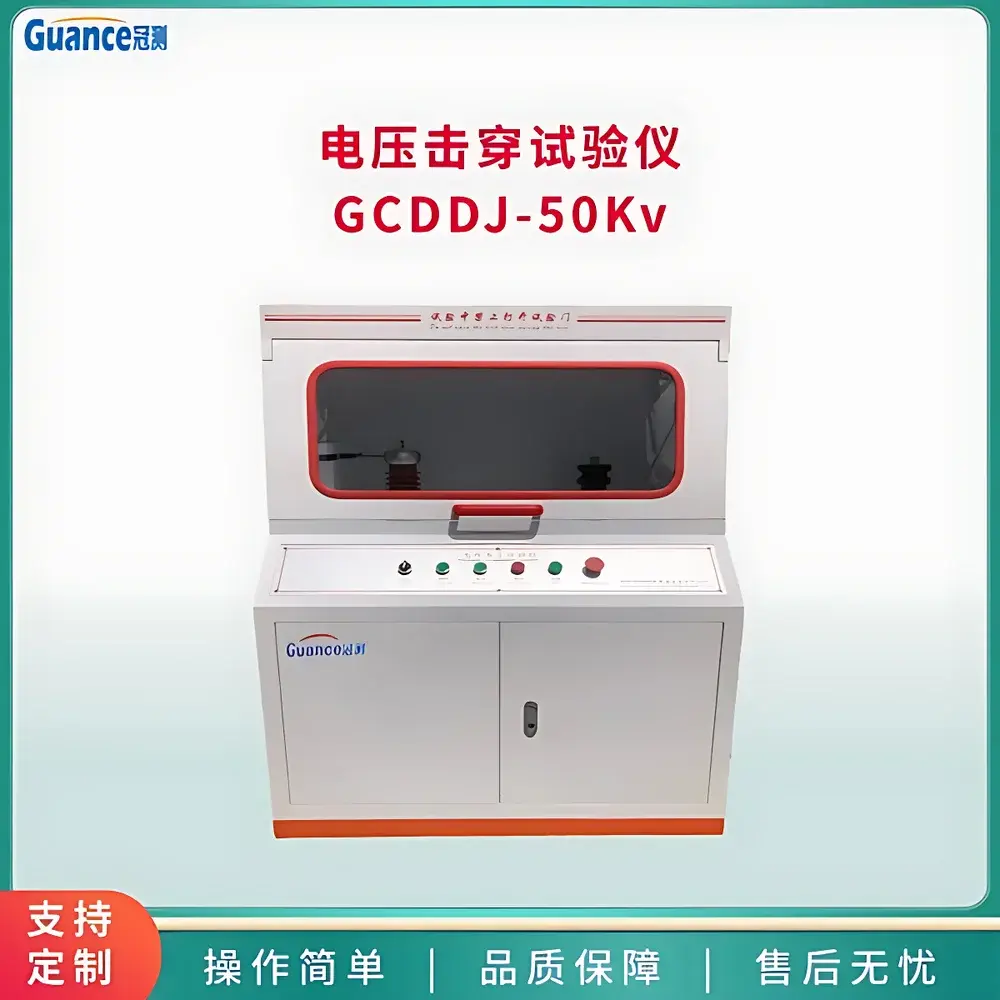
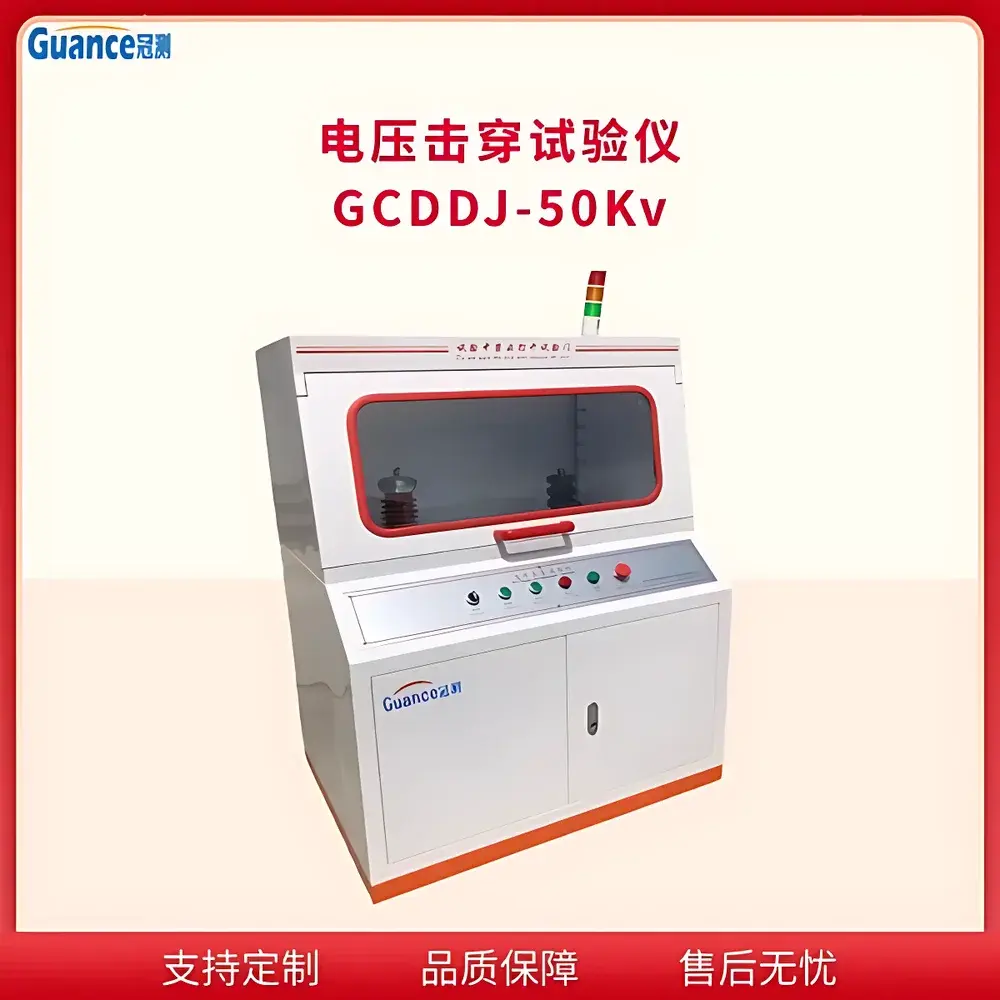
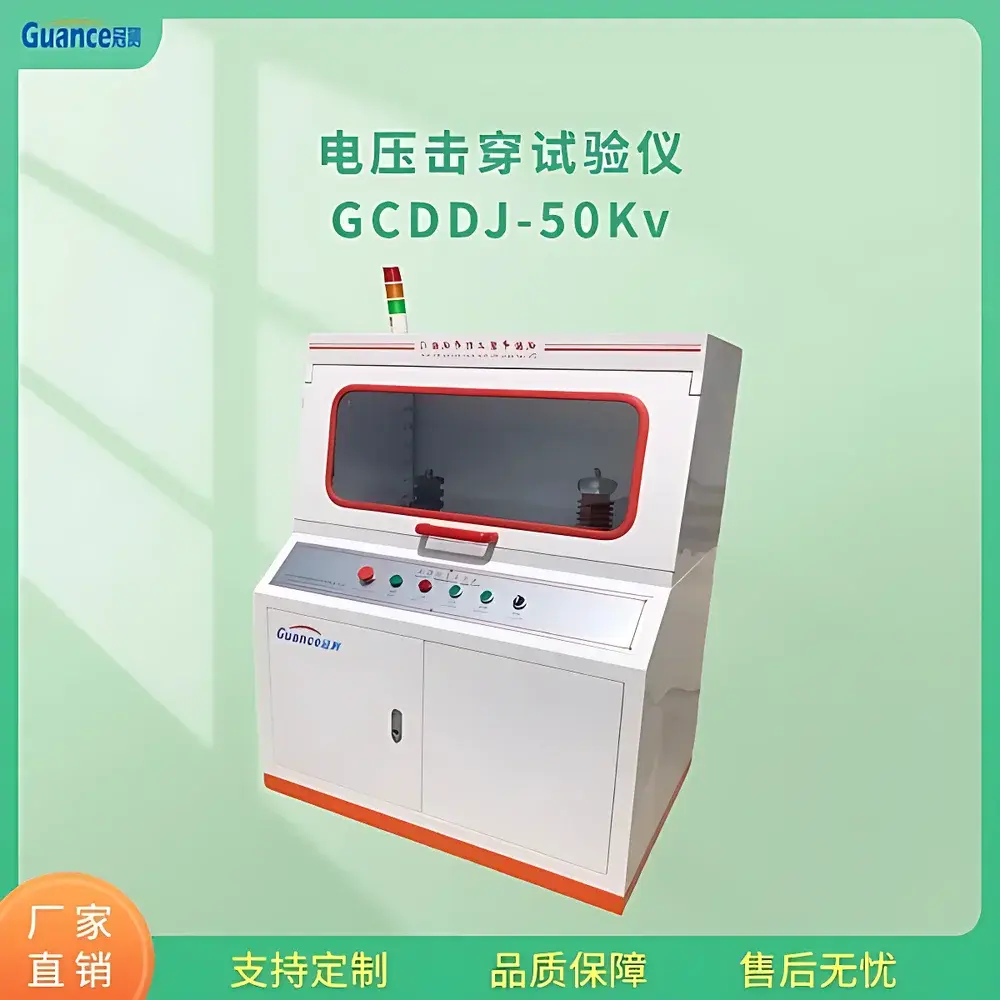
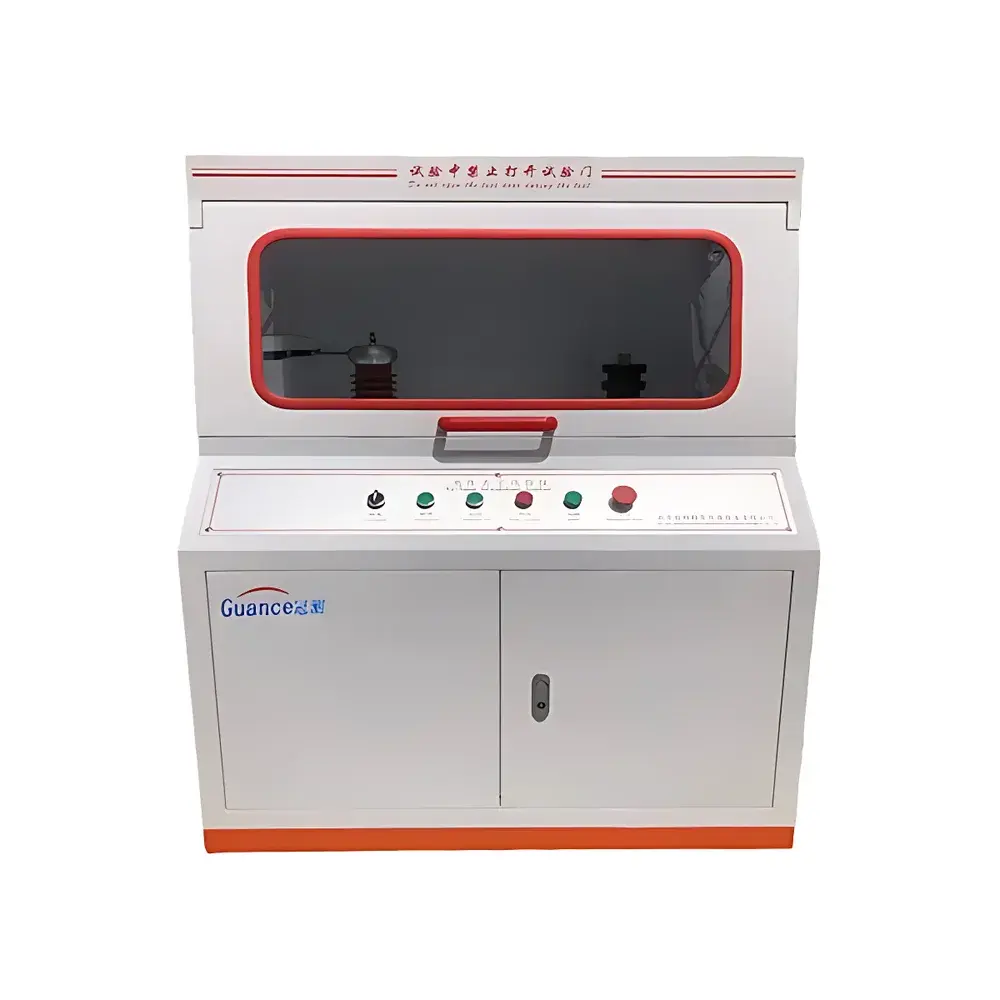
GuanCe Instruments GCDDJ-50kV2 Computer-Controlled Dielectric Voltage Breakdown Tester
| Brand | GuanCe Instruments |
|---|---|
| Origin | Beijing, China |
| Model | GCDDJ-50kV2 |
| Breakdown Voltage | 50 kV AC/DC |
| Electrical Capacity | 5–20 kVA |
| Input Voltage | AC 220 V / 380 V, 50 Hz |
| Rise Rate | 0.1–5 kV/s (adjustable) |
| Voltage Accuracy | ≤ ±1.5% |
| Leakage Current Range | 0–100 mA |
| Electrode Options | φ25 mm (×2), φ75 mm (×1) |
| Test Medium | Air, Oil Bath (300 × 150 × 200 mm), or High-Temperature Environment |
| Safety Protections | Overvoltage, Overcurrent, Short-Circuit, Ground-Fault |
| Dimensions (L×W×H) | 1600 × 850 × 1700 mm |
| Weight | ~300 kg |
Overview
The GuanCe Instruments GCDDJ-50kV2 is a computer-controlled dielectric voltage breakdown tester engineered for precise determination of electrical strength and dielectric withstand performance of solid insulating materials under alternating current (AC) or direct current (DC) voltage stress. Based on the fundamental principle of dielectric breakdown—where an applied electric field exceeds the material’s intrinsic insulation threshold, resulting in rapid conduction through ionization or thermal runaway—the instrument delivers repeatable, traceable, and standards-compliant test outcomes. Designed for laboratory and quality control environments, it supports standardized test configurations per IEC 60243-1, ASTM D149, GB/T 1408.1–2006, GB/T 1695–2005, GB/T 3333, HG/T 3330, and GB/T 12656. Its architecture integrates Siemens PLC-based real-time control with optically isolated data acquisition, ensuring immunity to electromagnetic interference during high-voltage ramping and transient event capture.
Key Features
- Programmable voltage ramping from 0.1 kV/s to 5 kV/s with selectable modes: uniform rise, stepwise gradient, or fixed-voltage hold (dielectric withstand)
- Dual-mode breakdown detection: voltage collapse or leakage current threshold (0–100 mA range, calibrated sensor input)
- Integrated high-voltage generation module with AC/DC dual-output capability up to 50 kV, supported by custom-wound transformers and EMI-suppressed circuitry
- Motor-driven variable autotransformer (variac) system with mechanical zero-return and upper-limit safety interlocks
- Modular electrode assembly including standard stainless-steel disc electrodes (φ25 mm × 2, φ75 mm × 1), compatible with ASTM D149 electrode geometries and customizable per user specification
- Oil bath test chamber (300 × 150 × 200 mm) with suspended sample support frame, internal LED illumination, and integrated exhaust fan for vapor management
- Full-spectrum safety architecture: hardware-enforced overvoltage cutoff, current-limiting protection, ground-fault monitoring, and pneumatic door interlock with visual status tower light (red/green/yellow)
- Optically isolated communication interface between PLC controller and host PC ensures noise-free data transmission during high-potential testing
Sample Compatibility & Compliance
The GCDDJ-50kV2 accommodates rigid and semi-rigid dielectric specimens—including thermoplastics, elastomers (e.g., vulcanized rubber), laminates, polymer films, epoxy resins, mica composites, ceramics, glass, insulating varnishes, and paper-based dielectrics (e.g., capacitor paper, cable paper). Testing may be conducted in ambient air, transformer oil immersion (per ASTM D877/D1816), or elevated-temperature chambers (optional integration). All operational parameters—including electrode spacing, voltage polarity, ramp rate, and dwell time—are configurable to meet method-specific requirements defined in ISO/IEC 17025-accredited laboratories. The system supports audit-ready documentation workflows compliant with GLP and GMP principles, including electronic signature-capable reporting and full test session logging per FDA 21 CFR Part 11 readiness guidelines.
Software & Data Management
The Windows-based control software provides a deterministic, menu-driven interface optimized for routine QC use and R&D validation. Real-time visualization includes synchronized plots of applied voltage vs. time and leakage current vs. time, updated at ≥100 Hz sampling rate. Test protocols are stored as reusable templates with parameter presets aligned to GB, ASTM, or ISO methods. Raw data export to CSV or Excel (.xlsx) enables post-test statistical analysis (e.g., Weibull distribution fitting for breakdown voltage dispersion). Reports include operator ID, timestamp, environmental conditions (recorded manually), electrode configuration, test mode, pass/fail criteria, and measured breakdown values—with optional digital signature fields. Audit trails log all parameter changes, start/stop events, and safety interventions, satisfying traceability requirements for ISO 9001 and IATF 16949-certified facilities.
Applications
This instrument serves critical roles across multiple sectors: incoming raw material qualification for polymer compounders; final product release testing of molded insulators in power electronics; R&D screening of novel nanocomposite dielectrics; failure analysis of aged cable insulation; and comparative evaluation of coating systems for motor windings or printed circuit board substrates. It supports both single-point breakdown characterization and multi-sample statistical assessment per ASTM D3487 or IEC 60674-2. In academic settings, it facilitates teaching of solid-state dielectric physics, partial discharge inception studies (when paired with external PD detectors), and accelerated aging correlation experiments under controlled thermal-electrical stress.
FAQ
What standards does the GCDDJ-50kV2 support?
It complies with GB/T 1408.1–2006, GB/T 1695–2005, ASTM D149, IEC 60243-1, and related national and international specifications for dielectric strength testing.
Can the system perform both AC and DC breakdown tests?
Yes—dual-mode high-voltage output allows seamless switching between sinusoidal 50 Hz AC and stabilized DC voltage sources without hardware reconfiguration.
Is remote operation or network connectivity supported?
The system uses standard Ethernet TCP/IP communication with OPC UA-compatible drivers; remote monitoring and limited control are achievable via secure LAN deployment.
How is calibration traceability maintained?
Voltage and current sensors are factory-calibrated against NIST-traceable references; users receive calibration certificates and recommended annual verification intervals per ISO/IEC 17025.
Are custom electrode configurations available?
Yes—GuanCe Instruments offers OEM electrode design and machining services, including needle-plane, spherical, and guarded electrode sets per user-defined geometry and material specifications.



