
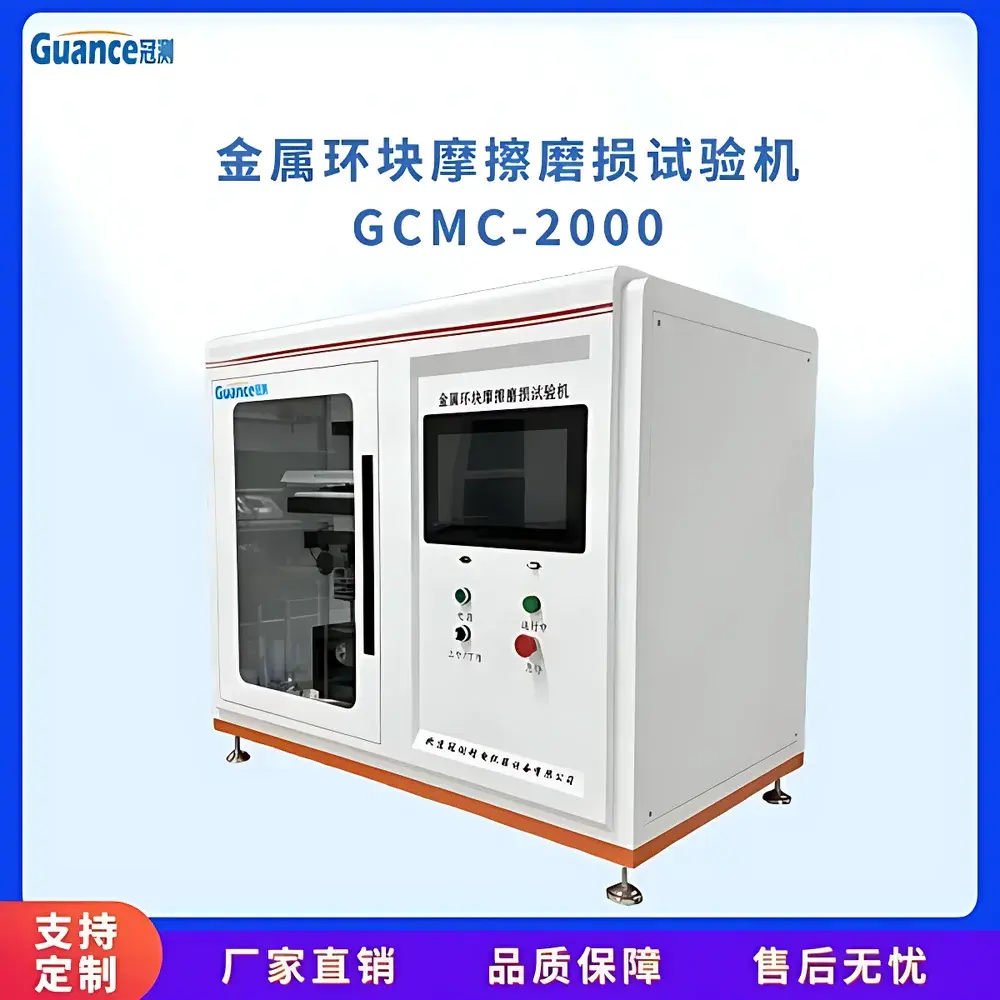
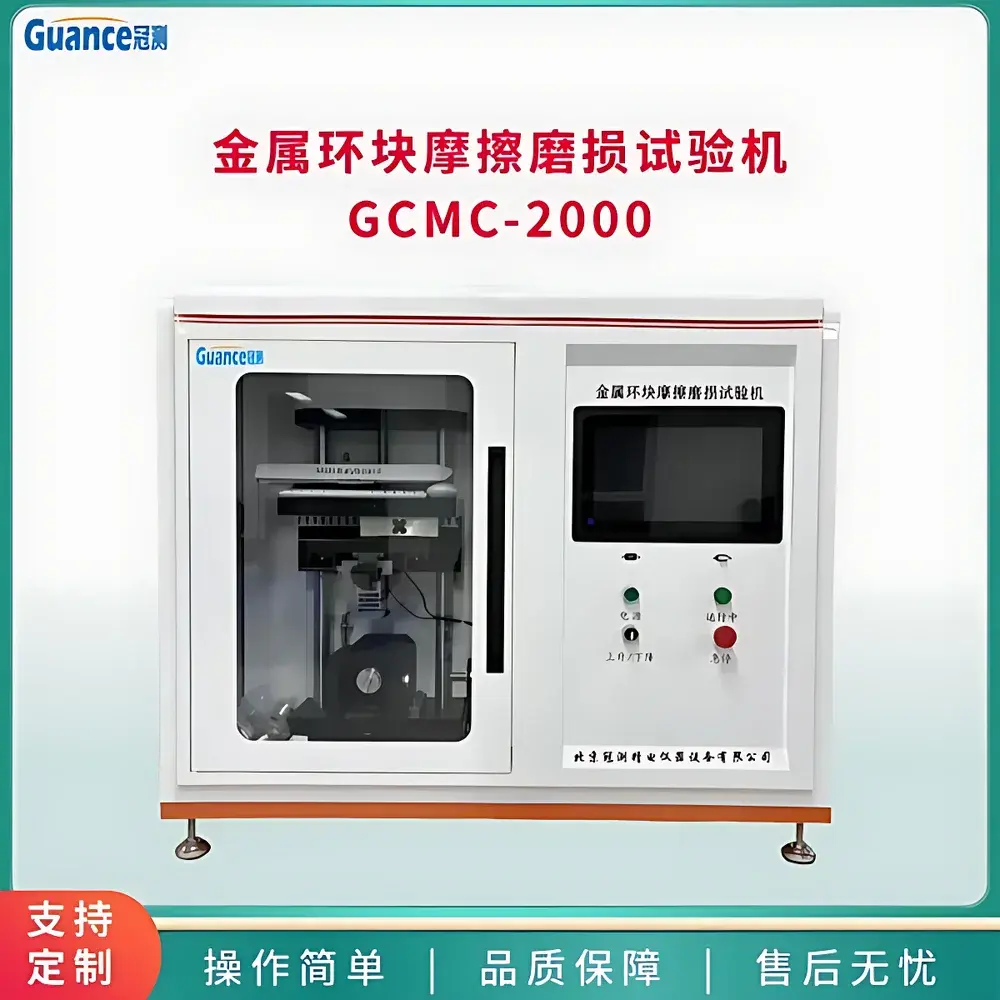
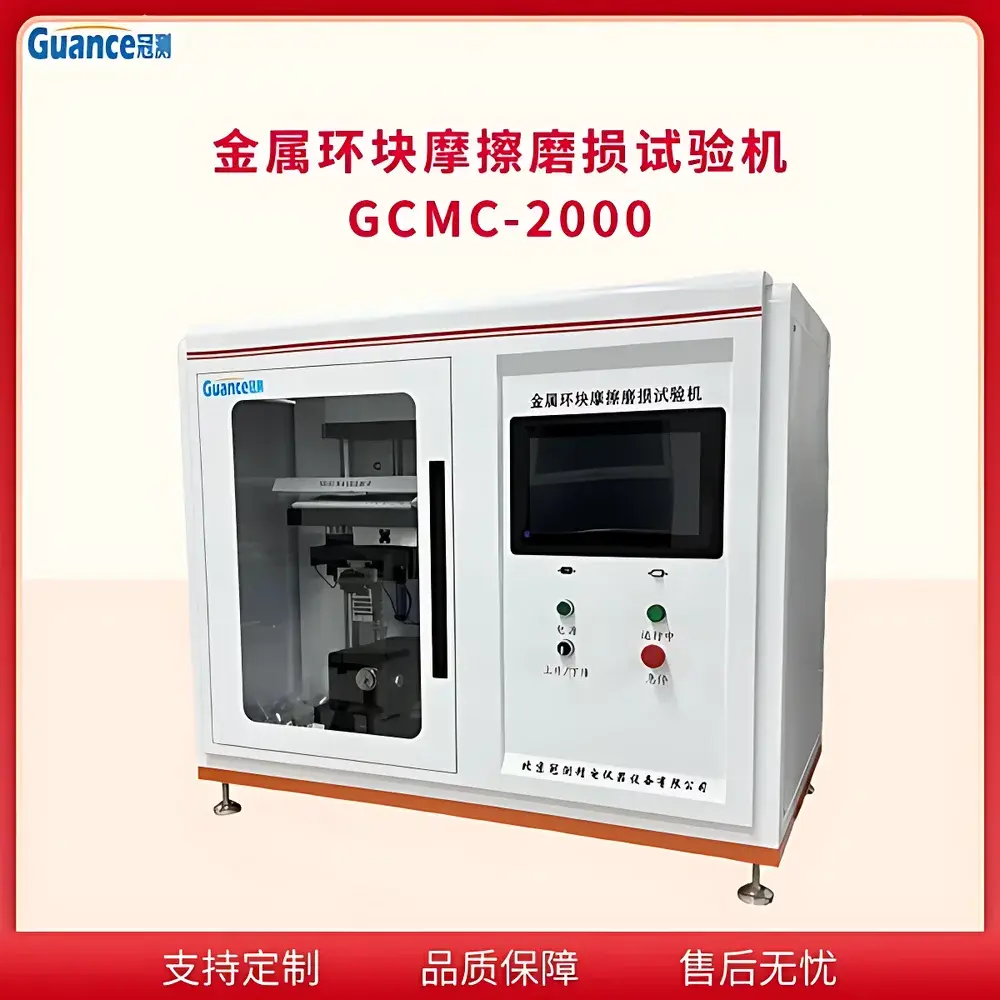
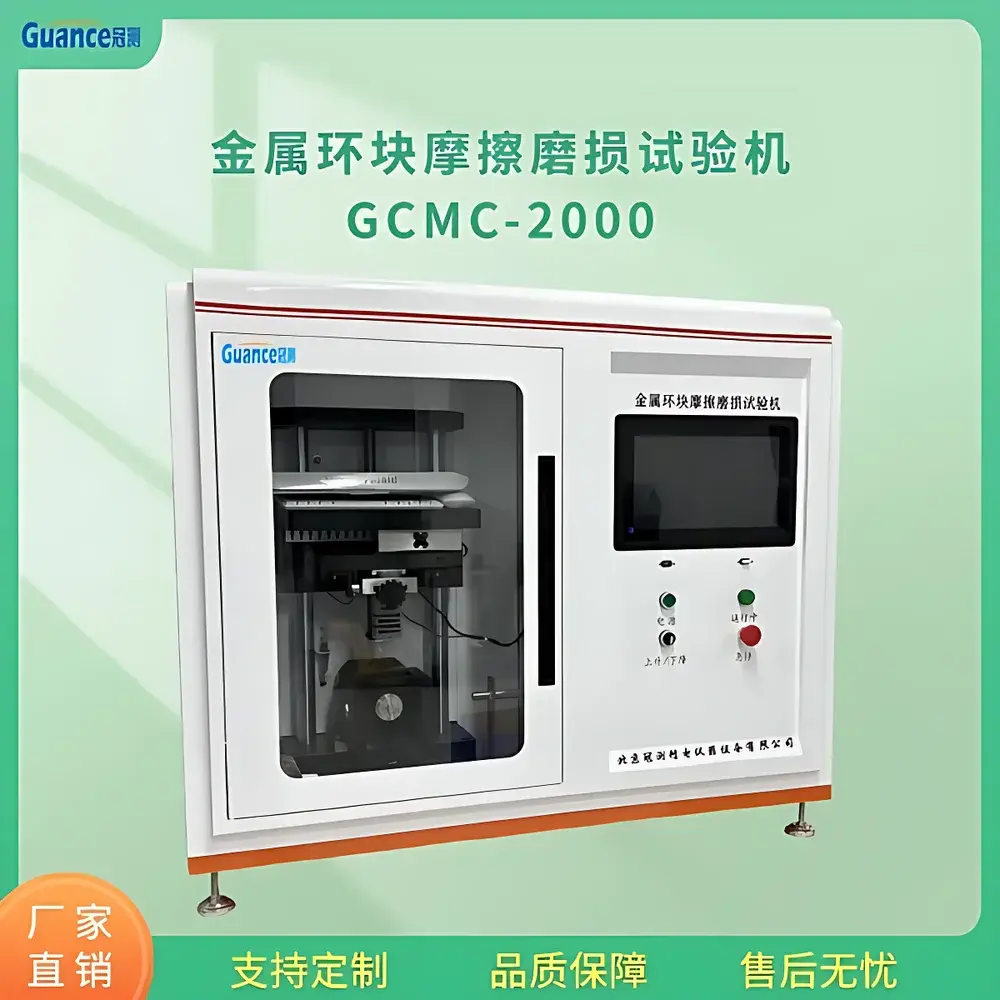
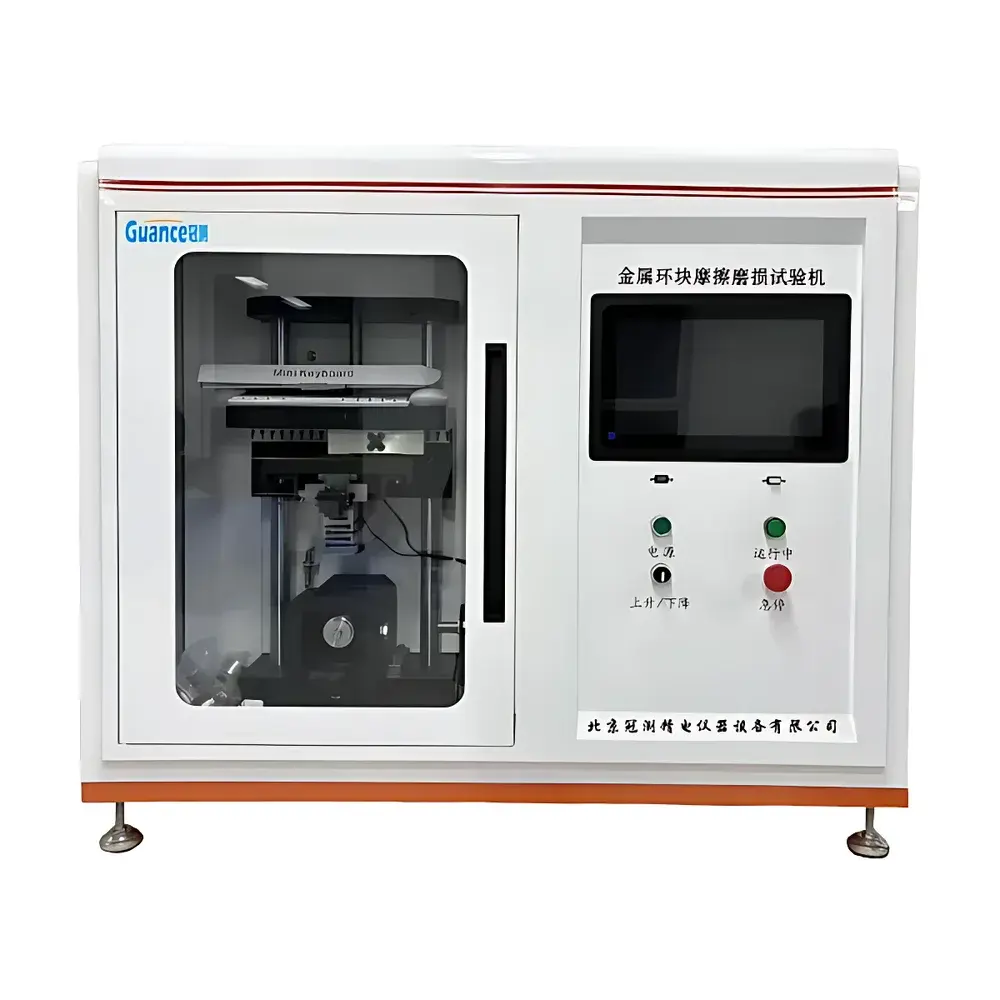
GuanCe Instruments GCMC-2000 Pin-on-Disk Tribological Tester
| Brand | GuanCe Instruments |
|---|---|
| Origin | Hebei, China |
| Manufacturer Type | Authorized Distributor |
| Country of Origin | China |
| Model | GCMC-2000 |
| Instrument Type | Pin-on-Disk (Ring-on-Block) Tribometer |
| Maximum Friction Force | 0–1000 N |
| Rotational Speed Range | 0–3000 rpm |
| Temperature Control Range | 0–200 °C |
| Normal Load Capacity | 0–2000 N |
| Friction Force Resolution | 0.1 N (typical, per ASTM G99 calibration practice) |
| Radial Runout of Spindle | ≤0.01 mm |
| Axial Displacement of Spindle | ≤0.01 mm |
| Parallelism Between Spindle Axis and Test Table | ≤0.02 mm |
| Specimen Dimensions (Block) | 12 mm × 12 mm × 19 mm |
| Power Supply | 220 V / 50 Hz |
| Rated Power | 2 kW |
| Dimensions (L×W×H) | 600 mm × 500 mm × 500 mm |
| Net Weight | 75 kg |
| Compliance | GB/T 12444–2006, ASTM G99, ISO 7148-1 |
Overview
The GuanCe Instruments GCMC-2000 Pin-on-Disk Tribological Tester is an electromechanical benchtop system engineered for quantitative evaluation of sliding friction and wear behavior in metallic materials under controlled normal load, rotational speed, temperature, and environmental conditions. It operates on the standardized pin-on-disk (or ring-on-block) configuration defined in GB/T 12444–2006 and aligned with ASTM G99 and ISO 7148-1 methodologies. In this configuration, a stationary rectangular block specimen (12 mm × 12 mm × 19 mm) is pressed against a rotating annular test ring (or disk) with precise normal force control. The system continuously measures dynamic friction force and applied normal load to compute real-time coefficient of friction (COF), while simultaneously recording interface temperature via embedded thermocouples. Post-test analysis includes volumetric wear calculation from optical measurement of wear scar width (per GB/T 12444) and gravimetric mass loss of the rotating ring using high-precision analytical balances (not included). Designed for repeatability and mechanical stability, the GCMC-2000 features sub-10 µm spindle runout tolerances and rigid cast-iron base construction to minimize parasitic vibration and ensure data fidelity across extended test durations.
Key Features
- Precise dual-axis load application: Independent control of normal load (0–2000 N) and friction force acquisition (0–1000 N, resolution ≤0.1 N) via calibrated load cells
- Variable-speed motor drive: Continuous rotational speed regulation from 0 to 3000 rpm with closed-loop feedback for stable angular velocity under load
- Integrated thermal management: PID-controlled heating element and PT100 sensor enable isothermal testing from ambient to 200 °C with ±1 °C stability over 30-min dwell
- Dry/wet lubrication compatibility: Modular sample chamber accommodates un-lubricated (dry sliding), oil-immersed, or grease-lubricated configurations with optional drip-feed ports
- Mechanical metrology-grade alignment: Spindle radial runout ≤0.01 mm, axial displacement ≤0.01 mm, and spindle-to-table parallelism ≤0.02 mm — verified per ISO 230-1
- Real-time synchronized acquisition: Simultaneous logging of friction force, normal force, rotational speed, interface temperature, and elapsed time at ≥10 Hz sampling rate
Sample Compatibility & Compliance
The GCMC-2000 accepts standard metallic specimens conforming to GB/T 12444–2006 geometry requirements (block: 12 × 12 × 19 mm; counterface ring: inner/outer diameters per specification). It supports ferrous alloys (e.g., carbon steels, stainless steels, tool steels), non-ferrous metals (aluminum, copper, titanium grades), and sintered metal composites. Testing protocols align with internationally recognized tribological standards including ASTM G99 (Standard Test Method for Wear Testing with a Pin-on-Disk Machine), ISO 7148-1 (Plain Bearings — Materials — Part 1: Metal Bearing Materials), and GB/T 12444–2006 (Metallic Materials — Wear Testing Methods — Ring-on-Block Sliding Wear Test). All hardware and firmware comply with CE electromagnetic compatibility (EMC) directives and IEC 61000-6-2/6-3. Data integrity meets GLP documentation requirements when paired with audit-trail-enabled software configurations.
Software & Data Management
The proprietary GCMC Control Suite (v3.2+) provides intuitive Windows-based operation without third-party runtime dependencies. It supports fully programmable test sequences including ramp-hold-step profiles for load, speed, and temperature. Key software capabilities include: automatic COF derivation from raw force vectors; time-sliced statistical analysis (mean, SD, min/max) over user-defined intervals; overlay plotting of up to four synchronized parameters (e.g., COF vs. temperature vs. cumulative revolutions); export of ASCII CSV and Excel-compatible XLSX files with embedded metadata (operator ID, calibration date, environmental conditions); and PDF report generation with customizable headers, pass/fail thresholds, and digital signature fields. Raw binary data archives are timestamped and checksum-verified to support 21 CFR Part 11 compliance when deployed with network authentication and role-based access controls.
Applications
The GCMC-2000 serves as a primary qualification tool in metallurgical R&D laboratories evaluating surface hardening treatments (carburizing, nitriding, PVD/CVD coatings), bulk alloy development (bearing steels, wear-resistant cast irons), and lubricant formulation screening (anti-wear additive efficacy, boundary film stability). It is routinely employed by Tier-1 automotive suppliers validating brake pad–rotor interfaces, by energy equipment manufacturers assessing steam turbine bearing materials, and by independent ISO/IEC 17025-accredited testing labs performing contractual wear certification per OEM specifications (e.g., Ford WSS-M2C949-A, GM 6277M). Academic users apply it to fundamental studies of tribo-oxidation kinetics, third-body layer evolution, and temperature-dependent transition from adhesive to abrasive wear regimes.
FAQ
What standards does the GCMC-2000 directly support?
It is configured and validated for GB/T 12444–2006, ASTM G99, and ISO 7148-1. Custom method templates can be loaded for other standards requiring pin-on-disk geometry.
Can the system operate under vacuum or inert gas?
Not natively — the base configuration lacks sealed chamber integration. However, third-party glovebox adapters with feedthroughs for load/temperature/speed signals are compatible upon request.
Is calibration traceability provided?
Yes — factory calibration certificates for load cells and temperature sensors are supplied, traceable to CNAS-accredited national standards (GB/T 27025). On-site recalibration services are available.
What maintenance is required for long-term accuracy?
Biannual verification of spindle alignment and load cell linearity is recommended. Lubrication of linear guides and inspection of belt tension should occur every 500 operational hours.
Does the system support automated specimen exchange?
No — specimen mounting and unloading are manual procedures per current design. Robotic integration is not supported in v3.x firmware.



