
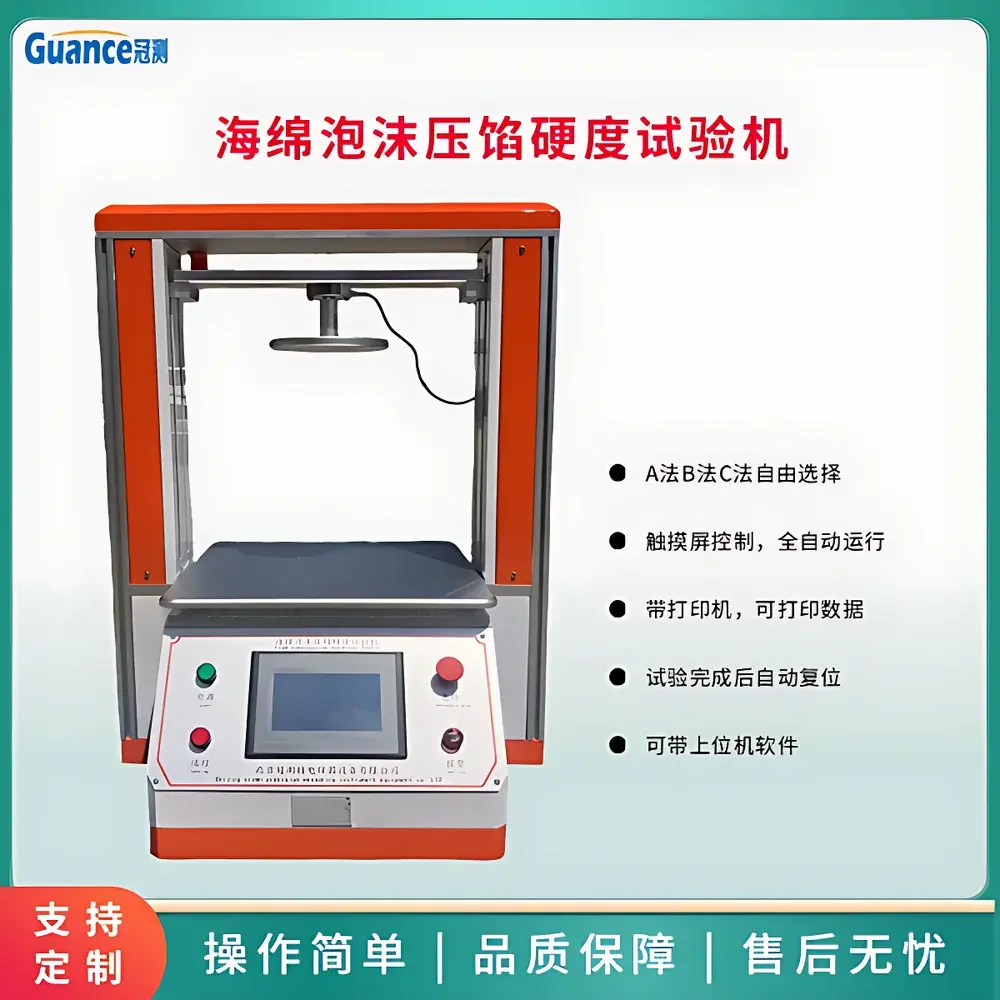
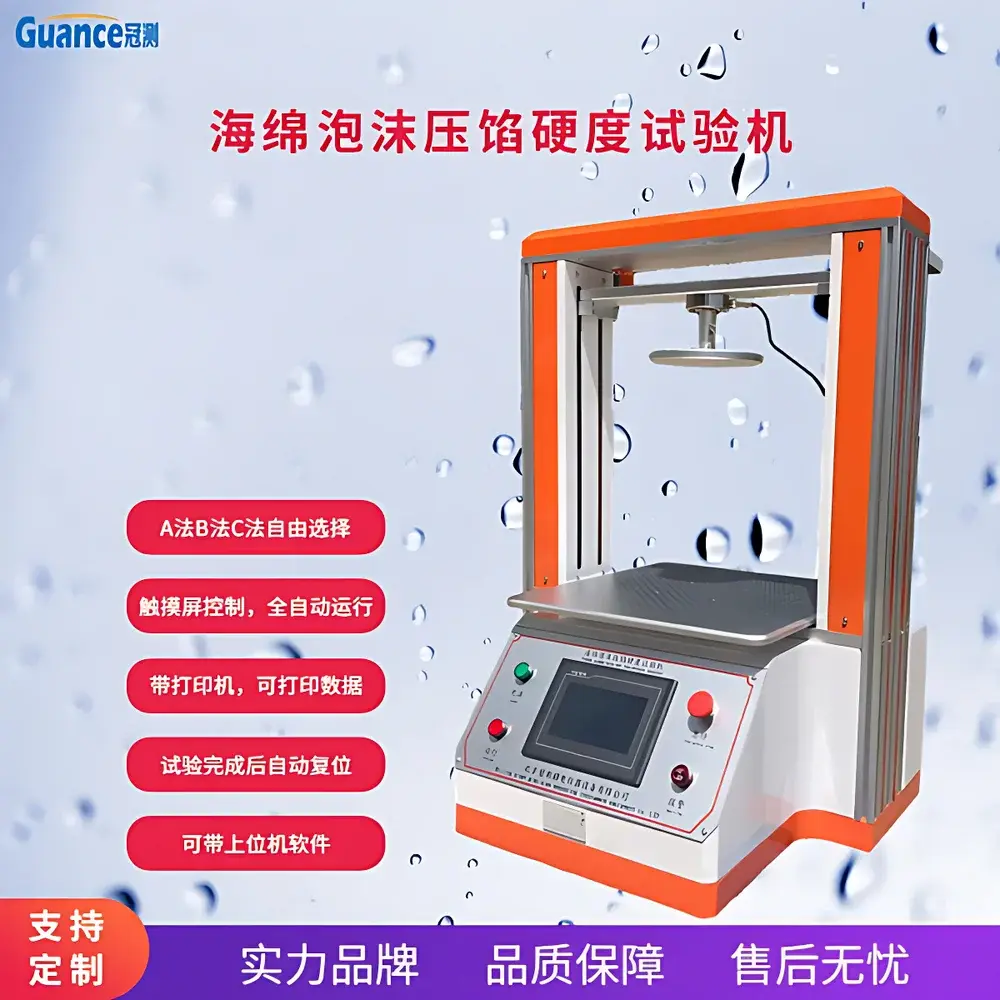
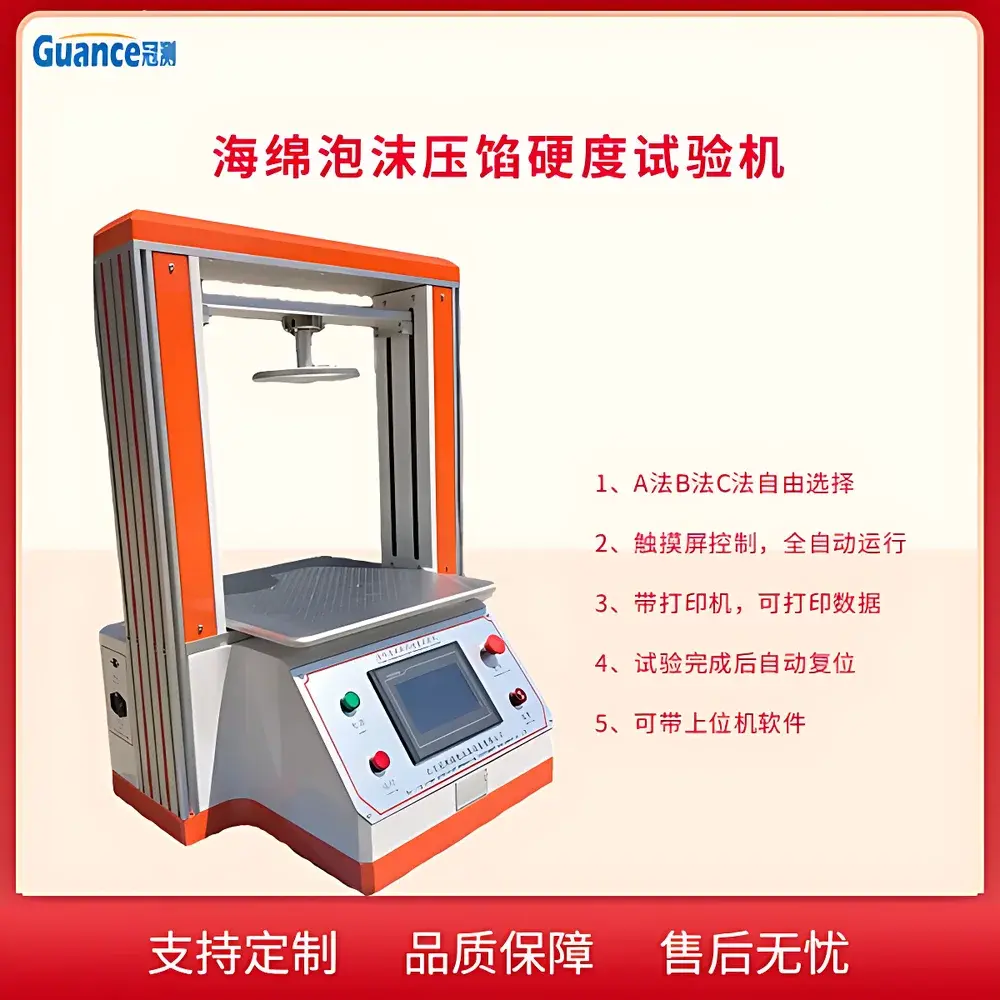
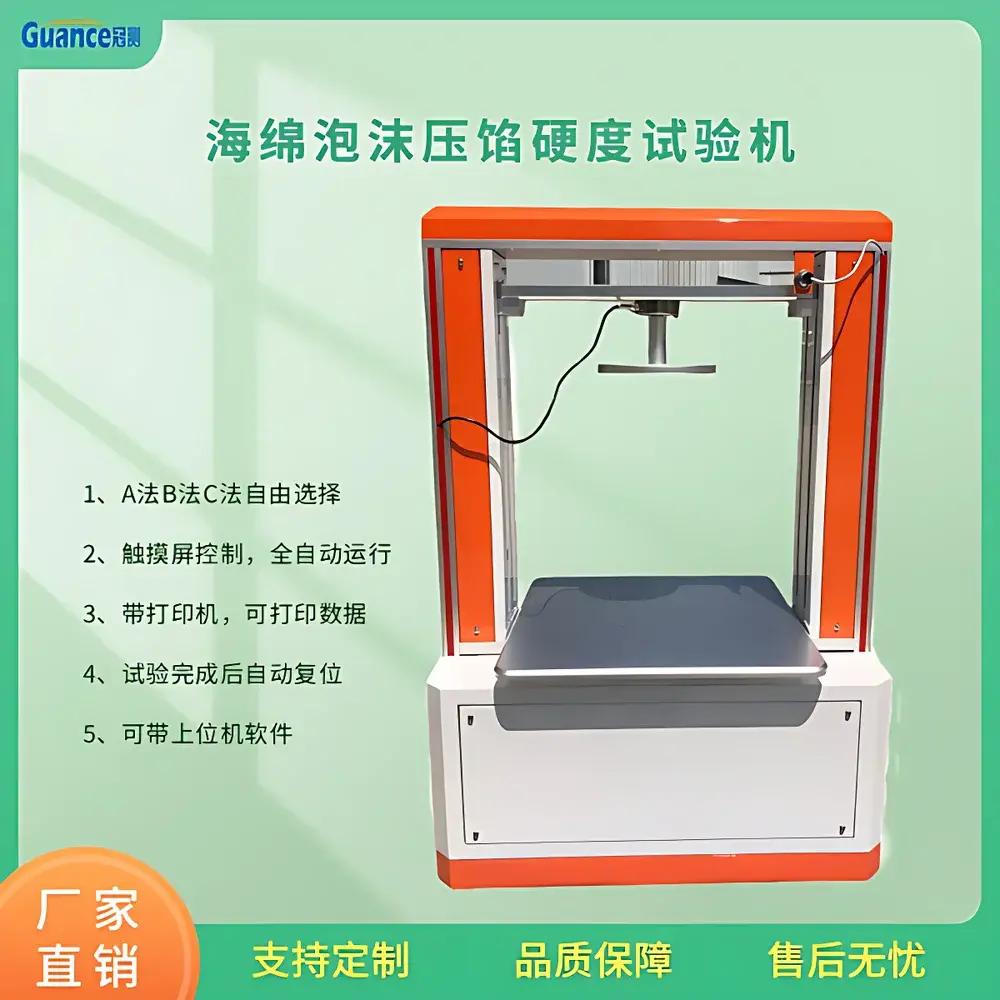
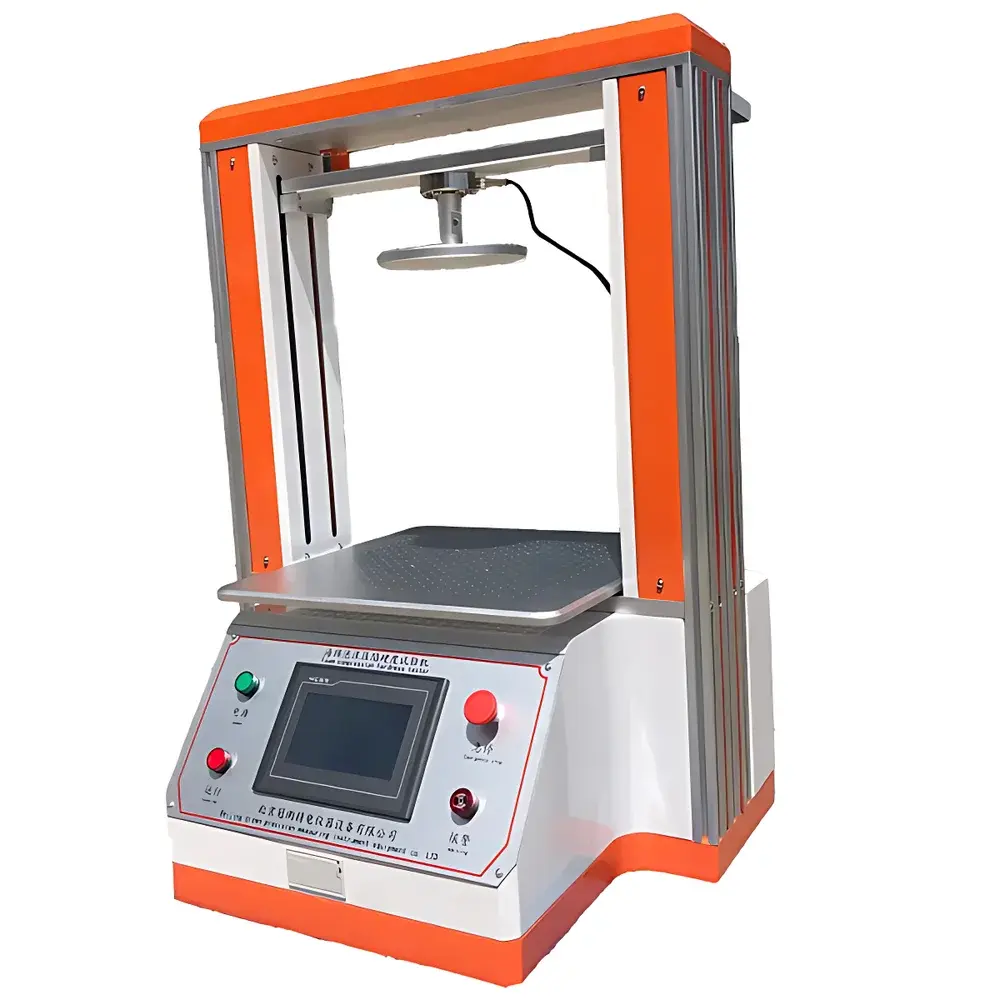
GuanCe PMYX-2000A Foam Indentation Hardness Tester
| Key | Brand: GuanCe Instruments |
|---|---|
| Origin | Beijing, China |
| Model | PMYX-2000A |
| Max Test Force | 20 kN |
| Crosshead Speed | Default 100 mm/min (adjustable) |
| Platen Dimensions | 550 mm × 400 mm × 1200 mm (L×W×H) |
| Force Resolution | 0.01 N |
| Accuracy | <1% FS |
| Indenter Diameter | 200 mm (customizable) |
| Effective Stroke | 400 mm |
| Control Interface | 7-inch touch screen |
| Power Supply | 220 V / 50 Hz |
| Weight | 150 kg |
| Compliance | GB/T 10807-2006, GB/T 12825-2003, GB/T 18942.1-2003, ASTM D3574, GB/T 26392-2011 |
Overview
The GuanCe PMYX-2000A Foam Indentation Hardness Tester is a precision-engineered compression testing system designed specifically for the mechanical characterization of flexible polymeric foams and sponge materials. It operates on the principle of controlled quasi-static indentation—applying a calibrated compressive load via a motor-driven platen onto standardized foam specimens, while continuously measuring force, displacement, and time. The instrument implements standardized indentation protocols defined in international and national specifications—including ISO-derived methods codified in GB/T 10807-2006 (determination of indentation hardness by indentation method), GB/T 12825-2003 (indentation hardness of porous elastic polymers), and ASTM D3574 (test methods for flexible cellular materials). Its architecture integrates a high-rigidity frame, precision ball-screw actuation, and a digital closed-loop control system to ensure repeatable loading profiles, minimal hysteresis, and sub-millisecond data acquisition timing—critical for capturing transient viscoelastic responses during pre-compression, dwell, and recovery phases.
Key Features
- Programmable crosshead speed ranging from 1 mm/min to 300 mm/min, with default operation at 100 mm/min—fully compliant with rate-sensitive indentation standards such as ASTM D3574 Method A–D.
- High-resolution force measurement using a calibrated load cell with 0.01 N resolution and <1% full-scale accuracy across the 20 kN capacity range.
- Automated multi-cycle indentation sequences: three pre-compression cycles followed by precise indentation to 25%, 40%, or 65% of original thickness, with programmable dwell durations up to 300 seconds.
- Integrated 7-inch industrial touch-screen HMI enabling intuitive test setup, real-time monitoring, and on-device parameter adjustment without external PC dependency.
- Real-time synchronized plotting of force vs. displacement and force vs. time curves; cursor-based data interrogation for exact values at any point on the curve.
- Dedicated indentation algorithms for calculating indentation hardness index (IHI), indentation modulus ratios (e.g., F25%/F40%, F65%/F40%), and instantaneous peak load per ASTM D3574 Method C.
- Onboard thermal-printer for immediate hard-copy output of test reports including specimen ID, method used, key metrics, and graphical traces.
- Modular indenter geometry support: standard 200 mm diameter flat circular platen (conforming to GB/T 10807), with optional custom diameters available upon request.
Sample Compatibility & Compliance
The PMYX-2000A accommodates rectangular foam specimens up to 500 mm × 500 mm × 150 mm (L×W×H), ensuring compatibility with standard test samples required by GB/T 10802 (flexible polyurethane foam), GB/T 18942.1-2003 (low-density porous elastomers), and ASTM D3574 (slab, bonded, and molded urethane foams). It supports all major indentation test configurations: Method A (40% indentation hardness index), Method B (multi-stage indentation modulus ratio analysis), Method C (instantaneous peak load at 40%), and Method D (user-defined multi-step compression sequences replicating dynamic service conditions). All firmware logic and calibration routines are traceable to national metrological standards (CNAS-accredited reference labs), and the system supports audit-ready documentation generation aligned with GLP principles. While not FDA 21 CFR Part 11-certified out-of-the-box, raw data export (CSV, XML) enables integration into validated LIMS or ELN platforms meeting regulatory data integrity requirements.
Software & Data Management
The embedded control software provides deterministic test execution based on preloaded method templates—each conforming to clause-specific requirements of GB/T 10807-2006 or ASTM D3574. Users may create, name, store, and recall custom test protocols—including non-standard multi-cycle sequences with variable speeds, dwell times, and target displacements. All test data—including timestamps, force readings, displacement values, and calculated indices—are automatically timestamped and saved in a hierarchical folder structure. Export options include CSV (for Excel/Origin analysis), PDF (formatted reports with graphs), and XML (for automated ingestion into enterprise QA databases). The system logs operator ID, method version, calibration status, and environmental metadata (if external sensors are connected), supporting retrospective root-cause analysis and quality system audits.
Applications
This tester serves quality control laboratories in foam manufacturing, automotive seating R&D, furniture component validation, medical cushioning development, and packaging material certification. Typical use cases include: verification of batch-to-batch consistency in viscoelastic response; comparative evaluation of open-cell vs. closed-cell foam formulations; assessment of aging effects on recovery kinetics (per GB/T 26392-2011); correlation of indentation hardness with compression set performance; and validation of material substitutions against OEM specification limits. Its ability to execute repeatable 5-cycle fatigue sequences makes it suitable for preliminary durability screening prior to full-scale dynamic testing.
FAQ
What standards does the PMYX-2000A directly support?
It natively implements GB/T 10807-2006, GB/T 12825-2003, GB/T 18942.1-2003, ASTM D3574 (Methods A–D), and GB/T 26392-2011.
Can the system perform cyclic compression fatigue testing?
Yes—Method D allows fully customizable multi-step sequences, including repeated compression/recovery cycles with independent speed, displacement, and dwell settings.
Is force calibration traceable to national standards?
Yes—factory calibration certificates reference CNAS-accredited force standards; users may perform field verification using certified deadweight sets.
Does the instrument support networked data transfer?
Data export is supported via USB storage; Ethernet or RS-232 interfaces are optional upgrades for factory-configured systems.
What is the maximum sample height accommodated under the platen?
The effective stroke is 400 mm, and the overall machine height is 1200 mm—allowing specimens up to ~150 mm thick with adequate clearance for full 70% indentation depth.



