
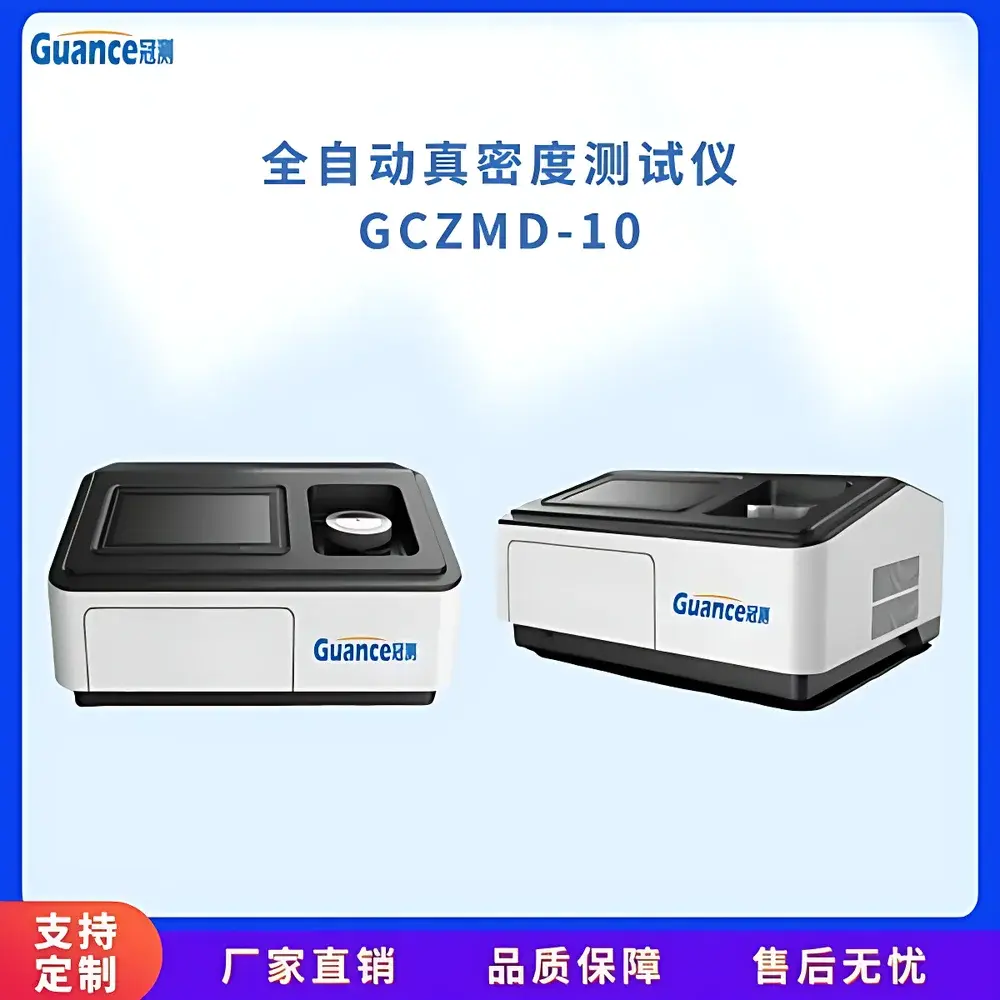
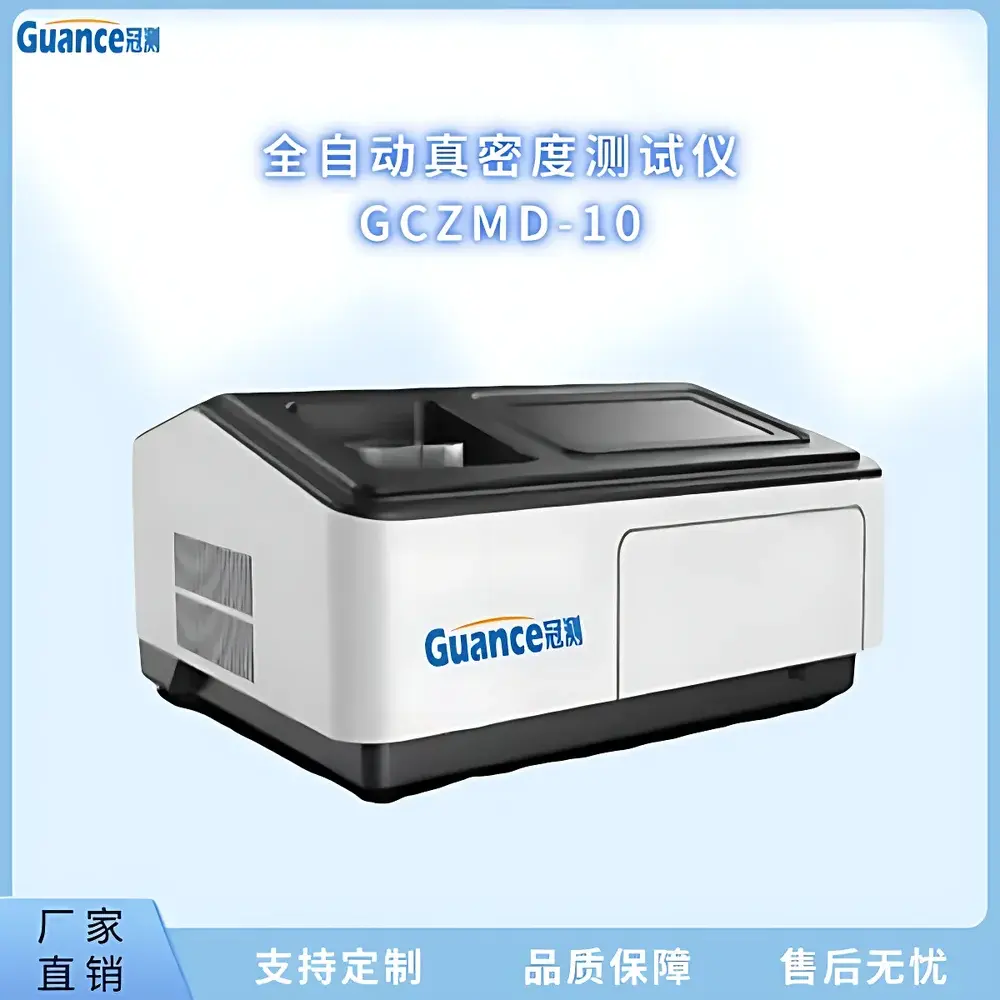
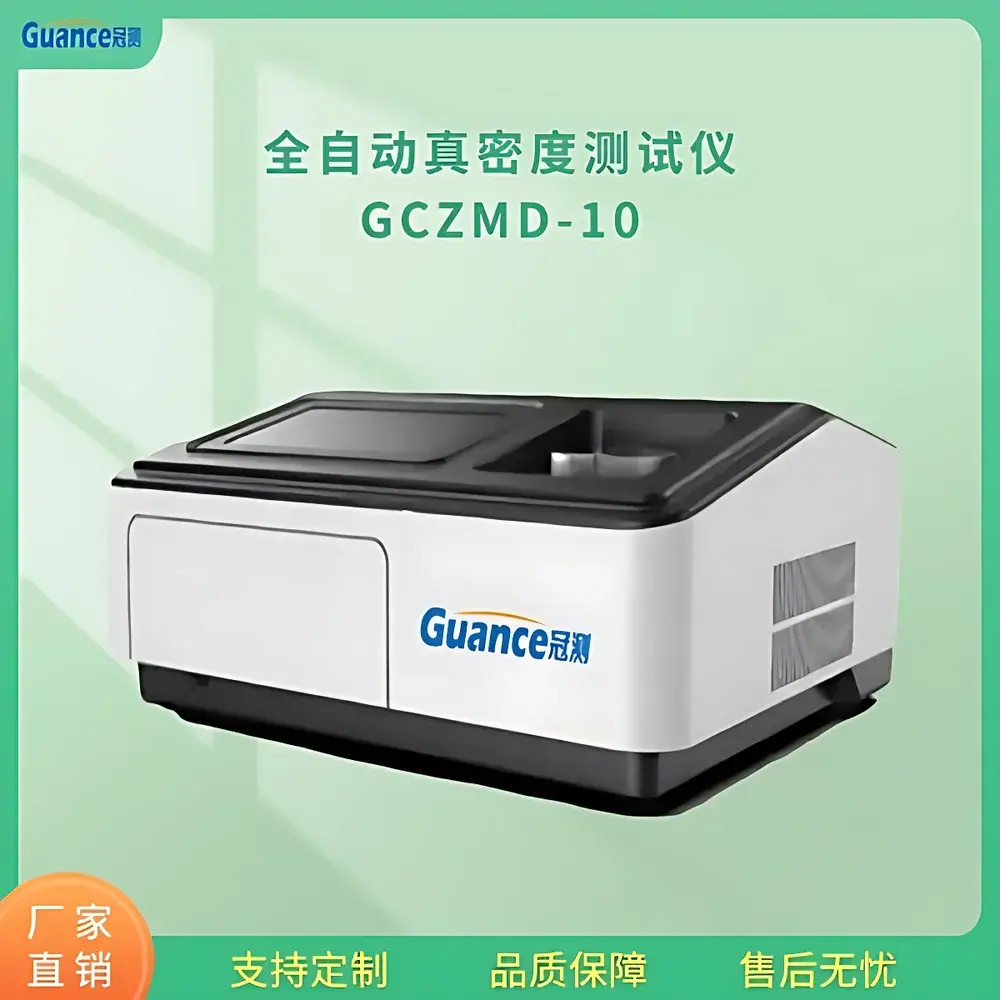
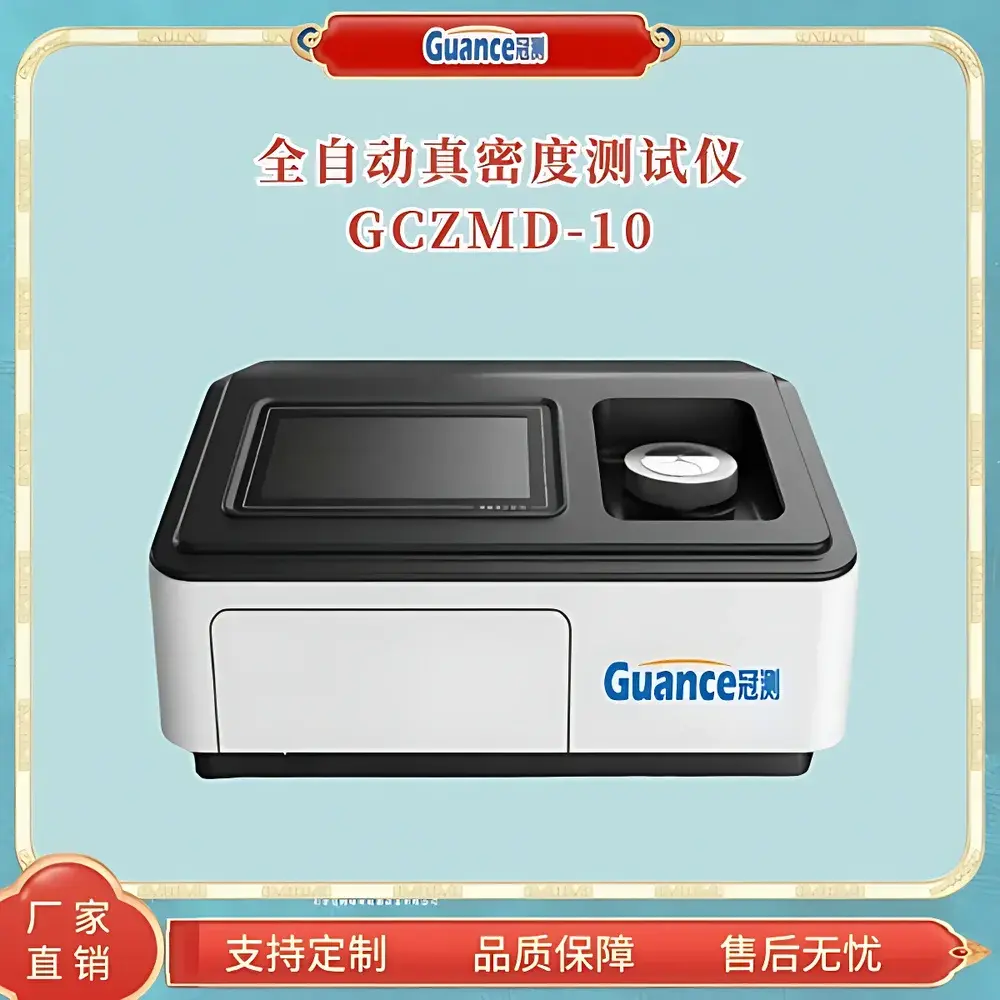
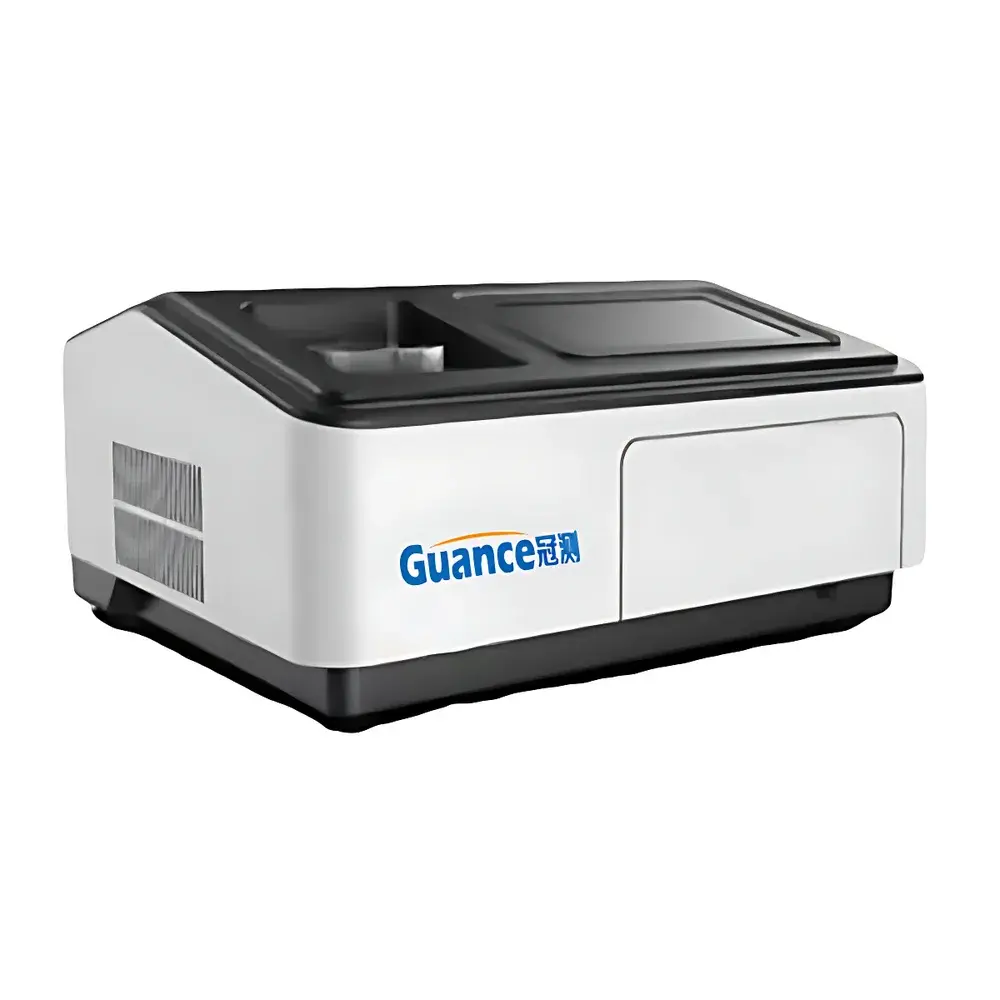
GuanCe Instruments GCZMD-10d True Density Analyzer
| Brand | GuanCe Instruments |
|---|---|
| Origin | Beijing, China |
| Manufacturer Type | Authorized Distributor |
| Regional Category | Domestic (PRC) |
| Model | GCZMD-10d |
| Instrument Type | True Density Analyzer |
| Form Factor | Benchtop (Compact) |
| Sample Compatibility | Solids & Liquids |
| Density Range | 0–20 g/cm³ |
| Maximum Sample Mass | 5 g |
| Density Resolution | 0.01 g/cm³ |
| Density Accuracy | ±0.1% (relative) |
| Repeatability | ≤0.01 g/cm³ (RSD 0.1–0.3%) |
| Minimum Sample Volume | 0.01 mL |
| Temperature Operating Range | 0–40 °C |
| Display | High-contrast 7-inch TFT capacitive touchscreen |
| Pressure Control | Dual-stage regulated up to 2.0 bar (default test pressure: 1.3 bar) |
| Gas Options | Helium (recommended), Nitrogen (user-specified) |
| Measurement Principle | Gas Pycnometry (Helium Displacement, ASTM D5550 / ISO 12154 compliant) |
| Test Time | ~4 minutes per run (configurable via script) |
| Data Interface | RS485, RJ45 Ethernet, USB host (U-disk storage), integrated thermal printer (TMS variant) |
| ADC Resolution | 24-bit |
| Sample Chamber Volume | 10 mL ±0.2 mL |
| Power Supply | AC 220 V, 50 Hz |
| Rated Power | 28 W |
| Dimensions (W×D×H) | 410 × 320 × 155 mm |
| Net Weight | 4.6 kg |
Overview
The GuanCe Instruments GCZMD-10d True Density Analyzer is a benchtop gas pycnometer engineered for high-precision determination of true (skeletal) density of solid and liquid materials. It operates on the fundamental principle of gas displacement—specifically helium expansion into a calibrated reference chamber—governed by the ideal gas law (PV = nRT). When a sample is introduced into the evacuated sample chamber, helium gas expands from the reference chamber to fill the void volume, and the resulting pressure differential is measured with high-stability transducers. Using pre-calibrated chamber volumes and temperature-compensated pressure readings, the instrument computes the non-porous volume occupied by the sample—excluding interstitial voids and open pores—enabling calculation of true density as mass divided by skeletal volume. This method conforms to ASTM D5550 (“Standard Test Method for Density of Soil and Rock in Place by the Rubber Balloon Method”) and ISO 12154 (“Determination of true density of powders and solids by gas pycnometry”), making it suitable for GLP-compliant laboratories engaged in material characterization, quality assurance, and regulatory submissions.
Key Features
- Integrated modular architecture: Co-located pressure sensors, solenoid valves (imported Japanese CFVB25-Z-O-B2C-3), and 10 mL sample cell minimize dead volume and enhance sealing integrity.
- Thermal equilibrium design: Tubeless, monolithic module construction ensures uniform gas temperature distribution across chambers—critical for reducing thermal drift and improving measurement reproducibility.
- Intelligent pressure regulation: Adaptive pressure detection algorithm dynamically adjusts fill/evacuate cycles to compensate for upstream gas cylinder fluctuations, maintaining stable test conditions.
- Script-driven operation: Advanced users may modify embedded C-based test protocols via touchscreen interface to customize purge cycles, equilibration time, and repeat iterations.
- High-fidelity data acquisition: 24-bit analog-to-digital conversion enables sub-millitorr pressure resolution and supports long-term stability tracking under ambient lab conditions.
- Dual-pressure capability: Adjustable upper limit up to 2.0 bar allows controlled compression of compressible samples (e.g., foams, soft polymers) without deformation-induced error.
- Comprehensive connectivity: Standard RS485, RJ45 Ethernet, and USB host port support integration with LIMS, SCADA systems, or standalone PC-based data logging (PNS variant).
Sample Compatibility & Compliance
The GCZMD-10d accommodates diverse physical forms—including granules, powders, monoliths, slurries, and low-viscosity liquids—with minimal sample preparation. Its 10 mL chamber accepts masses up to 5 g and volumes as small as 0.01 mL, enabling analysis of high-value or limited-availability materials. The system includes certified reference standards (PVC, aluminum, copper) for routine calibration verification. All firmware and hardware design elements comply with IEC 61000-4 electromagnetic compatibility standards. Data audit trails—including operator ID, timestamp, environmental temperature, pressure setpoint, and raw sensor outputs—are retained locally and exportable in CSV format, satisfying FDA 21 CFR Part 11 requirements when deployed with validated electronic signature workflows.
Software & Data Management
Embedded firmware features a responsive 7-inch capacitive touchscreen with handwritten input support and multilingual UI (English default). Each analysis generates a complete process log: chamber pressure vs. time curves, temperature traces, valve actuation events, and final density output. Results are automatically saved to internal memory and optionally mirrored to USB flash drives. The TMS variant includes an integrated thermal printer supporting configurable report templates—listing sample ID, batch number, analyst, calibration status, statistical summary (mean, SD, RSD), and compliance flags. Exported datasets retain metadata headers compatible with Microsoft Excel, MATLAB, and JMP for downstream statistical analysis or SPC charting.
Applications
This analyzer serves core R&D and QC functions across industries where skeletal density directly correlates with performance or specification: catalyst development (metal dispersion, pore collapse assessment), ceramic sintering control (green vs. fired density), pharmaceutical excipient qualification (crystallinity index proxy), battery electrode coating density (Li-ion cathode porosity estimation), soil science (mineral composition modeling), and advanced composites (fiber volume fraction validation). Routine use cases include batch release testing of activated carbon, silica gel, molecular sieves, metal powders (Ti-6Al-4V, Inconel), and polymer resins prior to extrusion or molding.
FAQ
What gases are compatible with the GCZMD-10d?
Helium is the primary recommended gas due to its small kinetic diameter, inertness, and ability to penetrate sub-nanometer pores. Nitrogen may be substituted upon user configuration but requires recalibration and yields slightly lower resolution for microporous materials.
Is temperature control active or passive?
The instrument maintains thermal equilibrium passively via its tubeless, thermally coupled module design; no Peltier or chiller is integrated. Ambient lab temperature must remain within 0–40 °C for specified accuracy.
Can the GCZMD-10d measure closed-cell foam density?
Yes—its dual-pressure mode (up to 2.0 bar) suppresses cell wall flexure during measurement, allowing accurate skeletal density determination without artificial volume inflation.
How is calibration verified?
Certified density standards (PVC, Al, Cu) are supplied with NIST-traceable certificates. Users perform daily or per-batch verification using the built-in calibration routine, with deviation logs stored in the audit trail.
Does the system support networked data export?
Yes—RJ45 Ethernet enables TCP/IP communication for remote monitoring, scheduled data push to FTP/SFTP servers, or direct ingestion into enterprise LIMS via Modbus TCP or custom REST API adapters (available under extended support contract).



