
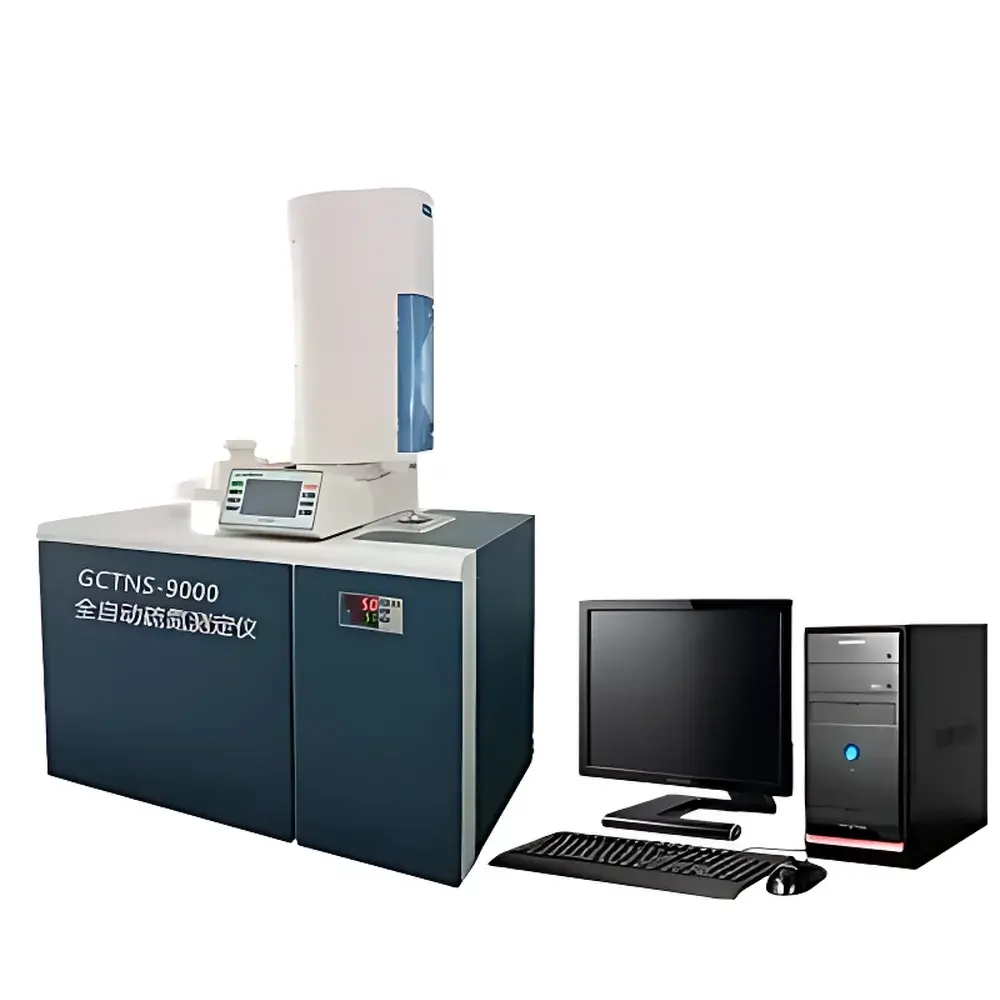
GUOCHUANG GCTS-9000 Automated UV Fluorescence Sulfur Analyzer
| Brand | GUOCHUANG |
|---|---|
| Origin | Jiangsu, China |
| Manufacturer Type | Direct Manufacturer |
| Model | GCTS-9000 |
| Measured Element | Sulfur |
| Measurement Principle | Ultraviolet Fluorescence (UVF) |
| Measurement Range | 0.02–10,000 ppm (mg/L), dilutable for higher concentrations |
| Detection Limit | 0.01 ppm |
| Combustion Furnace Temperature Range | Ambient to 1300 °C |
| Temperature Control Accuracy | ±1 °C |
| Sample Volume (Liquid) | 2–50 μL |
| Analysis Time per Sample | ~120 s |
| Carrier Gas | High-purity Argon (≥99.9%) and Oxygen (≥99.9%) |
| Power Supply | AC 220 V ±10%, 50 Hz, 1500 W |
| Dimensions (W×D×H) | 505 × 541 × 960 mm |
| Weight | 40 kg |
Overview
The GUOCHUANG GCTS-9000 Automated UV Fluorescence Sulfur Analyzer is a benchtop elemental analyzer engineered for precise, trace-level quantification of total sulfur in liquid hydrocarbon matrices using the ultraviolet fluorescence (UVF) detection principle. In this method, sulfur-containing compounds are thermally oxidized in a high-temperature quartz combustion furnace (up to 1300 °C) under controlled oxygen/argon atmosphere, converting all sulfur species to sulfur dioxide (SO₂). The SO₂ molecules are then carried into a reaction chamber where they are excited by pulsed ultraviolet light; upon relaxation, they emit characteristic fluorescence at ~340 nm, which is detected by a low-noise photomultiplier tube (PMT). Signal intensity is linearly proportional to sulfur concentration over six orders of magnitude, enabling robust quantification from sub-ppm to percent-level sulfur content. Designed for compliance with global regulatory testing protocols—including ASTM D5453, D6667, D7183, ISO 20846, EN 15486, and SH/T 0689—the GCTS-9000 delivers metrologically traceable results suitable for quality control laboratories in petroleum refining, fuel certification, lubricant formulation, and petrochemical R&D.
Key Features
- Automated vertical sample introduction with programmable syringe-based injection (2–50 μL), eliminating carryover and ensuring reproducible dosing.
- Integrated 110-position autosampler with positional accuracy ≤±0.1 mm, supporting unattended batch analysis for up to 110 samples without manual intervention.
- Precision mass flow controllers for real-time regulation of oxygen and argon gas streams—no manual needle-valve adjustments required.
- Quartz pyrolysis tube with proprietary surface treatment, resistant to carbon deposition and eliminating routine disassembly or replacement.
- Optimized UV fluorescence cell featuring automatic UV source intensity compensation, low-background optical design, and sealed light-tight housing to minimize stray-light interference.
- Dual-sensor environmental monitoring: real-time feedback of furnace temperature (±1 °C stability) and gas pressure/flow deviations, triggering audible/visual alarms and automated shutdown if thresholds are exceeded.
- Embedded thermal protection logic: software-enforced upper-temperature limit with automatic furnace cooldown and system lockout to prevent hardware damage.
- Modular gas purification train including hydrocarbon traps, moisture scrubbers, and particulate filters—ensuring baseline stability and detector longevity.
- Quick-connect gas line architecture using stainless-steel ball-lock fittings for tool-free maintenance and leak-tight integrity verification.
Sample Compatibility & Compliance
The GCTS-9000 is validated for direct analysis of volatile and non-volatile liquid fuels and feedstocks, including gasoline, diesel, jet fuel, LPG, naphtha, light olefins (e.g., propylene, butadiene), crude oil fractions, biodiesel blends, and lubricating oils. It meets the physical and performance requirements specified in ASTM D5453 (light hydrocarbons, spark-ignition fuels, diesel, and engine oils), ASTM D6667 (gaseous hydrocarbons and LPG), ISO 20846 (motor gasoline), and GB/T 11060.8 (natural gas). All measurement procedures adhere to Good Laboratory Practice (GLP) principles, with full audit trail support—including user login timestamps, parameter change logs, calibration history, and raw signal export—for FDA 21 CFR Part 11–compliant environments when deployed with validated software configurations.
Software & Data Management
The instrument operates under a Windows-based control platform with intuitive graphical interface supporting multilingual operation (English default). The acquisition software performs real-time spectral visualization, automatic baseline correction, peak integration, and dynamic standard curve generation using up to 12 calibration points. All analytical metadata—including sample ID, injection volume, furnace temperature profile, gas flow rates, and raw fluorescence counts—are embedded in each result file (.csv and .xls export supported). Built-in data validation tools flag outliers based on RSD thresholds (e.g., ≤2.5% for >100 ppm; ≤6% for 10–100 ppm), and users may configure automated QC checks against reference standards prior to report generation. Audit trails are stored locally with write-protection and time-stamped digital signatures, satisfying traceability requirements for ISO/IEC 17025-accredited testing laboratories.
Applications
- Regulatory compliance testing of ultra-low-sulfur diesel (ULSD) and Euro 6/China VI gasoline formulations.
- Process monitoring of hydrotreating units to verify sulfur removal efficiency across feedstock cuts.
- Quality assurance of biofuels and ethanol-gasoline blends (E10, E85) per ASTM D5768 and GB/T 34100.
- Trace sulfur speciation support via coupling with GC-UVF interfaces (optional configuration).
- Research applications involving catalyst deactivation studies, sulfur poisoning kinetics, and refinery stream characterization.
- Contract laboratory services requiring GLP-compliant reporting for API, EPA, and CNPC submissions.
FAQ
What sulfur species does the GCTS-9000 detect?
It measures total sulfur—regardless of chemical form (e.g., mercaptans, sulfides, disulfides, thiophenes, sulfoxides)—by quantitative oxidative conversion to SO₂.
Can the instrument analyze solid or gaseous samples?
No—it is optimized exclusively for liquid-phase injection; solids require solvent dissolution and gases require cryo-trapping or permeation tube calibration.
Is method validation documentation available?
Yes—system suitability tests, detection limit verification (LOD = 0.01 ppm), linearity assessment (r² ≥ 0.9995), and precision data (RSD ≤ 2.5% at 100 ppm) are provided in the Instrument Qualification Package.
How often does the UV lamp require replacement?
The xenon flash lamp has a rated lifetime of ≥1 × 10⁹ pulses; typical usage (200 injections/day) yields >3 years of operational service before scheduled replacement.
Does the software support networked deployment and LIMS integration?
Yes—via TCP/IP protocol and ASTM E1384-compliant ASCII output; optional OPC UA server module enables real-time data streaming to enterprise LIMS or MES platforms.
Related Products






