
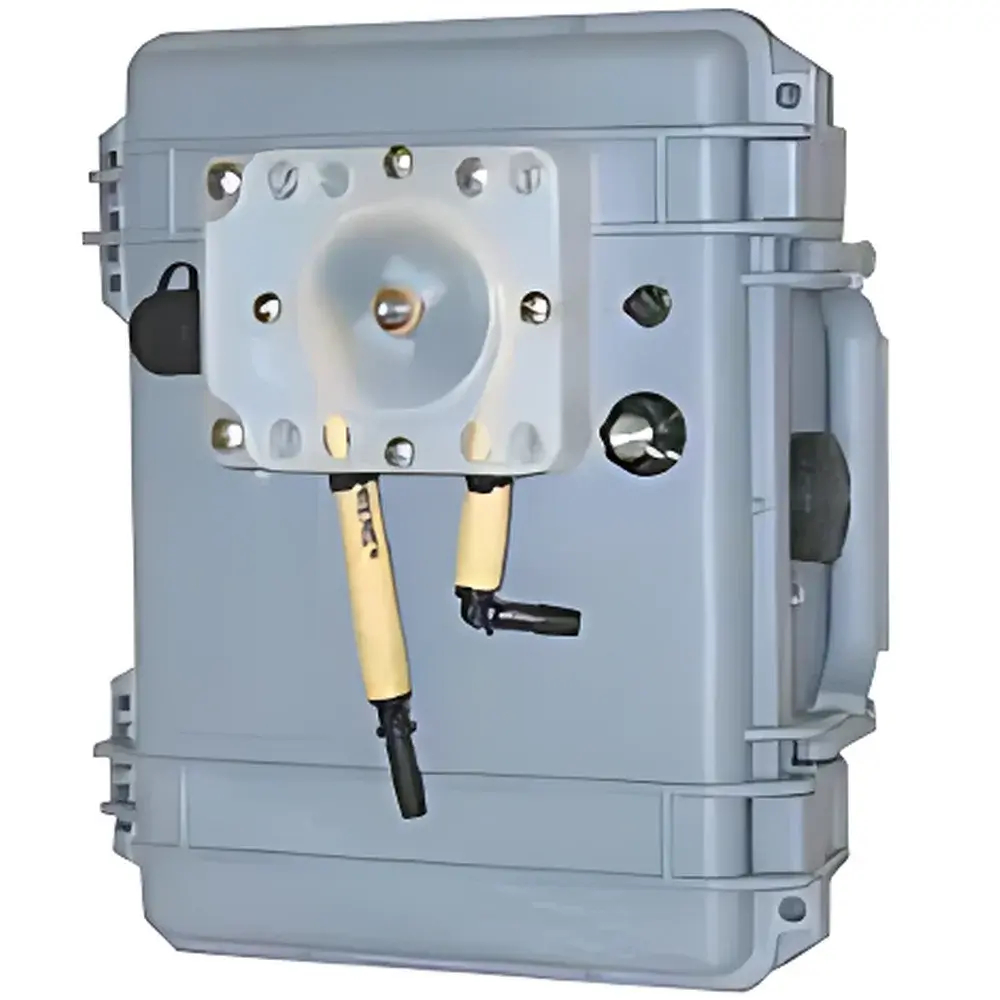
GW SP200 Adjustable-Speed Water Sampler
| Brand | GW |
|---|---|
| Origin | USA |
| Manufacturer Type | Authorized Distributor |
| Origin Category | Imported |
| Model | SP200 |
| Pricing | Available Upon Request |
| Operating Temperature | 0–70 °C |
| Power Supply | External 12 VDC, max 2 A |
| Pump Type | Peristaltic |
| Flow Rate | 0–500 mL/min (at 4-ft head) |
| Backflush Flow Rate | Identical to sampling flow rate |
| Maximum Suction Lift | 22 ft (6.7 m) |
| Tubing | Abrasion-resistant peristaltic tubing, 1/4″ ID |
| Sample Intake Hose | 4.6 m nylon-reinforced polyethylene, fitted with inlet filter |
| Enclosure | UV-stabilized PVC |
| Dimensions | 230 × 190 × 110 mm |
| Weight | 2 kg |
| Standard Kit | SP200 sampler unit, carrying case, 4.6 m intake hose, 3 m power cable, user manual |
Overview
The GW SP200 Adjustable-Speed Water Sampler is a field-deployable, battery-compatible peristaltic sampling instrument engineered for reliable, operator-controlled collection of water samples from shallow wells, surface water bodies (lakes, ponds, reservoirs), and storage tanks. It operates on the principle of positive displacement via rotary roller compression of flexible tubing—eliminating fluid contact with mechanical components and ensuring sample integrity across diverse matrices. Unlike vacuum or diaphragm-based systems, the peristaltic architecture provides inherent isolation between drive mechanism and sample stream, minimizing cross-contamination risk and enabling consistent low-flow sampling without priming. Designed for ambient environmental operation, the SP200 maintains stable performance across a wide thermal envelope (0–70 °C), supporting deployments in temperate through subtropical climates without active thermal regulation.
Key Features
- Single-knob continuous flow control (0–500 mL/min at 4-ft static head), enabling precise volumetric targeting for compliance-driven sampling protocols (e.g., EPA Method 1664, ISO 5667-10).
- Integrated backflush function synchronized with sampling speed—automatically reverses pump direction to purge residual sample and particulate from the intake line, reducing carryover between discrete sampling events.
- UV-stabilized PVC enclosure rated IP54 for dust resistance and limited water ingress protection, suitable for outdoor use in rain, humidity, and direct sunlight exposure.
- Modular 4.6 m reinforced polyethylene intake hose with stainless-steel mesh filter (nominal pore size ~250 µm) prevents macro-debris entry while maintaining laminar flow characteristics.
- Compact footprint (230 × 190 × 110 mm) and lightweight design (2 kg) facilitate handheld operation, backpack mounting, or integration into mobile monitoring carts.
- 12 VDC input compatibility supports standard lead-acid, LiFePO₄, or portable power station sources—no internal battery required, simplifying maintenance and regulatory compliance for field logistics.
Sample Compatibility & Compliance
The SP200 is validated for non-corrosive, low-suspended-solids aqueous matrices including freshwater, treated effluent, and potable distribution system water. Its peristaltic pump configuration avoids metal wetted parts, making it compatible with mildly acidic or alkaline samples (pH 4–10) when using supplied tubing. The system adheres to core principles outlined in ISO 5667-1 (water sampling — Part 1: Guidance on the design of sampling programs) and supports trace-metal clean sampling when paired with acid-washed intake lines and appropriate procedural blanks. While not certified to IEC 61000-6-2/4 for EMC immunity, its low-voltage DC operation minimizes electromagnetic interference in sensitive field environments. No hazardous substance declarations (RoHS, REACH) are required due to absence of restricted heavy metals or halogenated flame retardants in the housing and tubing materials.
Software & Data Management
The SP200 operates as a standalone hardware device with no embedded firmware, cloud connectivity, or proprietary software dependency. All operational parameters—including start/stop timing, flow rate selection, and backflush initiation—are managed manually via front-panel controls. This architecture eliminates cybersecurity vulnerabilities, ensures long-term functional obsolescence resistance, and aligns with GLP-compliant laboratories requiring audit-trail simplicity. Field logs may be recorded externally using standardized forms aligned with EPA Form 1010 or ISO/IEC 17025 documentation templates. For automated scheduling, the unit can be integrated with external programmable timers or PLC-based controllers via dry-contact trigger inputs (optional accessory).
Applications
- Routine grab sampling for nutrient (NO₃⁻, PO₄³⁻), turbidity, and microbiological analysis in lake and reservoir monitoring networks.
- Compliance sampling at drinking water intake points under US Safe Drinking Water Act (SDWA) or EU Drinking Water Directive (DWD) Annex I requirements.
- Pre-treatment influent characterization in wastewater treatment plants where low-flow, particle-laden streams demand gentle aspiration.
- Educational fieldwork and citizen science initiatives requiring intuitive, low-maintenance instrumentation with minimal training overhead.
- Emergency response scenarios—rapid deployment for post-storm runoff or spill assessment where portability and immediate operability are critical.
FAQ
Can the SP200 be used for groundwater sampling from deep wells?
No. With a maximum suction lift of 6.7 m (22 ft), the SP200 is restricted to shallow aquifers, springs, or surface sources. For deeper wells, submersible or bladder-pump systems meeting ASTM D5088 are recommended.
Is the included tubing chemically resistant to chlorine or hydrogen peroxide?
The standard 1/4″ peristaltic tubing is formulated for general freshwater use and exhibits limited resistance to oxidants above 2 mg/L free chlorine. For disinfectant-laden samples, fluoropolymer-reinforced tubing (sold separately) is advised.
Does the unit meet FDA 21 CFR Part 11 requirements for electronic records?
Not applicable—the SP200 generates no electronic records, timestamps, or audit trails. Its manual operation satisfies paper-based GLP/GMP workflows without digital validation burden.
What maintenance intervals are recommended for field longevity?
Roller alignment and tubing replacement every 500 operating hours or after 2000 cycles, whichever occurs first; visual inspection of filter integrity prior to each sampling event.
Can multiple SP200 units be synchronized for composite sampling?
Yes—using externally wired master-slave relay logic or time-based triggers, up to four units may be coordinated for spatially distributed composite sampling per ISO 5667-14 guidelines.
Related Products







