
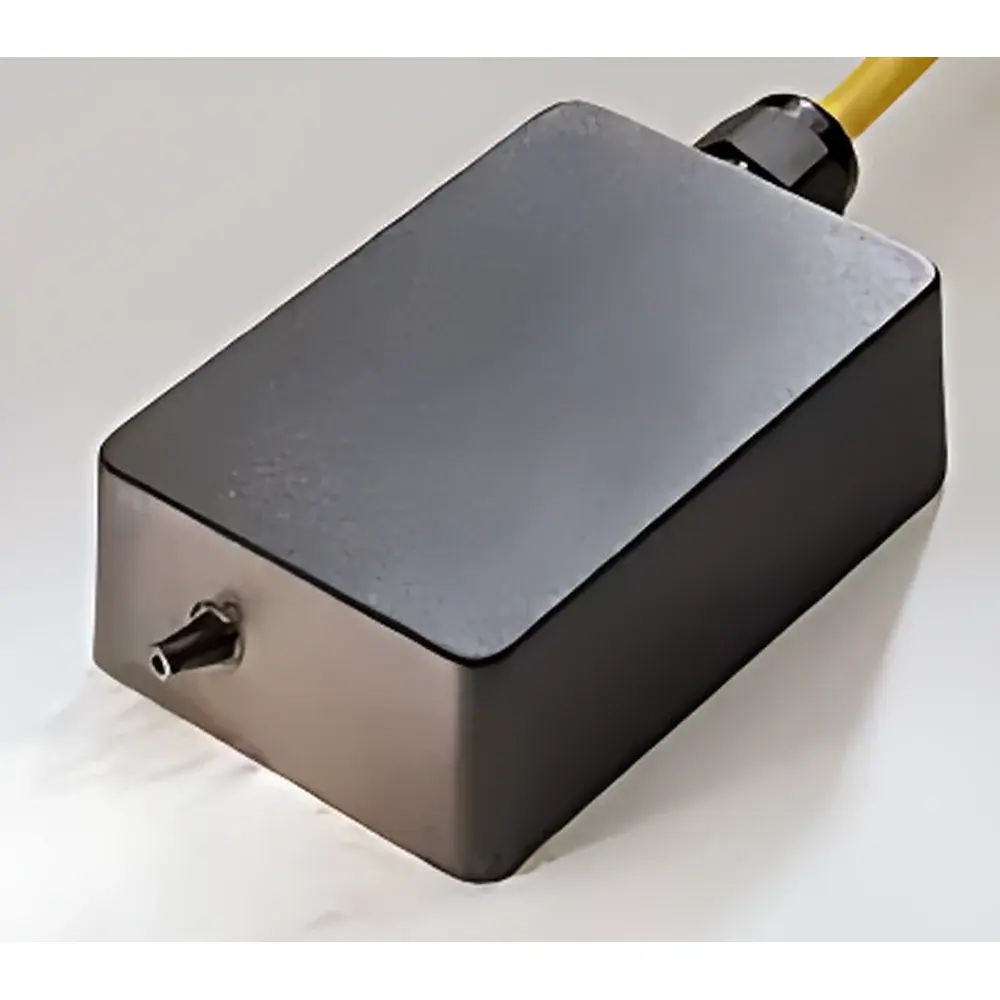
GW WE100 Barometric Pressure Sensor
| Brand | GW |
|---|---|
| Origin | USA |
| Model | WE100 |
| Pressure Range | 800–1100 mbar |
| Accuracy | ±1% FS |
| Linearity | ±0.1% FS |
| Output Signal | 4–20 mA |
| Supply Voltage | 10–36 VDC |
| Warm-up Time | ≥3 s |
| Operating Temperature | −40 to +55 °C |
| Dimensions | 7.6 × 5.1 × 2.5 cm |
| Weight | 59 g |
| Enclosure | Fully Sealed Electronics |
| Cable | Marine-Grade |
Overview
The GW WE100 Barometric Pressure Sensor is an industrial-grade, fully sealed analog transducer engineered for continuous, high-stability atmospheric pressure measurement in demanding environmental monitoring and telemetry applications. Based on a compensated silicon piezoresistive sensing element, the WE100 delivers reliable output across its calibrated range of 800–1100 mbar—covering standard sea-level to high-altitude barometric conditions encountered in meteorological stations, ecological observatories, and unmanned remote sensing platforms. Its 4–20 mA current-loop output ensures noise-immune signal transmission over extended cable runs, making it especially suitable for integration into SCADA systems, data loggers, and distributed environmental sensor networks where electromagnetic interference (EMI) or long-distance wiring is present. The sensor operates within a wide temperature range (−40 to +55 °C), enabling deployment in unheated enclosures, outdoor weatherproof housings, or mobile telemetry units without active thermal regulation.
Key Features
- High-stability piezoresistive pressure sensing element with temperature compensation
- Industrial 4–20 mA analog output compliant with IEC 61000-6-2/6-4 EMI immunity standards
- Fully potted and hermetically sealed electronics for IP67-level ingress protection
- Marine-grade, tinned-copper shielded cable rated for UV resistance and salt-spray environments
- Low power consumption and wide 10–36 VDC supply tolerance for flexible field power sourcing
- Rapid thermal stabilization with ≤3-second warm-up time—critical for time-synchronized telemetry deployments
- Compact form factor (7.6 × 5.1 × 2.5 cm) and lightweight design (59 g) optimized for UAV-mounted, buoy-based, and portable monitoring systems
Sample Compatibility & Compliance
The WE100 is designed exclusively for non-corrosive, dry ambient air measurement and is not intended for use with aggressive gases, condensing vapors, or particulate-laden airstreams. It complies with RoHS 2011/65/EU and REACH (EC) No. 1907/2006 directives. While not certified to specific meteorological standards (e.g., WMO Guide to Instruments and Methods of Observation), its ±1% full-scale accuracy and ±0.1% linearity meet typical requirements for Class II environmental monitoring per ISO 17025-accredited calibration practices. For regulatory deployments requiring traceable calibration, the sensor supports external verification using NIST-traceable barometric reference standards. Its analog interface facilitates integration into systems undergoing GLP or GMP validation where audit trails are maintained via host data acquisition software.
Software & Data Management
As a passive analog transducer, the WE100 does not include embedded firmware or onboard data storage. Its 4–20 mA output is compatible with any industry-standard analog input module—including those found in Campbell Scientific CR series loggers, Siemens Desigo CC controllers, and National Instruments CompactDAQ chassis. When integrated into validated environmental monitoring systems, the sensor’s output can be logged with timestamped metadata, enabling compliance with FDA 21 CFR Part 11 requirements when paired with appropriate audit-trail-enabled software (e.g., LabVIEW DSC Module or custom SCADA historian configurations). Calibration coefficients and installation parameters (e.g., elevation offset, local gravity correction) are managed externally by the host system—not stored within the sensor.
Applications
- Real-time barometric correction for differential pressure-based gas flux measurements (e.g., eddy covariance towers)
- Altitude-referenced calibration of unmanned aerial vehicle (UAV) flight control systems
- Long-term trend analysis in automated ecological observatories and national weather station networks
- Pressure normalization for air quality analyzers (e.g., PM2.5, NOx, O3) operating under variable ambient conditions
- Telemetry backbone for oceanographic buoys and coastal monitoring platforms requiring marine-grade durability
- Reference pressure input for HVAC optimization in green building energy management systems
FAQ
Is the WE100 sensor suitable for indoor laboratory use?
Yes—its stability, low drift, and wide operating temperature range make it appropriate for controlled lab environments; however, it is optimized for field-deployed, unattended operation.
Does the sensor require periodic recalibration?
Per ISO/IEC 17025 guidance, annual calibration against a traceable reference is recommended for critical environmental monitoring applications; field verification every 6 months is advised for high-accuracy deployments.
Can the WE100 be mounted vertically or inverted without affecting accuracy?
Yes—the sensor exhibits no orientation-dependent error due to its solid-state MEMS architecture and lack of moving parts or fluid-filled chambers.
What is the maximum recommended cable length for the 4–20 mA output?
Up to 1,000 meters is achievable with 18 AWG twisted-pair shielded cable and proper grounding at the receiving end, assuming a 24 VDC supply and ≤500 Ω loop resistance.
Is explosion-proof certification available for this model?
No—the WE100 is not intrinsically safe or ATEX-certified; it is intended for general-purpose environmental use only.







