
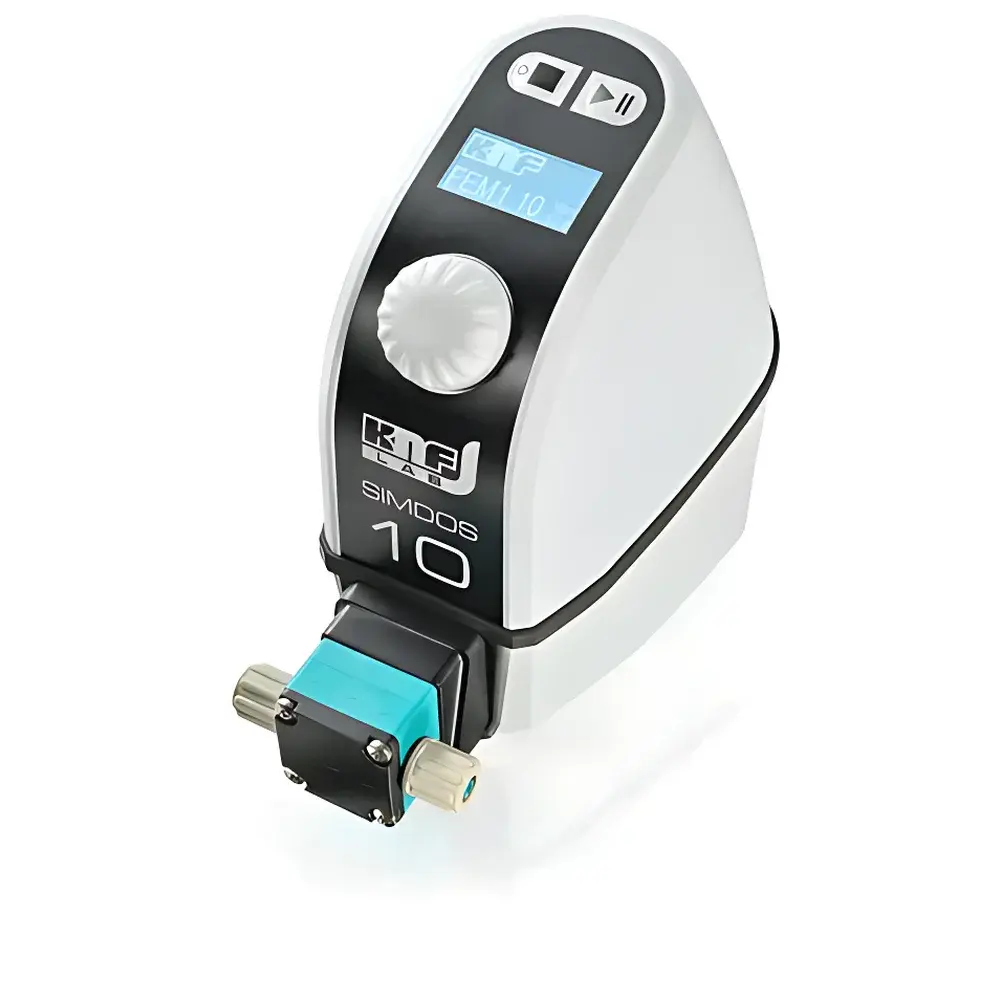
KNF SIMDOS 10 Series Diaphragm Metering Pump
| Brand | KNF |
|---|---|
| Origin | Switzerland |
| Model | FEM 1.10 KT/TT/FT/ST.18 S |
| Flow Rate | 1–100 mL/min |
| Self-Priming Height | 3 mWg |
| Max Discharge Head | 60 mWg |
| Inlet/Outlet Port | 4 mm ID / 6 mm OD (KT/TT), NPT 1/8" (FT) |
| Pump Head / Diaphragm / Valve Material Options | PP/PTFE-coated + FFKM, PVDF/PTFE-coated + FFKM, PTFE/PTFE-coated + FFKM |
| Accuracy | ±2% of reading (RC) |
| Repeatability | ±1% |
| Ambient Temperature Range | 5–40 °C |
| Liquid Temperature Range | 5–80 °C |
| IP Rating | IP65 |
| Power Supply | 99–264 VAC, 50–60 Hz |
| Control Inputs | 0–10 V, 0–20 mA, 4–20 mA (RC models only) |
| Max Fluid Viscosity | 150 cSt |
| Dimensions (L×H×W) | 134 × 93 × 145 mm |
| Weight | 1.5 kg |
Overview
The KNF SIMDOS 10 Series is a precision-engineered diaphragm metering pump designed for accurate, repeatable liquid delivery in laboratory and light industrial environments. Unlike peristaltic or piston-based systems, the SIMDOS 10 employs a mechanically actuated, oil-free diaphragm mechanism with integrated check valves—ensuring pulse-free, contamination-free fluid transfer without lubricant migration or tubing fatigue. Its core architecture follows the principles of positive displacement via elastic membrane deflection, enabling precise volumetric dosing across variable backpressures up to 60 mWg. The pump operates silently (<55 dB(A)), requires zero routine maintenance, and is certified for continuous dry-run capability—a critical advantage in intermittent dosing or start-stop applications such as reagent addition, loop circulation, or environmental sampling.
Key Features
- True metering functionality with dual-mode operation: manual dial control (KT/TT/FT variants) or analog signal-driven regulation (RC variants via 0–10 V / 4–20 mA inputs)
- Chemically resistant wetted path options: PP/PTFE-coated pump head with FFKM valves (for general-purpose use); PVDF/PTFE-coated head (enhanced resistance to halogenated solvents and oxidizers); all-PTFE head with FFKM seals (for aggressive media including concentrated acids, bases, and organic peroxides)
- High repeatability (±1%) and calibrated accuracy (±2% RC) traceable to internal factory verification protocols aligned with ISO/IEC 17025–compliant metrology practices
- IP65-rated enclosure ensures protection against dust ingress and low-pressure water jets—suitable for benchtop use in fume hoods, cleanrooms (ISO Class 8), or semi-industrial QC labs
- Integrated thermal cutoff and current monitoring prevent coil overheating during extended duty cycles or blocked outlet conditions
- Compact footprint (134 × 93 × 145 mm) and lightweight design (1.5 kg) facilitate integration into automated workstations, analytical flow cells, or portable field instrumentation
Sample Compatibility & Compliance
The SIMDOS 10 accommodates liquids with viscosities up to 150 cSt and temperatures from 5 °C to 80 °C, supporting aqueous solutions, alcohols, acetone, THF, DMF, dilute mineral acids (e.g., HCl ≤37%, HNO₃ ≤65%), and caustic solutions (NaOH ≤50%). It is not rated for abrasive slurries, particulates >50 µm, or gases. All RC models support configurable analog input scaling and linearization tables compatible with LabVIEW™, MATLAB® Data Acquisition Toolboxes, and PLC-based SCADA systems. The device complies with IEC 61000-6-3 (EMC emission), IEC 61000-6-2 (immunity), and meets CE marking requirements under the EU Machinery Directive 2006/42/EC and Low Voltage Directive 2014/35/EU. While not intrinsically safe, it may be deployed in Zone 2 classified areas when installed per IEC 60079-14 guidelines.
Software & Data Management
Although the SIMDOS 10 operates as a standalone analog-controlled instrument without embedded firmware or USB connectivity, its RC variants integrate seamlessly into validated data acquisition ecosystems. When paired with compliant DAQ hardware (e.g., National Instruments USB-6009 or Keysight 34972A), the pump supports full audit trail generation—including timestamped flow setpoints, actual current draw (proxy for load), and runtime counters—enabling alignment with FDA 21 CFR Part 11 requirements for electronic records when deployed within GxP workflows. Calibration certificates include uncertainty budgets referenced to NIST-traceable flow standards (gravimetric method per ISO 5167-1). No proprietary software is required; configuration is performed via external controller logic or programmable logic sequencers.
Applications
- Automated reagent dispensing in titration systems and wet-chemistry analyzers
- Circulation of calibration standards in online water quality monitors (e.g., COD, TOC, nitrate sensors)
- Controlled monomer feed in lab-scale polymerization reactors (RAFT, ATRP)
- Continuous eluent delivery in preparative HPLC and ion chromatography systems
- Sampling loop priming and purge cycles in EPA Method 300.0–compliant anion analysis platforms
- Dosing of catalysts or inhibitors in microreactor studies requiring stoichiometric precision at mL/min scale
FAQ
Can the SIMDOS 10 handle viscous silicone oils or glycerol-based formulations?
No. With a maximum viscosity limit of 150 cSt, it is unsuitable for silicone oils (>1,000 cSt) or undiluted glycerol (1,412 cSt at 25 °C). For such fluids, consider KNF’s NMP series diaphragm pumps with heated heads and low-speed motors.
Is dry-running harmful to the pump over time?
No. The SIMDOS 10 is explicitly engineered for indefinite dry operation due to its non-contact diaphragm actuation and FFKM valve resilience—validated per DIN EN 13709 test protocols.
Does KNF provide IQ/OQ documentation for GMP environments?
Yes. Upon request, KNF supplies customizable Installation Qualification (IQ) and Operational Qualification (OQ) templates—including test scripts for flow linearity, repeatability, and analog input response—compatible with pharmaceutical and biotech validation frameworks.
What is the expected service life under continuous 24/7 operation?
Based on accelerated life testing at 100% duty cycle and 25 °C ambient, mean time between failures (MTBF) exceeds 20,000 hours for the motor assembly and 30,000 hours for the diaphragm module—assuming proper chemical compatibility and absence of particulate contamination.



