
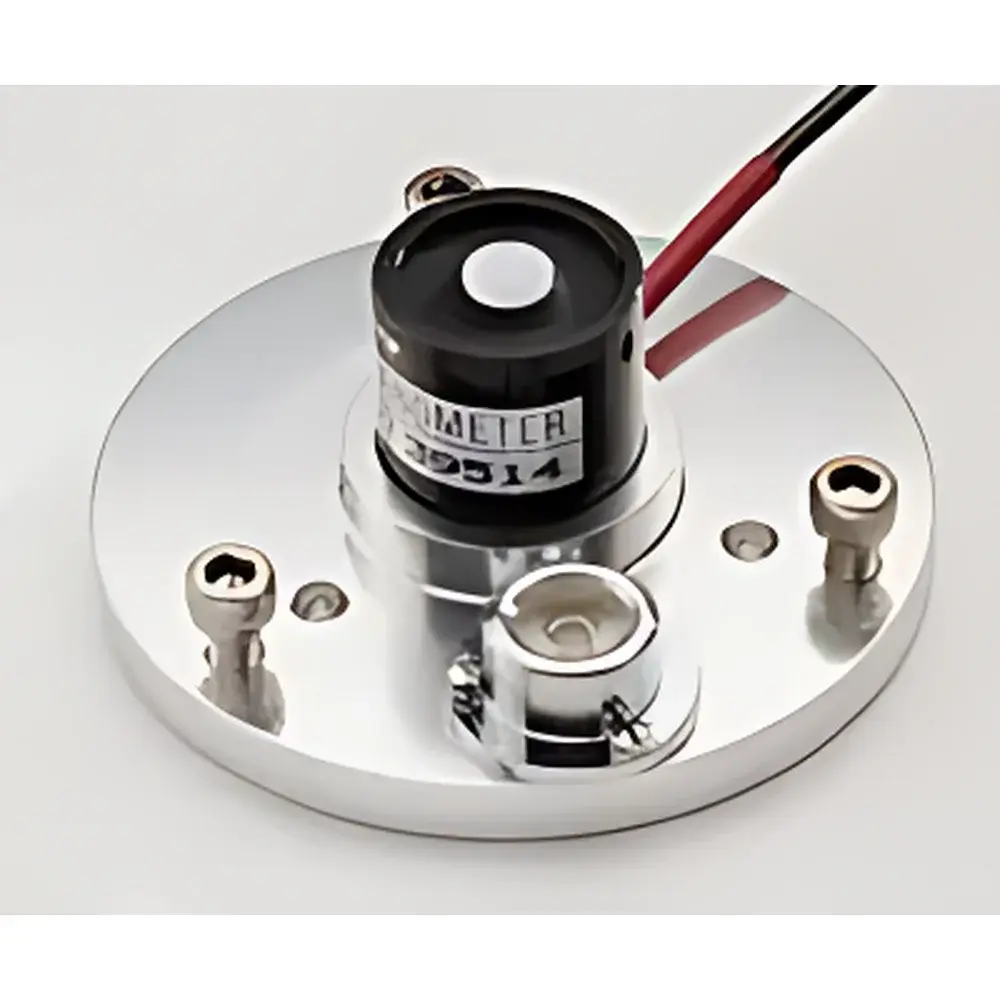
GW WE300 Pyranometer with Silicon Photovoltaic Detector
| Brand | GW |
|---|---|
| Origin | USA |
| Model | WE300 |
| Output | 4–20 mA |
| Spectral Response | 400–1100 nm |
| Measurement Range | 0–1500 W/m² |
| Accuracy | ±1% |
| Operating Voltage | 10–36 VDC |
| Warm-up Time | ≥3 s |
| Operating Temperature | −40 to +55 °C |
| Dimensions | Ø76 mm × 38 mm |
| Weight | 114 g |
| Detector Type | High-Stability Silicon Photovoltaic Cell |
| Enclosure | Fully Sealed Electronics |
| Cable | Marine-Grade Shielded Cable |
| Compliance | CE, RoHS |
Overview
The GW WE300 Pyranometer is a precision-calibrated, silicon photovoltaic-based solar irradiance sensor engineered for continuous, high-reliability measurement of global horizontal irradiance (GHI) in environmental monitoring, meteorological networks, photovoltaic system performance assessment, and ecological remote sensing applications. Unlike thermopile-based pyranometers, the WE300 employs a spectrally selective silicon photodiode optimized for the photosynthetically active radiation (PAR)-adjacent band (400–1100 nm), delivering rapid response and stable output under variable solar angles and diffuse/direct irradiance conditions. Its design adheres to the functional intent of ISO 9060:2018 “Solar energy — Specification and classification of instruments for measuring hemispherical solar and direct solar radiation”, classifying it as a Secondary Standard-class instrument when used within its specified spectral and angular constraints. The sensor operates on a two-wire 4–20 mA current loop, enabling robust signal transmission over extended cable runs with minimal susceptibility to electromagnetic interference—critical for telemetry deployments in coastal, agricultural, or remote ecological observatories.
Key Features
- High-stability silicon photovoltaic detector with low temperature coefficient (< ±0.15 %/°C) and long-term drift < 2 % per year
- Marine-grade, UV-resistant, shielded cable (standard 5 m length, customizable) rated for outdoor exposure and salt-spray environments
- Fully potted, hermetically sealed electronics housing providing IP67 ingress protection against dust and water immersion
- Low power consumption (≤1.2 W at 24 VDC) and wide operating voltage range (10–36 VDC) compatible with solar-powered data loggers and SCADA systems
- Fast thermal stabilization: full electrical output stability achieved within 3 seconds of power-on
- Compact cylindrical form factor (Ø76 mm × 38 mm, 114 g) facilitating integration into multi-sensor telemetry masts and UAV-deployable environmental pods
Sample Compatibility & Compliance
The WE300 is designed for unobstructed, horizontal mounting on stable platforms with clear sky view (no shading from structures, vegetation, or terrain). It complies with IEC 61724-1:2021 for photovoltaic system monitoring and meets the electromagnetic compatibility (EMC) requirements of EN 61326-1 for industrial measurement equipment. While not certified to the full thermopile traceability chain of ISO/CIE standards, its calibration is traceable to NIST-traceable reference cells via accredited laboratory procedures. The device satisfies RoHS Directive 2011/65/EU and carries CE marking for conformity with EU safety, health, and environmental protection standards. For GLP/GMP-aligned environmental monitoring programs, the 4–20 mA analog output supports audit-ready data acquisition when paired with compliant data loggers featuring time-stamped, linearized recording and secure storage.
Software & Data Management
The WE300 requires no embedded firmware or proprietary software—it interfaces seamlessly with industry-standard data acquisition systems (e.g., Campbell Scientific CR series, Onset HOBO RX3000, Delta-T Devices DL2e) that support 4–20 mA analog inputs. Raw current values are linearly proportional to irradiance (0 W/m² = 4 mA; 1500 W/m² = 20 mA), enabling straightforward scaling in SCADA HMI configurations or Python/Matlab post-processing scripts. When integrated into cloud telemetry platforms (e.g., ThingsBoard, AWS IoT Core), the sensor supports automated calibration validation through periodic zero-point checks (nighttime dark-current verification) and slope consistency analysis across diurnal cycles. Optional analog-to-digital conversion modules with built-in cold-junction compensation and 16-bit resolution ensure metrological integrity in distributed environmental sensor networks.
Applications
- Real-time GHI monitoring for utility-scale and distributed photovoltaic plant performance ratio (PR) analysis
- Long-term solar resource assessment in pre-feasibility studies for renewable energy projects
- Ecological field stations measuring light availability for phenology modeling and net primary productivity (NPP) estimation
- Coastal and offshore meteorological buoys where marine-grade durability and EMI resilience are mandatory
- Calibration reference for unmanned aerial vehicle (UAV)-borne multispectral radiometers in precision agriculture campaigns
- Integration into smart city environmental dashboards tracking urban heat island mitigation metrics
FAQ
Is the WE300 suitable for use in calibration laboratories as a transfer standard?
No—the WE300 is not intended as a primary or secondary transfer standard per ISO/IEC 17025. It is optimized for field-deployed operational monitoring, not metrological intercomparison.
Does the sensor require periodic recalibration?
Yes—annual recalibration is recommended for applications demanding ≤1 % uncertainty budgets; calibration certificates include spectral responsivity curves and temperature correction coefficients.
Can the WE300 measure diffuse irradiance when paired with a shading ring?
Yes—when mounted with a properly aligned, motorized shadow band or static shading ring meeting ISO 9060:2018 geometric specifications, it can be configured for diffuse component measurement in research-grade solar monitoring stations.
What is the maximum cable length supported without signal degradation?
With 24 AWG twisted-pair shielded cable and 24 VDC supply, reliable operation is verified up to 500 m; longer runs require loop-powered repeaters or local signal conditioning.
Is there a digital communication option (e.g., Modbus RTU) available?
Not natively—the WE300 is analog-only. However, third-party 4–20 mA to RS-485 Modbus converters with galvanic isolation are widely deployed in industrial telemetry integrations.







