
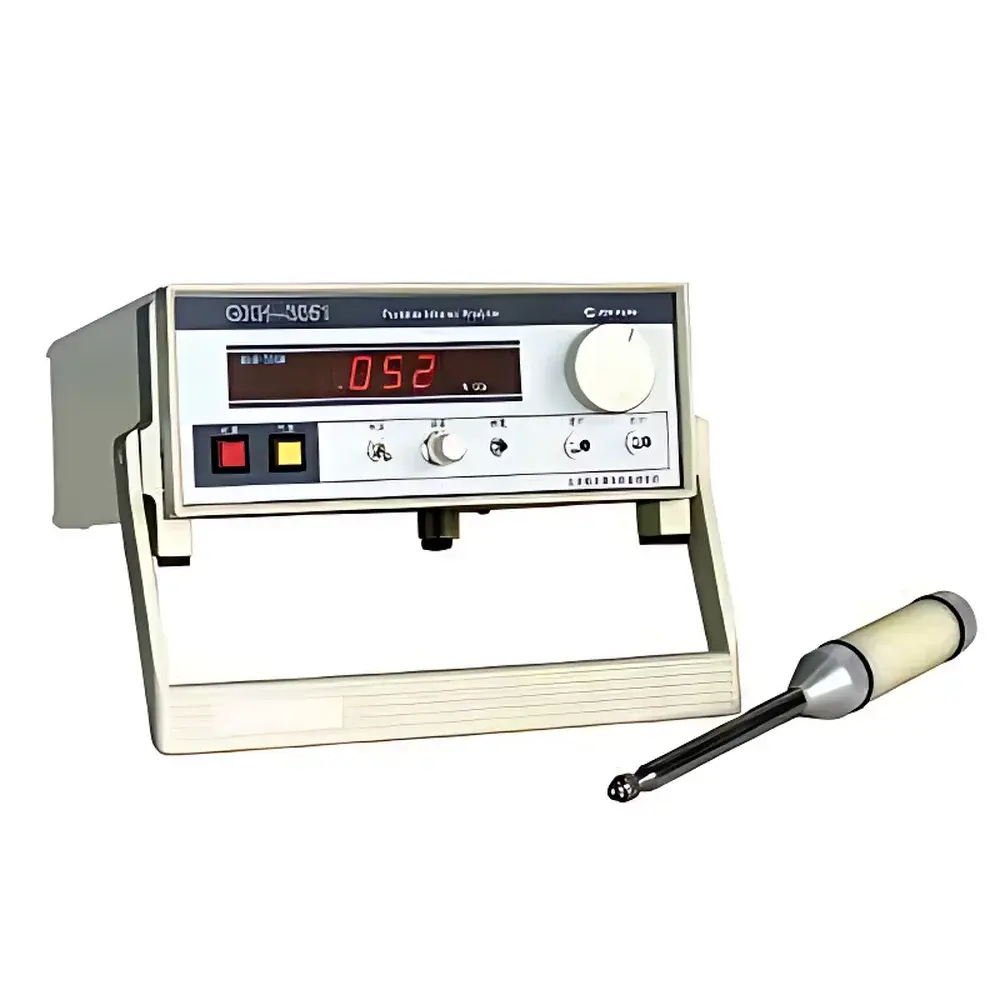
GXH-3051 Portable Multi-Gas Analyzer (CO₂, CO, SO₂, CH₄)
| Origin | Beijing, China |
|---|---|
| Manufacturer Type | Authorized Distributor |
| Origin Category | Domestic (PRC) |
| Model | GXH-3051 |
| Price | Upon Request |
| Measurement Range (CO₂) | 0–1000 ppm / 0–100% vol |
| Zero Drift | ≤ ±1% FS / 4 h |
| Span Drift | ≤ ±1% FS / 4 h |
| Linearity | ≤ ±1% FS |
| Repeatability | ≤ ±1% |
| Warm-up Time | 15 min |
| Weight | 1.5 kg |
| Display | Backlit LCD with Direct Concentration Readout |
| Gas Flow Control | Adjustable via Integrated Flow Regulator |
| Calibration Mode | Six-Port Manual Valve for Zero/Measurement Path Switching |
| Power | Dual Rechargeable Battery System with Low-Voltage Alert |
Overview
The GXH-3051 Portable Multi-Gas Analyzer is an engineered field-deployable instrument designed for real-time, quantitative measurement of carbon dioxide (CO₂), carbon monoxide (CO), sulfur dioxide (SO₂), and methane (CH₄) in ambient and confined-space environments. It operates on the principle of non-dispersive infrared (NDIR) absorption spectroscopy for CO₂ and CO, supplemented by electrochemical sensing for SO₂ and catalytic combustion or thermal conductivity detection for CH₄—configurable per application requirements. The analyzer meets the operational demands of occupational health and environmental hygiene professionals conducting spot checks in indoor air quality (IAQ) assessments, public facility audits, and emergency response scenarios. Its compact architecture, integrated gas handling system, and dual-battery power management enable uninterrupted operation during extended field surveys without reliance on external power sources.
Key Features
- Multi-gas capability with factory-calibrated NDIR optical cells for CO₂ and CO, ensuring high selectivity and minimal cross-sensitivity to common interferents such as water vapor and hydrocarbons.
- Dual-rechargeable lithium-ion battery system with intelligent charge management and audible/visual low-voltage alert—supports continuous operation for ≥8 hours under typical sampling conditions.
- Backlit monochrome LCD display with real-time concentration readout in ppm or % volume, auto-ranging, and unit-switching functionality.
- Manually actuated six-port rotary valve enabling rapid, contamination-free switching between zero-air calibration and sample gas introduction—eliminates need for external calibration gas cylinders during routine field use.
- Adjustable mass flow controller (0.2–1.0 L/min) ensures optimal sample residence time across sensor elements, maintaining measurement stability under variable pressure and humidity conditions.
- Ruggedized ABS housing rated IP54 for dust and splash resistance, designed for transport in standard instrument cases and deployment in non-laboratory settings including HVAC ducts, ship cabins, hospital waiting areas, and commercial entertainment venues.
Sample Compatibility & Compliance
The GXH-3051 is validated for use with ambient air, recirculated indoor air, and low-particulate exhaust streams where condensable vapors are absent or pre-filtered. It complies with national metrological verification regulations for portable gas analyzers issued by the People’s Republic of China’s State Administration for Market Regulation (SAC/TC 124). While not certified to IEC 61000-6-2 (EMC immunity) or ATEX/IECEx for hazardous locations, its design aligns with general-purpose IAQ monitoring guidance referenced in ISO 16814:2008 (Indoor Air Quality — Guidelines for Assessment) and ASHRAE Standard 62.1. Instrument outputs satisfy basic data integrity requirements for GLP-aligned reporting; full 21 CFR Part 11 compliance requires integration with validated third-party data logging software.
Software & Data Management
The analyzer operates in standalone mode without embedded firmware-based data storage. All measurements are displayed in real time and may be manually recorded or transferred via optional RS232-to-USB interface to host PCs running vendor-provided configuration utility. This utility supports instrument setup (zero/span calibration coefficients, alarm thresholds, flow setpoints), firmware updates, and export of timestamped CSV files. Audit trails—including calibration events, battery status logs, and user-initiated zero cycles—are retained in volatile memory for the duration of a single power session and must be exported prior to shutdown for archival purposes.
Applications
- Indoor air quality surveillance in schools, offices, hotels, cinemas, and healthcare facilities per national hygiene standards GB/T 18883–2022.
- Occupational exposure assessment in maintenance zones, parking garages, boiler rooms, and confined workspaces where CO accumulation poses acute toxicity risk.
- Verification of ventilation efficiency through CO₂ differential analysis (supply vs. return air) in HVAC commissioning and retro-commissioning protocols.
- Environmental screening at landfill perimeter sites, wastewater treatment plant enclosures, and agricultural storage silos for CH₄ and CO₂ leakage detection.
- Public health response support during mass gathering events, cruise vessel inspections, and mobile epidemiological investigations requiring rapid atmospheric hazard triage.
FAQ
What gases can the GXH-3051 measure simultaneously?
The instrument is configured for sequential or single-gas measurement of CO₂, CO, SO₂, and CH₄. Simultaneous multi-gas detection requires optional sensor module upgrades and is not supported in base configuration.
Is factory calibration traceable to national standards?
Yes—each unit undergoes verification against certified reference gases accredited to CNAS (China National Accreditation Service) standards prior to shipment. Certificate of Conformance includes calibration date, reference gas lot numbers, and uncertainty values per ISO/IEC 17025.
Can the device be used outdoors in rain or high humidity?
It is rated IP54 and tolerates brief exposure to light rain and ambient humidity up to 90% RH non-condensing. Prolonged outdoor deployment requires protective housing and inlet particulate filtration.
Does the six-port valve require periodic maintenance?
The valve is sealed and lubrication-free; recommended inspection interval is every 12 months or after 5,000 actuation cycles, whichever occurs first. No user-serviceable parts are present.
What is the minimum detectable concentration for CO₂ in the 0–1000 ppm range?
The specified lower limit of detection (LOD) is 1 ppm CO₂, determined per ISO 11843-1 using signal-to-noise ratio ≥3 under controlled laboratory conditions. Field LOD may vary depending on ambient temperature stability and flow consistency.
Related Products







