
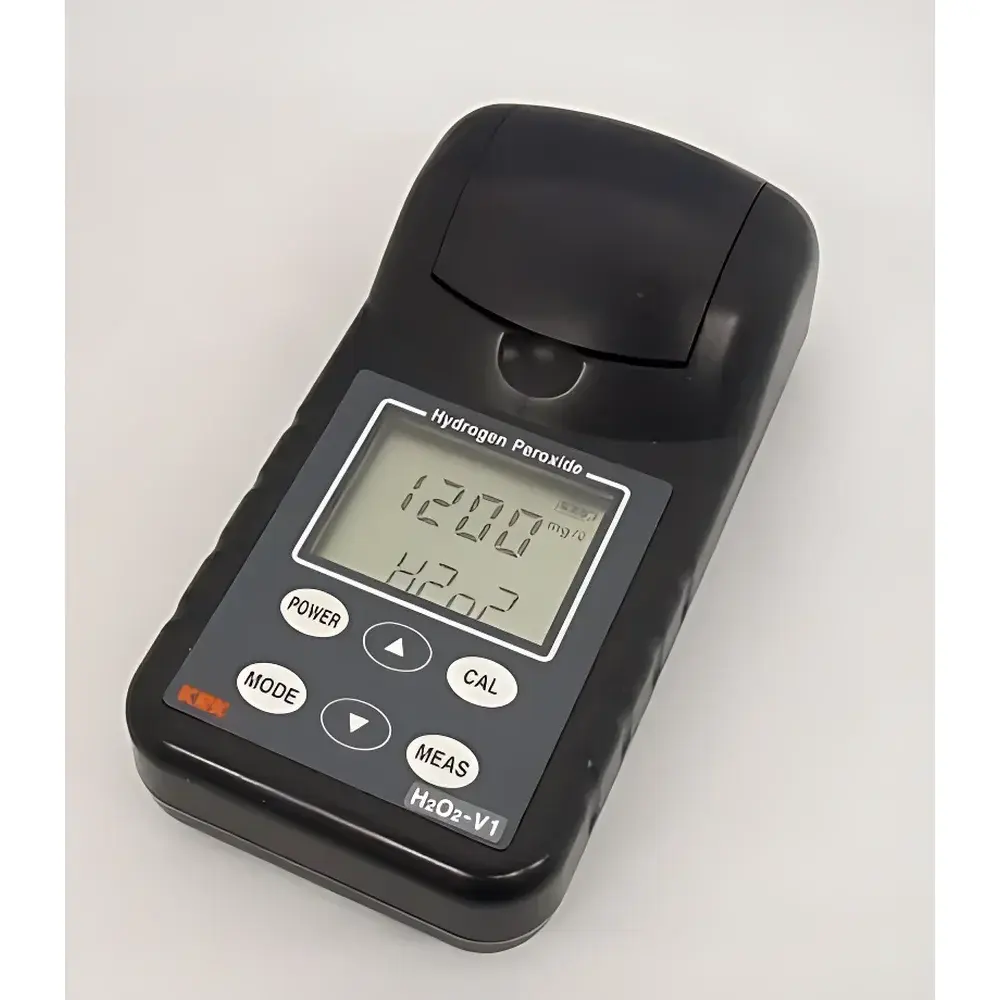
H2O2-V1 Portable Photometric Hydrogen Peroxide Analyzer for Copper Plating Baths
| Brand | Rikari Chemical |
|---|---|
| Origin | Japan |
| Model | H2O2-V1 |
| Measurement Principle | Molybdenum Yellow Spectrophotometry |
| Range | 0.0–120.0 g/L |
| Resolution | 0.1 g/L |
| Repeatability | ≤ ±5% FS |
| Response Time | <5 s after power-on |
| Measurement Time | ~60 s per sample |
| Auto-power-off | 5 s after measurement |
| Calibration | Zero calibration + span calibration using standard solution |
| Light Source | LED (stable narrow-band emission) |
| Power Supply | 4 × AA alkaline batteries (LR03, 6 V DC) |
| Dimensions | 88 W × 174 D × 65 H mm |
| Weight | ~310 g |
| Standard Accessories | Instrument body, 4 × AA batteries, H2O2-V1-RA reagent (500 mL), 5-mL syringe, 0.1-mL micropipette, instruction manual, warranty card, carrying case |
Overview
The H2O2-V1 is a dedicated portable photometric analyzer engineered for the direct, interference-resistant quantification of hydrogen peroxide (H₂O₂) in acidic copper electroplating baths. Unlike conventional titrimetric or enzymatic methods, it employs molybdenum yellow spectrophotometry — a well-established colorimetric reaction where H₂O₂ oxidizes molybdate under acidic conditions to form a stable yellow-colored complex (MoO₄²⁻ → MoO₂²⁺ → [MoO₂(H₂O)₄]²⁺), whose absorbance at ~405 nm is linearly proportional to H₂O₂ concentration. Critically, this chemistry exhibits high selectivity against common bath constituents: Cu²⁺ ions (up to 120 g/L), free sulfuric acid (up to 200 g/L), chloride, and accelerators do not interfere with the signal. The instrument’s optical path is optimized for high turbidity tolerance and minimal cuvette-volume dependency, enabling reliable measurements without dilution — even at the upper limit of its 0.0–120.0 g/L range.
Key Features
- True field-deployable design: Compact footprint (88 × 174 × 65 mm), lightweight construction (~310 g), and battery-powered operation (4 × AA, 6 V DC) enable routine use directly at plating tanks or QC benches.
- Robust interference rejection: Validated performance in real-world copper sulfate–sulfuric acid electrolytes containing ≥100 g/L Cu²⁺ and ≥150 g/L H₂SO₄ — no sample pretreatment or matrix-matching required.
- High-resolution photometric detection: Integrated LED light source with narrow spectral bandwidth (<15 nm FWHM) ensures long-term stability and eliminates lamp drift-related recalibration.
- Minimal consumables & low operational cost: Uses only one proprietary reagent (H2O2-V1-RA), supplied in 500 mL bottles; each analysis consumes ≤0.5 mL reagent.
- Intuitive workflow: One-button start; automatic zeroing; measurement completes in ~60 seconds; result displayed with 0.1 g/L resolution and retained on screen for 5 seconds before auto-shutdown.
- Embedded diagnostics: Real-time self-check of battery voltage, LED output intensity, and calibration status; alerts for low battery, expired reagent, or out-of-tolerance photodiode response.
Sample Compatibility & Compliance
The H2O2-V1 is validated for use with industrial acidic copper plating baths compliant with IPC-4552A, ASTM B656, and JIS H 8601 specifications. It meets ISO/IEC 17025 requirements for method validation when operated per manufacturer-specified protocols (including daily zero calibration and weekly span verification with traceable standards). While not a GLP/GMP-certified system, its audit-ready calibration log (manually recorded), fixed-wavelength optics, and absence of software-based data manipulation make it suitable for internal process control under ISO 9001:2015 and IATF 16949 quality management systems. Reagent lot traceability is maintained via batch-coded H2O2-V1-RA vials.
Software & Data Management
The H2O2-V1 operates as a standalone hardware analyzer with no embedded firmware storage or USB connectivity. All measurement data are read directly from the LCD display and manually transcribed into laboratory notebooks or LIMS. This architecture eliminates cybersecurity risks associated with networked instruments and simplifies regulatory compliance in environments where electronic records are not mandated. For facilities requiring digital capture, optional third-party barcode-scanned logging templates (e.g., Excel-based or LabWare LIMS interfaces) may be deployed externally. Reagent expiration tracking is supported via printed lot numbers on each H2O2-V1-RA bottle label.
Applications
- Real-time monitoring of H₂O₂ concentration during acid copper electroplating bath maintenance to ensure optimal micro-throwing power and deposit ductility.
- Verification of peroxide dosing accuracy following automated chemical addition systems (e.g., Mettler Toledo InPro 7000 series controllers).
- Root-cause analysis of poor adhesion, pitting, or haze in plated through-holes (PTH) linked to suboptimal oxidant levels.
- Supporting DOE studies on accelerator–oxidant interaction kinetics in high-speed PCB plating lines.
- Periodic bath qualification prior to high-reliability aerospace or medical device component plating runs (per AS9100 or ISO 13485).
FAQ
Does the H2O2-V1 require daily calibration with both zero and span standards?
No — zero calibration is performed before each measurement session; span calibration is recommended weekly or after reagent lot changes, using the certified H2O2-V1-STD reference solution.
Can the instrument measure H₂O₂ in non-copper plating solutions, such as nickel or gold baths?
It is not validated for those matrices; competing metal ions (e.g., Ni²⁺, Au³⁺) may catalyze H₂O₂ decomposition or form interfering chromophores. Use only in acidic Cu–H₂SO₄ systems per specification.
What is the shelf life of the H2O2-V1-RA reagent?
Unopened bottles retain stability for 12 months when stored at 2–8 °C; once opened, use within 30 days under refrigeration and protect from light.
Is the 0.1 g/L resolution maintained across the full 0–120 g/L range?
Yes — resolution is hardware-limited by the 16-bit ADC and optical signal-to-noise ratio; accuracy degrades slightly above 100 g/L (±6% FS), as stated in the technical validation report.
How does temperature affect measurement accuracy?
The analyzer contains no temperature compensation; measurements should be conducted at 20–25 °C. Bath samples must be cooled to ambient prior to analysis to avoid thermal quenching of the molybdenum yellow complex.







