
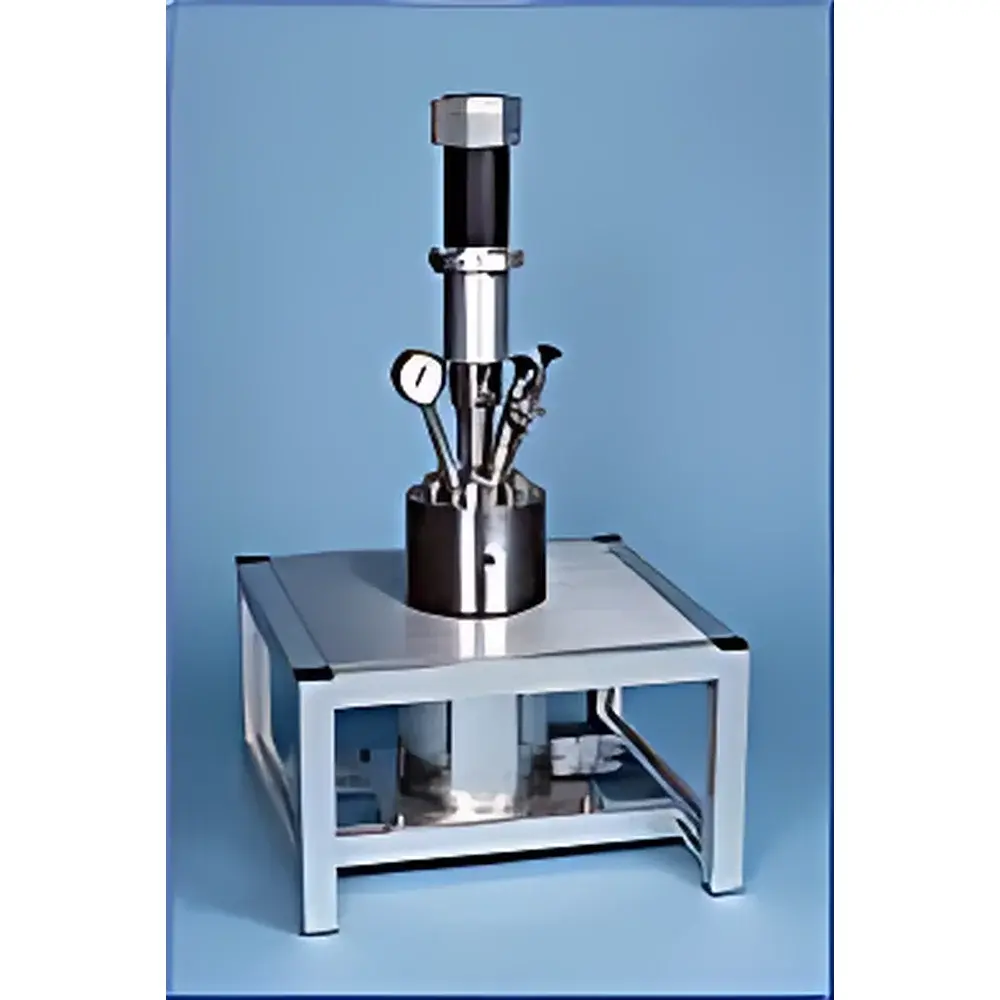
Haage Lab-Scale High-Pressure Reactor Series
| Brand | Haage |
|---|---|
| Origin | Germany |
| Type | Laboratory High-Pressure Reactor |
| Volume Range | 0.15 – 100 L |
| Operating Pressure | 50 – 1000 bar |
| Temperature Range | up to 700 °C |
| Construction Material | Stainless Steel (standard) |
| Vacuum Capability | Yes (compatible with vacuum operation per design specification) |
| Standard Configuration | Dual high-temp inlet/outlet valves, gas inlet/outlet valve, pressure gauge, sampling blind port, dual thermocouple ports (internal & wall-mounted), certified rupture disc with spare, central stirrer mounting port, auxiliary electrode ports |
| Optional Features | Magnetic drive stirrer (60–4000 N·cm torque), digital speed control & display, inert gas purge valve, integrated safety interlocks (temperature limiters), pressure transducer with digital readout, internal condenser, bottom drain valve, ATEX-certified configuration, massive non-metallic lining |
Overview
The Haage Lab-Scale High-Pressure Reactor Series is an engineered solution for controlled synthesis, catalytic testing, hydrothermal processing, and corrosion studies under extreme thermodynamic conditions. Designed and manufactured in Germany, these reactors operate on the principle of sealed-vessel batch reaction dynamics, where precise regulation of pressure, temperature, and mass transfer enables reproducible kinetic and thermodynamic investigations. Each unit complies with the structural integrity requirements of AD 2000 Merkblatt HP0 and EN 13445-3 (Unfired Pressure Vessels), ensuring mechanical reliability at operating pressures up to 1000 bar and temperatures up to 700 °C. The reactor body is constructed from high-purity austenitic stainless steel (1.4571 / SS316Ti) as standard, with full traceability documentation supplied. Critical components—including flanges, closures, and sealing surfaces—are forged (not cast) to eliminate porosity and ensure long-term fatigue resistance under cyclic pressurization.
Key Features
- Fully welded, monolithic pressure vessel architecture with double-welded seam verification (100% radiographic inspection available upon request)
- Modular closure system featuring radial-tightening bolts and self-centering conical seals for leak-tight performance at maximum rated pressure
- Standard dual-thermocouple monitoring: one inserted into the reaction zone (via thermowell), one embedded in the vessel wall—enabling real-time differentiation between bulk fluid and thermal boundary layer temperatures
- Certified rupture disc assembly (TÜV-certified, DIN EN ISO 4126-2 compliant) with documented burst tolerance and replacement unit included
- Configurable central drive interface supporting magnetic coupling systems with torque ratings from 60 to 4000 N·cm, fully compatible with external PID-controlled motor drives
- Optional ATEX Zone 1/21 certification (2014/34/EU) for operation in potentially explosive atmospheres containing gases, vapors, mists, or combustible dusts
Sample Compatibility & Compliance
These reactors accommodate heterogeneous and homogeneous reaction media—including corrosive halogenated solvents, supercritical CO₂, molten salts, and aggressive mineral acids—when equipped with appropriate material upgrades (e.g., Hastelloy C-276 linings or tantalum-clad interiors). All standard configurations meet ISO 9001:2015 manufacturing controls and are supplied with full PED 2014/68/EU Declaration of Conformity. For regulated environments, optional features support GLP-compliant data integrity: audit-trail-enabled pressure/temperature logging (with timestamped CSV export), electronic signature capability, and 21 CFR Part 11–ready firmware (requires Haage ControlSuite v4.2+). Reaction vessels are validated per ASTM E2928-21 for high-pressure calibration traceability against NIST-traceable reference standards.
Software & Data Management
When integrated with Haage ControlSuite software (v4.x), the reactor supports synchronized acquisition of up to 16 analog channels—including pressure (0–1000 bar, ±0.1% FS), temperature (−50 to +700 °C, ±0.5 °C), torque (0–4000 N·cm), and rotational speed (0–1200 rpm). Data is stored locally in encrypted SQLite databases with SHA-256 hashing and supports automated export to LIMS-compatible formats (ASTM E1384, ANSI/NIST-ITL 1-2011). Real-time trend visualization includes derivative-based event detection (e.g., exotherm onset, phase transition inflection points) and configurable alarm thresholds with email/SNMP notification. All firmware updates undergo IEC 62443-3-3 security validation prior to release.
Applications
- Catalyst screening and lifetime testing under industrially relevant P/T conditions (e.g., Fischer–Tropsch, ammonia synthesis, hydrodesulfurization)
- Supercritical fluid processing (scCO₂, scH₂O) for extraction, nanoparticle synthesis, and polymer impregnation
- Hydrothermal carbonization and biomass conversion kinetics
- Electrochemical reaction studies using integrated electrode ports (reference, counter, working electrodes)
- Corrosion rate quantification per ASTM G31/G102 in simulated downhole or geothermal brines
- High-pressure hydrogenation and dehydrogenation pathways in pharmaceutical intermediate synthesis
FAQ
What pressure and temperature ratings apply to the 5-L reactor model at 500 °C?
At 500 °C, the standard 5-L stainless steel reactor is rated for continuous operation at 500 bar. Derating curves are provided in the ASME Section VIII Div. 1 Appendix 1 design report included with each unit.
Can the reactor be operated under vacuum prior to pressurization?
Yes. All models include vacuum compatibility down to ≤10⁻² mbar (measured at ambient temperature), verified via helium leak testing (≤1×10⁻⁹ mbar·L/s) per ISO 15848-2.
Is third-party calibration certification available?
Yes. TÜV SÜD or Dekra-certified calibration packages (including pressure transducer, thermocouples, and torque sensor) are available with NIST-traceable certificates and uncertainty budgets.
How is stirring performance validated across the full torque range?
Magnetic drive efficiency and slippage thresholds are verified per DIN 28138 using calibrated load cells and high-speed torque analyzers; test reports document no-load vs. full-load speed deviation (<±0.3 rpm at 1000 rpm).
Are spare parts and service support available outside the EU?
Global technical support is provided through Haage’s authorized distributor network; critical spares (seals, rupture discs, thermowells) are stocked regionally with <72-h lead time for most locations.



