
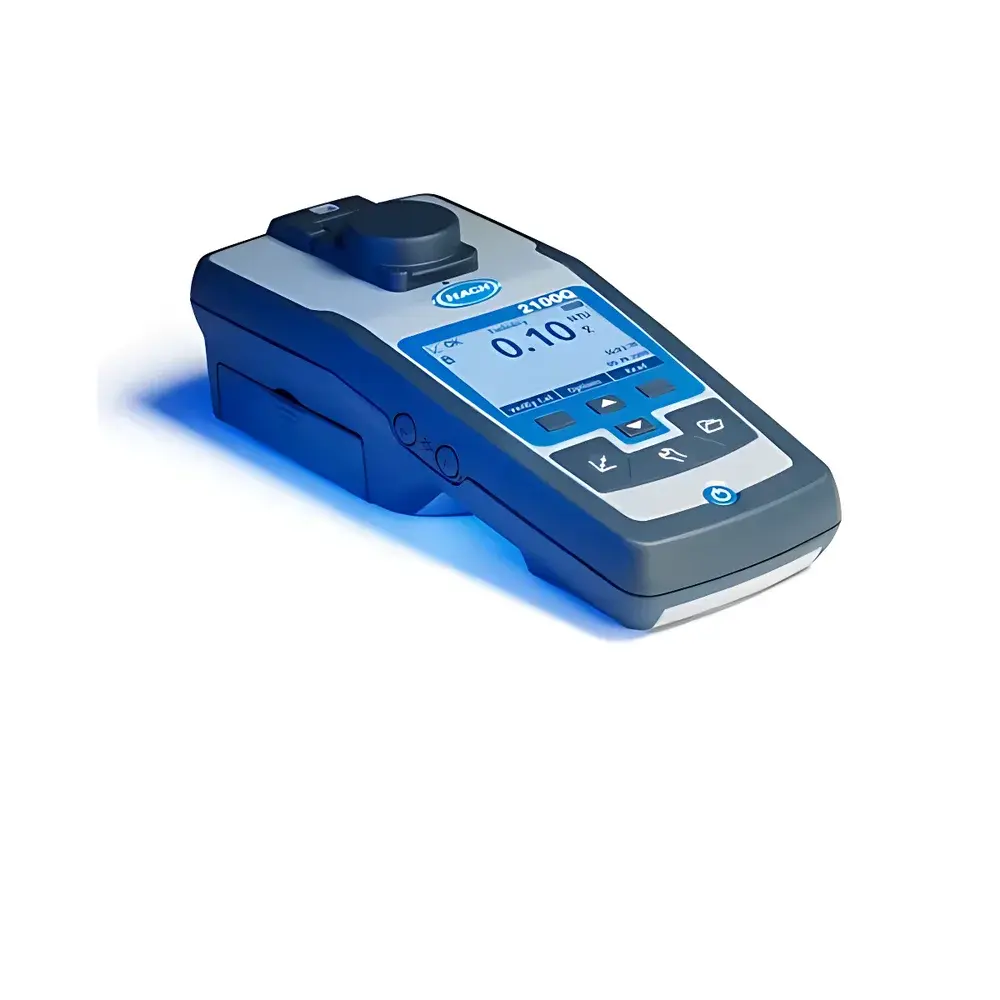
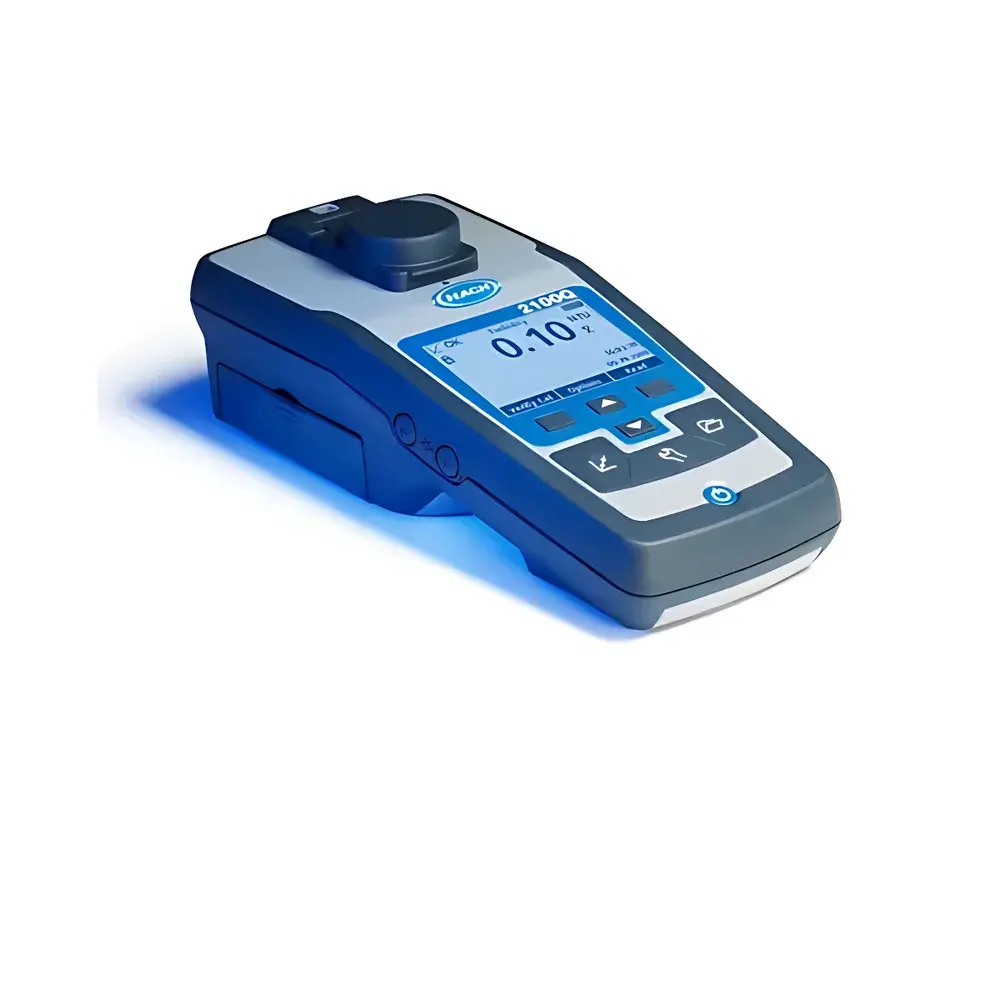
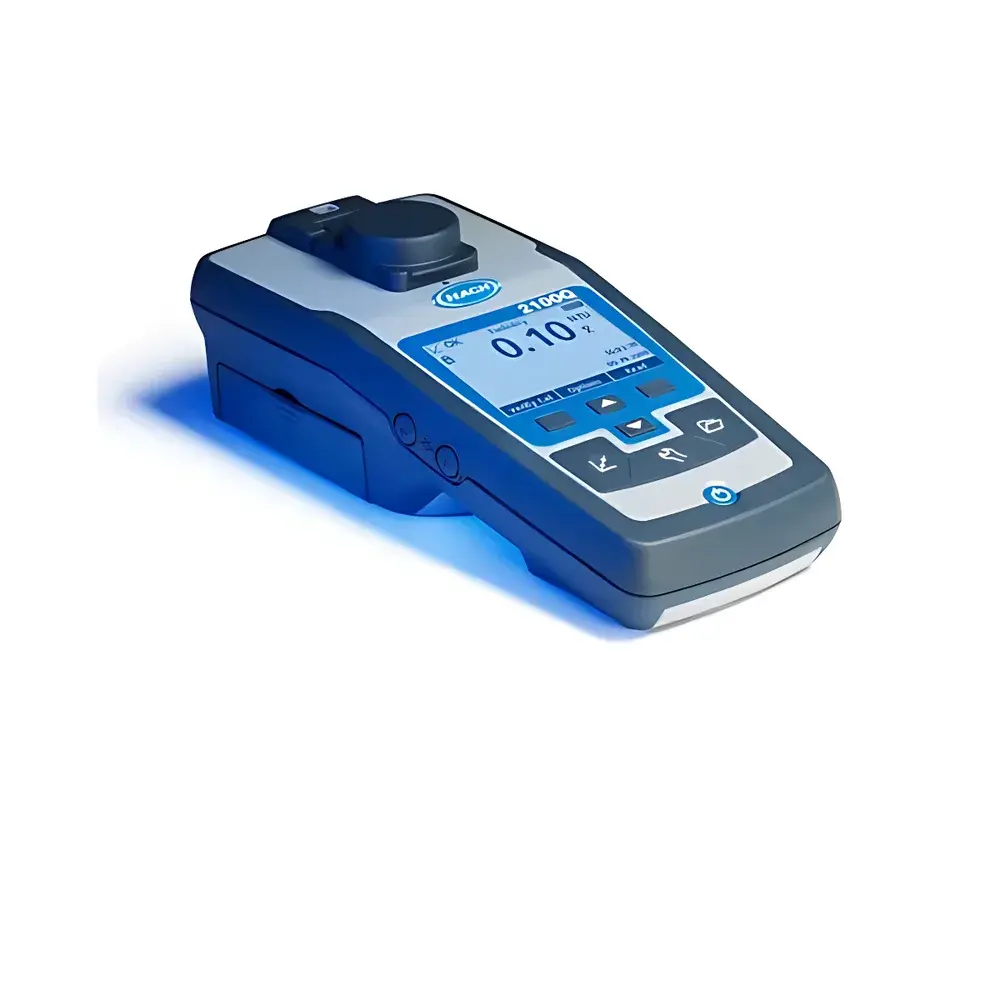
Hach 2100Q Portable Turbidimeter
| Brand | Hach |
|---|---|
| Origin | USA |
| Model | 2100Q |
| Product Type | Portable |
| Measurement Range | 0–1000 NTU |
| Resolution | 0.01 NTU |
| Accuracy | ±2% of reading + stray light contribution |
| Stray Light | < 0.02 NTU (FNU) |
| Compliance | EPA Method 180.1 |
| Optical Principle | Ratio-based 90° scattered light detection with simultaneous transmission compensation |
| Ingress Protection | IP67 (excluding sealed cover and battery compartment) |
| Data Storage | 500 measurement records with timestamp, operator ID, sample ID, calibration status, and error logs |
| Power Options | 4 × AA alkaline batteries, rechargeable NiMH batteries (with USB+Power Module), or AC adapter (100–240 V, 50/60 Hz) |
| Interface | USB (supports 22 languages including English) |
| Measurement Modes | Normal, Signal Average, Rapid Settling Turbidity (RST) |
Overview
The Hach 2100Q Portable Turbidimeter is a field-deployable, EPA Method 180.1-compliant optical instrument engineered for precise, traceable turbidity quantification in diverse water quality applications. It operates on the principle of ratio-based nephelometry: a collimated near-infrared LED source emits light through the sample, and two photodetectors simultaneously measure 90° scattered light intensity and transmitted light intensity. This dual-signal architecture enables real-time compensation for color interference, lamp intensity drift, and stray light—critical for maintaining metrological integrity under variable ambient conditions. Unlike single-detector systems, the 2100Q’s patented ratio algorithm normalizes scattering response against transmission loss, significantly reducing bias from colored or highly absorbing samples. The instrument is calibrated using formazin or StablCal standards traceable to NIST SRM 2130a, ensuring alignment with international reference frameworks. Its compact, ruggedized chassis supports deployment across regulatory monitoring, process control, and emergency response scenarios without compromising laboratory-grade repeatability.
Key Features
- IP67-rated enclosure (excluding sealed cover and battery compartment) for reliable operation in rain, dust, and splash-prone environments
- Rapid Settling Turbidity (RST) mode: employs time-series averaging and proprietary convergence logic to deliver stable, reproducible readings for fast-settling suspensions—eliminating subjective endpoint judgment
- Dual-detector optical path with automatic signal normalization: mitigates errors from sample color, photometric noise, and stray light (< 0.02 NTU FNU)
- On-device calibration guidance with multilingual prompts (22 languages supported), including one-point Rapid-Cal for low-range verification
- Integrated data logging: stores up to 500 measurements with full metadata—date/time stamp, operator ID, sample ID, measurement mode, calibration history, and diagnostic flags
- Flexible power architecture: compatible with disposable alkaline cells, rechargeable NiMH packs (via optional USB+Power Module), or universal AC input (100–240 V, 50/60 Hz)
Sample Compatibility & Compliance
The 2100Q is validated for aqueous matrices ranging from potable water and wastewater effluents to pharmaceutical process streams and environmental surface waters. Its optical design minimizes interference from dissolved organic matter and low-concentration colloids, making it suitable for compliance monitoring per U.S. EPA Method 180.1 and ISO 7027:2016 (Nephelometric Principle). The instrument meets GLP data integrity requirements through audit-trail-capable firmware: all calibrations, configuration changes, and measurement events are time-stamped and logged with user identification. While not FDA 21 CFR Part 11–certified out-of-the-box, its data export protocol (CSV via USB) supports integration into validated LIMS or ELN systems where electronic signature and change control are enforced at the enterprise level.
Software & Data Management
Data transfer requires no proprietary software: the optional USB+Power Module functions as a mass-storage device, enabling direct drag-and-drop export of .csv files to any Windows/macOS/Linux host. Each record includes ISO 8601 timestamps, NTU/FNU units, measurement mode identifier, calibration verification status, and embedded error codes (e.g., “Low Signal”, “High Stray Light”). Field technicians may pre-assign operator IDs and sample identifiers via on-device menu navigation—ensuring chain-of-custody continuity prior to lab handoff. Firmware updates are delivered via Hach’s publicly accessible support portal and installed via same USB interface, maintaining version traceability per ISO/IEC 17025 clause 5.9.
Applications
- Drinking water distribution system validation (post-filtration, reservoir inflow/outflow)
- Wastewater treatment plant process control (clarifier effluent, membrane bioreactor monitoring)
- Environmental field surveys (stream/river turbidity profiling, sediment transport studies)
- Pharmaceutical water-for-injection (WFI) and purified water (PW) system qualification
- Emergency response during flood events or infrastructure failure (rapid on-site screening)
- Educational laboratories requiring EPA-aligned methodology and robust student interface design
FAQ
Does the 2100Q require annual recalibration by an accredited lab?
No—field users perform routine verification using supplied StablCal standards; however, traceable recalibration every 12 months is recommended per ISO/IEC 17025 and internal QA policies.
Can the 2100Q measure samples with high absorbance (e.g., dyed industrial effluents)?
Yes—the ratio measurement compensates for absorbance-induced signal attenuation, though extreme color (>500 Pt-Co units) may necessitate method validation per ASTM D6708.
Is the USB+Power Module included with the base unit?
No—it is an optional accessory (Hach P/N 2910000); the standard configuration ships with alkaline batteries only.
What is the temperature operating range for reliable performance?
The instrument is specified for 0–50 °C ambient operation; battery life and LCD contrast degrade outside this range.
How does RST mode differ from Signal Average mode?
RST applies adaptive sampling intervals and statistical convergence criteria to fast-settling suspensions, whereas Signal Average performs fixed-duration integration without settling-state detection.






