
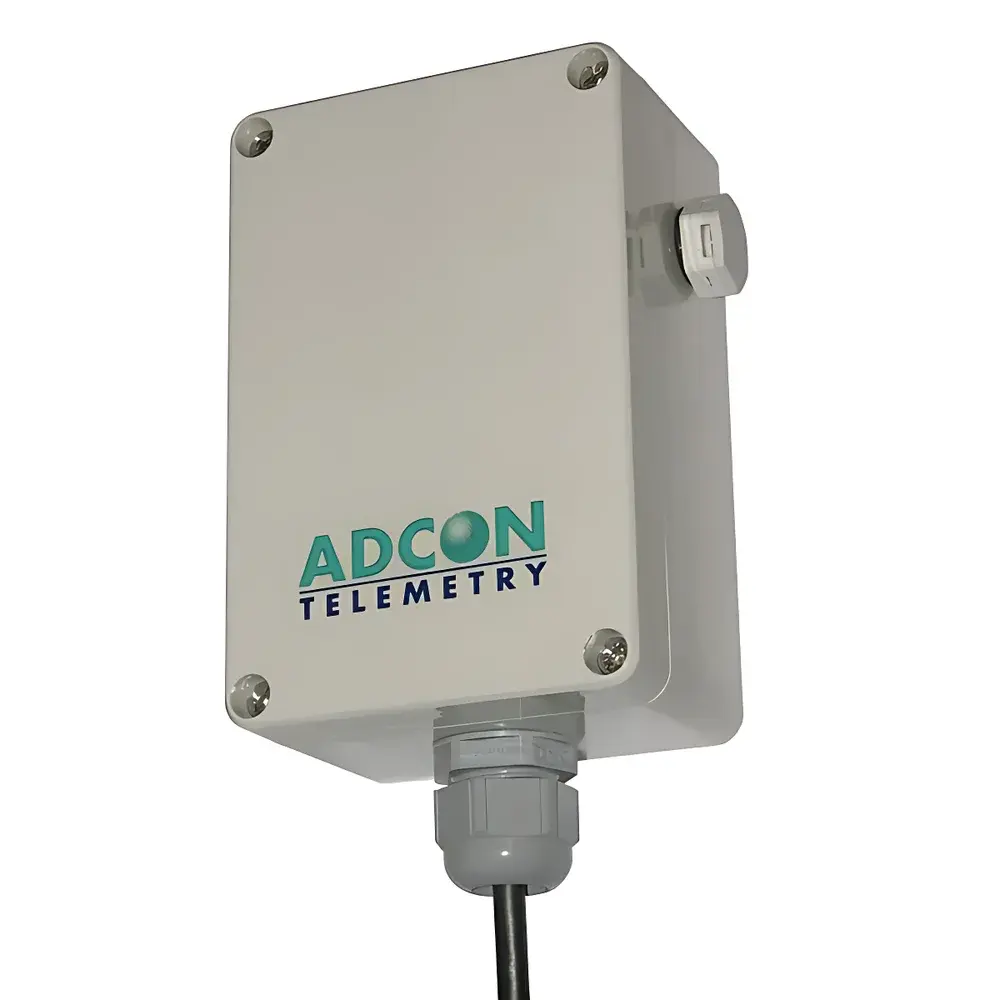
HACH ADCON BP1 Barometric Pressure Sensor
| Brand | ADCON |
|---|---|
| Origin | Switzerland |
| Model | BP1 |
| Measurement Range | 500–1500 mbar |
| Accuracy | ±0.1% FS (0–80°C) |
| Output Signal | 0.1–2.5 VDC |
| Linearity | ±0.025% FS |
| Long-term Stability | ≤1 mbar (for ranges ≤1 mbar) |
| Operating Temperature | −20°C to +80°C |
| Enclosure Material | Polycarbonate |
| Sensor Element Material | 316L Stainless Steel (DIN 1.4435) |
| Cable | 3 m PE-shielded, with PENTAX 7-pin waterproof connector |
| IP Rating | IP67 (sensor: IP68) |
| Supply Voltage | 3.5–12 VDC @ <3 mA |
| Shock Resistance | 20 g (11 ms) |
| Vibration Resistance | 20 g (5–2000 Hz, ±3 mm amplitude) |
| Pressure Cycle Endurance | 10 million cycles at 0–100% FS (25°C) |
| Housing Dimensions (incl. mounting bracket, vent, cable gland) | 145 × 90 × 70 mm |
| Sensor Dimensions | Ø21 × 121 mm |
| Weight (incl. 3 m cable) | 500 g |
Overview
The HACH ADCON BP1 Barometric Pressure Sensor is a high-stability, industrial-grade atmospheric pressure transducer engineered for continuous, unattended operation in meteorological monitoring, environmental research, and hydrological telemetry networks. Based on piezoresistive sensing technology, the BP1 employs a temperature-compensated silicon pressure element—identical to that used in the proven ADCON LEV1 water level sensor—ensuring consistent metrological performance across its full 500–1500 mbar operating range. Designed in accordance with World Meteorological Organization (WMO) guidelines for barometric instrumentation, the sensor integrates passive thermal compensation and mechanical damping to suppress transient errors induced by wind gusts or rapid ambient temperature shifts. Its hermetically sealed, vented polycarbonate housing maintains internal–external pressure equilibrium while excluding moisture ingress—a critical feature for long-term reliability in exposed outdoor installations.
Key Features
- Piezoresistive pressure sensing element with full temperature compensation over −20°C to +80°C
- WMO-compliant mechanical design: integrated pressure equalization vent with hydrophobic membrane
- Robust IP67-rated enclosure (IP68 for sensor core), resistant to dust, rain, and temporary submersion
- Stainless steel (316L/DIN 1.4435) pressure port and internal wetted parts for corrosion resistance in coastal or industrial environments
- Low-power operation: 3.5–12 VDC supply at <3 mA, optimized for solar-powered RTU deployments
- High-reliability PENTAX 7-pin waterproof connector (IEC 60529 compliant) with shielded polyethylene cable
- Proven mechanical endurance: rated for 10 million full-scale pressure cycles at 25°C
- Integrated mounting bracket and clamping hardware for stable rooftop or mast installation on weather stations
Sample Compatibility & Compliance
The BP1 is designed exclusively for atmospheric (ambient) air pressure measurement and is not intended for liquid or gas media other than dry, clean ambient air. It complies with WMO Guide to Meteorological Instruments and Methods of Observation (CIMO Guide, Chapter 12) requirements for barometric sensors deployed in Class I and II observational networks. The device meets IEC 60068-2 mechanical stress standards (shock: 20 g/11 ms; vibration: 20 g, 5–2000 Hz), and its electrical isolation (>100 MΩ at 50 VDC) supports safe integration into grounded telemetry systems. While not certified for hazardous locations, its construction adheres to RoHS and REACH directives. No calibration certificate is supplied as standard; however, traceable NIST-traceable calibration is available upon request for applications requiring documented metrological assurance.
Software & Data Management
The BP1 delivers an analog voltage output (0.1–2.5 VDC) linearly proportional to measured pressure, enabling direct interfacing with any ADC-equipped remote terminal unit (RTU), data logger, or SCADA system supporting 0–5 V or 0–10 V inputs. When paired with HACH’s TELEMAC or ADCON-compatible telemetry platforms, the sensor integrates seamlessly into automated data acquisition workflows featuring configurable sampling intervals, local storage buffering, and alarm thresholds. Firmware-level linearization and temperature correction are applied within compatible RTUs using factory-provided coefficients (supplied in datasheet Annex A). For audit-trail compliance in regulated environmental monitoring (e.g., EPA Method 21–related air quality networks), the BP1 supports timestamped, non-volatile logging when deployed with GLP/GMP-capable loggers—though it does not implement FDA 21 CFR Part 11 electronic signature functionality natively, as it is an analog transducer without embedded microprocessing.
Applications
- Real-time barometric pressure monitoring in automated weather stations (AWS) and climate observatories
- Atmospheric correction input for radar altimeters, GNSS-based subsidence monitoring, and hydrostatic level systems
- Pressure trend analysis for short-term weather forecasting and severe storm early warning systems
- Reference pressure source in calibration laboratories supporting field instrument verification (e.g., for vented groundwater piezometers)
- Long-term environmental monitoring in national hydrological networks (e.g., USGS, Environment Canada, DWD)
- Industrial process support where ambient pressure compensation is required for mass flow or volumetric calculations
FAQ
What is the recommended mounting orientation for optimal accuracy?
The BP1 must be installed horizontally with its vent port facing upward and unobstructed to ensure free atmospheric exchange. Avoid mounting beneath overhangs or inside enclosures lacking passive ventilation.
Can the BP1 be used for absolute pressure measurement in vacuum or low-pressure chamber applications?
No. The BP1 is strictly calibrated for ambient atmospheric pressure (500–1500 mbar) and relies on its external vent for reference. It is unsuitable for sealed or sub-atmospheric environments.
Is field recalibration possible without returning the unit to a service center?
Field zero adjustment is not supported. Due to its fixed temperature compensation architecture and factory-trimmed offset/gain, recalibration requires traceable reference equipment and is performed only at authorized service facilities.
Does the 3-meter cable length include the connector housing?
Yes—the stated 3 m includes the full assembly: sensor body, cable, and PENTAX connector with strain relief.
How does the BP1 handle condensation inside the vent assembly?
The hydrophobic membrane in the vent prevents liquid water ingress while permitting unrestricted air diffusion. Condensation forming on the membrane surface does not impede pressure equilibration and evaporates naturally under ambient airflow.
Related Products







