
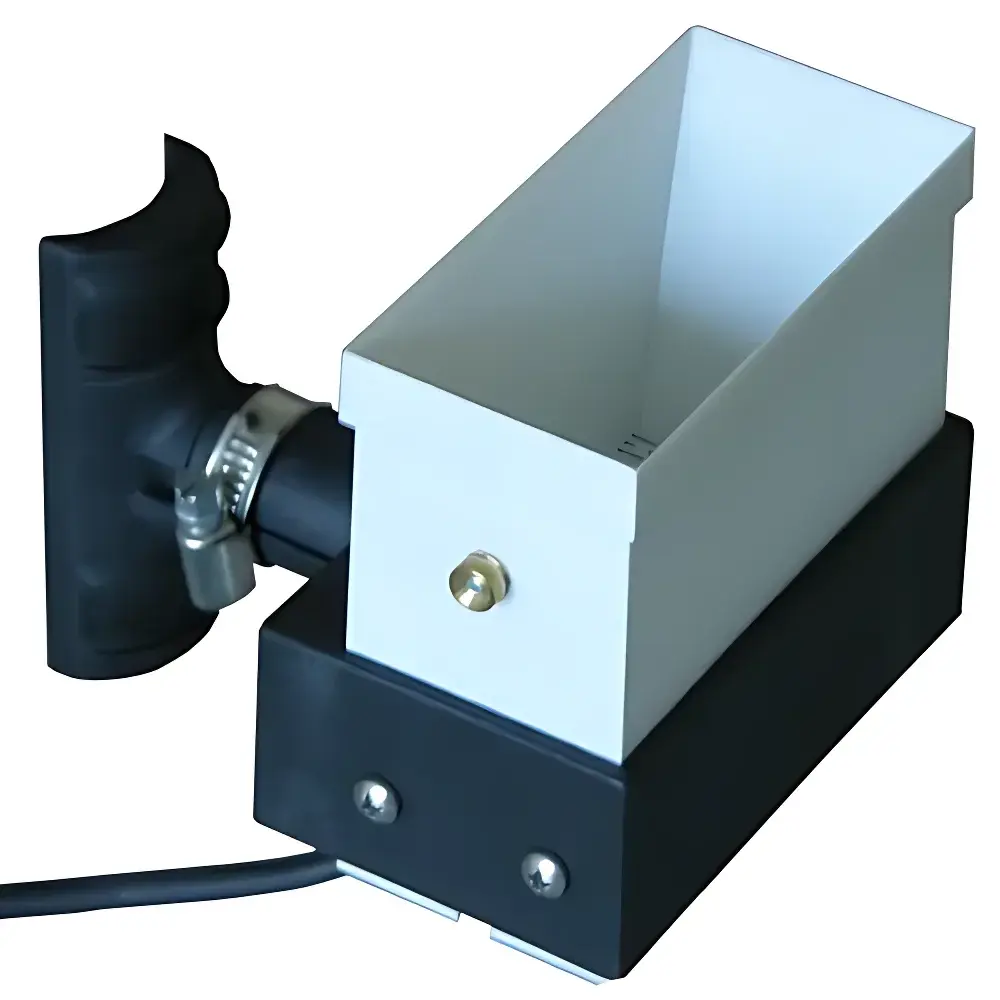
HACH ADCON Irrigation Flow Meter (Model 201.733.002)
| Brand | ADCON |
|---|---|
| Origin | Imported |
| Application | Drip Irrigation System Efficiency Monitoring |
| Resolution | 1 mm (rainfall mode) / 5 g per tip (irrigation mode) |
| Collection Orifice Area | 50 cm² |
| Tip Volume | 5 g |
| Operating Temperature Range | −30 °C to +70 °C |
| Weight | 0.4 kg |
| Housing Material | Styrosun® |
| Cable | 5 m shielded cable with PENTAX 7-pin connector |
| Compatible RTUs | A723, A733, A753 series |
| Mounting | Pole-mounted with two pipe clamps |
Overview
The HACH ADCON Irrigation Flow Meter (Model 201.733.002) is a precision-engineered tipping-bucket sensor designed specifically for quantitative monitoring of low-flow irrigation events in drip and micro-irrigation systems. Unlike conventional rain gauges optimized for atmospheric precipitation, this device operates on a calibrated mass-based tipping principle: each bucket tip corresponds to a precise 5 g accumulation of water—equivalent to 5 mL under standard density assumptions—enabling direct conversion to volumetric flow rates (e.g., L/h or gal/h) when integrated with time-stamped data loggers. Its mechanical design eliminates reliance on electronic flow transducers or pressure differentials, ensuring long-term stability without drift, battery dependency, or sensitivity to sediment-laden water common in agricultural settings. The sensor’s core architecture adheres to fundamental principles of gravimetric fluid measurement, where repeatability is governed by mechanical symmetry, pivot friction minimization, and consistent orifice geometry—factors validated through multi-year field deployments across Mediterranean, arid, and temperate horticultural zones.
Key Features
- Styrosun® polymer housing—UV-stabilized, frost-resistant down to −30 °C, and chemically inert to common agrochemicals including copper sulfate, glyphosate solutions, and acidic fertilizers.
- 50 cm² precision-machined collection funnel with sharpened rim geometry to deter avian perching and minimize organic debris accumulation.
- Self-cleaning tipping mechanism with low-hysteresis stainless-steel pivot and gravity-assisted reset—no moving parts require lubrication or scheduled maintenance.
- Factory-calibrated 5 g per tip resolution, traceable to NIST-traceable mass standards; recalibration achievable in-field using certified weights and standardized test protocols.
- Integrated 5 m shielded cable with IP67-rated PENTAX 7-pin connector ensures EMI resilience in electrically noisy farm environments and compatibility with ADCON’s A723, A733, and A753 remote telemetry units (RTUs).
- Pole-mounting kit includes adjustable U-bracket and dual hose clamps for secure attachment to PVC, PE, or metal distribution pipes (Ø16–32 mm).
Sample Compatibility & Compliance
The sensor is validated for use with non-turbulent, gravity-fed drip line outflows—ideally routed via dedicated 4–6 mm ID polyethylene tubing directly into the funnel inlet. It is not suitable for pressurized mainline flows (>0.5 bar), suspended particulate loads exceeding 50 mg/L, or fluids containing viscous additives (e.g., humic acid concentrates). While not certified to ISO 9060 (for meteorological rain gauges), its tipping accuracy meets ASTM D3370 Annex A3 requirements for cumulative water volume verification in irrigation audits. The device supports GLP-aligned data integrity when paired with ADCON RTUs configured for audit-trail logging, timestamped event capture, and tamper-evident memory storage—fully compliant with FAO Water Productivity Framework reporting standards.
Software & Data Management
Raw tip events are transmitted as digital pulse signals (TTL-level) to compatible ADCON RTUs, which embed timestamps with ±100 ms precision and apply configurable scaling factors (e.g., 5 g = 0.005 L → 18 L/h at 3600 tips/h). Data is stored locally in non-volatile memory and uplinked via GSM, LoRaWAN, or satellite to ADCON’s AquaManager cloud platform. This enables automated generation of irrigation efficiency KPIs—including application uniformity (AU), distribution uniformity (DUlq), and seasonal water balance reconciliation—exportable in CSV, Shapefile, or direct API integration with farm management software (e.g., Granular, Climate FieldView). All firmware updates and configuration changes are digitally signed and logged per FDA 21 CFR Part 11 requirements when deployed in regulated nursery or vineyard operations.
Applications
- Real-time validation of emitter performance across subsurface drip irrigation (SDI) laterals in almond orchards and vineyards.
- Quantitative assessment of clogging progression in fertigation lines during multi-week nutrient injection cycles.
- Calibration reference for soil moisture sensor networks—correlating applied volume with volumetric water content change in root zones.
- Audit-ready documentation for USDA NRCS EQIP incentive programs requiring verifiable water savings metrics.
- Research-grade monitoring in controlled-environment agriculture (CEA) trials evaluating root-zone delivery efficiency under variable EC and pH regimes.
FAQ
Can this sensor measure flow from pressurized manifolds?
No. It is strictly intended for gravity-fed, low-head (<0.3 m) drip line outputs. Pressurized flow induces turbulent entry and splash loss, compromising tip repeatability.
What is the minimum detectable flow rate?
At 5 g/tip and 1-second minimum inter-tip interval, the theoretical lower limit is ~18 L/h—though field validation recommends ≥30 L/h for robust statistical sampling over 15-minute intervals.
Is recalibration required after exposure to fertilizer solutions?
Not routinely. Styrosun®’s chemical resistance prevents surface degradation; however, annual verification using a 50 g certified weight and stopwatch is recommended per ISO/IEC 17025-aligned QA procedures.
Does the funnel require routine cleaning in dusty environments?
Yes. While the sharpened rim deters birds, airborne dust and pollen may accumulate seasonally. A monthly visual inspection and gentle rinse with deionized water is sufficient—no disassembly needed.
Can multiple sensors feed into one RTU?
Yes. The A733 and A753 RTUs support up to four independent tipping inputs with isolated optical coupling, enabling spatially distributed monitoring across irrigation blocks.
Related Products







