
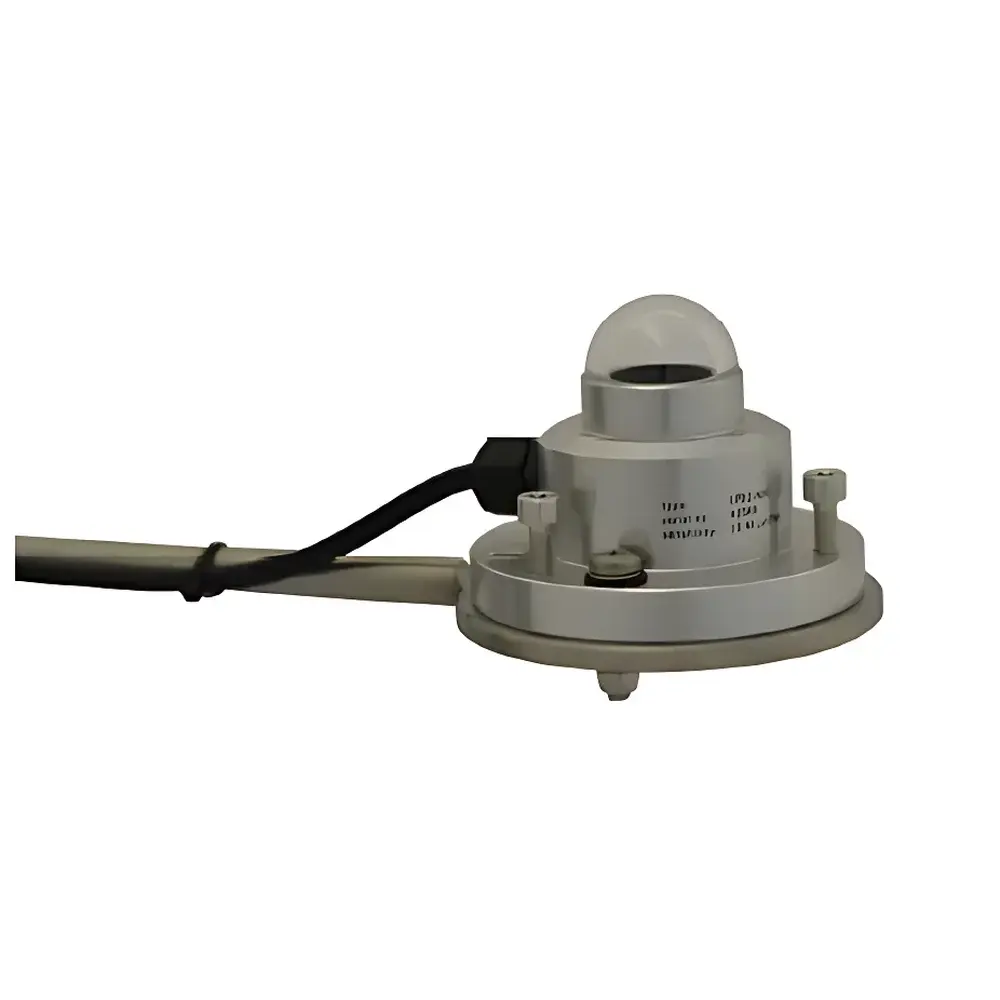
HACH ADCON LP-02 Pyranometer
| Brand | ADCON |
|---|---|
| Origin | Imported |
| Manufacturer Type | Authorized Distributor |
| Model | LP-02 |
| Calibration Standard | ISO 9060:2018 Class C (Secondary Standard) & WMO Guide (2018) |
| Spectral Range | 305–2800 nm |
| Sensitivity | 15 µV/(W·m⁻²) |
| Max Irradiance | 2000 W·m⁻² |
| Temp. Coefficient of Sensitivity | ±0.1 %/°C |
| Operating Temperature | −40 °C to +80 °C |
| Long-Term Stability (per year) | ±1 % |
| Non-Linearity (0–1000 W·m⁻²) | ±2.5 % |
| Tilt Response (at 1000 W·m⁻²) | ±3 % |
| Output Options | 0–2.5 V analog (with integrated Adcon amplifier) or mV-level thermopile signal (no amplifier) |
| Cable | 3 m shielded cable with PENTAX 7-pin connector |
| Mounting | Rigid pole-mount bracket |
| Dimensions (w/ bracket) | 420 × 355 × 150 mm (L×W×H) |
| Weight | 2.15 kg |
| Compliance | ISO 9060:2018, WMO No. 8, ASTM E824-94 |
Overview
The HACH ADCON LP-02 Pyranometer is a thermopile-based solar irradiance sensor engineered for continuous, high-reliability measurement of global horizontal irradiance (GHI) in meteorological, agricultural, and photovoltaic monitoring applications. It operates on the principle of thermal detection: incident solar radiation across the full shortwave spectrum (305–2800 nm) heats a blackened thermopile junction, generating a proportional millivolt output via the Seebeck effect. Its flat spectral response—achieved through precision black coating and optimized dome geometry—ensures minimal deviation across the solar spectrum, meeting ISO 9060:2018 Class C (Secondary Standard) and WMO Guide (2018) requirements for routine environmental monitoring. Unlike silicon-cell pyranometers, the LP-02 delivers spectrally unbiased measurements unaffected by spectral shifts under varying atmospheric conditions (e.g., cloud cover, aerosol load, or solar zenith angle), making it suitable for evapotranspiration (ETo) modeling, climate network validation, and PV system performance ratio analysis.
Key Features
- Thermopile sensing element with quartz hemispherical dome for uniform angular response and long-term stability
- ISO 9060:2018 Class C and WMO-compliant calibration traceable to World Radiometric Reference (WRR)
- Dual configuration options: LP-02 (bare thermopile output) and LP-02-A (integrated Adcon signal conditioner providing 0–2.5 V analog output)
- Robust mechanical design: IP67-rated housing, stainless-steel mounting bracket, and 3 m shielded cable with PENTAX 7-pin connector for EMI resilience
- Wide operational envelope: functional from −40 °C to +80 °C, enabling deployment in arctic, desert, and tropical environments
- Low temperature coefficient (±0.1 %/°C) and annual drift ≤ ±1 %, minimizing recalibration frequency in unattended stations
Sample Compatibility & Compliance
The LP-02 is compatible with all ADCON RTU platforms—including A723, A733, and A75x series (e.g., A753 GPRS)—via standardized analog or direct thermopile input channels. When interfaced with A75x gateways, users may configure custom drivers to digitize raw mV signals from non-amplified units directly at Port B, leveraging the RTU’s built-in low-noise amplification stage. The sensor conforms to international standards governing radiometric instrumentation: ISO 9060:2018 (specifying classification, response time, directional error, and temperature dependence), WMO Guide to Meteorological Instruments and Methods of Observation (Chapter 7), and ASTM E824-94 (Standard Practice for Calibrating Solar Radiometers). Its design supports GLP-aligned data acquisition workflows when deployed in regulated agricultural research or utility-scale PV O&M programs requiring audit-ready irradiance records.
Software & Data Management
Raw or conditioned LP-02 outputs integrate natively into ADCON’s ADvantage™ software suite and third-party SCADA platforms (e.g., Ignition, WinCC OA) via Modbus RTU/TCP or ASCII serial protocols. Time-synchronized irradiance values are logged with metadata including sensor ID, RTU timestamp, and diagnostic flags (e.g., dome contamination warning, voltage drop alerts). For compliance-critical deployments, ADCON RTUs support 21 CFR Part 11–aligned audit trails, electronic signatures, and secure data encryption during transmission. Historical GHI datasets can be exported in CSV or NetCDF formats for post-processing in Python (using pvlib), MATLAB, or R-based ETo models (FAO-56 Penman-Monteith).
Applications
- Agricultural meteorology: Real-time ETo calculation for irrigation scheduling and drought index derivation
- Photovoltaic plant monitoring: Performance ratio (PR) assessment, soiling loss quantification, and yield forecasting
- National weather service networks: GHI contribution to synoptic observation databases and climate trend analysis
- Research-grade environmental monitoring: Long-term solar resource assessment for site feasibility studies
- Educational instrumentation: Teaching radiometry fundamentals, energy balance modeling, and sensor calibration methodology
FAQ
Does the LP-02 require periodic recalibration?
Yes. While its annual instability is specified at ±1 %, ISO 9060 recommends recalibration every two years for secondary-standard instruments used in climate monitoring. Traceable recalibration services are available through HACH-authorized metrology labs.
Can the LP-02 be used for diffuse irradiance measurement?
No. The LP-02 measures global horizontal irradiance only. For diffuse component separation, a shading ring or tracking sun遮蔽 device must be used in conjunction with a second LP-02 unit.
What is the recommended cleaning protocol for the quartz dome?
Use deionized water and lint-free optical tissue; avoid solvents or abrasive cleaners. Dome soiling increases measurement uncertainty—regular visual inspection and cleaning every 1–3 months are advised in dusty or coastal environments.
Is the LP-02 compatible with non-ADCON data loggers?
Yes. The bare thermopile version (Order No. 200.733.018) outputs ~15 µV per W·m⁻² and interfaces with any high-resolution (≥16-bit) analog input channel supporting microvolt-level resolution and cold-junction compensation.
How does tilt response affect accuracy on inclined surfaces?
The ±3 % tilt error at 1000 W·m⁻² applies to off-horizontal mounting. For tilted-plane irradiance (e.g., PV array plane-of-array), use correction algorithms based on incidence angle modifier (IAM) models—not direct LP-02 readings.
Related Products







