
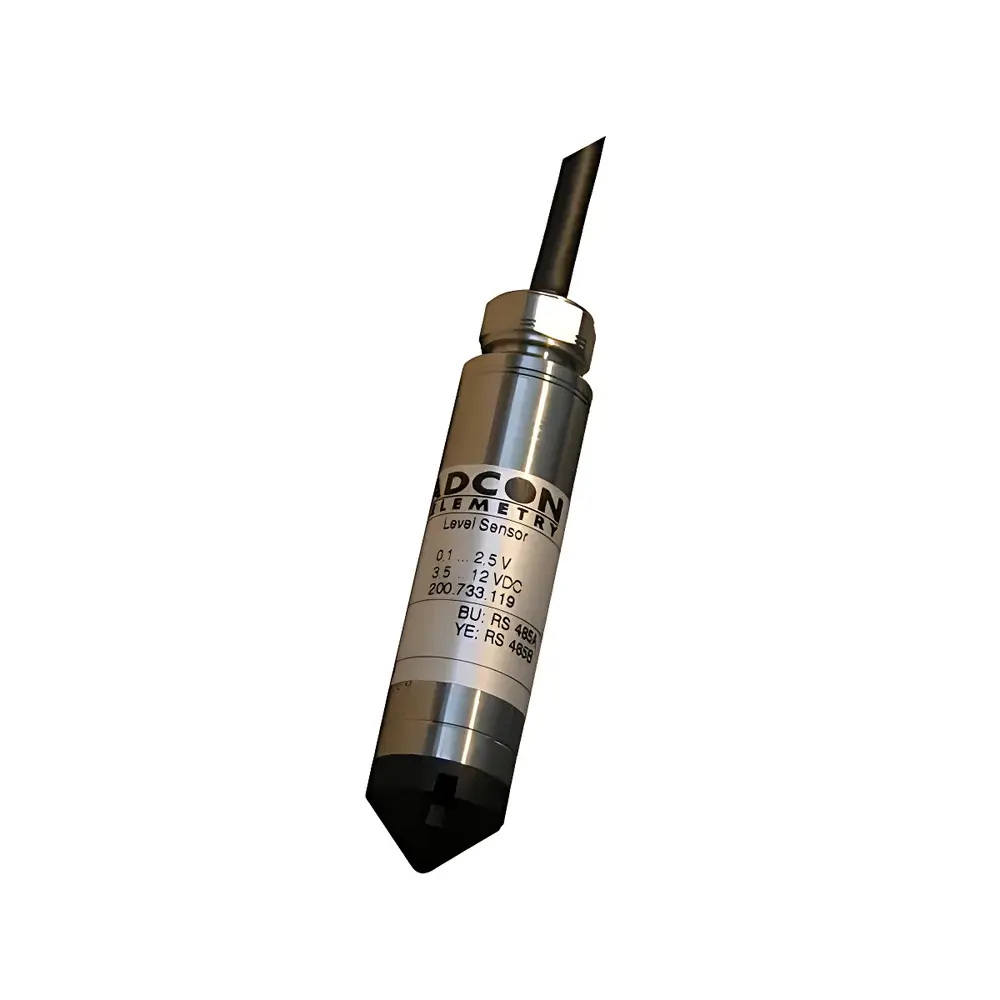
HACH ADCON LVE1 Digital Compensated Submersible Level Pressure Sensor
| Brand | ADCON |
|---|---|
| Origin | Switzerland |
| Model | LVE1 |
| Pressure Ranges | 1, 3, 10 bar |
| Overpressure Limits | 3, 7, 20 bar |
| Output Signal | 0.1–2.5 V DC |
| Supply Voltage | 3.2–12 V DC |
| Accuracy (0–40°C) | ±0.1% FS |
| Resolution | < 0.01% FS |
| Long-term Stability | ≤1 mbar (for ranges < 2 bar), ≤0.1% FS (for ranges ≥ 2 bar) |
| Operating Temperature | −40°C to +80°C |
| Temp. Compensation Range | 0°C to +80°C |
| Probe Dimensions | Ø22 mm × 95 mm |
| Cable | Ventilated PE, standard 15 m (custom lengths available) |
| Connector | Binder 7-pin M9 male |
| IP Rating | IP68 (probe), IP67 (connector) |
| Wetted Materials | 316L stainless steel (DIN 1.4435), FKM fluorocarbon elastomer, polyethylene |
| Media Compatibility | Water, wastewater, groundwater, non-corrosive aqueous solutions |
Overview
The HACH ADCON LVE1 is a high-precision, digitally compensated submersible level pressure sensor engineered for long-term hydrostatic level monitoring in demanding environmental and industrial applications. Based on piezoresistive pressure transduction with integrated temperature compensation and barometric reference via ventilated cable, the LVE1 delivers true gauge pressure measurements corrected for atmospheric fluctuations—enabling accurate liquid level determination without requiring separate barometric sensors or manual compensation routines. Manufactured in Switzerland and distributed globally under the HACH brand, the LVE1 adheres to stringent design principles for reliability in remote, unattended installations—including groundwater monitoring wells, reservoirs, stormwater basins, and wastewater treatment infrastructure. Its compact cylindrical form factor (Ø22 mm × 95 mm), combined with IP68-rated stainless-steel (DIN 1.4435) housing and FKM-sealed electronics, ensures mechanical robustness and chemical resistance in aggressive aqueous media.
Key Features
- Digital temperature compensation across 0°C to +80°C, minimizing thermal drift and ensuring stable output over wide ambient variations
- Ventilated polyethylene (PE) cable with integrated desiccant-free pressure equalization path—eliminates condensation risk at the sensor head while maintaining long-term vent integrity
- Quartz-based pressure compensation module housed within the probe tip, embedded directly into the cable assembly for zero-point stability and reduced hysteresis
- Three standard pressure ranges (1, 3, and 10 bar), corresponding to approximate liquid column heights of 10 m, 30 m, and 100 m water column (WC) at 4°C, with overpressure safety margins up to 200% of full scale
- Low-power analog output (0.1–2.5 V DC) compatible with most RTU, PLC, and data logger inputs; operates from 3.2–12 V DC, enabling direct integration with battery-powered telemetry systems
- High-resolution signal (< 0.01% FS) and tight accuracy specification (±0.1% FS over 0–40°C) support regulatory-grade data collection compliant with ISO 4064-1 and EN 14154 for water utility metering applications
Sample Compatibility & Compliance
The LVE1 is designed for continuous immersion in potable water, surface water, groundwater, treated and untreated wastewater, and other non-aggressive aqueous solutions. All wetted parts—including diaphragm, housing, and sealing elements—are constructed from 316L stainless steel (DIN 1.4435), FKM fluorocarbon elastomer, and UV-stabilized polyethylene, ensuring resistance to chloride-induced stress corrosion cracking and microbial-influenced corrosion (MIC). The sensor meets IP68 ingress protection for the probe body and IP67 for the Binder M9 connector, permitting permanent submersion at depths up to 100 m (dependent on selected range). It complies with RoHS 2011/65/EU and REACH SVHC regulations. While not intrinsically safe certified, its low-voltage operation and absence of spark-prone components make it suitable for Zone 2 hazardous area deployments when installed per IEC 60079-14 guidelines.
Software & Data Management
The LVE1 functions as a standalone analog transducer and does not require proprietary firmware or configuration software. Its linear voltage output integrates seamlessly with industry-standard SCADA platforms—including Campbell Scientific CR-series loggers, Siemens Desigo CC, and HACH’s own EVM and DataTrac systems—supporting automated calibration verification and time-synchronized sampling intervals. When deployed with HACH ADCON-compatible RTUs (e.g., ADCON Tattletale series), the sensor benefits from built-in diagnostics such as open-circuit detection, short-circuit monitoring, and supply voltage logging. All measurement data generated satisfies ALCOA+ principles (Attributable, Legible, Contemporaneous, Original, Accurate, Complete, Consistent, Enduring, Available) when recorded in validated systems compliant with 21 CFR Part 11 and EU Annex 11 requirements for electronic records in environmental monitoring.
Applications
- Groundwater level monitoring in observation wells and aquifer assessment networks
- Reservoir and tank level control in municipal water supply systems
- Wastewater lift station level sensing with surge tolerance and sludge resistance
- Stormwater detention basin volume estimation and flood warning systems
- Levee and dam seepage monitoring using piezometer arrays
- Environmental compliance reporting under EPA Method 120.1 and ISO 555-2 for hydrostatic level measurement
FAQ
What does “digitally compensated” mean for the LVE1?
Digital compensation refers to on-board microprocessor-based correction of temperature-induced zero and span errors using calibrated coefficients stored in non-volatile memory—distinct from analog-only temperature compensation circuits.
Can the LVE1 be used in seawater?
Yes, provided the installation duration is limited and maintenance intervals are observed; prolonged exposure may accelerate crevice corrosion at threaded interfaces despite 316L construction.
Is barometric compensation automatic?
Yes—the ventilated cable provides passive atmospheric reference; no external barometer or software correction is required for gauge-level output.
What is the recommended recalibration interval?
ADCON recommends annual verification against NIST-traceable deadweight testers or certified hydraulic comparators, especially after mechanical shock or extended high-temperature exposure.
Does the LVE1 support Modbus or SDI-12 output?
No—it outputs only analog voltage; digital protocols require external signal conditioning or use of an ADCON RTU with integrated analog-to-digital conversion and protocol translation.
Related Products







