
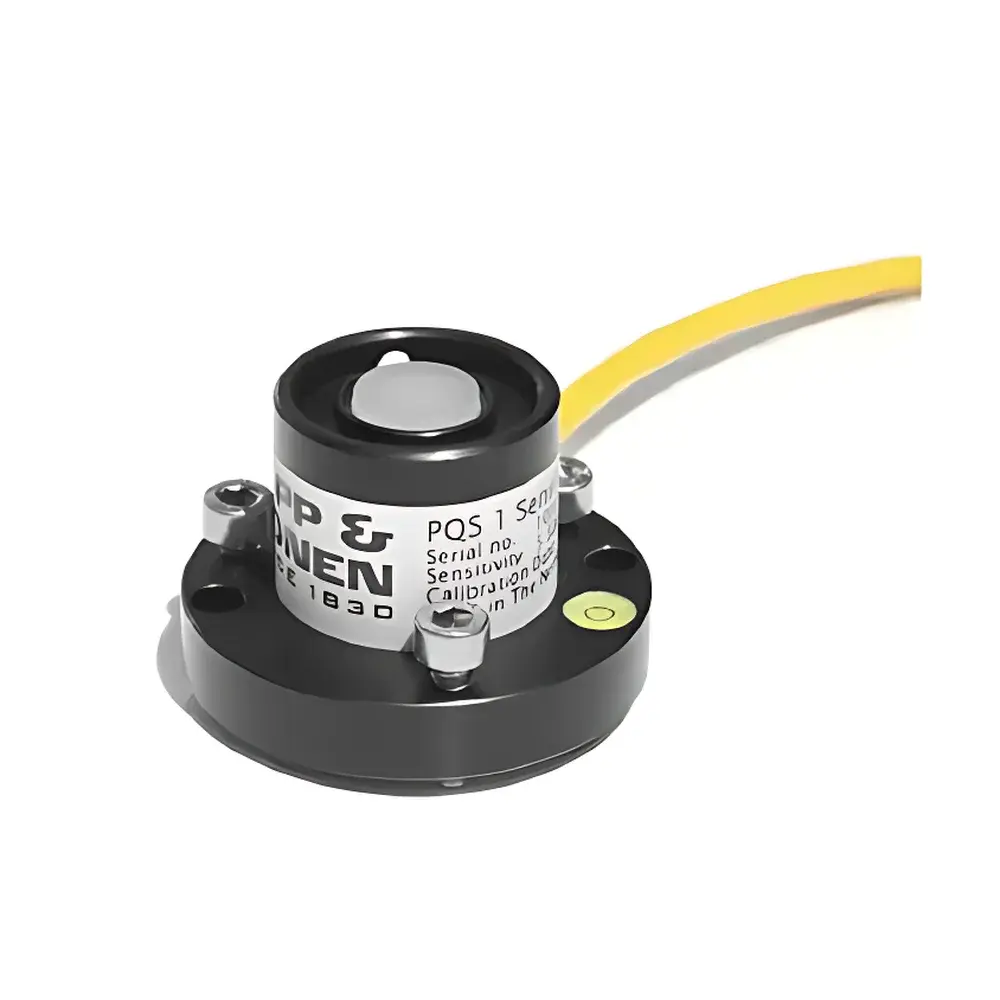
HACH ADCON PQS1 PAR Quantum Sensor for Photosynthetically Active Radiation
| Brand | ADCON |
|---|---|
| Origin | Imported |
| Manufacturer Type | Authorized Distributor |
| Model | PQS1 |
| Spectral Range | 400–700 nm ±4 nm |
| Sensitivity | 10–50 µV/µmol·m⁻²·s⁻¹ |
| Output Signal | 0–2.5 V (standard Adcon analog, with integrated amplifier) |
| Cable Length | 5 m (optional 15 m) |
| Response Time | <1 µs |
| Long-Term Drift | <2% per year |
| Nonlinearity (0–10,000 µmol·m⁻²·s⁻¹) | <1% |
| Cosine Response Error (up to 80° incidence at 1000 µmol·m⁻²·s⁻¹) | <30 µmol·m⁻²·s⁻¹ |
| Temperature Coefficient | −0.12%/°C |
| Field of View | 180° |
| Leveling Accuracy (integrated bubble vial) | ±0.2° |
| Detector Type | Silicon photodiode |
| Operating Temperature | −30°C to +70°C |
| Storage Temperature | −30°C to +70°C |
| Humidity Tolerance | 0–100% RH (non-condensing) |
| Ingress Protection | IP67 |
Overview
The HACH ADCON PQS1 PAR Quantum Sensor is a precision-calibrated, field-deployable instrument engineered for the continuous measurement of Photosynthetically Active Radiation (PAR) in both terrestrial and controlled-environment applications. Based on the McCree (1972) spectral definition—400–700 nm—the sensor quantifies photon flux density (PPFD) in units of µmol·m⁻²·s⁻¹, reflecting the number of photosynthetically usable photons incident upon a planar surface per unit time and area. Unlike broadband radiometers or lux meters, the PQS1 employs a spectrally matched silicon photodiode with optical filtering optimized for quantum response uniformity across the PAR band. Its cosine-corrected diffuser ensures high angular accuracy up to 80° incidence angle, critical for representative canopy-level or greenhouse roof measurements where light arrives from multiple sky vault positions. Designed for long-term unattended operation, the sensor integrates an onboard signal conditioning amplifier delivering a stable 0–2.5 V analog output compatible with ADCON’s telemetry platforms (e.g., ADEL, ADEL-PRO), SCADA systems, and third-party data loggers supporting standard voltage inputs.
Key Features
- Traceable calibration to NIST-traceable reference standards, with documented uncertainty budgets per ISO/IEC 17025 practices
- Robust IP67-rated housing constructed from UV-stabilized polycarbonate and stainless-steel mounting hardware, resistant to pesticide exposure, rain, dust, and thermal cycling
- Integrated bubble level and adjustable leveling screws enable rapid, repeatable horizontal alignment—essential for minimizing cosine error in fixed installations
- Low-temperature coefficient (−0.12%/°C) and wide operating range (−30°C to +70°C) ensure stability across seasonal field deployments and greenhouse environments
- Sub-microsecond electrical response time (<1 µs) supports high-frequency sampling for dynamic light studies, including sunfleck analysis and LED pulse characterization
- Factory-characterized cosine response curve provided in calibration certificate; directional error remains <30 µmol·m⁻²·s⁻¹ up to 80° zenith angle under 1000 µmol·m⁻²·s⁻¹ irradiance
Sample Compatibility & Compliance
The PQS1 is compatible with all common environmental monitoring infrastructures, including wired and wireless ADCON telemetry networks, Campbell Scientific CR series loggers, HOBO UX120 systems, and Modbus-enabled controllers. It meets IEC 61215 and IEC 61724-1 requirements for PV system performance monitoring when used in agrivoltaic research. While not certified to FDA 21 CFR Part 11, its analog output architecture supports GLP/GMP-aligned validation protocols when paired with compliant data acquisition systems featuring audit trails, electronic signatures, and calibration management. The sensor conforms to ISO 17025 calibration traceability requirements and complies with ASTM E2524–21 for spectral responsivity verification of PAR sensors.
Software & Data Management
Raw voltage outputs from the PQS1 are converted to PPFD using the factory-provided sensitivity factor (µV per µmol·m⁻²·s⁻¹), typically ranging between 10–50 µV/(µmol·m⁻²·s⁻¹). ADCON’s ADEL software suite provides automated scaling, temperature compensation (via optional external probe integration), and time-series visualization with configurable averaging intervals (1 s to 1 hr). Export formats include CSV, NetCDF, and XML, enabling direct ingestion into R, Python (pandas/xarray), MATLAB, or commercial platforms such as CropX or Climate FieldView. All calibration metadata—including date, reference standard ID, and spectral mismatch correction factors—is embedded in metadata headers.
Applications
- Agronomy & Precision Agriculture: Quantifying light interception by crop canopies to model LAI, estimate radiation use efficiency (RUE), and calibrate yield prediction models
- Controlled Environment Agriculture (CEA): Real-time feedback control of supplemental LED lighting in vertical farms and greenhouses, ensuring optimal DLI (Daily Light Integral) delivery
- Forest Ecology: Stratified PAR profiling above, within, and beneath forest canopies to parameterize radiative transfer models (e.g., MAESTRA, 3-PG)
- Ecophysiology Research: Measuring light gradients in understory microhabitats, phenological tracking of shade-tolerant species, and photoinhibition studies
- Solar Energy Integration: Monitoring PAR attenuation in agrivoltaic arrays to assess trade-offs between energy generation and crop productivity
- Educational & Citizen Science: Robust design and plug-and-play analog interface support undergraduate labs and long-term school-based phenology projects
FAQ
What is the difference between PAR and illuminance (lux)?
PAR measures photosynthetically usable photon flux (µmol·m⁻²·s⁻¹) across 400–700 nm, while lux measures human-eye-weighted luminous flux (lm·m⁻²). Lux values cannot be reliably converted to PPFD without spectral knowledge.
Can the PQS1 be used underwater or in submerged hydroponic systems?
No—the IP67 rating applies only to temporary immersion (1 m for 30 min); prolonged submersion or direct water contact invalidates calibration and risks condensation ingress.
Is temperature compensation applied internally?
The sensor provides raw voltage output; temperature compensation must be implemented externally using either a separate temperature probe or pre-defined coefficients in the data logger firmware.
How often does the PQS1 require recalibration?
ADCON recommends annual recalibration under ISO/IEC 17025-accredited conditions, especially after exposure to extreme UV doses, mechanical shock, or chemical cleaning agents.
Does the 5 m cable include shielding and twisted-pair construction?
Yes—the standard cable features double-shielded, twisted-pair conductors with tinned copper braid and foil wrap, minimizing EMI in electrically noisy agricultural or industrial settings.







