
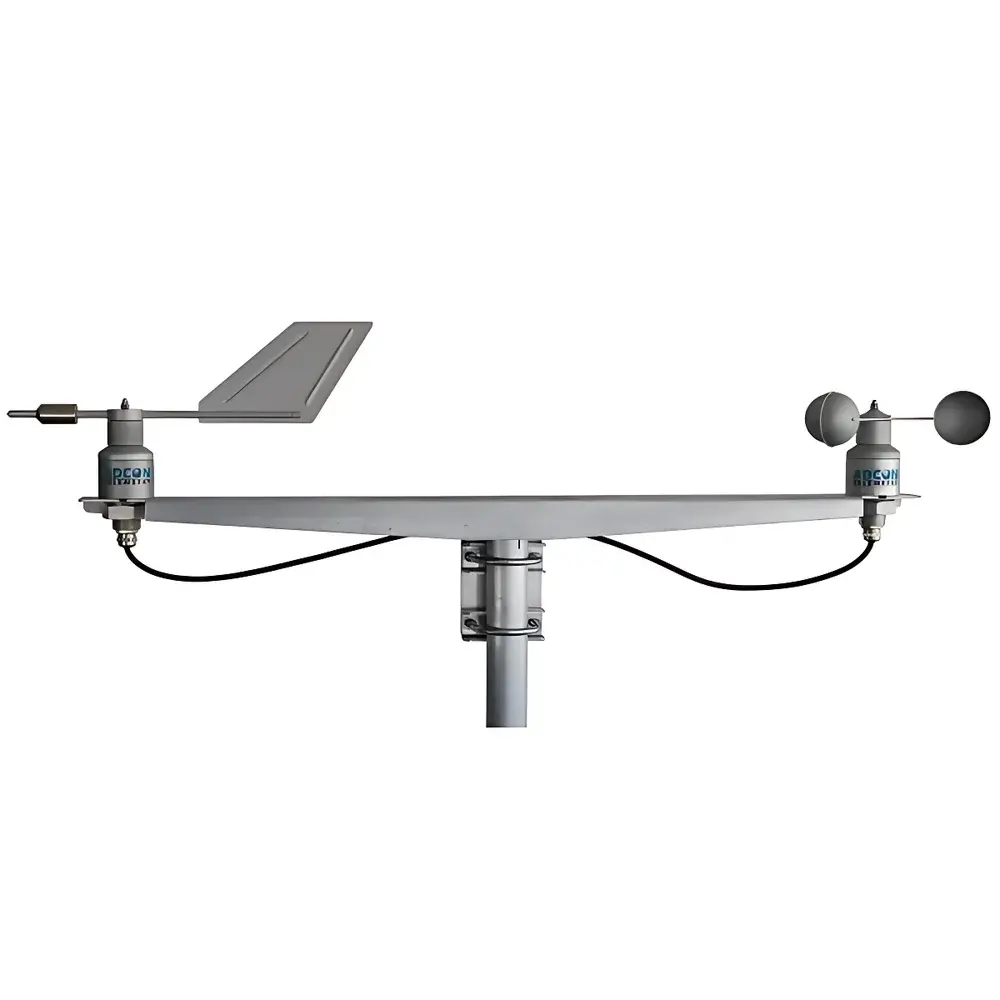
HACH ADCON Pro Anemometer & Wind Vane Sensor
| Brand | ADCON |
|---|---|
| Origin | Germany (Manufactured for HACH) |
| Model | Pro |
| Wind Speed Range | 0.4–270 km/h |
| Startup Wind Speed | <0.4 m/s |
| Wind Speed Sensor | Three-cup aluminum rotor with low-friction bearings |
| Wind Direction Sensor | Precision Hall-effect transducer with aluminum/stainless-steel vane |
| Housing Material | Anodized aluminum, seawater-corrosion resistant |
| Mounting | 80 cm mast arm with universal bracket |
| Cable Configuration | Integrated PENTAX connector + Y-split cable (dual-sensor interface to single ADCON RTU port) |
| Compliance | WMO-recommended installation geometry and performance criteria |
Overview
The HACH ADCON Pro Anemometer & Wind Vane Sensor is a dual-parameter meteorological transducer engineered for long-term, high-reliability deployment in demanding environmental monitoring applications. Designed and manufactured in Germany to meet World Meteorological Organization (WMO) observational standards, this sensor integrates two physically independent yet electrically coordinated measurement modules — a three-cup anemometer and a precision wind vane — into a single mechanically robust housing. Its operational principle relies on mechanical rotation translated into calibrated electrical signals: wind speed is derived from rotational frequency of the aluminum cup assembly, while wind direction is determined via angular position sensing using a solid-state Hall-effect transducer. This architecture eliminates slip rings and potentiometers, ensuring stable zero-point integrity and minimizing signal drift over extended service life. The sensor is optimized for integration into HACH ADCON remote telemetry units (RTUs), supporting both standalone hydrometeorological stations and distributed environmental networks where data continuity, corrosion resistance, and field-serviceability are critical.
Key Features
- WMO-compliant mechanical design, including standardized mounting geometry (80 cm mast arm with universal bracket) and aerodynamic sensor separation to minimize flow interference
- Anodized aluminum housing rated for continuous exposure to marine, coastal, and industrial atmospheres — fully resistant to salt spray and UV degradation
- Low-startup anemometer (<0.4 m/s threshold) featuring oversized aluminum cups and precision-ground low-friction ball bearings for consistent response across the full dynamic range (0.4–270 km/h)
- Wind vane constructed from lightweight aluminum and stainless steel, dynamically balanced for minimal inertia and rapid directional response
- Hall-effect wind direction sensing provides absolute angular output (0–360°) with no mechanical wear, hysteresis-free repeatability, and immunity to contact oxidation
- Modular Y-split cable architecture: each sensor element connects via its own PENTAX cable, merging into a single RTU interface — enabling component-level replacement without system downtime
- Factory-calibrated and traceable to national metrological standards; calibration documentation available upon request
Sample Compatibility & Compliance
The ADCON Pro sensor is compatible with all HACH ADCON-series RTUs (e.g., ADCON Tattletale, ADCON A5, and ADCON Edge platforms) and supports standard analog (0–5 VDC or 4–20 mA) and digital (SDI-12, RS-485 Modbus RTU) output configurations. It meets WMO Guide to Meteorological Instruments and Methods of Observation (CIMO Guide, Chapter 6) requirements for exposure height, siting, and mechanical stability. While not certified to IEC 61400-12-1 (for wind energy assessment), its performance envelope aligns with Class II accuracy specifications per ISO 12239 for general-purpose wind monitoring. The sensor’s materials and construction comply with ISO 9223 (corrosivity classification) Category C5-M (marine environments) and UL 94 V-0 flammability rating for enclosure components.
Software & Data Management
Data acquisition is natively supported through HACH ADCON’s ADvantage software suite, which enables real-time visualization, automated quality control flagging (e.g., frozen vane detection, cup stall diagnostics), and scheduled calibration verification routines. All raw sensor outputs are time-stamped with microsecond resolution and stored with embedded metadata (sensor ID, firmware version, temperature-compensated status). For regulatory compliance, ADvantage supports audit-trail logging and user-access controls aligned with 21 CFR Part 11 principles when deployed in GLP/GMP-aligned environmental monitoring programs. Export formats include CSV, NetCDF, and EPA-compatible DCP/FTP protocols for integration with national weather services or EPA AirNow infrastructure.
Applications
- Regulatory air quality and ambient meteorological monitoring networks (EPA, EEA, national hydrometeorological services)
- Coastal and offshore environmental observatories requiring corrosion-resistant instrumentation
- Hydrological forecasting stations where wind-driven evaporation and surface turbulence modeling depend on high-fidelity vector wind data
- Industrial fence-line monitoring for fugitive emission dispersion modeling
- Research-grade micrometeorology studies requiring long-term sensor stability and minimal maintenance intervals
- Renewable energy site assessment (pre-construction phase), where cost-effective, WMO-aligned data collection is prioritized over turbine-class certification
FAQ
Can the anemometer and wind vane be replaced independently?
Yes. Each sensor module uses a dedicated PENTAX cable and mounts separately onto the shared 80 cm mast arm. Replacement requires only basic hand tools and does not necessitate recalibration of the counterpart unit.
Is the sensor suitable for marine deployment?
Yes. The anodized aluminum housing, stainless-steel fasteners, and sealed bearing assemblies are specifically qualified for continuous operation in ISO C5-M corrosive environments, including offshore platforms and tidal monitoring buoys.
Does it support NIST-traceable calibration?
Factory calibration is performed against reference standards accredited to ISO/IEC 17025. NIST-traceable calibration certificates are available as an optional add-on at time of order or during scheduled maintenance.
What is the recommended maintenance interval?
Under typical environmental conditions, visual inspection and cleaning are advised annually; bearing lubrication or electronic recalibration is not required within the first five years of operation.
Can it interface with non-ADCON data loggers?
Yes — via analog voltage/current outputs or SDI-12/Modbus RTU protocols. Pinout diagrams and protocol specifications are provided in the technical manual included with shipment.







