
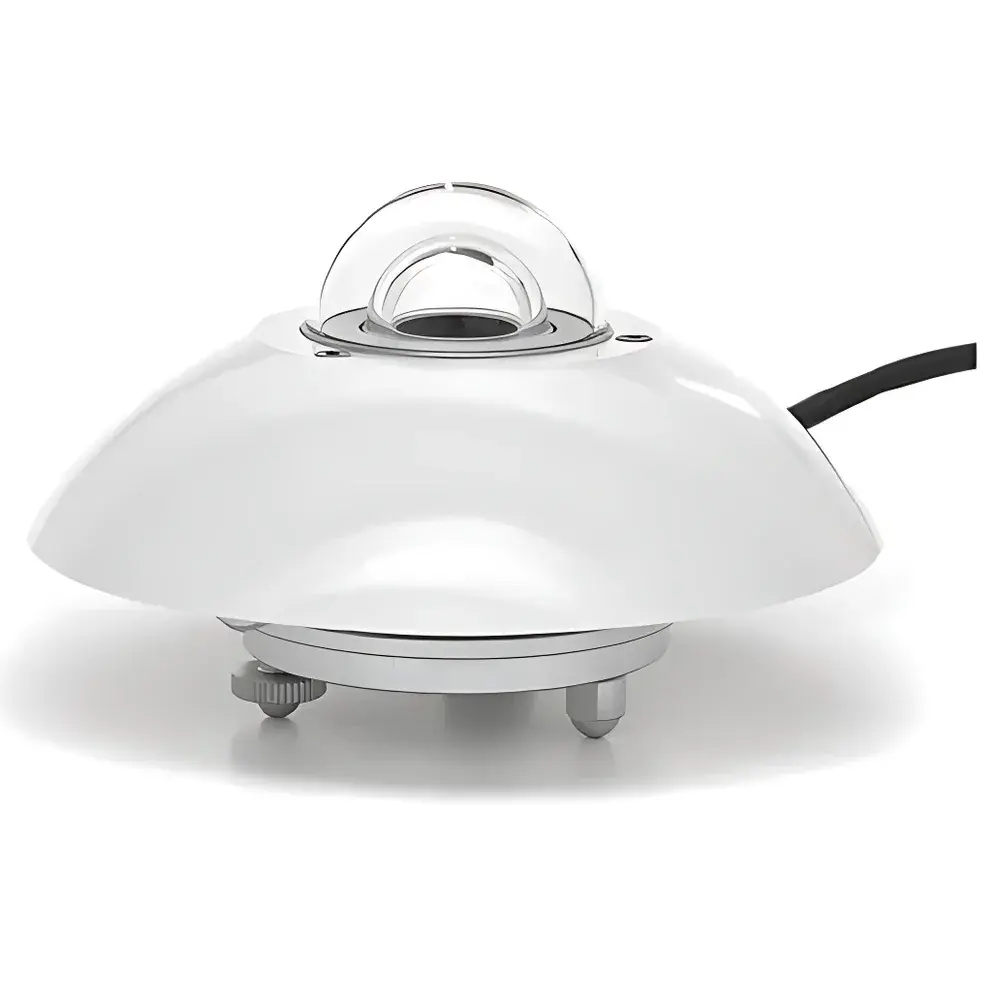
HACH ADCON SR11 Pyranometer
| Brand | ADCON |
|---|---|
| Origin | Imported |
| Manufacturer Type | Authorized Distributor |
| Model | SR11 |
| Output Signal | 0–2.5 V DC (with integrated amplifier) |
| Sensitivity | 15 µV/(W/m²) |
| Spectral Range | 305–2800 nm |
| Max. Irradiance | 2000 W/m² |
| Temp. Coefficient of Sensitivity | ±0.1 %/°C |
| Operating Temperature | −40 °C to +80 °C |
| Long-term Instability (per year) | < ±1 % |
| Non-linearity (0–1000 W/m²) | < ±2.5 % |
| Tilt Response (at 1000 W/m²) | < ±3 % |
| Compliance | ISO 9060:2018 Class A, ISO 9847 |
| Dimensions (incl. mounting mast) | 420 × 355 × 150 mm (L × W × H) |
| Weight | 2.6 kg |
| Cable | 3 m shielded cable with PENTAX 7-pin connector |
| Compatible RTUs | A723, A733, A75x series |
Overview
The HACH ADCON SR11 Pyranometer is a high-precision, thermopile-based solar irradiance sensor engineered for continuous, traceable measurement of global horizontal irradiance (GHI). Designed and calibrated in accordance with ISO 9060:2018 Class A specifications—the highest classification for spectral response, directional error, and temperature stability—the SR11 delivers metrological-grade performance suitable for reference-grade meteorological networks, PV system performance monitoring, and climate research applications. Its dual-glass hemispherical dome minimizes thermal offset and spectral transmission deviation across the full solar spectrum (305–2800 nm), while the blackened thermopile detector ensures uniform planar response to incident radiation regardless of solar zenith angle. Unlike silicon-cell pyranometers, the SR11 provides true broadband measurement without spectral selectivity bias, eliminating underestimation during diffuse or low-angle conditions.
Key Features
- ISO 9060:2018 Class A certified—meets stringent requirements for directional response, temperature dependence, non-linearity, and long-term stability
- Dual fused-silica dome construction reduces thermal emittance and improves cosine correction at high zenith angles
- Integrated signal conditioning amplifier delivers stable 0–2.5 V DC analog output, directly compatible with all ADCON RTUs (A723, A733, A75x series)
- Thermopile sensing element with 15 µV/(W/m²) sensitivity enables high-resolution data acquisition even at low irradiance levels
- Ruggedized stainless-steel housing and aluminum mounting mast rated for continuous outdoor operation from −40 °C to +80 °C
- Pre-calibrated at accredited laboratory; calibration certificate traceable to WRR (World Radiometric Reference) included
- Low tilt response error (< ±3 % at 1000 W/m²) ensures accuracy under non-horizontal installation scenarios common in rooftop PV arrays
Sample Compatibility & Compliance
The SR11 is designed for direct exposure to unobstructed solar radiation and requires no consumables or optical filters. It is fully compatible with standard meteorological mounting hardware—including leveling bases, sun trackers (e.g., Solys 2), and passive ventilation domes—and integrates seamlessly into existing ADCON telemetry infrastructure. All units comply with ISO 9060:2018 (Class A) and ISO 9847 for pyranometer calibration methodology. For regulatory reporting and grid-code compliance (e.g., IEC 61724-1, EN 50530), the SR11 satisfies the “reference cell” requirement when deployed alongside secondary standard sensors in Tier 1 PV monitoring systems. Its design supports GLP-aligned field validation protocols and is routinely specified in national weather service deployments requiring NIST-traceable instrumentation.
Software & Data Management
The SR11 outputs a linear analog voltage proportional to instantaneous irradiance, enabling integration with any data logger supporting 0–2.5 V input ranges and 16-bit resolution. When paired with ADCON’s A7xx-series RTUs, raw voltage readings are automatically converted to W/m² using factory-applied calibration coefficients stored in non-volatile memory. Firmware versions ≥3.2.1 support on-device linearization, temperature compensation (±0.1 %/°C), and diagnostic flags for sensor health monitoring (e.g., dome contamination detection via dark-current drift analysis). Data export formats include CSV, XML, and Modbus TCP for ingestion into SCADA platforms (e.g., Ignition, Siemens Desigo), PV performance analytics tools (e.g., SolarAnywhere, PVsyst), and cloud-based environmental databases (e.g., NOAA’s NCDC, Copernicus Climate Data Store).
Applications
- Reference-grade solar resource assessment for utility-scale photovoltaic plant feasibility studies
- Real-time GHI monitoring in operational PV power plants per IEC 61724-1 Annex A requirements
- Long-term climate trend analysis in national meteorological observatories and WMO GAW stations
- Calibration transfer and intercomparison campaigns between primary and secondary standard radiometers
- Albedo and surface reflectance studies when deployed in upward/downward paired configurations
- Validation of satellite-derived irradiance products (e.g., CAMS, NSRDB) through ground-truthing campaigns
FAQ
Does the SR11 require periodic recalibration?
Yes. Per ISO 9060:2018 and best practice guidelines, annual recalibration against a traveling standard or at an accredited laboratory (e.g., PMOD/WRC, NREL) is recommended to maintain Class A compliance.
Can the SR11 be used with non-ADCON data loggers?
Yes—its 0–2.5 V analog output is protocol-agnostic; however, users must apply the individual calibration coefficient (µV per W/m²) and account for temperature compensation manually if the logger lacks built-in correction algorithms.
Is the 3 m cable length extendable?
Extension is possible using twisted-pair shielded cable (e.g., Belden 8761) up to 50 m; beyond that, signal attenuation and noise susceptibility increase significantly—active signal repeaters or digital interface options (e.g., RS-485 with ADCON A755) are advised.
What maintenance is required for long-term accuracy?
Daily visual inspection for dome soiling; quarterly cleaning with deionized water and lint-free cloth; biannual verification of leveling and mechanical integrity of the mounting mast.
Is the SR11 suitable for tilted-plane irradiance (POA) measurements?
Yes—its Class A tilt response specification (< ±3 % at 1000 W/m²) validates its use on fixed-tilt or single-axis tracker-mounted arrays, provided proper orientation and horizon clearance are maintained.







