
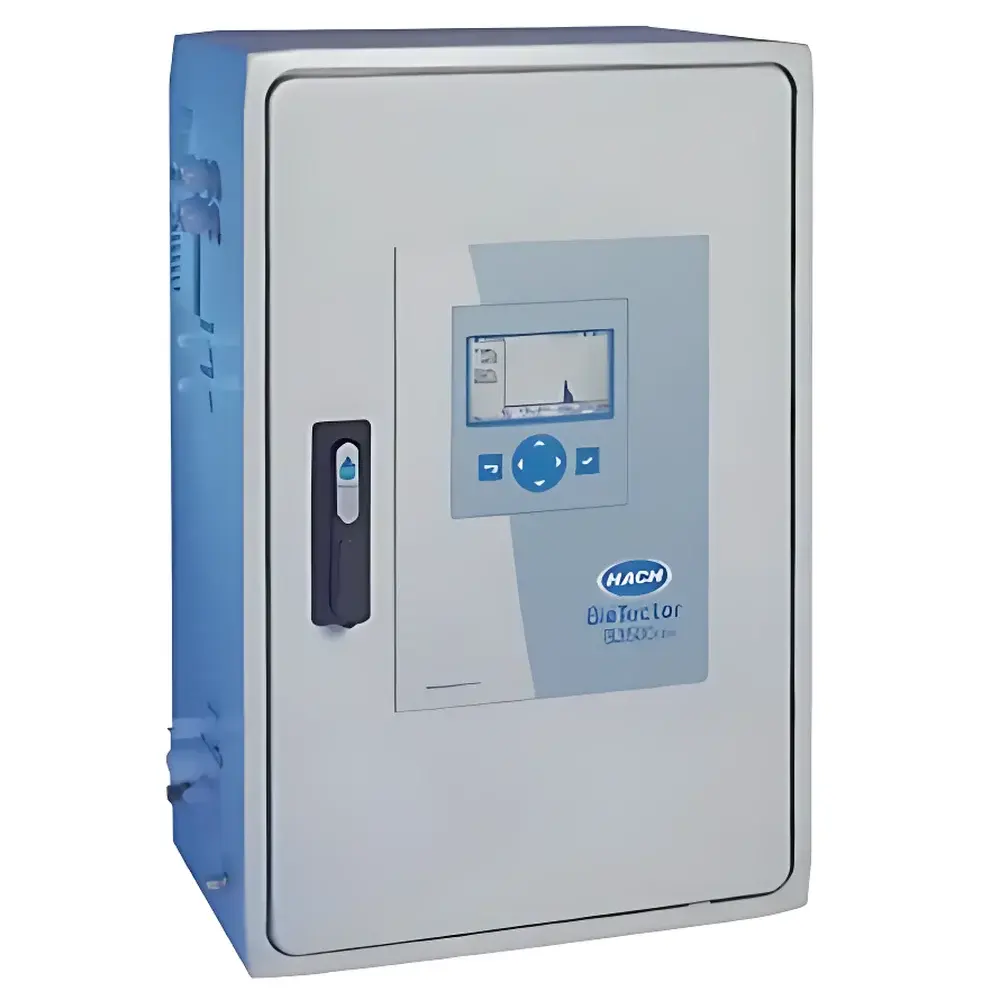
HACH BIOTECTOR B3500dw Total Organic Carbon Analyzer
| Brand | HACH |
|---|---|
| Model | BIOTECTOR B3500dw |
| Instrument Type | Online TOC Analyzer |
| Oxidation Method | Two-Stage Advanced Oxidation (TSAO) with Hydroxyl Radicals |
| Measurement Principle | NDIR Detection of CO₂ after Acidification and Oxidation |
| Measurement Range (Standard) | 0–250 mgC/L |
| Extended Range (with Overrange Tracking) | 0–1,000 mgC/L |
| Accuracy | ±3% of reading or ±0.45 mgC/L (standard range) |
| Repeatability | Same as accuracy specification |
| Detection Limit | Not specified |
| Resolution | Not specified |
| Sample Particle Size Limit | ≤100 µm |
| Operating Temperature | 0–45 °C |
| Sample Inlet Temperature | 0–60 °C |
| Chloride Tolerance | Up to 30% w/w |
| Humidity Range | 5–85% RH, non-condensing |
| Power Supply | 115/220 VAC |
| Dimensions (H×W×D) | 750 × 500 × 320 mm |
| Weight | 46 kg |
| Data Storage | 9,999 reaction records + 99 error logs |
| Communication Protocols | Modbus®, PROFIBUS |
| Cycle Time | Typically 7.5 minutes |
| Display | 40×16 LED-backlit LCD |
| Languages | English, Spanish, French (others on request) |
| Maintenance Interval | Every 6 months |
| Compliance | EPA-approved oxidation method (U.S. Patent No. 6,623,974 B1) |
Overview
The HACH BIOTECTOR B3500dw is a robust, industrial-grade online Total Organic Carbon (TOC) analyzer engineered for continuous, unattended operation in critical water quality monitoring applications—including drinking water treatment, pharmaceutical water systems, and municipal distribution networks. It employs a proprietary Two-Stage Advanced Oxidation (TSAO) process—validated under U.S. Patent No. 6,623,974 B1—to achieve near-complete oxidation of recalcitrant organic compounds that resist conventional UV/persulfate methods. Following acidification to liberate inorganic carbon (TIC), the sample undergoes TSAO using hydroxyl radicals generated via ozone-enhanced alkaline oxidation. The resulting CO₂ is stripped under low-pH conditions and quantified via high-stability Non-Dispersive Infrared (NDIR) detection. This dual-phase measurement architecture enables simultaneous determination of TOC, TIC, and TC with trace-level sensitivity and metrological integrity aligned with regulatory expectations for source water and purified water streams.
Key Features
- Patented TSAO oxidation technology—EPA-recognized for complete mineralization of complex organics, including humic substances and chlorinated byproduct precursors
- Self-cleaning reactor design minimizes fouling and eliminates manual scrubbing cycles
- Automated calibration and fluidic line rinsing reduce operator dependency and analytical drift
- Overrange tracking capability extends dynamic measurement up to 1,000 mgC/L without hardware modification
- High-availability architecture supports ≥99.86% uptime over 12-month operational periods
- Integrated microcontroller with membrane keypad and 40×16 backlit LCD ensures intuitive local operation under ambient lighting conditions
- Modbus® and PROFIBUS digital interfaces enable seamless integration into SCADA, DCS, and MES platforms
- Comprehensive onboard data logging: 9,999 reaction records and 99 diagnostic event logs with timestamped metadata
Sample Compatibility & Compliance
The B3500dw accommodates raw, filtered, and treated water matrices with suspended solids ≤100 µm and chloride concentrations up to 30% w/w—making it suitable for brackish influent, desalination pre-treatment, and reclaimed water applications. Its TSAO method satisfies performance criteria referenced in U.S. EPA Method 415.3 and ASTM D7573 for oxidizable carbon quantification. While not inherently 21 CFR Part 11-compliant out-of-the-box, the analyzer supports audit-trail-enabling configurations when deployed with HACH’s compliant software suite (e.g., HACH Insight™) in GLP/GMP-regulated environments. All firmware revisions undergo rigorous validation per IEC 62304 and maintain traceable calibration history per ISO/IEC 17025 requirements.
Software & Data Management
Data acquisition and instrument control are managed through an embedded real-time operating system with configurable alarm thresholds, trend logging, and remote diagnostics. Raw CO₂ absorbance values, oxidation efficiency metrics, and reagent consumption counters are stored with UTC timestamps and accessible via serial or Ethernet export. Optional HACH Data Manager software provides CSV/Excel export, statistical process control (SPC) charting, and automated report generation compliant with internal QA protocols. Firmware updates are delivered via secure USB or network push, with version rollback capability and SHA-256 signature verification to ensure integrity.
Applications
- Drinking water utilities verifying compliance with EPA Stage 2 Disinfectants and Disinfection Byproducts Rule (DBPR)
- Pharmaceutical facilities monitoring Purified Water (PW) and Water for Injection (WFI) per USP and EP 2.2.44
- Power plant boiler feedwater systems detecting organic contamination before ion exchange or RO membranes
- Municipal wastewater reuse plants validating tertiary effluent quality prior to aquifer recharge or irrigation discharge
- Food & beverage production lines ensuring rinse water TOC remains below process-critical thresholds
FAQ
What oxidation method does the B3500dw use, and why is it superior to UV-based TOC analyzers?
The B3500dw implements Two-Stage Advanced Oxidation (TSAO), generating hydroxyl radicals via ozone-assisted alkaline oxidation. Unlike UV/persulfate systems, TSAO fully mineralizes refractory organics—including fulvic acids, polycyclic aromatics, and nitrogenous compounds—that contribute to disinfection byproduct formation but evade UV photolysis.
How frequently must the system be maintained, and what tasks are involved?
Scheduled maintenance is required every six months and includes replacement of consumables (oxidant reagents, acid, carrier gas filters), verification of NDIR detector zero/span stability, and functional testing of auto-calibration and line-flush sequences.
Can the B3500dw measure both TOC and TIC in the same analysis cycle?
Yes. Each full measurement sequence begins with acidification and sparging to quantify TIC, followed by TSAO and secondary sparging to determine TOC. TC is derived arithmetically as the sum of TOC and TIC.
Is the analyzer suitable for high-chloride environments such as seawater desalination pretreatment?
Yes. With validated tolerance up to 30% w/w chloride, the B3500dw operates reliably in brackish and hypersaline feedwaters where conventional TOC analyzers suffer from electrode passivation or catalyst poisoning.
Does the system support remote monitoring and cybersecurity protocols?
It supports encrypted firmware updates, password-protected configuration access, and role-based user permissions. When integrated with HACH’s cloud-enabled gateway devices, it complies with IEC 62443-3-3 security levels for industrial control systems.
Related Products







