
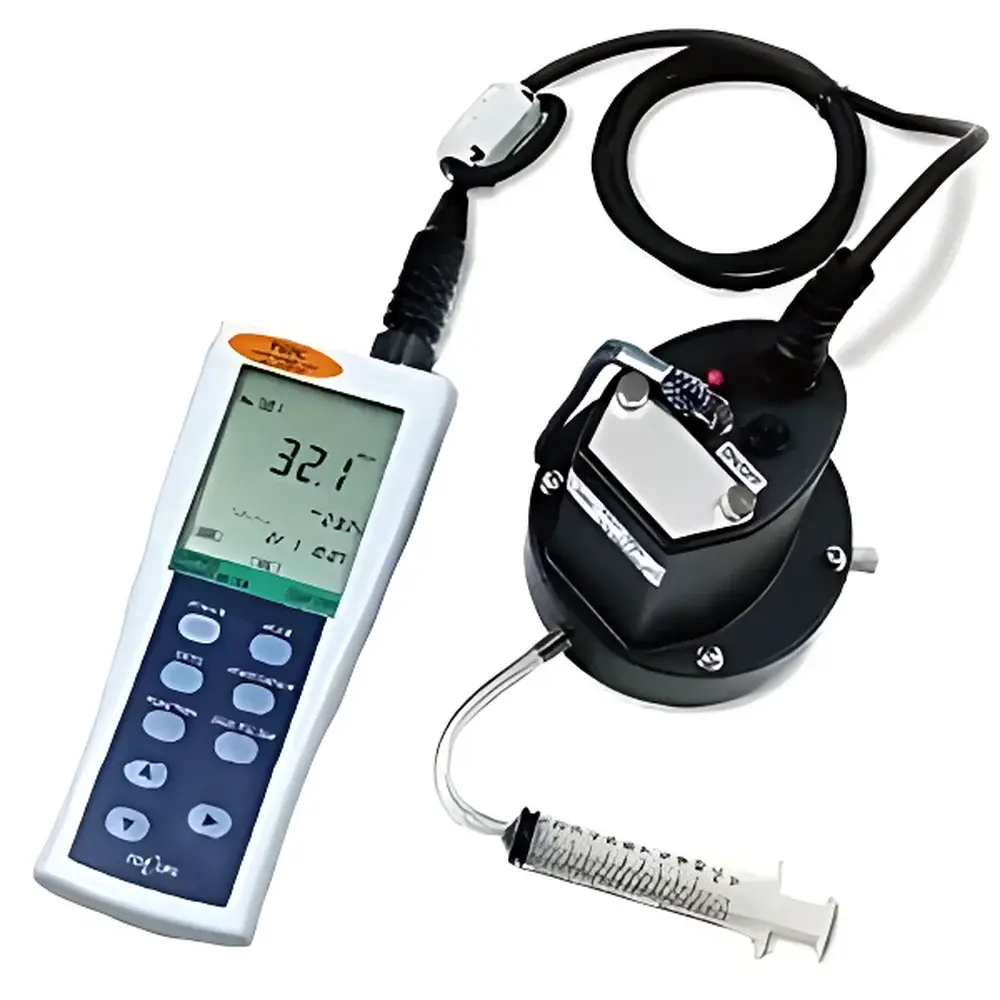
HACH DKK SSM-21P Portable Surface Salinity Meter
| Brand | HACH |
|---|---|
| Manufacturer Origin | Japan (DKK Corporation) |
| Manufacturer Type | Original Equipment Manufacturer (OEM) |
| Country of Origin | Imported |
| Model | SSM-21P |
| Pricing | Upon Request |
Overview
The HACH DKK SSM-21P Portable Surface Salinity Meter is an engineered field instrument designed for rapid, non-destructive quantification of water-soluble salt contamination on steel substrates prior to coating application. It operates on the principle of conductivity-based extraction: a precisely defined volume (10 mL) of ultrapure water is introduced into a magnetically coupled measurement cell sealed against the surface; soluble salts—including chlorides, sulfates, and nitrates—dissolve into the water phase, and the resulting solution’s electrical conductivity is measured in situ. Using pre-programmed conversion algorithms aligned with ISO 8502-9 and the IMO’s Protective Coating Performance Standard (PSPC), the device calculates and displays surface salt concentration in mg/m² as NaCl-equivalent or total water-soluble salts. Unlike traditional Bresle patch methods, the SSM-21P eliminates adhesive residue, manual wiping, and solution extraction—reducing operator variability and ensuring repeatable, auditable results under marine, offshore, and industrial infrastructure maintenance protocols.
Key Features
- Magnetic coupling system for secure, residue-free attachment to ferrous surfaces—no tapes, adhesives, or surface preparation required.
- Four simultaneous display modes: (1) Water-soluble salt concentration (PSPC-compliant), (2) Water-soluble salt concentration converted per ISO 8502-9 Annex A, (3) NaCl-equivalent concentration (mg/m²), and (4) Conductivity (μS/cm).
- Integrated motor-driven stirring within the ELC-006 measurement cell ensures homogeneous dissolution and stable conductivity readings within 60–180 seconds.
- Automatic range switching across dual conductivity scales (0–199.9 / 0–1999 μS/cm) and dual salt concentration ranges (0–199.9 / 0–1999 mg/m²) optimizes resolution across low- and high-contamination scenarios.
- Automatic temperature compensation (ATC) from 0–50°C referenced to 25°C, with fixed 2.0%/°C coefficient—calibrated to match standard ASTM D4940 and ISO 8502-9 thermal response profiles.
- Onboard data logging for up to 300 measurements, each timestamped and stored with conductivity value, calculated salt concentration, and ambient temperature.
Sample Compatibility & Compliance
The SSM-21P is validated for use on carbon steel, stainless steel, and weathering steel substrates encountered in ship hulls, offshore platforms, storage tanks, bridges, and pipeline structures. Its measurement cell (ELC-006) defines a fixed 1250 mm² contact area—ensuring consistency with ISO 8502-6 (Bresle method reference area) and enabling direct comparability with laboratory-based ion chromatography or titration results. The instrument complies with ISO 8502-9:2017 (“Determination of water-soluble salt contamination on steel surfaces”), meets PSPC Section 4.2.3 requirements for pre-coating surface cleanliness verification, and supports traceable quality assurance in accordance with ISO/IEC 17025-accredited coating inspection workflows. No calibration certificates are issued by default; however, users may perform field verification using certified KCl standard solutions (e.g., 100 μS/cm at 25°C).
Software & Data Management
Data export is conducted via manual transcription or optional infrared (IR) interface accessories (sold separately). Each logged record includes date/time stamp, conductivity reading, derived salt mass per unit area, and measured temperature—supporting GLP-aligned documentation for coating contractor reports and third-party QA audits. While the device lacks USB or Bluetooth connectivity, its internal memory retains full measurement history even during battery replacement. All firmware logic—including ISO 8502-9 polynomial conversion coefficients and PSPC linear scaling factors—is factory-embedded and non-user-modifiable, preserving regulatory integrity. Audit trails are maintained through sequential record numbering and immutable timestamps, satisfying basic FDA 21 CFR Part 11 principles where electronic records are manually transcribed into controlled documentation systems.
Applications
- Pre-paint surface qualification on newly blasted or weathered marine steel structures.
- Verification of high-pressure water jetting (HPWJ) and ultra-high-pressure (UHP) cleaning efficacy prior to shop or field coating.
- Root-cause analysis of premature coating delamination linked to residual chloride ingress.
- Third-party inspection services performing SSPC-PA 2 or ISO 19840-compliant coating system audits.
- Condition monitoring of aging infrastructure where cyclic wet-dry exposure accelerates salt accumulation beneath existing coatings.
FAQ
Does the SSM-21P require calibration before each use?
No—routine calibration is not required. However, users should verify system performance daily using a traceable 100 μS/cm KCl standard solution prior to critical measurements.
Can the device measure non-ferrous surfaces such as aluminum or concrete?
No—the magnetic coupling mechanism is specific to ferromagnetic substrates. For non-ferrous surfaces, alternative methods (e.g., Bresle patch + portable conductivity meter) must be employed.
What is the minimum surface roughness required for reliable sealing?
The ELC-006 cell performs reliably on Sa 2.5 blast-cleaned steel (ISO 8501-1), corresponding to a surface profile of 50–85 μm. Sealing failure may occur on excessively smooth (< Sa 2) or highly pitted (>125 μm) surfaces.
Is the 10 mL water volume strictly mandatory?
Yes—the instrument’s conversion algorithms assume exact 10 mL extraction volume. Deviations invalidate ISO 8502-9 compliance and introduce systematic error exceeding ±15%.
How is temperature compensation applied during measurement?
The built-in thermistor measures solution temperature in real time; conductivity values are automatically adjusted to 25°C using the fixed 2.0%/°C coefficient specified in ISO 8502-9 Annex B.







