
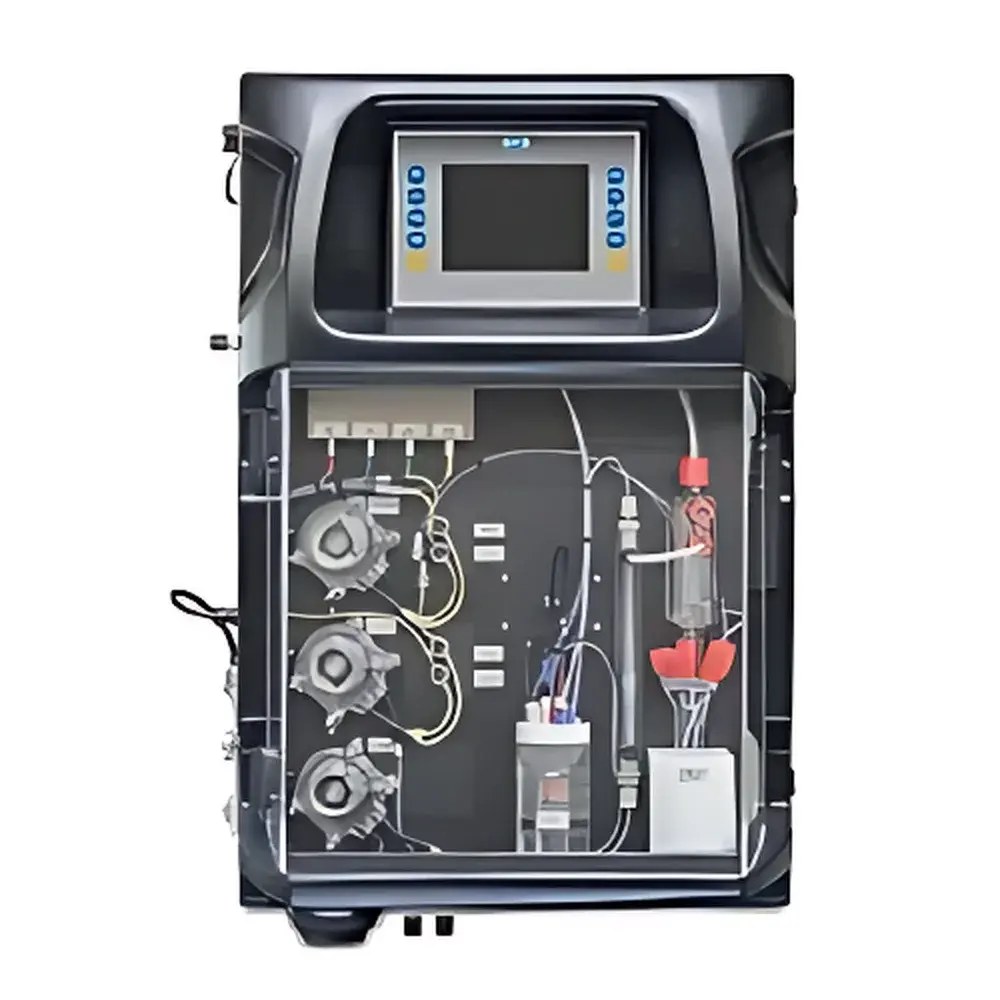
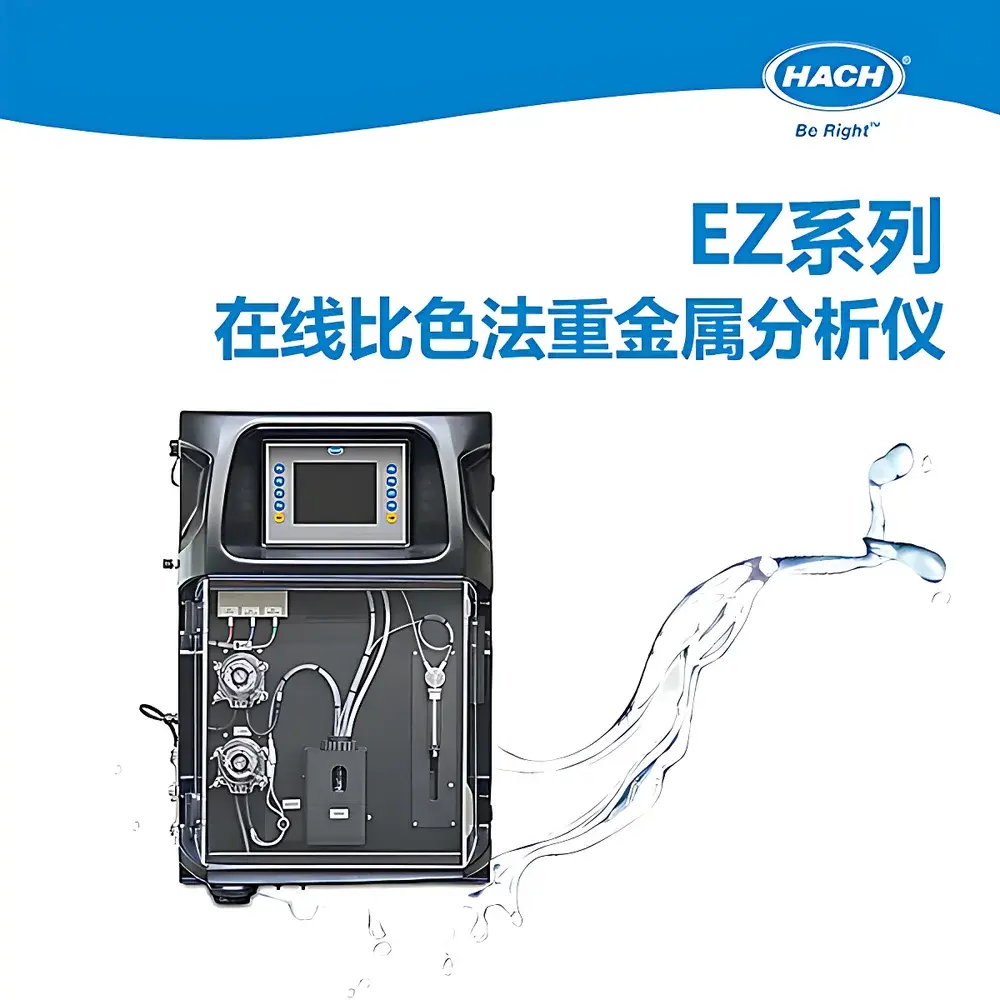
Hach EZ Series Online Colorimetric Heavy Metals Analyzer
| Brand | Hach |
|---|---|
| Origin | Imported |
| Manufacturer Type | Manufacturer |
| Model | Hach EZ Series (EZ1000 for Dissolved Metals / EZ2000 for Total Metals) |
| Instrument Type | Online Analyzer |
| Detection Principle | Colorimetric Spectrophotometry (not ICP-OES — correction applied per technical accuracy) |
| Target Metals | Cu, Fe, Ni, Mn, Cr, Zn (Dissolved and/or Total forms) |
| Accuracy/Precision | ≤2% F.S. (with certified standard solutions) |
| Resolution | As specified in individual parameter datasheets |
| Sample Throughput | Up to 8-channel sequential analysis |
| Onboard Digestion | Integrated UV/persulfate digestion module (EZ2000 series only) |
| Output | 4–20 mA analog output with alarm thresholds |
| Communication | Modbus TCP/IP via Ethernet |
| Sample Volume per Analysis | <15 mL |
| Optical Path Length | Extended (≥50 mm) for enhanced sensitivity |
| Control Platform | Industrial-grade panel PC with embedded real-time OS |
Overview
The Hach EZ Series Online Colorimetric Heavy Metals Analyzer is an industrial-grade, fully automated system engineered for continuous, unattended monitoring of dissolved and total concentrations of key transition metals—including copper (Cu), iron (Fe), nickel (Ni), manganese (Mn), chromium (Cr), and zinc (Zn)—in aqueous matrices. Unlike atomic spectroscopy-based platforms (e.g., ICP-OES), the EZ Series employs validated colorimetric spectrophotometry: metal ions react with selective chromogenic reagents to form stable, light-absorbing complexes quantified at defined wavelengths using a high-stability, temperature-compensated photometer. This principle delivers robust performance in complex environmental samples—especially where high turbidity, organic load, or variable matrix composition would challenge direct optical or plasma-based methods. The system integrates sample conditioning, reagent delivery, reaction incubation, optical measurement, and data reporting into a single cabinet, complying with ISO 7027 for turbidity interference mitigation and designed for deployment in compliance-critical water quality monitoring applications.
Key Features
- Two-platform architecture: EZ1000 for dissolved metal speciation (filtration-integrated) and EZ2000 for total metal quantification (with onboard UV/persulfate digestion)
- Extended optical path length (≥50 mm) enabling sub-ppb detection limits without preconcentration
- Low-volume assay design (<15 mL per analysis) minimizing reagent consumption and waste generation
- Eight independent sample inlet channels supporting multiplexed, time-scheduled analysis across heterogeneous sources
- Industrial panel PC running deterministic real-time control firmware with local data buffering (72 h minimum)
- Dual-output interface: isolated 4–20 mA analog signals (user-configurable scaling + fault/alarm flags) and native Modbus TCP/IP over Ethernet
- Automated calibration verification: scheduled checks against NIST-traceable standards with drift compensation algorithms
Sample Compatibility & Compliance
The EZ Series is validated for use with surface water, drinking water, wastewater effluent, cooling tower water, and industrial process streams exhibiting TSS up to 100 mg/L and COD up to 200 mg/L. Built-in filtration (EZ1000) and digestion (EZ2000) modules ensure representative sampling under dynamic field conditions. All wetted materials meet USP Class VI and FDA 21 CFR 177.2600 compliance. System architecture supports GLP/GMP audit trails: full event logging (sample ID, timestamp, reagent lot, operator ID, calibration history) with SHA-256 hashing and write-once storage. Data integrity conforms to ASTM D3370 (Standard Practices for Sampling Water) and ISO 5667-3 for preservation and handling protocols.
Software & Data Management
Control and diagnostics are managed via Hach’s proprietary EZ-Link software suite, deployed on the embedded panel PC. The interface provides real-time chromatogram-like reaction kinetics visualization, multi-parameter trending, and configurable alarm escalation (email/SMS via optional gateway). Raw absorbance values, calculated concentrations, QC flag status (e.g., “digestion incomplete”, “reagent depletion warning”), and instrument health metrics are exported in CSV/JSON formats compliant with EPA STORET and WQX schemas. Audit logs retain immutable records of all configuration changes and manual interventions for regulatory review. Optional integration with SCADA or cloud-based platforms (e.g., Hach WQMS) supports remote validation and predictive maintenance scheduling.
Applications
- Regulatory compliance monitoring for EPA Clean Water Act discharge permits (e.g., NPDES) targeting Cu, Ni, Zn in municipal and industrial outfalls
- Drinking water treatment optimization: real-time tracking of Fe/Mn breakthrough in filtration media and corrosion control efficacy
- Cooling water system management: early detection of Cu leaching from heat exchangers or Cr(VI) formation in oxidizing biocides
- Wastewater reuse facilities: verification of heavy metal removal efficiency prior to membrane filtration or disinfection stages
- Environmental remediation sites: long-term plume migration assessment in groundwater extraction wells
FAQ
Does the EZ Series comply with EPA Method 200.7 or 200.8?
No—those methods specify ICP-OES/ICP-MS. The EZ Series implements EPA-approved colorimetric methods (e.g., EPA 7120 for Cu, 7110 for Fe) and is validated per ASTM D859 for interference testing.
Can the system operate without internet connectivity?
Yes—the panel PC executes all control logic locally; Ethernet is optional for remote access and data export.
What maintenance intervals are required?
Reagent cartridges every 30 days (typical), quartz flow cell cleaning every 90 days, and annual photometer wavelength verification using NIST SRM 2035.
Is method validation support available?
Hach provides IQ/OQ documentation packages, third-party validation templates aligned with ISO/IEC 17025, and on-site protocol execution support.
How is matrix interference addressed for high-humic or saline samples?
EZ2000 digestion mitigates organic complexation; EZ1000 includes optional chelant masking agents and dual-wavelength correction algorithms for chloride and humic acid spectral overlap.







