
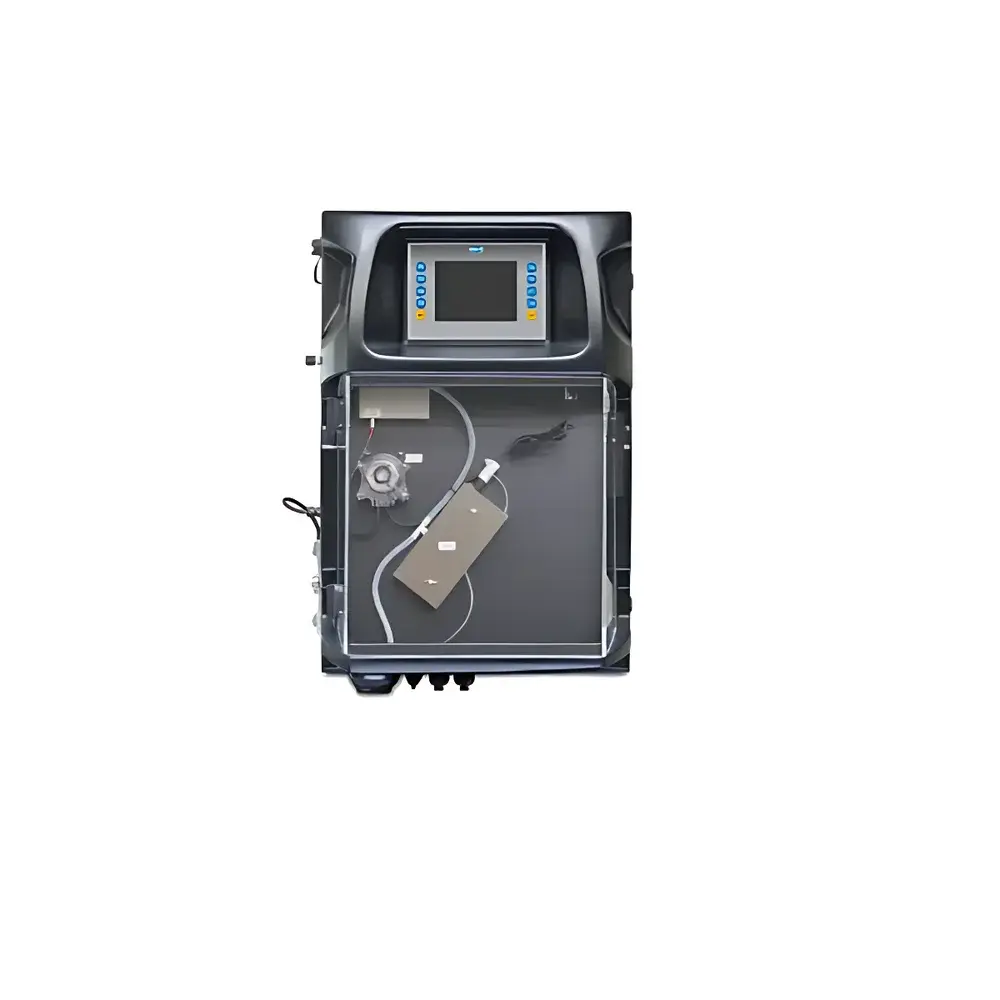
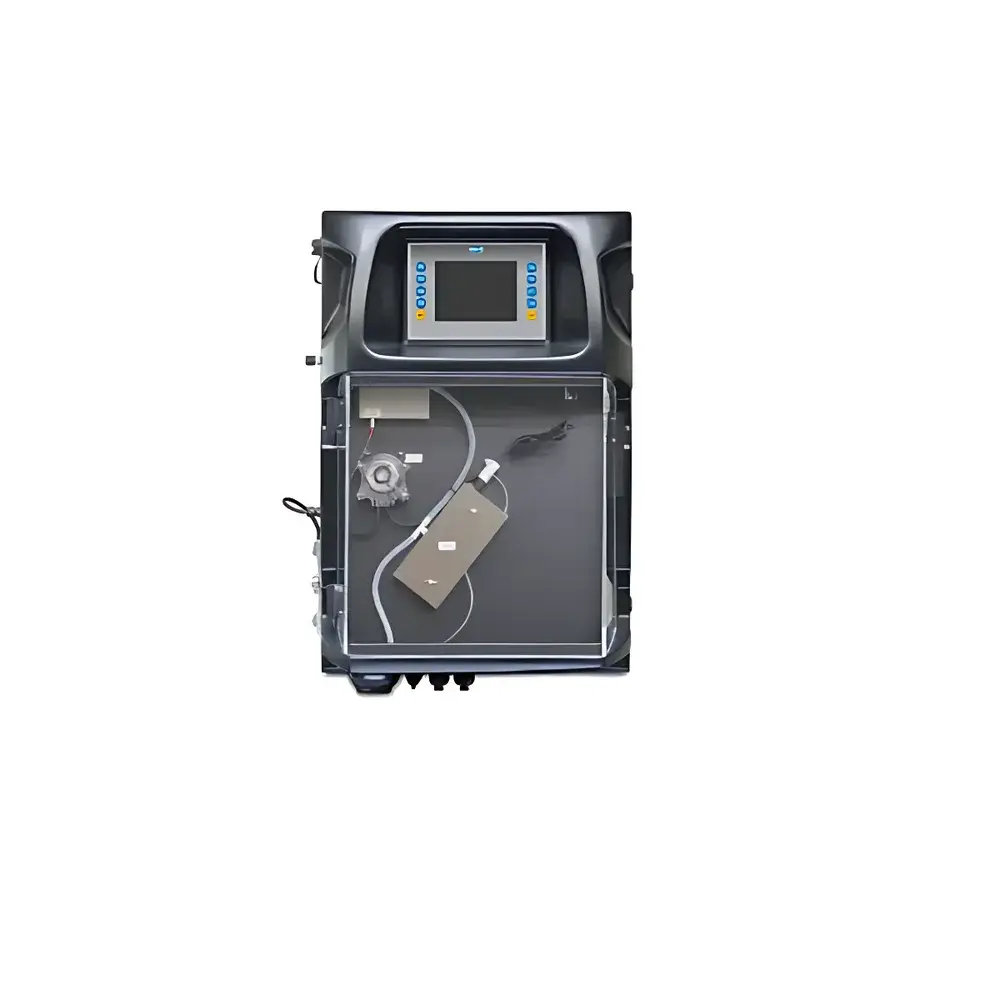
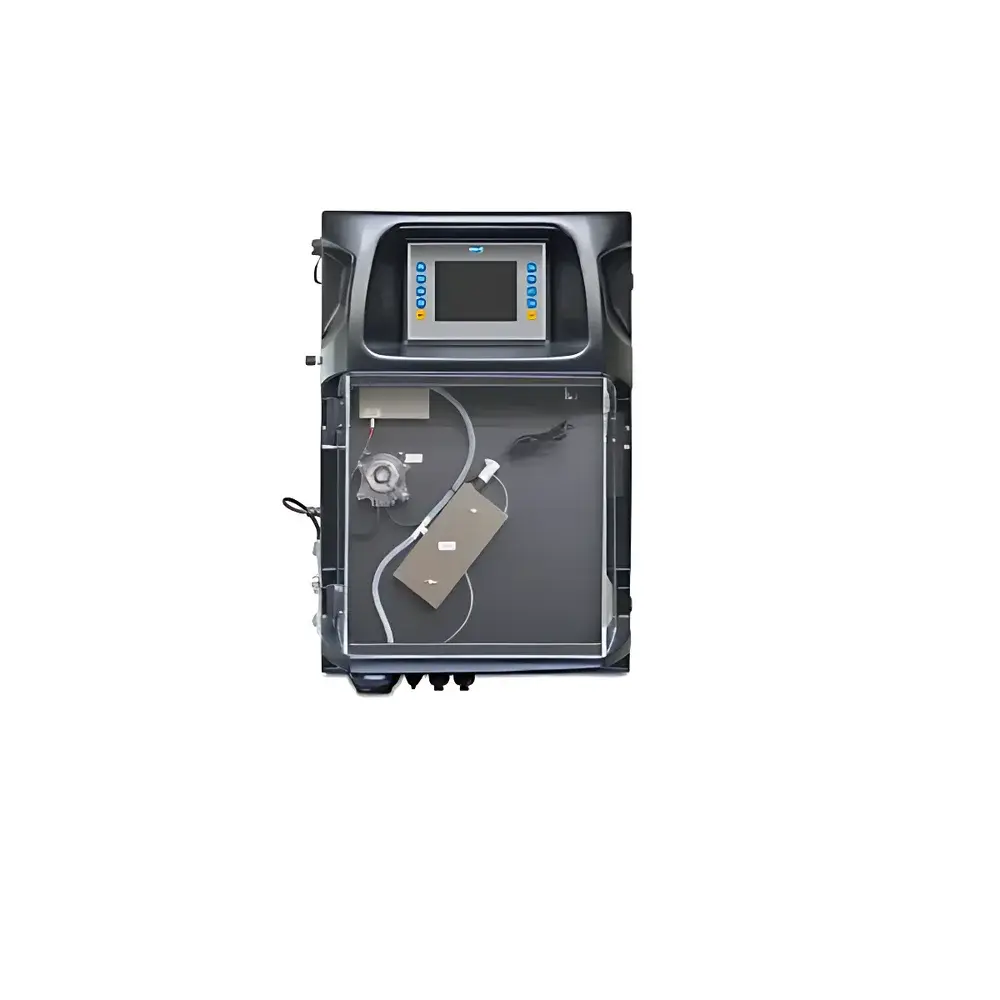
Hach EZ3000 Online Sulfide Analyzer
| Brand | Hach |
|---|---|
| Origin | USA |
| Model | EZ3000 |
| Measurement Principle | Batch-type Direct Ion-Selective Electrode (ISE) Method |
| Compliance | ASTM D4658-15 |
| Detection Range | EZ3017: 1–10 mg/L |
| EZ3018 | 10–100 mg/L |
| Detection Limit | EZ3017: ≤0.5 mg/L |
| EZ3018 | ≤2.5 mg/L |
| Accuracy | ≤2% F.S. (with certified standard solutions) |
| Measurement Interval | 5 minutes (configurable) |
| Calibration | Automated two-point calibration (frequency user-configurable) |
| Validation | Automated, frequency user-configurable |
| Operating Temperature | 5–35°C ±5°C (avoid direct sunlight and rain exposure) |
| Relative Humidity | 5–95% non-condensing |
| Reagent Storage Temp. | 10–30°C |
| Sample Flow Rate | 100–300 mL/min |
| Sample Temperature | 10–30°C |
| Power Supply | 110–240 VAC, 50/60 Hz, max. 120 VA |
| Analog Output | 4–20 mA (standard 1 channel, up to 8 optional) |
| Digital Output Options | RS232, Modbus TCP/IP, Modbus RTU (RS485) |
| Sample Requirements | Max. particle size ≤100 µm |
| Certifications | CE, UL |
| Enclosure Rating | Analyzer housing: IP55 |
| PC panel | IP65 |
| Dimensions (H×W×D) | 690 × 465 × 330 mm |
| Shipping Weight | 30 kg |
Overview
The Hach EZ3000 Online Sulfide Analyzer is an industrial-grade, continuous monitoring system engineered for reliable, low-maintenance quantification of dissolved sulfide (S²⁻) in aqueous process streams. It employs a batch-type direct ion-selective electrode (ISE) measurement principle—distinct from colorimetric or amperometric methods—which enables real-time electrochemical detection without chemical reagent consumption for the primary sensing step. The instrument fully complies with ASTM D4658-15, the standard test method for sulfide in water using ion-selective electrodes, ensuring methodological traceability for regulatory reporting and quality assurance workflows. Designed for deployment in demanding environmental and utility applications—including drinking water treatment, power plant cooling water systems, and surface water monitoring—the EZ3000 delivers stable performance under variable flow, temperature, and matrix conditions while minimizing operator intervention.
Key Features
- Batch-mode ISE architecture eliminates carryover between measurements, significantly reducing inter-sample contamination risk and extending electrode service life.
- Integrated intelligent control system automates sample aspiration, conditioning, measurement, cleaning, and waste disposal—reducing manual maintenance to quarterly electrode inspection and annual calibration verification.
- Two interchangeable sensor modules (EZ3017 and EZ3018) support dual-range operation: 1–10 mg/L and 10–100 mg/L, respectively—enabling precise resolution across low-level background monitoring and high-concentration upset event detection.
- Flexible I/O architecture supports up to eight independent analog outputs (4–20 mA) and optional digital protocols including Modbus TCP/IP for SCADA integration and RS232/RS485 for local diagnostics or legacy PLC interfacing.
- Ruggedized enclosure meets IP55 (analyzer housing) and IP65 (front-panel interface), permitting outdoor installation in sheltered environments without climate-controlled enclosures.
Sample Compatibility & Compliance
The EZ3000 is validated for use with clarified aqueous samples meeting defined physical constraints: suspended solids <0.1 g/L, particle diameter ≤100 µm, and turbidity <50 NTU. Samples outside these limits require pre-filtration (e.g., 50 µm inline filter) or clarification via settling or centrifugation prior to analysis. The analyzer’s compliance with ASTM D4658-15 ensures data integrity for regulatory submissions under U.S. EPA, state environmental agencies, and ISO/IEC 17025-accredited laboratories. While not intrinsically explosion-proof, its CE and UL certifications confirm electrical safety compliance for Class I, Division 2 hazardous location suitability when installed per NEC Article 500 guidelines.
Software & Data Management
The embedded firmware supports configurable data logging at user-defined intervals (minimum 1 minute), with onboard storage retaining ≥30 days of high-resolution time-series data (timestamped concentration, temperature, electrode potential, and diagnostic flags). All calibration and validation events are automatically timestamped and archived with operator ID (if network-authenticated) to satisfy GLP/GMP audit requirements. Remote access via Ethernet enables secure web-based configuration, real-time trending, alarm management (email/SNMP), and firmware updates—fully compatible with Hach’s Asset Insight platform for fleet-wide instrument health monitoring and predictive maintenance scheduling.
Applications
- Drinking water utilities: Continuous monitoring of sulfide breakthrough in groundwater sources or post-chlorination residual control.
- Thermal power generation: Detection of microbiologically influenced corrosion (MIC) precursors in closed-loop cooling water and condensate systems.
- Surface water quality networks: Early warning of anaerobic sediment resuspension events in reservoirs and estuaries.
- Industrial wastewater pretreatment: Compliance verification for sulfide discharge limits prior to municipal sewer entry (e.g., per 40 CFR Part 403).
- Biogas desulfurization units: Feedback control of iron sponge or biological scrubber efficiency in renewable energy facilities.
FAQ
What sample filtration is required prior to EZ3000 analysis?
A 50–100 µm inline particulate filter is strongly recommended for all applications to prevent sensor fouling and ensure consistent flow dynamics through the measurement cell.
Can the EZ3000 be integrated into a Modbus-based SCADA system?
Yes—the instrument supports both Modbus RTU (RS485) and Modbus TCP/IP natively, with configurable slave ID, register mapping, and polling intervals to align with existing infrastructure.
How frequently must the ISE sensor be replaced?
Under typical drinking water conditions, the sulfide ISE demonstrates ≥12 months of stable response; replacement interval extends further in low-sulfide, low-chloride matrices and shortens in high-TDS or sulfide-rich industrial effluents.
Is remote calibration possible without on-site technician access?
Full two-point automated calibration requires physical access to the reagent reservoirs and sensor module—but calibration schedule, validation triggers, and pass/fail criteria are fully configurable remotely via the web interface.
Does the EZ3000 support 21 CFR Part 11-compliant electronic records?
While the base firmware provides full audit trail functionality (user actions, timestamps, parameter changes), full Part 11 compliance requires deployment within a validated Hach Enterprise Analytics environment with role-based access controls and digital signature enforcement.




