
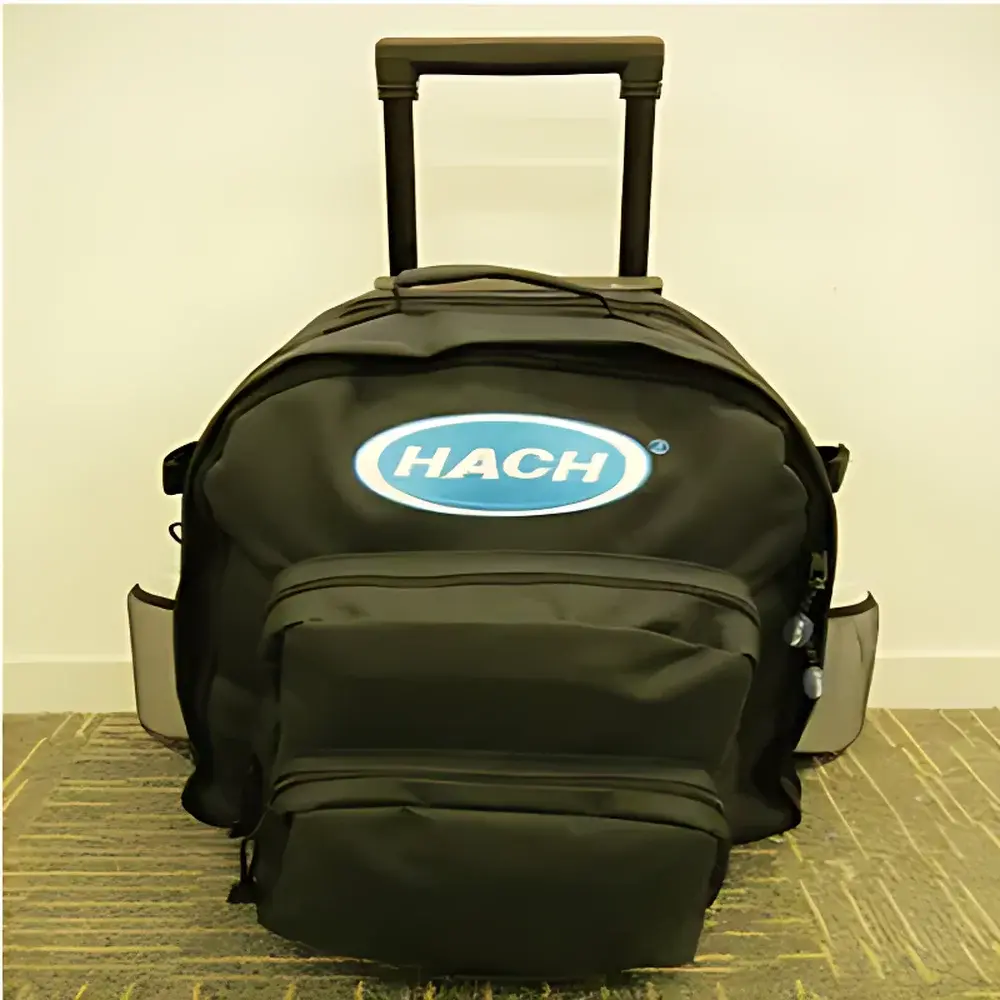
Hach HM01 Heavy Metals Emergency Field Testing Kit with DR2800 Spectrophotometer
| Brand | Hach |
|---|---|
| Origin | Imported |
| Manufacturer | Hach Company |
| Instrument Type | Portable |
| Detection Principle | Colorimetric Spectrophotometry |
| Measurable Metals | As, Cr(Total), Cr(VI), Cu, Ni, Zn, Cd, Pb |
| Measurement Range (Typical) | As 0–4000 ppb |
| Reagent Catalog Numbers | 2822800, 2242500, 1271099, 2105869, 2651600, 2429300, TNT852, TNT850 |
| Kit Configurations | HM01 (DR2800 + battery + MP6P probe), HM02 (DR2800 + battery + H170NP pH/ORP probe + PHW77-SS stainless steel probe), HM03 (no DR2800, includes MP6P), HM04 (no DR2800, includes H170NP + PHW77-SS) |
| Compliance | Designed for field use in accordance with EPA Method 200.7, ISO 11969, and ASTM D3559/D5191 for metals analysis in water |
Overview
The Hach HM01 Heavy Metals Emergency Field Testing Kit is a purpose-engineered portable solution for rapid, on-site quantification of priority toxic metals in environmental water matrices. Built around the Hach DR2800 benchtop spectrophotometer—reconfigured for ruggedized field deployment—the system implements standardized colorimetric methods compliant with U.S. EPA, ISO, and ASTM protocols. Each assay relies on selective chromogenic reagents that form metal-specific complexes with defined molar absorptivities, enabling direct concentration calculation via Beer-Lambert law-based calibration curves stored in the instrument’s internal method library. The kit is explicitly designed for time-critical scenarios: post-industrial spill response, municipal drinking water source screening, wastewater discharge verification, and regulatory compliance audits under emergency notification frameworks such as the U.S. EPA’s National Contingency Plan (NCP) or China’s “Emergency Environmental Incident Response Guidelines.” Its architecture prioritizes analytical robustness over laboratory-grade precision—delivering reproducible semi-quantitative to quantitative data within regulatory action thresholds (e.g., WHO provisional guidelines, EU Drinking Water Directive limits).
Key Features
- Integrated field-ready platform combining the DR2800 spectrophotometer (230–900 nm wavelength range, ±1 nm optical resolution, <±0.005 AU photometric accuracy) with pre-packaged, lot-certified reagents in stabilized dry-powder or liquid formats.
- Multi-parameter capability covering eight regulated metals: Arsenic (As), Total Chromium (Cr), Hexavalent Chromium (Cr(VI)), Copper (Cu), Nickel (Ni), Zinc (Zn), Cadmium (Cd), and Lead (Pb)—each validated per Hach Method Number (e.g., Method 8024 for Cr(Total), Method 8023 for Cr(VI)).
- Pre-programmed method library with 240+ EPA- and ISO-aligned test protocols; user-selectable calibration modes (single-point, multi-point, or factory curve) with automatic wavelength selection and blank subtraction.
- Ruggedized transport case (HM01/HM02 variants) featuring shock-absorbing foam inserts, IP65-rated instrument housing, rechargeable Li-ion battery pack (≥8 hrs continuous operation), and integrated barcode scanner for reagent lot traceability.
- Touchscreen interface with guided workflow prompts, real-time spectral preview, and on-device pass/fail flagging against user-defined regulatory limits (e.g., EPA MCLs, WHO GDWs).
Sample Compatibility & Compliance
The kit is validated for use with raw surface water, treated drinking water, groundwater, industrial effluents, and stormwater runoff—samples requiring no pretreatment beyond filtration (0.45 µm membrane) for turbid matrices. All included methods conform to internationally recognized standards: arsenic determination aligns with EPA Method 200.7 (ICP-OES reference correlation); hexavalent chromium follows EPA Method 7196A (diphenylcarbazide colorimetry); total chromium adheres to ISO 11969:2017. Data integrity meets GLP/GMP documentation requirements through embedded audit trail functionality (user login, method version, date/time stamp, reagent lot ID, raw absorbance values). The system supports 21 CFR Part 11-compliant electronic signatures when paired with Hach’s LabStation software.
Software & Data Management
Instrument-generated results are exportable via USB or Bluetooth to Hach’s LogBook™ desktop application or cloud-connected Hach Insight™ platform. Data files include full metadata: sample ID, operator ID, GPS coordinates (when enabled via external GNSS module), method parameters, calibration history, and raw spectral scans. LogBook enables batch reporting compliant with ISO/IEC 17025 documentation structures—including uncertainty estimation per GUM guidelines—and auto-generates PDF certificates with digital signature fields. For regulatory submissions, CSV and XML exports map directly to EPA’s WQX schema and China’s National Environmental Monitoring Network (NEMN) ingestion protocols.
Applications
- Emergency response teams conducting rapid reconnaissance at mining tailings dam breaches or electroplating facility leaks.
- Public health laboratories performing routine surveillance of arsenic in rural groundwater wells during monsoon season.
- Industrial hygienists verifying Cr(VI) levels in cooling tower blowdown prior to discharge permitting.
- Environmental consultants supporting EIA baseline studies for new chemical manufacturing plants.
- Academic researchers deploying low-cost, high-reproducibility field assays in watershed-scale metal speciation mapping projects.
FAQ
What sample volume is required per test?
Typical assays consume 10–50 mL of filtered sample, depending on metal concentration and method sensitivity.
Can the DR2800 be used for non-heavy-metal parameters?
Yes—the instrument supports >240 Hach methods including nutrients (nitrate, phosphate), disinfectants (chlorine, chlorine dioxide), and organic indicators (COD, TOC), making it a multipurpose field analyzer.
Is calibration verification required before each field deployment?
Per ISO/IEC 17025, initial calibration verification using NIST-traceable standards is mandatory; subsequent field checks require at least one certified reference material (CRM) per sampling day.
How are reagent stability and shelf life managed?
All reagents are supplied with lot-specific expiration dates and temperature-stability data; dry-powder formulations retain performance for ≥24 months unopened at 2–8°C, and ≥6 months after opening under desiccated storage.
Does the kit support regulatory reporting to national agencies?
Yes—data export formats comply with EPA WQX, China’s MEP-2019-01 data submission schema, and EU WFD Annex V reporting templates.







