
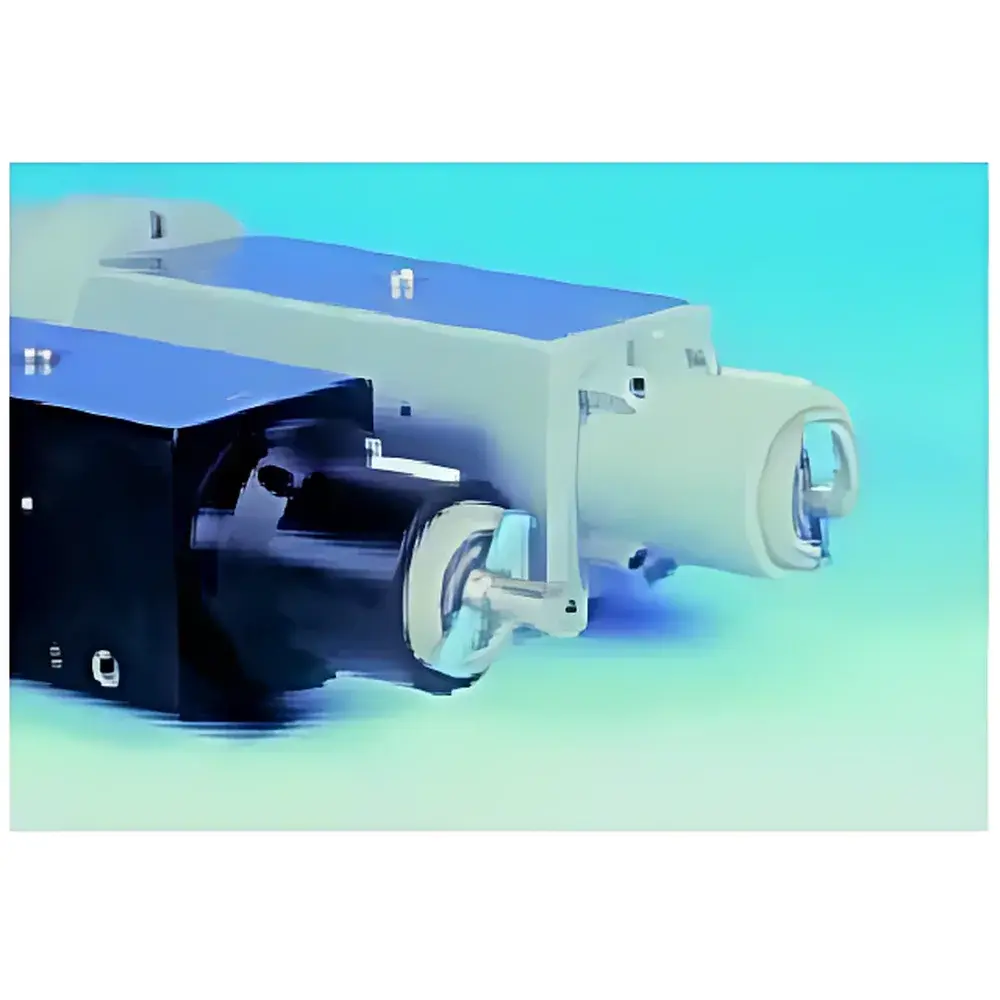
HACH Z LLIG S-14 Dissolved Oxygen Analyzer
| Brand | HACH |
|---|---|
| Origin | Imported |
| Manufacturer Type | Manufacturer |
| Instrument Type | Laboratory DO Analyzer |
| Model | Z LLIG S-14 |
| Measurement Principle | Polarographic (Clark-type with mechanical self-cleaning) |
| Range | 0–15 mg/L (Fe anode) / 0–25 mg/L (Zn anode) |
| Resolution | 0.05 mg/L |
| Standard Deviation | < 0.1 mg/L |
| Operating Temperature | 0–45 °C |
| Ambient Temperature | −20–40 °C |
| Max Pressure | 3 bar |
| pH Range | 6–9 |
| Minimum Conductivity | 200 µS/cm |
| Sensor Lifetime | 15–20 years |
| Electrode Lifetime | 3–5 years |
| Abrasive Wheel Replacement Interval | 8–18 months |
| Power Supply | 24 VDC ±15%, 200 mA |
| Output Signal | Digital (RS-485 or HART-compatible, depending on transmitter configuration) |
Overview
The HACH Z LLIG S-14 Dissolved Oxygen Analyzer is a robust, long-life polarographic (Clark-type) sensor system engineered for continuous, high-reliability dissolved oxygen (DO) measurement in demanding water and wastewater applications. Unlike optical or galvanic sensors, the Z LLIG S-14 employs a membrane-covered cathode and consumable anode—typically iron (Fe) or zinc (Zn)—operating under a controlled polarization voltage to generate a diffusion-limited current proportional to dissolved oxygen concentration. Its defining engineering feature is the integrated mechanical self-cleaning mechanism, which periodically rotates an abrasive wheel across the sensor membrane surface to remove biofilm, scale, and particulate fouling—enabling stable operation even in highly contaminated, low-flow, or high-suspended-solids environments such as activated sludge basins, anaerobic digesters, and industrial effluent streams. Designed for permanent submersion up to 30 meters depth, the analyzer eliminates signal degradation over extended cable runs through its native digital output architecture, supporting transmission distances exceeding 1,000 meters without repeaters or signal conditioning.
Key Features
- Integrated mechanical self-cleaning system with replaceable abrasive wheel (8–18 month service interval), ensuring consistent membrane integrity and measurement stability in fouling-prone installations.
- Dual-anode configuration: Fe anode for standard range (0–15 mg/L); Zn anode for extended range (0–25 mg/L), both compliant with ISO 5814 and ASTM D888 for electrochemical DO determination.
- Hermetically sealed, corrosion-resistant titanium housing rated to 3 bar pressure—suitable for deep immersion, pressurized pipelines, and submerged aeration zones.
- Low-drift analog-to-digital conversion and temperature-compensated signal processing, delivering resolution of 0.05 mg/L and standard deviation < 0.1 mg/L under steady-state conditions.
- Modular transmitter design supports flexible integration with HACH SC1000, CL17, or third-party PLC/DCS systems via RS-485 Modbus RTU or HART 7 protocol.
- Wide operational envelope: functional from 0–45 °C liquid temperature and −20–40 °C ambient, with minimum conductivity requirement of 200 µS/cm—compatible with freshwater, brackish, and seawater matrices (pH 6–9).
Sample Compatibility & Compliance
The Z LLIG S-14 is validated for use across heterogeneous aqueous matrices including municipal and industrial wastewater, activated sludge, anaerobic digestate, potable water distribution systems, natural surface waters (lakes, rivers), and high-organic-load process streams in pulp & paper, food & beverage, and petrochemical facilities. It meets the physical and electrochemical performance criteria referenced in ISO 5814:2012 (Water quality — Determination of dissolved oxygen — Electrochemical probe method) and aligns with EPA Method 360.1 for wastewater DO monitoring. While not intrinsically certified for hazardous locations, its 24 VDC power architecture enables safe deployment in Class I, Division 2 environments when installed with appropriate barrier systems. The sensor’s 15–20 year housing lifetime and 3–5 year electrode replacement cycle support long-term GLP-compliant calibration tracking and reduce total cost of ownership in regulated utilities.
Software & Data Management
When paired with HACH’s Intelligence Transmitter platforms (e.g., SC200 or SC1000), the Z LLIG S-14 supports full audit-trail functionality per FDA 21 CFR Part 11 requirements—including user authentication, electronic signatures, and immutable event logging for calibration, cleaning, and maintenance events. Real-time DO data is timestamped, temperature-compensated, and exportable via Modbus TCP or OPC UA to SCADA, LIMS, or cloud-based asset management systems. Firmware updates are performed remotely via secure HTTPS, and diagnostic logs—including membrane impedance trends, cleaning cycle history, and polarization stability metrics—are accessible for predictive maintenance planning.
Applications
- Process control of air blower systems in activated sludge and MBR plants via real-time DO feedback loops.
- Monitoring denitrification efficiency in anoxic zones and nitrification kinetics in aerobic tanks.
- Compliance reporting for discharge permits (e.g., NPDES) requiring continuous DO surveillance in final effluent channels.
- Long-term ecological monitoring in lakes and estuaries where sensor longevity and minimal field intervention are critical.
- Performance verification of ozone or hydrogen peroxide dosing systems in advanced oxidation processes.
- Baseline DO profiling in drinking water storage reservoirs and distribution networks to assess stagnation risk.
FAQ
What maintenance intervals are required for the Z LLIG S-14?
The abrasive cleaning wheel requires replacement every 8–18 months depending on fouling severity; the DO electrode is replaced every 3–5 years; the sensor body itself is rated for 15–20 years of continuous service.
Can the sensor operate in seawater or high-salinity environments?
Yes—provided conductivity remains ≥200 µS/cm and pH stays within 6–9. No additional salinity compensation is needed due to the polarographic principle’s inherent insensitivity to ionic strength variations.
Is the Z LLIG S-14 compatible with non-HACH transmitters?
It outputs standardized digital signals (RS-485 Modbus RTU or HART 7) and can interface with any Modbus-enabled controller or DCS that supports its register map and polling structure.
Does the analyzer require zero-oxygen calibration?
No—unlike optical sensors, it uses a two-point calibration (air saturation and zero-O₂ sodium sulfite solution) per ISO 5814, with optional single-point air-saturation verification for routine checks.
How is temperature compensation handled?
An integrated Pt1000 RTD provides simultaneous temperature measurement; compensation follows the Stern–Volmer relationship as defined in ISO 5814 Annex B, applied in real time by the transmitter firmware.







