
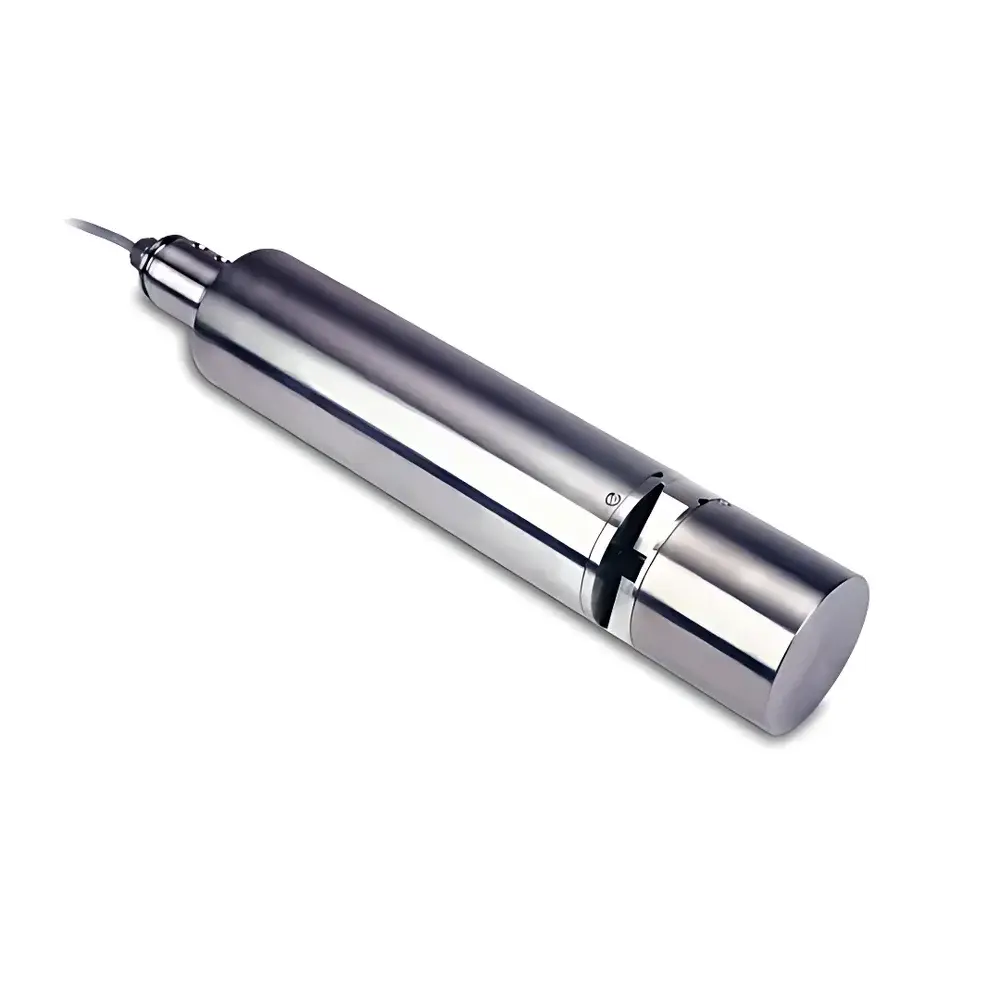
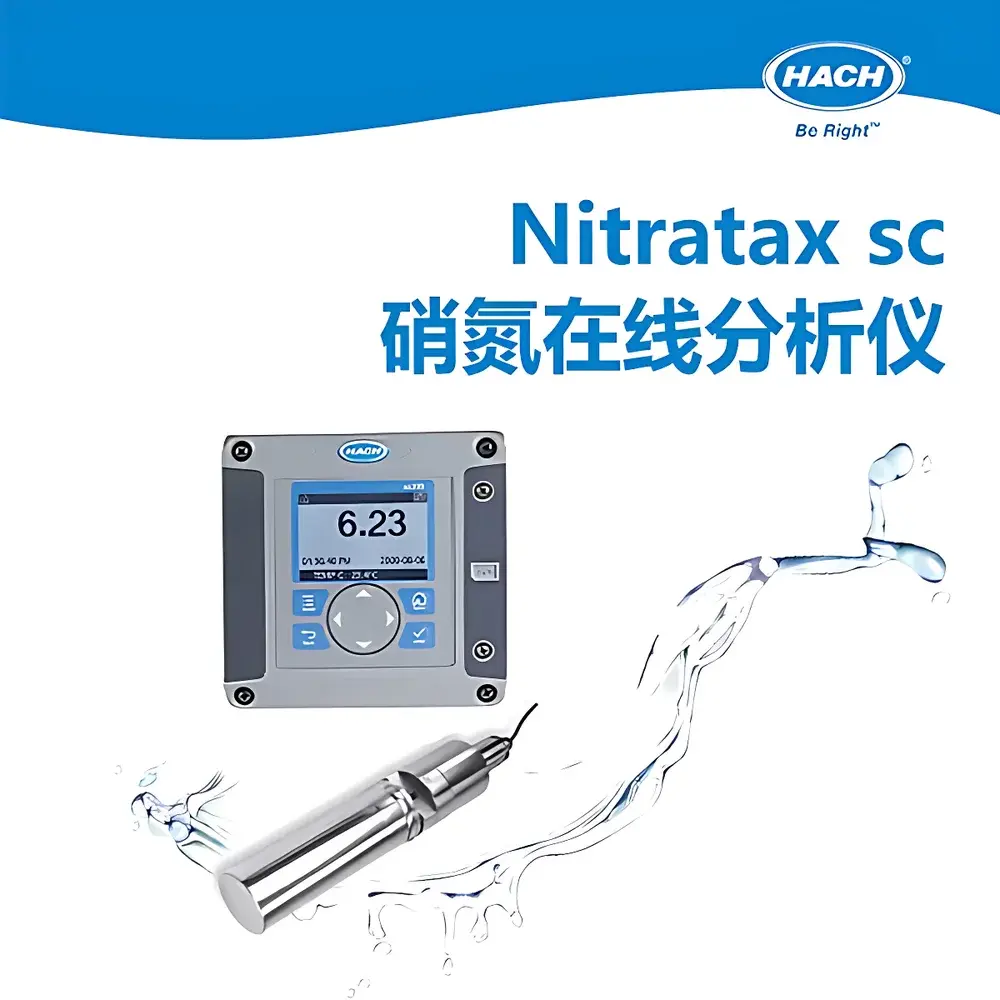
HACH NITRATAX sc Online Nitrate Analyzer (Discontinued)
| Brand | HACH |
|---|---|
| Origin | Imported |
| Manufacturer Status | Manufacturer |
| Measurement Principle | UV Absorption (Dual-Beam, 210 nm) |
| Optical Path Lengths | 1 mm, 2 mm, 5 mm |
| NO₃–N Range | 0.1–100.0 mg/L (1 mm), 0.1–50.0 mg/L (2 mm), 0.1–25.0 mg/L (5 mm) |
| LOD (NO₃–N) | 0.1 mg/L (typical) |
| Accuracy | ±3% ±0.5 mg/L (1 mm), ±5% ±1.0 mg/L (2 mm), ±5% ±0.5 mg/L (5 mm) |
| Resolution | 0.1 mg/L or 0.5 mg/L depending on configuration |
| Sludge Compensation | Yes |
| Measurement Interval | 1 min or 5 min |
| Response Time (T₁₀₀) | ≤1 min (1 mm path), ≤15 min (2 mm path) |
| Installation Options | Immersion & Flow-Through Cell |
| Housing Material | Stainless Steel (316L), Dual-Sealed or Single-Sealed variants |
| Calibration | Standard Solution-Based |
| Maintenance Interval | Every 6 months |
| Operating Temperature | 2–40 °C |
| Max Submersion Depth | 2 m (0.5 bar) |
| Probe Cable Length | 10 m (extendable) |
| Dimensions (L × D) | 33.3 × 7.0 cm, 32.7 × 7.0 cm, or 32.3 × 7.5 cm |
| Self-Cleaning Function | Integrated ultrasonic or mechanical wiper (model-dependent) |
Overview
The HACH NITRATAX sc Online Nitrate Analyzer is a discontinued but widely deployed ultraviolet (UV) absorption-based instrument engineered for continuous, reagent-free quantification of nitrate-nitrogen (NO₃–N) in aqueous environments. It operates on the fundamental photometric principle that nitrate ions exhibit characteristic absorbance at 210 nm in the deep UV spectrum. Utilizing a dual-beam optical architecture, the analyzer compensates for lamp drift, fouling, and turbidity-induced signal attenuation—ensuring stable baseline performance over extended deployment cycles. Designed specifically for real-time process control and regulatory compliance monitoring, the NITRATAX sc was commonly integrated into drinking water treatment plants, surface water quality networks, industrial process streams, and wastewater treatment facilities—particularly within denitrification zones such as anoxic basins and biological nutrient removal (BNR) systems. Its measurement integrity relies not on wet chemistry, but on precise optical pathlength control and spectral discrimination, making it inherently robust against interferences from common anions (e.g., chloride, sulfate) when properly configured and maintained.
Key Features
- Reagent-free operation: Eliminates chemical consumption, hazardous waste generation, and associated handling protocols—reducing total cost of ownership and safety risk.
- Multiple optical pathlength options (1 mm, 2 mm, 5 mm): Enables optimal sensitivity and dynamic range selection based on expected NO₃–N concentration and suspended solids load.
- Integrated sludge compensation algorithm: Mitigates signal attenuation caused by particulate scattering and biofilm accumulation on the quartz window, enhancing long-term reliability in high-turbidity applications.
- Dual installation flexibility: Supports both direct immersion (submersible probe) and flow-through cell configurations—adaptable to existing infrastructure including open-channel weirs, pressurized pipelines, and recirculation loops.
- Self-cleaning capability: Equipped with either ultrasonic transducers or motor-driven mechanical wipers (depending on probe variant), minimizing manual intervention and maintaining optical clarity under challenging fouling conditions.
- Stainless steel (316L) construction with dual-sealed housing: Provides corrosion resistance and IP68-rated ingress protection for continuous underwater operation up to 2 meters depth.
Sample Compatibility & Compliance
The NITRATAX sc is validated for use in natural waters (rivers, lakes, reservoirs), treated potable water, activated sludge effluents, and industrial process streams with total suspended solids (TSS) ≤ 150 mg/L and UV transmittance (UVT) ≥ 40% at 254 nm. While not certified to ISO 15839 or EN 14183 for routine compliance reporting, its measurement methodology aligns with the foundational principles outlined in ASTM D4519–22 (“Standard Test Method for Nitrate-Nitrogen in Water by UV Spectrophotometry”) and supports data traceability required under EPA Method 353.2 adaptations. The analyzer’s output is compatible with SCADA, DCS, and LIMS platforms via 4–20 mA analog output and Modbus RTU/ASCII protocol. All firmware versions shipped post-2015 include audit-trail logging and user-access-level controls consistent with GLP-aligned operational practices.
Software & Data Management
The NITRATAX sc interfaces with HACH’s SC1000 Universal Controller or legacy SC200 platform, enabling local display, alarm configuration (high/low, rate-of-change), and scheduled calibration prompts. Raw absorbance values, compensated NO₃–N concentrations, diagnostic flags (e.g., lamp intensity, window cleanliness index), and temperature-compensated readings are timestamped and stored onboard for up to 30 days. Data export is supported via SD card or serial download using HACH’s Instrument Manager software (v4.x+), which generates CSV-structured files compliant with laboratory information management system (LIMS) ingestion requirements. Though not natively 21 CFR Part 11-compliant due to its pre-2018 firmware architecture, validated configurations—including external electronic logbooks and procedural SOPs—have been accepted in regulated municipal and pharmaceutical water monitoring contexts.
Applications
- Real-time optimization of denitrification in wastewater treatment: Feedback control of carbon dosing and internal recycle rates based on anoxic basin NO₃–N depletion kinetics.
- Early-warning detection of agricultural runoff events in surface water intake monitoring stations.
- Verification of nitrate removal efficiency across ion exchange or reverse osmosis polishing trains in pharmaceutical water systems (PW, WFI).
- Long-term trend analysis in groundwater monitoring wells impacted by septic leachate or fertilizer infiltration.
- Process validation support during commissioning of membrane bioreactors (MBRs) and moving bed biofilm reactors (MBBRs).
FAQ
Is the NITRATAX sc still supported by HACH?
HACH officially discontinued the NITRATAX sc in 2021; however, technical documentation, spare parts (e.g., lamps, quartz cells, cables), and firmware updates remain available through authorized service partners until at least 2027.
Can it measure nitrate in seawater or brackish water?
No—high chloride concentrations cause significant spectral interference at 210 nm; the analyzer is specified only for freshwater matrices with salinity < 1 g/L.
What maintenance is required beyond scheduled calibration?
Biannual inspection of quartz window integrity, verification of seal compression, cleaning of flow-cell interior (if installed), and replacement of UV lamp every 12–18 months (lamp life dependent on duty cycle).
Does it require temperature compensation?
Yes—integrated Pt100 sensor enables automatic temperature correction of absorbance coefficients per ASTM D4519 Annex A, improving accuracy across 2–40 °C operating range.
How does it handle high turbidity or algae blooms?
The sludge compensation function corrects for scattering effects up to moderate turbidity; however, sustained UVT < 30% at 254 nm may necessitate periodic manual window cleaning or relocation to a filtered sidestream.







