
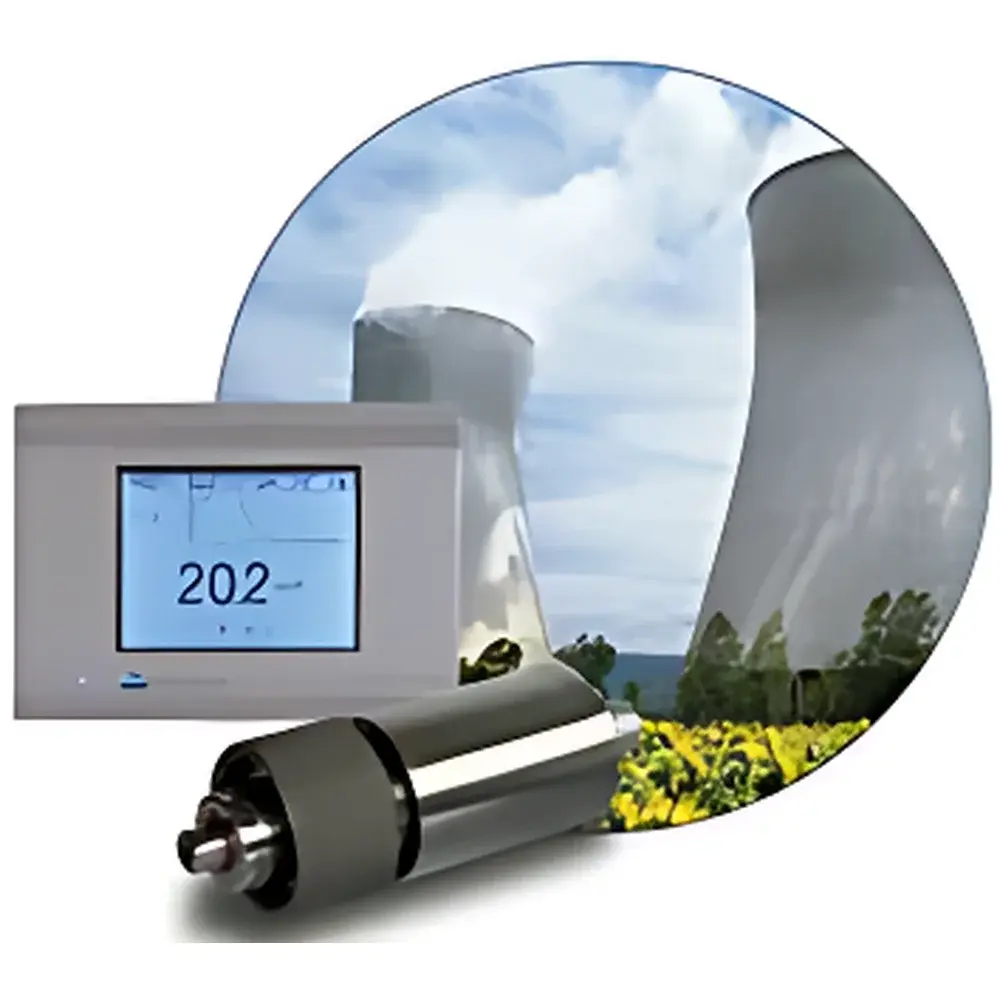
HACH ORBISPHERE K1100 Luminescence-Based Dissolved Oxygen Sensor
| Brand | HACH |
|---|---|
| Origin | Imported |
| Manufacturer | HACH Company |
| Model | ORBISPHERE K1100 |
| Calibration Interval | Annual |
| Response Time | <2 seconds |
| Detection Limit | 0.6 ppb |
| Accuracy | ±0.8 ppb |
| Measurement Principle | Dynamic Luminescence Quenching (Cold Light Method) |
| Compatibility | ORBISPHERE 410 Controller, 28 mm insertion fittings, flow-through cells |
| Output Options | 3 configurable relays, 3 smart analog outputs |
| Diagnostic Capability | Real-time sensor health monitoring, predictive maintenance alerts |
Overview
The HACH ORBISPHERE K1100 is a high-precision, luminescence-based dissolved oxygen (DO) sensor engineered for ultra-trace oxygen monitoring in critical power plant water chemistry applications—particularly in all-volatile treatment (AVT) and oxygenated treatment (OT) boiler feedwater and condensate systems. Unlike traditional electrochemical DO sensors that rely on oxygen-permeable membranes and electrolyte solutions, the K1100 employs a solid-state, membrane-free optical measurement principle grounded in dynamic luminescence quenching (often referred to as the “cold light method”). In this technique, a proprietary ruthenium-based luminophore is excited by blue LED light; molecular oxygen in the sample modulates the decay lifetime of the resulting red luminescence. This lifetime—measured in nanoseconds—is inversely proportional to the partial pressure of dissolved oxygen and is inherently temperature-compensated via integrated Pt1000 thermistor. The result is a fundamentally drift-resistant, zero-consumables sensing architecture with exceptional long-term stability and minimal sensitivity to flow rate, pressure fluctuations, or chemical interferences.
Key Features
- Membrane- and electrolyte-free design: Eliminates membrane fouling, electrolyte depletion, and polarization drift—common failure modes in amperometric sensors—thereby ensuring consistent accuracy across variable process conditions.
- Ultra-low detection capability: Capable of reliable quantification down to 0.6 ppb with ±0.8 ppb accuracy at low-range concentrations—meeting stringent AVT-R and AVT-O specifications per EPRI guidelines and ASTM D867–22.
- Sub-2-second response time: Enables real-time closed-loop control of deaerator and feedwater oxygen injection systems without lag-induced overshoot or instability.
- Annual calibration interval: Validated through accelerated aging studies and field deployments exceeding 12 months under continuous operation; zero-point calibration requires only nitrogen-purged air or certified zero-gas standard—no hazardous chemicals or wet calibration procedures.
- Robust mechanical architecture: Stainless steel 316L housing with IP68 rating; compatible with standard 28 mm sanitary insertion fittings and flow-through cells—enabling seamless retrofit into legacy ORBISPHERE 410 controller platforms without piping modifications.
- Integrated diagnostics: Continuous self-monitoring of luminophore integrity, LED output stability, photodetector signal-to-noise ratio, and thermal drift—feeding actionable alerts to the ORBISPHERE 410 controller’s event log and relay outputs.
Sample Compatibility & Compliance
The K1100 is validated for use in ultrapure water streams with conductivity < 0.1 µS/cm, pH 5.5–9.5, and temperatures from 0–100 °C. It exhibits negligible interference from chlorine (< 1 ppm), carbon dioxide, ammonia, or common corrosion inhibitors (e.g., filming amines). The sensor complies with IEC 61508 SIL 2 functional safety requirements when deployed with the ORBISPHERE 410 controller. Data integrity and audit readiness are supported via controller firmware compliant with FDA 21 CFR Part 11 (electronic records/signatures), including full electronic audit trail, user access control, and calibrated timestamping. All measurement data and diagnostic events meet GLP/GMP documentation standards for regulated utility environments.
Software & Data Management
The ORBISPHERE 410 controller provides embedded configuration, real-time trending, and alarm management via its intuitive web-based interface (HTTPS/TLS 1.2). Historical DO data—including raw lifetime values, temperature-corrected ppb readings, and diagnostic flags—is stored internally for up to 30 days and exportable via Modbus TCP or optional HART-IP. Firmware updates are delivered via secure SFTP with cryptographic signature verification. The system supports integration into DCS/SCADA platforms using standard protocols (Modbus RTU/TCP, 4–20 mA with HART), and all analog outputs feature 16-bit resolution with 0.1% FS linearity. Configuration changes and calibrations are logged with user ID, timestamp, and pre/post-values—fully traceable for regulatory review.
Applications
- Boiler feedwater and condensate monitoring in fossil and nuclear power plants (ASME PTC 19.11, EPRI TR-102395)
- Oxygen injection control in OT-treated systems
- Deaerator performance verification and optimization
- Steam cycle chemistry audits and compliance reporting (e.g., VGB S002, IAPWS RP-7)
- Research-grade ultrapure water systems requiring sub-ppb DO stability
FAQ
What calibration gases are required for zero-point calibration?
Nitrogen-saturated air (O₂ < 10 ppb) or certified zero-gas standard (e.g., N₂ with < 5 ppb O₂); no liquid reagents or span gases needed.
Can the K1100 be used in high-pressure applications?
Yes—rated for continuous operation up to 10 bar (145 psi) with appropriate pressure-rated flow cell or insertion fitting.
Does the sensor require temperature compensation?
Yes—built-in Pt1000 RTD provides automatic, real-time temperature correction per ISO 5814:2012; no manual input or external probe required.
How does the K1100 compare to Clark-type electrochemical sensors in terms of lifecycle cost?
Total cost of ownership is reduced by >65% over 5 years due to elimination of membrane/electrolyte replacements, quarterly calibrations, and unplanned downtime—validated in multi-site utility benchmark studies.
Is the luminophore replaceable in the field?
No—the sensor is sealed and non-serviceable; however, typical operational lifespan exceeds 5 years under continuous AVT-R conditions, with mean time between failures (MTBF) >43,000 hours.







