
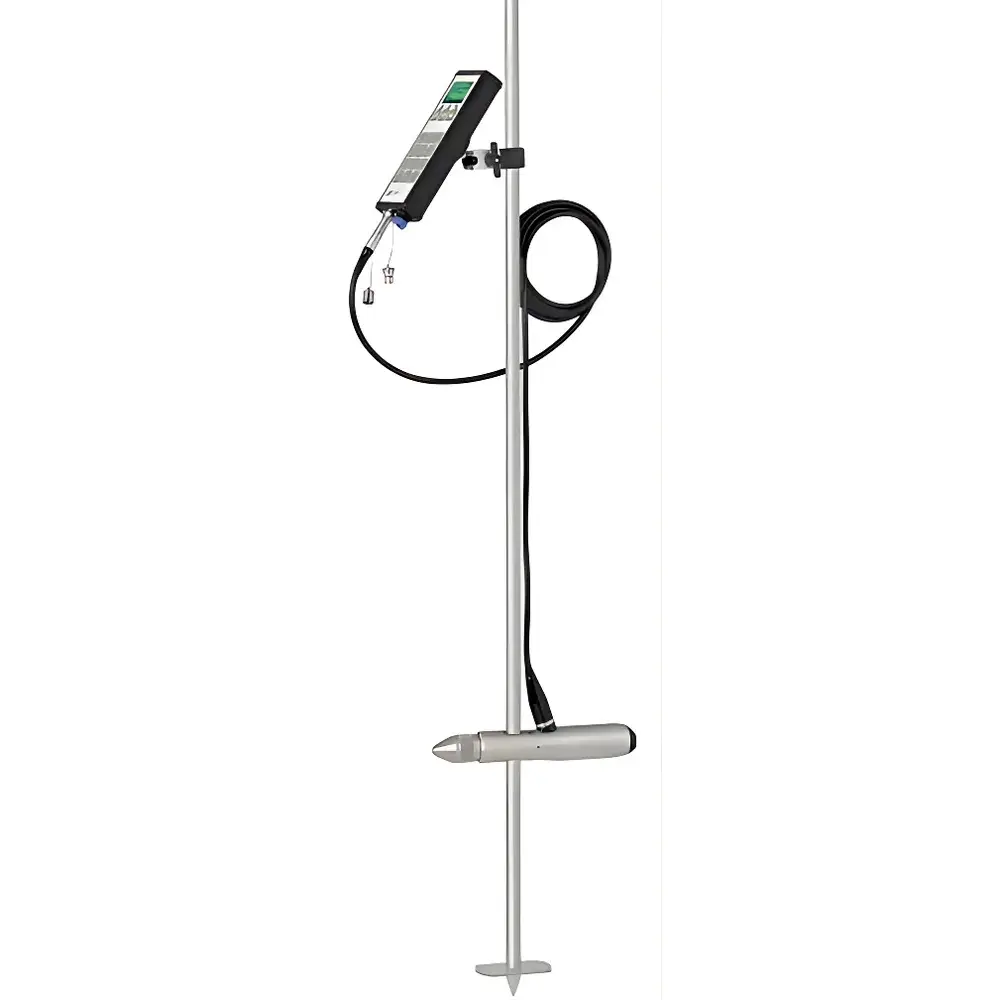
HACH OTT ADC Portable Ultrasonic Doppler Flowmeter
| Brand | OTT Hydromet |
|---|---|
| Origin | Imported |
| Model | OTT ADC |
| Flow Velocity Range | –0.2 to 2.5 m/s |
| Accuracy | ±1% of reading or ±0.0025 m/s |
| Resolution | 0.001 m/s |
| Measurement Distance from Probe | 10 cm |
| Acoustic Beam Diameter | 1 cm per beam |
| Measuring Segment Length | 5 cm |
| Transducer Frequency | 6 MHz |
| Dynamic Range | 50 dB |
| Pressure Sensor Range | 0–5 m H₂O |
| Pressure Sensor Accuracy | ±0.1% FS |
| Temperature Sensor Range | –5 to 35 °C |
| Temperature Accuracy | ±0.5 °C |
| Terminal Memory | 4 MB |
| Battery Life | >20 hours (rechargeable Li-ion) |
| Operating Temperature | –20 to 60 °C |
| Probe Weight (air/water) | 800 g / 200 g |
| Probe Dimensions | Ø40 mm × 14.5 mm |
| Cable Length Options | 2.5 m, 6 m, 10 m |
| Communication Interface | USB |
Overview
The HACH OTT ADC Portable Ultrasonic Doppler Flowmeter is an engineered field instrument designed for high-accuracy, non-intrusive velocity and discharge measurement in open channels, rivers, and small to medium-sized streams. It operates on the principle of continuous-wave ultrasonic Doppler shift detection: two 6 MHz acoustic beams transmit into the water column and detect frequency shifts induced by suspended particles (e.g., silt, plankton, microbubbles) moving with the flow. The digital signal processor (DSP) analyzes phase differences between transmitted and received waveforms to compute instantaneous particle velocity—assumed representative of local water velocity at a fixed interrogation volume located precisely 10 cm directly ahead of the probe face. Integrated pressure transduction enables simultaneous depth profiling and bottom detection, supporting robust vertical velocity distribution sampling and accurate cross-sectional area determination. The system conforms to ISO 748:2021 (Measurement of liquid flow in open channels — Velocity-area method) for velocity averaging and discharge computation, ensuring regulatory acceptability in environmental monitoring, hydrometric surveys, and water resource management.
Key Features
- Integrated dual-sensor architecture: Co-located 6 MHz ultrasonic Doppler transducers and a high-stability piezoresistive pressure sensor (0–5 m H₂O range, ±0.1% FS accuracy) for synchronized velocity–depth acquisition.
- Low-flow impedance probe design (Ø40 mm × 14.5 mm, 200 g in water) optimized for minimal flow disturbance and stable positioning in shallow or turbulent conditions.
- Dedicated handheld terminal with graphical LCD display, tactile keypad, and real-time visualization of velocity profiles, time-series plots, and cross-sectional flow distribution curves.
- Onboard quality control algorithms—including signal-to-noise ratio (SNR) monitoring, echo amplitude validation, and velocity variance filtering—to flag unreliable measurements during acquisition.
- Preconfigured compliance modes aligned with ISO 748, ASTM D5388, and national hydrometric protocols for automatic vertical integration, partial-section weighting, and uncertainty-aware discharge estimation.
- Rechargeable lithium-ion battery pack delivering >20 hours of continuous operation under typical field duty cycles, with low-power sleep mode and USB-C charging interface.
Sample Compatibility & Compliance
The OTT ADC is validated for use in natural rivers, irrigation canals, stormwater channels, and wastewater outfalls where suspended solids concentration exceeds ~20 mg/L—sufficient to generate measurable Doppler echoes. It performs reliably in turbid, aerated, or vegetation-affected flows where electromagnetic or mechanical current meters fail. The device meets IEC 60529 IP67 ingress protection requirements for temporary submersion and dust resistance. Its pressure and temperature sensing subsystems comply with EN 61326-1 for electromagnetic compatibility in industrial environments. Data integrity protocols align with GLP principles, including timestamped metadata logging, operator ID tagging, and audit-trail-capable firmware. While not FDA 21 CFR Part 11 certified (as it is not used in regulated pharmaceutical manufacturing), its structured binary data export supports traceable post-processing in validated laboratory workflows.
Software & Data Management
The included Windows-based post-processing software provides full access to raw echo waveform archives, velocity time series, depth profiles, and computed discharge records stored in the terminal’s 4 MB flash memory. Users may replay field sessions, apply manual quality flags, recompute averages using alternative weighting schemes (e.g., two-point, three-point, or six-point methods), and export tabular results in CSV, Excel, or PDF formats. All exports retain embedded calibration constants, sensor serial numbers, GPS coordinates (when paired with external GNSS), and measurement timestamps. The software enforces version-controlled configuration files, enabling reproducible analysis across multiple operators and sites. No cloud dependency or internet connection is required—data remains fully resident on local systems to meet data sovereignty requirements common in governmental hydrological agencies.
Applications
- Regulatory hydrometric monitoring under national water framework directives (e.g., EU WFD, US Clean Water Act reporting).
- Real-time flow verification during wastewater treatment plant effluent compliance audits.
- Field calibration and validation of permanent acoustic Doppler velocimeters (ADVs) or radar-based surface velocity sensors.
- Discharge assessment in ephemeral streams and flood-prone catchments where rapid deployment is critical.
- Academic research in fluvial geomorphology, sediment transport modeling, and eco-hydraulic habitat assessment.
- Infrastructure commissioning—measuring inflow/outflow at pump stations, weirs, and diversion structures without structural modification.
FAQ
What is the minimum suspended solids concentration required for reliable Doppler signal detection?
A nominal concentration of ≥20 mg/L of fine particulates (clay, silt, or organic detritus) is recommended. Performance degrades below this threshold unless microbubbles or phytoplankton are present.
Can the OTT ADC measure reverse flow (negative velocities)?
Yes—it resolves bidirectional flow within its specified range (–0.2 to +2.5 m/s) using signed Doppler shift interpretation, making it suitable for tidal channels and pumped recirculation systems.
Is the pressure sensor compensated for temperature drift?
Yes—the integrated temperature sensor (–5 to 35 °C, ±0.5 °C) feeds real-time corrections to the pressure transducer’s output, maintaining depth accuracy across seasonal field conditions.
How does the system handle air entrainment or surface foam?
The 6 MHz frequency and narrow 1 cm beam diameter minimize surface interference; however, excessive foam layers (>2 cm thick) may attenuate signal return and trigger QC alerts in the terminal.
Are firmware updates available, and how are they applied?
Firmware revisions are distributed via HACH Technical Support as signed .bin files; updates are performed offline using the USB interface and require no third-party tools or internet connectivity.
Related Products







