
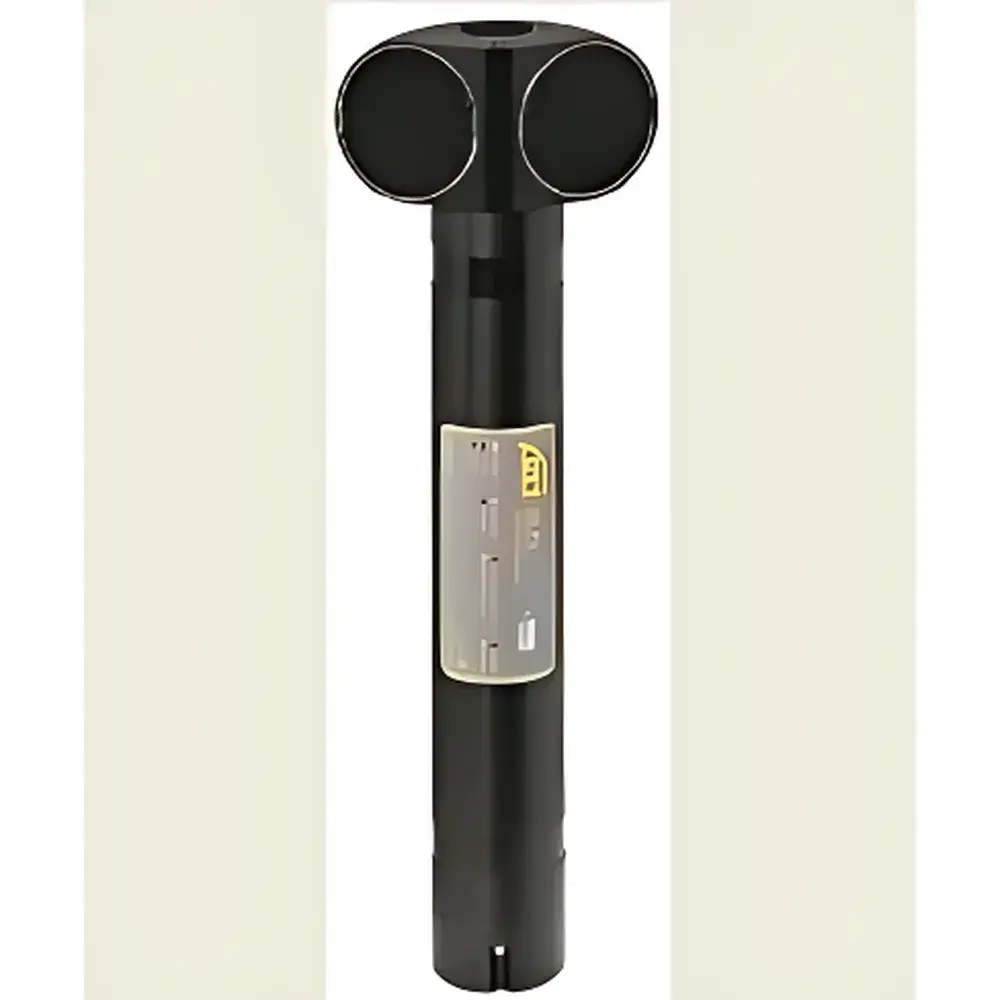
HACH OTT SLD Fixed-Mount Acoustic Doppler Velocity Profiler
| Brand | OTT Hydromet |
|---|---|
| Origin | Imported |
| Model | OTT SLD |
| Operating Principle | Dual-beam Horizontal Acoustic Doppler Velocimetry |
| Velocity Range | ±10 m/s |
| Velocity Accuracy | ±1% of reading or ±0.5 cm/s |
| Velocity Resolution | 0.1 cm/s |
| Ultrasonic Frequencies | 600 kHz / 1 MHz / 2 MHz |
| Beam Angle | 135° (±67.5° from flow axis) |
| Measurement Cells | 9 independent horizontal profiling cells |
| Cell Size Range | 0.2–10 m (frequency-dependent) |
| Minimum Blind Zone | 0.1–0.5 m |
| Maximum Profiling Range | 10–80 m |
| Water Level Measurement | Integrated upward-facing ultrasonic transducer + pressure sensor redundancy |
| Water Level Range | 0.15–10 m |
| Water Level Accuracy | ±3 mm |
| Temperature Sensor | Built-in PT1000, Range: –4 to +30 °C, Accuracy: ±0.1 °C |
| Tilt Sensors | Integrated pitch and roll compensation |
| Communication | RS485, SDI-12, RS232 |
| Power Supply | 9–16 V DC |
| Average Power Consumption | 50–500 mW |
| Housing Diameter | 7.5 cm |
| Length | 45–52.2 cm (frequency-dependent) |
| Weight | 7 kg |
| IP Rating | IP68 |
| Compliance | CE, RoHS, UL Recognized Components |
Overview
The HACH OTT SLD Fixed-Mount Acoustic Doppler Velocity Profiler is an engineered solution for continuous, non-intrusive velocity profiling and integrated water level measurement in open-channel hydrometric applications. It operates on the principle of horizontal acoustic Doppler velocimetry (ADV), deploying two precisely angled ultrasonic beams (135° total divergence, ±67.5° relative to the primary flow direction) to resolve both longitudinal (x-axis) and lateral (y-axis) velocity components across a defined cross-section. Unlike vertical ADCPs, the SLD’s fixed horizontal orientation enables robust deployment in shallow, sediment-laden, or flood-prone rivers and artificial channels where traditional propeller or electromagnetic meters suffer from fouling, mechanical wear, or calibration drift. Its dual-sensor water level system—combining time-of-flight ultrasonics with redundant pressure transduction—ensures metrological traceability under dynamic surface conditions, including wave action, floating debris, and rapid stage changes. The instrument is designed for long-term unattended operation in harsh outdoor environments, meeting IEC 60529 IP68 ingress protection and complying with CE, RoHS, and UL-recognized component standards.
Key Features
- Dual-frequency configurable ultrasonic transducers (600 kHz, 1 MHz, or 2 MHz) enabling optimization for range (up to 80 m at 600 kHz) or resolution (0.2 m cell size at 2 MHz)
- Nine independent horizontal velocity profiling cells, each computing depth-averaged velocity using ensemble-averaged Doppler shift analysis
- Real-time vector synthesis of x- and y-direction velocities to determine flow direction and magnitude with angular resolution < 2°
- Integrated temperature-compensated sound speed calculation using built-in PT1000 sensor (–4 to +30 °C, ±0.1 °C)
- Redundant water level sensing: primary ultrasonic echo timing + secondary absolute pressure verification; valid only when both agree within ±5 mm
- Onboard tilt compensation via MEMS-based pitch and roll sensors, enabling accurate installation on non-vertical or curved channel walls
- Low-power architecture (50–500 mW average) compatible with solar-battery telemetry systems for remote monitoring stations
- Configurable blind zone and cell length via HACH OTT QSoft calibration software, supporting site-specific hydraulic geometry adaptation
Sample Compatibility & Compliance
The OTT SLD is validated for use in natural rivers, irrigation canals, wastewater outfalls, and stormwater conveyance structures with minimum width-to-depth ratios of 10:1 and uniform bed morphology. It requires no stilling well or flume, eliminating hydraulic disturbance and maintenance overhead associated with mechanical stage devices. The instrument meets ASTM D5492-22 (Standard Guide for Open-Channel Flow Measurement Using Acoustic Doppler Instruments) and ISO 748:2022 (Liquid flow measurement in open channels — Velocity-area methods). Its firmware supports audit-trail logging per GLP/GMP requirements, and data output formats comply with USGS NWIS, WISKI, and EPA STORET conventions. All configurations are certified for electromagnetic compatibility (EN 61326-1) and environmental stress resilience (IEC 60068-2 series).
Software & Data Management
QSoft v5.x—the official configuration, calibration, and QA/QC suite—provides full instrument control, real-time diagnostics, and hydrodynamic validation tools. Users perform three-tier calibration: (1) hydraulic modeling-based velocity distribution mapping, (2) velocity profile fitting against known discharge events, and (3) field-derived rating curve generation using measured stage-discharge pairs. The software enforces traceable metadata tagging (time stamp, GPS coordinates, sensor health flags) and exports ASCII, CSV, or XML outputs compliant with ISO/IEC 17025 data integrity requirements. Internal 2 MB flash memory (expandable to 78 MB) stores raw velocity spectra, echo amplitude logs, and diagnostic snapshots for forensic analysis during regulatory audits. Remote access is enabled via RS485 Modbus RTU or SDI-12 protocols, supporting integration into SCADA, Telemetry Gateways, and cloud-based platforms such as HACH Asset Insight or AWS IoT Core.
Applications
- Regulatory compliance monitoring for wastewater discharge permits (e.g., EPA NPDES reporting)
- Flood forecasting and early warning systems in low-head river basins
- Irrigation district water allocation and loss auditing
- Urban stormwater infrastructure performance assessment (CSO/SSO monitoring)
- Hydroelectric intake flow verification and sediment transport studies
- Climate resilience modeling requiring high-temporal-resolution stage-velocity datasets
FAQ
What installation configurations does the OTT SLD support?
The SLD is available in both horizontal-mount (model suffix -H) and vertical-mount (-V) variants, with optional wall-mount brackets (part #22.300.017.3.2) for concrete or masonry channel linings.
How does the instrument handle high-turbidity or air-entrained flow conditions?
The 2 MHz configuration maximizes backscatter signal-to-noise ratio in suspended sediment-rich water; firmware includes adaptive echo thresholding and spectral noise rejection algorithms to maintain velocity lock under bubble interference.
Is the water level measurement affected by atmospheric pressure fluctuations?
No—the ultrasonic water level measurement is referenced to the instrument’s internal zero plane and is unaffected by barometric variation; the redundant pressure sensor serves only as a cross-check, not as the primary stage source.
Can the SLD be integrated into existing telemetry networks using legacy protocols?
Yes—RS485 Modbus RTU and SDI-12 interfaces ensure interoperability with Campbell Scientific CR-series loggers, Trimble NetR9 gateways, and most industrial RTU platforms without protocol translation hardware.
What is the recommended recalibration interval under continuous operation?
Per OTT Hydromet’s Field Service Bulletin FS-2023-04, annual verification against a traceable current meter or calibrated flume is advised; software-based drift correction using in-situ zero-velocity reference periods is supported between formal calibrations.
Related Products







